What an Effluent Treatment Plant in Düsseldorf Must Achieve in 2026
An effluent treatment plant in Düsseldorf in 2026 must meet EU Water Framework Directive and German Abwasserverordnung indirect-discharge limits set by the Bezirksregierung Düsseldorf, typically requiring physico-chemical pre-treatment, biological treatment (often MBR), and a membrane or tertiary polishing step. Nanofiltration and immersed MBRs are the dominant technologies for polishing to WFD-grade reuse quality. Typical installed CAPEX for an industrial ETP in the Rhine-Ruhr region runs €350–€1,200 per m³/day treated capacity.
Most industrial sites in the Rhine-Ruhr industrial belt are Indirekteinleiter: they do not discharge directly into the Rhine but into the public sewer of the city of Düsseldorf or a neighbouring Abwasserbeseitigungspflichtiger, which is then treated at a municipal WWTP. The legal basis is §58 of the Landeswassergesetz NRW (LWG NRW) plus the federal Abwasserverordnung (AbwV). Plants that exceed the indirect-discharge limits set in their permit face Bußgelder, a production halt order (Stilllegung), and in the worst case revocation of the permit — which is why every equipment choice below traces back to a permit clause, not to a vendor preference.
Three binding instruments stack on top of each other in 2026. The EU Water Framework Directive (2000/60/EC) sets the ecological objective of "good status" for all European waters by 2027, with COD ≤25 mg/L and total phosphorus ≤0.10 mg/L inside sensitive Rhine-Ruhr catchments. The German Abwasserverordnung, with its 57 annexes, defines industry-specific minimum requirements upstream of any municipal receiving plant. NRW state law adds the Selbstüberwachungsverordnung Abwasser (SüwVO Abw) for self-monitoring and reporting. For IED-listed sites — broadly defined under Directive 2010/75/EU and covering most chemical, large food, and metal-processing plants above the size threshold — the Industrial Emissions Directive applies in parallel and forces Best Available Techniques (BAT) reference documents into the permit.
Typical NRW Discharge Limits a 2026 ETP Must Hit
Indirect-discharge permits in NRW are site-specific, but the envelope an engineer should design against in 2026 is: COD ≤1,000 mg/L, TSS ≤200 mg/L, AOX ≤1 mg/L, total hydrocarbons ≤20 mg/L, pH 6.5–10, and temperature ≤35 °C. Heavy-metal ceilings vary by annex but typically include Cu ≤0.5 mg/L, Ni ≤0.5 mg/L, Cr ≤0.5 mg/L (total Cr; Cr(VI) usually ≤0.1 mg/L), and Zn ≤2 mg/L (typical NRW permit band 2025–2026; site-specific values vary by permit). Direct discharge to the Rhine under Annex 1 of the AbwV is materially tighter: COD ≤25 mg/L and total nitrogen ≤10 mg/L for sensitive stretches, which is why almost no industrial plant in Düsseldorf chooses direct discharge.
Each industry maps to a specific AbwV annex. Chemical manufacturing falls under Annex 22 (chemicals), metal finishing under Annex 9, food and beverage under Annex 15, and surface treatment of metals under Annex 40. Annex 22 is the strictest and is the one Düsseldorf chemical plants should expect to be measured against during a Bezirksregierung inspection. For IED-listed sites the BAT-AEL (Associated Emission Level) ranges from the relevant BREF are also written into the permit, so the design target is the lower of the two values.
Micropollutants are the 2026 watch item. The EU Watch List mechanism under WFD Article 8b is putting PFAS, pharmaceuticals such as diclofenac, and a range of transformation products under formal observation, and several NRW authorities are already pre-emptively requiring monitoring in indirect-discharge permits even where no numeric limit is yet binding. A forward-looking ETP design therefore includes a polishing step that can be upgraded once the German federal government transposes the upcoming PFAS thresholds (the EU PFAS restriction under REACH is moving in parallel in 2026).
| Parameter | Typical NRW indirect-discharge limit (2026) | Source / instrument |
|---|---|---|
| COD | ≤ 1,000 mg/L (site-specific; up to ~1,500 mg/L in some permits) | AbwV Annex applicable to site |
| TSS | ≤ 200 mg/L | AbwV general |
| AOX | ≤ 1 mg/L | AbwV Annex 22 (chemicals) |
| Hydrocarbons | ≤ 20 mg/L | AbwV Annex 49 |
| Cu / Ni / Cr (total) | ≤ 0.5 mg/L each (typical) | AbwV Annex 9 / 40 |
| Zn | ≤ 2 mg/L (typical) | AbwV Annex 9 / 40 |
| pH | 6.5 – 10 | AbwV general |
| Temperature | ≤ 35 °C | AbwV general |
| PFAS (monitoring, not yet binding) | site-specific Watch List | EU Watch List, WFD Art. 8b |
Process Train: From Pre-Treatment to Membrane Polishing
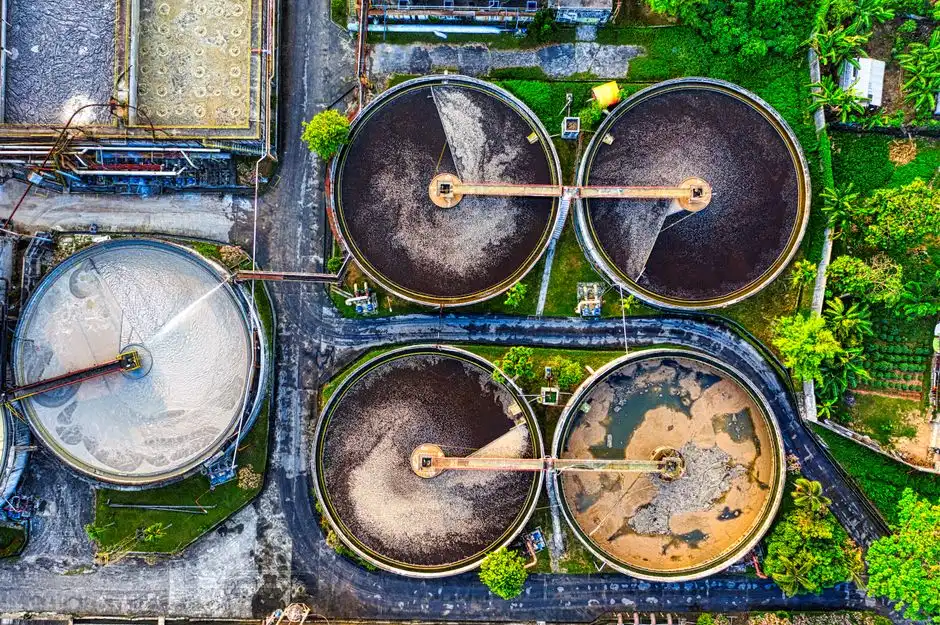
A 2026 industrial ETP in NRW is a four-stage train, and almost every quotation a Düsseldorf plant receives covers all four. Skipping a stage is the single most common design failure in retrofit projects.
Stage 1 — Screening and grit removal. Headworks protection starts with a GX rotary mechanical bar screen at 3–6 mm bar spacing. Modern units combine overflow protection (a high-water bypass) with a self-cleaning rake that lifts screenings into a screw conveyor, keeping the downstream biological stage free of fibrous material that would otherwise blind diffusers and MBR membranes. For high-FOG streams from food or metalworking, a downstream drum screen or grit cyclone is added to capture sand and metal swarf before the chemical step.
Stage 2 — Physico-chemical (DAF or lamella). The DAF micro-bubble mechanism — saturating a side stream with 4–6 bar air, then releasing it through needle valves to attach micro-bubbles (10–80 µm) onto flocculated particles — gives surface-loading rates of 20–40 m/h for lamella clarifiers and 5–25 m/h for DAF. A dissolved air flotation system is the default for NRW metalworking (emulsified oils) and food (FOG) plants because the floated sludge has 4–6% dry solids and is straightforward to dewater. Coagulant (typically FeCl₃ or PAC at 50–200 mg/L) and anionic polymer (1–5 mg/L) are dosed via a PLC-controlled chemical dosing system ahead of the flocculation tank.
Stage 3 — Biological treatment. Activated sludge (ASP), sequencing batch reactor (SBR), or membrane bioreactor (MBR) are the three realistic options. The IWA Publishing study Industrial effluent treatment with immersed MBRs: treatability and cost (Water Science & Technology, Vol. 80, Issue 4, 2019) documents that immersed MBRs handle variable industrial loads at roughly 30–50% of the footprint of an equivalent ASP, at the cost of higher aeration intensity (~0.3–0.5 kWh/m³ treated). For most Düsseldorf sites with flows of 50–500 m³/day and a reuse target, MBR is the default.
Stage 4 — Membrane polishing. Where the plant needs WFD-grade reuse water (cooling-tower make-up, boiler feed, process rinse water), nanofiltration or an industrial RO polishing system is added downstream. The University of Twente PhD thesis by G. A. Schrader (2015) demonstrates that direct nanofiltration of secondary effluent can reach conductivity <100 µS/cm and TOC <5 mg/L, suitable for indirect potable reuse and most industrial reuse loops. RO is reserved for high-salinity streams, semiconductor rinse water, or sites where the discharge permit sets very tight chloride / sulfate ceilings. An optional tertiary step — constructed wetlands for micropollutant polishing — is being piloted in several EU sites per Wageningen thesis 8189 (Lei, 2024) and is worth tracking for 2027 retrofit cycles.
Choosing the Right Configuration: DAF, MBR, SBR, or Hybrid
Most procurement failures in NRW happen because the plant was over- or under-specified. The decision matrix below maps influent profile to technology. Use the columns in the table to eliminate options before asking for a vendor quotation.
| Criterion | DAF only | Conventional ASP + clarifier | SBR | MBR (immersed) |
|---|---|---|---|---|
| Typical influent COD | ≤ 1,000 mg/L (pre-treatment only) | 500 – 3,000 mg/L | 500 – 3,000 mg/L | 500 – 10,000 mg/L |
| Footprint (relative) | 0.3× | 1.0× (baseline) | 0.7× | 0.5× |
| Effluent TSS target | ≤ 30 mg/L | ≤ 30 mg/L | ≤ 30 mg/L | ≤ 5 mg/L (membrane-retained) |
| CAPEX band (€ per m³/day) | €150 – €350 | €250 – €600 | €300 – €700 | €400 – €1,200 |
| OPEX band (€ per m³ treated) | €0.20 – €0.50 | €0.40 – €0.80 | €0.50 – €0.90 | €0.70 – €1.30 |
| Automation level | Low – medium | Medium | High | High (PLC + SCADA) |
| Reuse compatibility | No | No (without tertiary) | Limited | Yes (RO/NF downstream) |
The decision logic is straightforward. High FOG or metal-hydroxide sludge (food, metal finishing) requires DAF upstream of any biological step — the table's DAF-only column is therefore a pre-treatment, not a stand-alone answer. Variable flow with a reuse target — typical of Rhine-Ruhr dairy, beverage, and coating lines — points to an integrated MBR membrane bioreactor. Municipal-like sewage at 50–500 m³/day with no reuse demand is a clean fit for SBR, especially where the operator team is small. A tight footprint combined with a high effluent quality target — the Düsseldorf default for 2026 — pushes the decision to MBR. For NRW chemical and pharmaceutical sites, AOX and micropollutant removal usually forces an added NF/RO polishing stage downstream of the MBR, which the budget must reflect. A high-efficiency sedimentation tank can substitute for or back up the DAF stage where chemical floc loadings are moderate.
2026 CAPEX and OPEX Benchmarks for Industrial ETPs in NRW
Budget envelopes below are typical 2026 industrial ETP installed-cost ranges for the Rhine-Ruhr region — they are sense-check figures, not binding quotes. For OPEX sense-checking the 2026 OPEX breakdown for wastewater plants article gives a side-by-side line-item view, and the European ETP cost benchmark 2026 gives a useful cross-check for the same year.
| Plant size (flow) | Installed CAPEX (typical 2026 band) | OPEX driver lines |
|---|---|---|
| Small (< 50 m³/day) | €200,000 – €500,000 | Energy, polymer, sludge haulage |
| Mid (50 – 500 m³/day) | €500,000 – €2,500,000 | Energy 40–60%, chemicals 10–15%, membrane replacement 10–20%, sludge 10–20% |
| Large (500 – 5,000 m³/day) | €2,500,000 – €15,000,000 | Same mix; energy dominates at 50–65% of OPEX |
Three OPEX lines deserve a closer look. Aeration is the largest single line, typically 40–60% of plant OPEX, which is why energy-efficient diffused aeration and an MBR aeration-box design with intermittent cycling materially move the number. Membrane replacement runs every 5–8 years for MBR modules and every 3–5 years for NF/RO elements (HydropureWater field data, 2026). Sludge disposal goes to a licensed NRW hauler and is currently €80–€180 per wet tonne, depending on dry solids and classification. German industrial electricity at €0.25–€0.35/kWh in 2026 makes aeration design a board-level issue, not a procurement one — that is the link from regulatory pressure to equipment choice.
Procurement Checklist for a Düsseldorf ETP Project
Six items a buyer must verify before signing a purchase order for a 2026 ETP in the Rhine-Ruhr region. None of them is optional, and a missing item should be a hard stop on the procurement process.
- Design basis aligned to DWA-A 131 (dimensioning of single-stage activated sludge plants) and DWA-A 198 (dimensioning of trickling filters and SBR). Without a DWA-compliant basis, the Bezirksregierung will reject the permit application.
- CE and ATEX marking on all electrical equipment installed in Ex-zones 1 or 2. A DAF skid with sodium hydroxide dosing is a Zone 1 area under BetrSichV.
- EN 12255 performance testing at factory acceptance. The buyer should witness or commission a third-party test of the biological stage on a synthetic feed before shipment.
- German-language operator training documentation and CE-compliant risk assessment per BetrSichV §3.
- Remote monitoring capability (VPN-secured) with alarm forwarding to the operator's phone or control room. This is standard in the German market and is a SüwVO Abw requirement for self-monitoring.
- Written spare-part guarantee for 10 years, including membranes, blowers, pumps, and dosing pumps. A 10-year guarantee is the differentiator between a packaged equipment supplier and a serious plant contractor.
Engineering deliverables to demand with the order: process flow diagram, P&ID, mass balance, electrical load list, and the full permit application dossier for the Bezirksregierung Düsseldorf. A supplier that hands these over in German, in editable CAD/Word format, saves the buyer roughly 4–6 weeks of consultant time. Supplier qualification: NRW reference list, DWA membership, ISO 9001 + 14001 certificates, and evidence that PLC/SCADA programming is in-house rather than subcontracted. For sites with a temporary or rapid-deployment need between 10 and 200 m³/day, a containerised or skid-mounted package ETP with an integrated disinfection step (for example, a chlorine dioxide generator) is the standard 2026 answer.
Frequently Asked Questions
What permit do I need to discharge industrial wastewater in Düsseldorf in 2026?
An indirect-discharge permit (Indirekteinleitererlaubnis) from the Bezirksregierung Düsseldorf, issued under §58 LWG NRW and tied to the applicable Abwasserverordnung annex for your industry. IED-listed sites additionally need to demonstrate BAT-AEL compliance under Directive 2010/75/EU.
How much does an industrial ETP cost in NRW?
Installed CAPEX runs €200,000–€500,000 for small plants (<50 m³/day), €500,000–€2,500,000 for mid-sized (50–500 m³/day), and €2,500,000–€15,000,000 for large (500–5,000 m³/day), with OPEX dominated by energy (40–60%) and membrane replacement.
Do I always need an MBR, or can a conventional activated sludge plant meet NRW limits?
A conventional ASP with a well-sized secondary clarifier meets typical indirect-discharge limits if the site has the footprint and there is no on-site reuse target. MBR is the default where reuse is required, footprint is constrained, or the permit envelope is tight.
Can my ETP produce water good enough for on-site reuse?
Yes. An MBR followed by RO or NF polishing reaches conductivity <100 µS/cm and TOC <5 mg/L (Schrader 2015, University of Twente), which meets EU WFD-derived reuse quality for most industrial loops including cooling-tower make-up and process rinse water.
How long does a typical NRW ETP project take from order to commissioning?
8–14 months for a mid-sized plant (50–500 m³/day), covering permit application, detailed design, fabrication, on-site installation, commissioning, and the trial-operation period required before the Bezirksregierung issues the operating permit.
Related Equipment
- industrial RO polishing system — specifications, capacity range, and technical data