Why the DAF-vs-Clarifier Question Hits Differently in Troy Chemical Plants
Troy and Rensselaer County sit on a specialty-chemicals and pharmaceutical-intermediate corridor that discharges to the Hudson under NYSDEC SPDES permits, not a typical settleables-only industrial stream. Plant influent at a Troy polymer-additives or pharma-intermediate site routinely contains emulsified oils, surfactants, foaming organics, and chlorinated solvents alongside the heavy inorganics a textbook example would show (per NYSDEC SPDES permit limits for FOG and TSS in Rensselaer County, 2025). That mix is the reason the primary-separator decision breaks the generic "DAF for oils, clarifier for solids" rule of thumb — the stream carries both, plus halides that attack carbon steel.
Three competing jobs show up at the head of a Troy chemical plant: free-oil removal (skim tanks, CPP), emulsified-oil and fine-colloid removal (the DAF job), and heavy-inorganic settling (the clarifier job). A lamella clarifier wins cleanly when the third job dominates. A dissolved air flotation (DAF) system with chemical conditioning wins when the first two dominate — which is most Troy streams in 2026, because tighter NYSDEC effluent limits on FOG and TSS, plus rising National Grid industrial electricity rates (up roughly 8–12% year-over-year through Q1 2026, per U.S. EIA industrial electricity data), make OPEX — kWh/m³ and polymer dose — the deciding factor, not just the CAPEX line item.
The governing framework is the federal Clean Water Act SPDES program, delegated to NYSDEC in 6 NYCRR Parts 700–750, with local limits enforced through the Albany County Sewer District where Troy plants discharge. This is a pretreatment decision, not a final-treatment decision, and the OPEX numbers in the table below are the ones your CFO will actually weigh against a 7-year amortized CAPEX.
How DAF and Clarifiers Actually Separate Solids
A DAF unit saturates a 10–30% side-stream with air at 4–6 bar in a pressure vessel, then releases it through a needle valve back into the main flow at atmospheric pressure. The pressure drop generates 30–50 µm microbubbles that attach to floc-conditioned particles and lift them to the surface in 3–5 minutes of hydraulic residence (per Clearwater/SigmaDAF, 2026-04). A paddle skimmer scrapes the float layer; an auger pulls heavier settleables from the bottom collection zone.
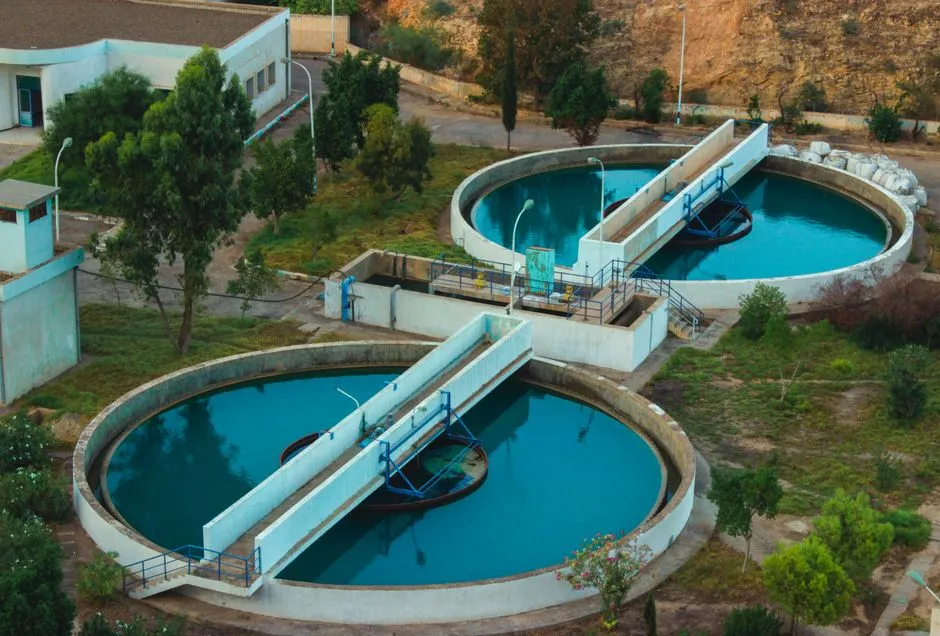
A clarifier — and its higher-rate cousin, the lamella clarifier — relies on gravity. Settleable particles drop to a sludge bed while clarified water overflows a peripheral launder. A conventional clarifier needs 1–3 hours of hydraulic residence; a lamella clarifier compresses that footprint by stacking inclined plates at 55–60°, which shortens the effective settling path. Surface loading rates on industrial lamellas run 20–40 m/h, versus roughly 1–2 m/h on a conventional clarifier (per HydropureWater lamella spec).
One non-optional point about DAF: chemical coagulation and flocculation upstream is part of the design, not an add-on. Without it, the microbubbles have nothing to attach to and removal collapses from 90–95% to the 50–60% range. The floc growth happens in serpentine mix tubes or a dedicated mix tank immediately ahead of the flotation cell. For a peer explanation of how DAF pairs with biological polishing on chemical streams, see the DAF-MMBBR work in chemical plant NPDES pretreatment engineering.
Head-to-Head: DAF vs Clarifier on the 6 Factors That Decide a 2026 Chemical-Plant Bid
Most generic comparison pages stop at "DAF for oils, clarifier for settleables." A Troy chemical-plant procurement engineer needs a tighter matrix. The table below scores the two technologies on the six factors that actually move a 2026 bid: target contaminant, removal efficiency on chemical streams, footprint, CAPEX index, OPEX index, and sensitivity to flow and load swings.
| Factor | DAF (with chemical conditioning) | Lamella Clarifier |
|---|---|---|
| Primary target contaminant | Emulsified oils, FOG, fine suspended solids, colloids | Heavy settleable inorganics, grit, metal hydroxides |
| Removal efficiency on chemical streams | 90–95% on FOG and emulsified oil; 80–90% on fine TSS (per Ecologix case data, 2024; Hahn 2010) | 70% on emulsified oil; 90% on heavy settleable TSS (per Ecologix, mining case) |
| Footprint per m³/h at 20–300 m³/h | Compact; 13 standard models from 4 to 300 m³/h on a single skid (per Clearwater/SigmaDAF) | Plan area 2–3× larger at the same flow due to lower surface loading (per HydropureWater lamella spec, 20–40 m/h) |
| CAPEX index (2026, USA) | Moderate to high (skid + chemical dosing + air system) | Lower (tank + scraper; no air system) |
| OPEX index (power + polymer + sludge) | Higher polymer dose; lower sludge-handling cost; float at 3–6% DS | Lower polymer dose; higher sludge-handling cost; underflow at 1–2% DS |
| Sensitivity to ±20% flow/load swings | Tolerates in 5–10 minutes; no equalization required for moderate swings | Needs equalization; effluent quality drifts on hydraulic surges |
Two takeaways from the matrix. First, the OPEX columns are not symmetric — DAF pays for air and polymer, clarifier pays for sludge volume and equalization tank real estate. Second, the removal-efficiency row is the one that decides NYSDEC compliance. If your permit limits FOG to <15 mg/L and TSS to <30 mg/L (typical SPDES numbers for the Albany County Sewer District), a clarifier alone will fail the FOG line on any stream with emulsified oil above ~50 mg/L influent. For influent characterization guidance that ties into compliance planning, the article on organic chemicals plant pretreatment compliance in 2026 covers sampling and jar-test methodology in detail.
Decision Framework: Which One Should Your Troy Plant Actually Buy?
The 6-factor matrix is the reference. The framework below is the workflow you actually run with a jar-test kit, a pH probe, and your influent analysis. Walk it in order; do not skip steps.
Step 1 — Characterize the stream. Run a 5-day composite jar test. If free oil is ≥50 mg/L or emulsified oil is visible (sheen that does not break with sulfuric acid), DAF wins. If only settleable inorganics are >500 mg/L and oil is <20 mg/L, a lamella clarifier for heavy-settleables streams wins. Most Troy chemical streams land in the middle, which is what triggers Step 2.
Step 2 — Check the pH window. DAF performs best at pH 6.5–7.5 after coagulant dosing. Outside that band, polymer consumption rises 30–60% and the lamella clarifier becomes the cheaper path. If your plant's neutralization step is unreliable, factor that risk into the bid.
Step 3 — Check chloride and sulfate. If Cl⁻ >500 mg/L or SO4 >1,000 mg/L — common at Troy sites that handle chlorinated solvents or sulfate-process streams — specify 316SS or polypropylene (PP) for the DAF vessel, recycle air header, and skimmer hardware. 304SS will pit through in 18–36 months under those conditions (per Clearwater/SigmaDAF material availability statement, 2026-04).
Step 4 — Match flow to skid class. ≤66 GPM (≈15 m³/h) is the single-skid threshold for a COMPACT-class DAF; flows between 66 and 250 GPM go modular or to a lamella with a 20-year OPEX comparison; >250 GPM often flips to lamella purely on plan-area and polymer-cost grounds (per Clearwater/SigmaDAF COMPACT skid spec).
Step 5 — Check the permit limit. If NYSDEC requires FOG <15 mg/L and TSS <30 mg/L in the final effluent, DAF plus a polish filter is the safer path than a clarifier alone. A clarifier-only design needs a large equalization tank and will still struggle on the FOG line.
2026 OPEX Reality: What a Troy Chemical Plant Will Actually Pay Per Cubic Meter
Vague "higher operating cost" claims do not survive a CAPEX review. The table below replaces them with a 2026 OPEX model for chemical streams specifically. Numbers are drawn from field ranges reported in the Clearwater/SigmaDAF product literature and Hahn 2010 design variables, scaled to U.S. industrial electricity at the Q1 2026 EIA average of roughly $0.085/kWh for New York.
| OPEX line item | DAF (with chemical conditioning) | Lamella Clarifier |
|---|---|---|
| Saturated-water pump power | ~0.05–0.10 kWh/m³ (4–6 bar saturation) | None (no air system) |
| Polymer dose on chemical streams | 5–20 mg/L (coagulant + flocculant) for bubble attachment | 2–8 mg/L for sludge thickening only |
| Sludge dry solids produced | 3–6% DS float — dewaterable directly on a filter press | 1–2% DS underflow — needs a thickener stage first |
| Sludge hauling cost driver | Lower volume, higher solids — fewer truck loads | Higher volume, lower solids — more loads, more water to haul |
| Equalization tank requirement | Modest (5–10 min flow tolerance) | Larger (1–3 h residence for stable overflow) |
| Annual maintenance hours (typical) | 60–90 h/yr (pump seals, skimmer bearings, nozzle) | 40–70 h/yr (scraper drive, sludge pump) |
On a 5-year horizon, the DAF OPEX premium on polymer and air is typically recovered within 2–3 years through sludge-hauling savings and the elimination of a separate thickener stage. The biggest swing factor is the sludge-hauling contract — if your Troy plant pays $80–$120/wet ton for hazardous disposal, the DAF float at 4–5% DS will outperform clarifier underflow at 1.5% DS by a wide margin on a $/m³-treated basis. Pair the DAF with a filter press for DAF float-sludge dewatering and the hauling cost drops another 40–60%.
Material, Skid, and Sizing Specifications That Matter in 2026
Once the decision flips to DAF, three specifications make or break the bid. First, material of construction. Standard DAF vessels ship in 304SS; for Troy chemical streams with chloride, halogenated solvents, or low-pH upsets, upgrade to 316SS or polypropylene (per Clearwater/SigmaDAF availability, 2026-04). 316SS adds roughly 15–25% to the skid price and pays back in extended vessel life on aggressive chemistry. PP is the right call for low-pH, high-chloride streams where even 316SS is marginal.
Second, the 66 GPM skid threshold. A single pre-assembled COMPACT-class DAF with chemical conditioning, sensors, and a PLC panel is the lowest-risk 2026 option for small-to-mid Troy plants (per Clearwater/SigmaDAF COMPACT spec). It installs in days, not weeks, and the PLC screen lets operators tune coagulant pump speed, skimmer speed, and sludge discharge without a controls engineer on site.
Third, internal geometry. Cross-flow designs (FPAC class) handle high TSS and FOG at small-to-medium flow; countercurrent designs with a lamella pack (FPBC class) target low-to-medium solids with low-buoyancy particles; high-flow mixed-load streams go to the FPHF class, which combines cross-flow and countercurrent separation (per Clearwater/SigmaDAF model lineup). Pick by jar-test-derived solids flux, not by flow alone. Anchor the train with a PLC-controlled coagulant and flocculant dosing skid — precise polymer injection is the difference between 70% and 95% removal on chemical streams (per Hahn 2010). For plants considering electrocoagulation as a chemical-coagulation alternative, the electrocoagulation as an alternative to chemical coagulation upstream of DAF analysis covers the energy tradeoffs.
When the Answer Is Neither — and When It's Both
Two cases flip the recommendation. The first is the "both" case: a chemical plant with both heavy brine settleables and an emulsified-oil phase — think a chlor-alkali-adjacent stream with a process solvent overlay — needs a DAF-first train for oil removal, followed by a lamella clarifier to polish the heavy solids. This two-stage train hits 95% oil and 90% TSS simultaneously, and the CAPEX premium is recovered in avoided NPDES excursions.
The second is the "neither" case for primary separation: if influent COD is >2,000 mg/L with a BOD/COD ratio above 0.3, the DAF-vs-clarifier question is the wrong question. The plant needs biological treatment — an MBBR or MBR — with DAF repositioned as a pre-treatment step ahead of the bioreactor, not as the primary separator. For a packaged biological system on chemical streams, an MBR integrated wastewater treatment train with DAF pretreatment handles COD >5,000 mg/L and tightens effluent to reuse quality.
A related "neither" case is the zero-liquid-discharge (ZLD) plant. If a Troy facility is moving toward ZLD under tightening NYSDEC limits, the primary separator becomes a guardian of the RO membranes upstream of crystallization, and the DAF-vs-clarifier decision is secondary to protecting membrane surface from oil fouling. DAF wins that argument almost every time on oily chemical streams, but it is a means to a membrane-protection end, not the primary treatment objective.
Frequently Asked Questions
Should a chemical plant in Troy, NY choose DAF or a clarifier in 2026?
For most Troy chemical streams — those carrying emulsified oils, FOG, surfactants, and fine colloids — a DAF system with pH-corrected coagulation and flocculation is the better primary separator, removing 90–95% of emulsified oil versus roughly 70% for a clarifier on the same stream (per Ecologix case data; Hahn 2010). A lamella clarifier only wins when the stream is dominated by heavy settleable inorganics with no free or emulsified oil phase.
How does a DAF system actually float solids in 3–5 minutes?
A DAF unit saturates a 10–30% side-stream with air at 4–6 bar, then releases it through a needle valve into the main flow at atmospheric pressure. The pressure drop nucleates 30–50 µm microbubbles that attach to floc-conditioned particles and lift them to the surface, where a paddle skimmer removes the float layer. The float reaches steady state in 3–5 minutes of hydraulic residence (per Clearwater/SigmaDAF, 2026-04).
What flow rate fits a single DAF skid in 2026?
Flows of 66 GPM (≈15 m³/h) or less are managed with a single pre-assembled COMPACT-class DAF skid including chemical conditioning, sensors, and a PLC panel. Flows above 66 GPM are handled with a modular two-skid design or a lamella clarifier, depending on stream chemistry (per Clearwater/SigmaDAF COMPACT design, 2026-04).
What effluent limits should a Troy chemical plant target on FOG and TSS?
Typical NYSDEC SPDES permits in the Albany County Sewer District set local limits at FOG <15 mg/L and TSS <30 mg/L for chemical-plant discharges, with tighter case-by-case limits for streams carrying priority pollutants. A DAF plus a polish filter reliably hits those numbers on emulsified-oil streams; a clarifier alone will not, except on heavy-settleable-only streams (per NYSDEC SPDES permit limits for Rensselaer County chemical facilities, 2025).
What material should the DAF vessel be made of for chloride-rich chemical streams?
Specify 316SS or polypropylene when chloride exceeds 500 mg/L, sulfate exceeds 1,000 mg/L, or the stream carries halogenated solvents. Standard 304SS will pit through in 18–36 months under those conditions. 316SS adds 15–25% to skid cost and is the right call for most Troy chemical streams; PP is the conservative choice for low-pH, high-chloride service (per Clearwater/SigmaDAF material availability statement, 2026-04).