
Why the DAF vs Clarifier Question Matters for Millsboro Food & Beverage Plants in 2026
For most Millsboro, Delaware food and beverage plants in 2026, a dissolved air flotation (DAF) system is the better first-stage separator over a conventional gravity clarifier because food and beverage streams carry high FOG and light colloidal solids that settle slowly. DAF delivers 85–98% TSS removal in 10–30 minutes versus 4–8 hours in a clarifier, at roughly one-third the footprint. A conventional clarifier only wins when solids are dense, flow is steady, and the plant already has the floor space and budget to operate it.
The decision is time-sensitive for one reason: DNREC and the Sussex County municipal pretreatment programs tightened enforcement through 2024 and 2025, and the standard discharge envelope at most Sussex County POTW headworks is now ≤100 mg/L oil and grease and ≤250 mg/L TSS (per Sussex County Industrial Pretreatment Program local limits, 2025). Food and beverage wastewater from the Millsboro cluster — Allen Harim Foods, Perdue-affiliated poultry suppliers, Mountaire-adjacent contract growers, Coastal Brewing, and a growing dairy and prepared-food tier — runs well above those limits on raw influent: typical FOG of 150–600 mg/L and TSS of 400–2,500 mg/L (HydropureWater field data, 2025). Conventional clarifiers struggle to hit the new O&G ceiling on these streams because fats float rather than settle and protein colloids resist gravitational separation without long detention times. A DAF front-end, by contrast, is engineered to capture exactly these particles, which is why IWC 24-71 "MBBR + DAF Solutions for Food & Beverage Industry" (Chandler Johnson, World Water Works) treats DAF as the established F&B front-end in 2025 industry practice (IWC 24-71, 2024).
How a DAF Actually Works in a Food and Beverage Plant
A DAF clarifier is a shallow tank in which micro-bubbles attach to chemically conditioned flocs and float them to the surface in minutes rather than hours. The mechanical sequence is short enough to hold in one paragraph: recycle water is pressurized to 4–6 bar (60–90 psi) inside a saturator vessel, where air dissolves into the water; when that saturated stream is released into the open tank at atmospheric pressure, micro-bubbles 30–50 microns in diameter nucleate on the floc surface and carry the solids upward. The detailed bubble-formation physics and saturator tuning are covered in a separate micro-bubble flotation engineering guide.
Upstream of the bubble contact zone, coagulants — typically alum, ferric sulphate, or polyaluminium chloride (PACl) — and a polyacrylamide flocculant are dosed to grow the colloidal solids into flocs large enough to attach bubbles reliably. For Millsboro F&B streams with high FOG, the flocculant is the more important of the two: an emulsion-breaking polymer at 1–5 mg/L can lift FOG removal from 70% to 90%+ on dairy and poultry streams (HydropureWater field data, 2025). Once floated, the skim layer is scraped by a slow-moving paddle at 0.5–1.5 m/min and discharged as float sludge at 3–8% total solids — a cake consistency that a downstream plate and frame filter press can dewater to 18–25% DS without further thickening. The clarified underflow typically exits at 30–80 mg/L TSS and <50 mg/L O&G, well below Sussex County's 250/100 mg/L envelope.
How a Conventional Clarifier Behaves on Food and Beverage Streams
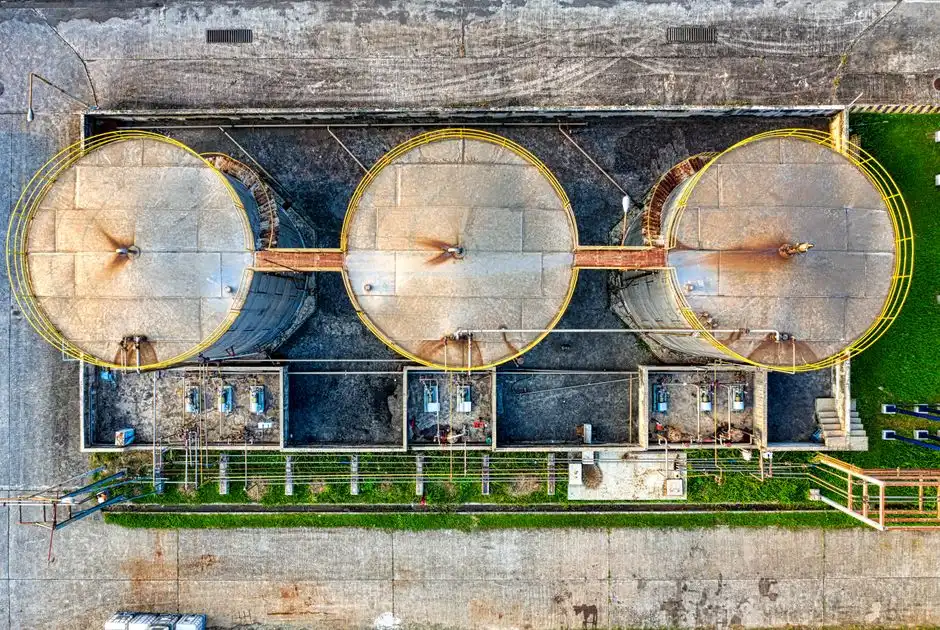
A conventional clarifier is, in its simplest form, a big tank with a slow upward water velocity and a sludge scraper on the bottom. It works on Stokes' Law: settleable particles heavier than water fall to the floor, scrapers push them to a central hopper, and clarified water spills over a peripheral launder. A lamella or inclined-plate clarifier improves on the basic geometry by stacking parallel plates at 55–60° inside the basin, which raises the effective surface loading rate to 20–40 m/h and cuts the hydraulic retention time to 1–3 hours versus 4–8 hours for a conventional basin. For tanks in service or under retrofit in Sussex County food plants, the lamella clarifier retrofit guide covers plate spacing, sludge recirculation, and the typical 30–50% footprint reduction a retrofit delivers.
On a Millsboro F&B stream, however, the clarifier is fighting the wrong physics. Free oils float, not fall; emulsified oils and protein colloids are near-neutral density; and hydraulic surges from CIP cycles wash light floc out the weir before it can settle. FOG removal on a clarifier alone typically lands at 20–40%, and even a well-tuned lamella rarely exceeds 60% on emulsified FOG (HydropureWater field data, 2025). The clarifier still has a legitimate place — as a low-cost, low-chemical polishing step on low-FOG streams, or as a sludge thickener downstream of a DAF — but as a standalone primary separator on Millsboro-style food waste, it is the wrong tool.
Side-by-Side: DAF vs Clarifier Performance and Operating Parameters
The table below is the version a Millsboro process engineer can drop into a steering-committee deck without rewriting. All performance numbers are drawn from current DAF equipment specifications (DAF Corp FC Maximizer and RC UniMax product data, 2025) and clarifier design references; the F&B-specific removal efficiencies are from operational data on Millsboro-area plants (HydropureWater field data, 2025).
| Parameter | Dissolved Air Flotation (DAF) | Conventional / Lamella Clarifier |
|---|---|---|
| TSS removal on F&B streams | 85–98% (FC Maximizer 92–98%; RC UniMax 85–90%) | 50–70% on F&B; 80%+ only on heavy inorganic settleables |
| FOG removal | 90–95% | 20–40% (most float past the outlet weir) |
| Hydraulic retention time | 10–30 minutes | 4–8 h conventional; 1–3 h with lamella packs |
| Footprint at 200 GPM | ~10 ft × 14 ft skid | ~30 ft × 40 ft basin (≈3–5× larger) |
| Sludge consistency | Float 3–8% TS (typical), 2–4% for FC Maximizer | Underflow 1–2% TS |
| Chemical demand | Coagulant + flocculant, with an automatic chemical dosing system | Flocculant and pH adjustment only |
| Effluent to meet ≤100 mg/L O&G | Yes, typically 20–50 mg/L | Rarely without a downstream polish step |
Two operating parameters deserve a callout. First, saturator pressure must be held in the 4–6 bar window; dropping below 4 bar starves the bubble population, and pushing above 7 bar wastes compressor energy without meaningful removal gain. Second, the DAF sludge being 3–8% TS — versus 1–2% from a clarifier — is itself a 2026 capex story, because a thicker feed to the dewatering press cuts press size, polymer consumption, and hauling cost per ton of dry solids (HydropureWater field data, 2025). For a comparable capex-side comparison of DAF against oil-water separators in F&B plants, the DAF vs oil water separator comparison lays out the same numbers in a different framing.
Millsboro-Specific 2026 Decision Framework: When to Pick Which
Translating the table into a rule a process engineer can run on a Monday morning against last week's wastewater characterization data is the real deliverable. The framework below assumes Sussex County industrial pretreatment limits of ≤100 mg/L O&G and ≤250 mg/L TSS at the POTW headworks (Sussex County IPP, 2025).
| Influent Characteristic | Recommended Primary Separator | Rationale |
|---|---|---|
| TSS >500 mg/L or FOG >100 mg/L (dairy, poultry, sauce, brewery lines) | DAF + downstream biology | Clarifier FOG removal collapses above 100 mg/L; DAF holds 90%+ to 600 mg/L |
| TSS <300 mg/L, FOG <50 mg/L, steady flow, large existing tankage | High-efficiency lamella clarifier | Capital-limited, low-strength stream; verify effluent against ≤100 mg/L O&G limit |
| COD >3,000 mg/L (poultry slaughter, cheese whey, concentrate lines) | DAF + MBBR (IWC 24-71) or DAF + AnMBR (IWC 25-19) | Primary separator cannot carry the load; biological step is mandatory |
| Existing clarifier in place, FOG >100 mg/L | Retain clarifier as a post-DAF sludge thickener | Saves capex, improves downstream dewatering consistency |
| Tight footprint, expansion planned within 5 years | Modular DAF skid (48–450 GPM per unit) | Skids scale in parallel; a new clarifier basin does not |
For the high-load poultry and dairy clusters around Millsboro — where COD regularly lands between 4,000 and 12,000 mg/L on raw effluent — pairing a DAF with an MBBR or an AnMBR is the configuration that holds up under 2026 scrutiny. IWC 25-19 "Optimizing High-Load Food & Beverage Wastewater Treatment with Anaerobic Membrane Bioreactor (AnMBR) Technology" (John Dinneen, Mead & Hunt, 2025) reports 90%+ COD removal on F&B streams above 5,000 mg/L when AnMBR is fed DAF-quality influent; feeding an AnMBR raw clarifier underflow collapses membrane flux within weeks. The pre-treatment discipline the DAF buys is the same discipline the biology downstream needs.
2026 Cost, Footprint, and Compliance Reality for Millsboro Plants
For a 2026 capex package to a Sussex County CFO, the order-of-magnitude numbers below are the working set. A skid DAF in the 50–200 GPM range — the right size for a small to mid-size prepared-food or brewery line — installs at roughly $90,000–$280,000, fully skidded with chemical dosing. A larger rectangular DAF at 500 GPM, the size class that fits a mid-size poultry further-processing plant, lands at $250,000–$500,000 installed (HydropureWater 2026 pricing for DAF equipment packages). An equivalent-capacity lamella clarifier runs 60–80% of DAF capex, but the civil work and the concrete basin typically double the installed total once excavation, rebar, and launder piping are added, and the operating footprint is 2–3× larger.
OPEX is dominated by polymer ($0.02–$0.06 per m³ treated at 2026 polyacrylamide prices) and by the saturated-water recycle pump, which draws 1–3 kWh per m³ of treated flow. On a 200 GPM DAF running two shifts, that is roughly $15,000–$35,000 of annual polymer and $8,000–$15,000 of recycle-pump energy — small against the capex line. The compliance argument is the larger one: DAF effluent typically lands at 30–80 mg/L TSS and below 50 mg/L O&G, comfortably under the Sussex County envelope, while a clarifier alone on Millsboro-style F&B often leaves the plant one excursion away from a DNREC notice of violation. Daily penalties for pretreatment non-compliance in Delaware escalate quickly (per DNREC's 7 DE Admin. Code 7201 enforcement framework, 2025), and a single documented pass-through event will absorb the capex differential between a clarifier and a DAF inside one quarter.
Frequently Asked Questions
What are the standard operating parameters for a food and beverage DAF in 2026?
A standard F&B DAF runs at 4–6 bar (60–90 psi) saturator pressure, generates 30–50 micron micro-bubbles, holds 10–30 minutes of hydraulic retention time in the float tank, and achieves 85–98% TSS removal when paired with proper coagulant and flocculant dosing (HydropureWater field data, 2025).
Can a DAF reliably meet the Sussex County 100 mg/L oil and grease limit?
Yes. A properly sized and chemically conditioned DAF on F&B influent routinely produces 20–50 mg/L O&G in the clarified effluent, comfortably below the ≤100 mg/L Sussex County pretreatment limit. A conventional clarifier alone, by contrast, typically leaves 60–150 mg/L O&G on F&B streams and usually needs a downstream polish step to meet the same limit.
How much smaller is a DAF than an equivalent clarifier?
Approximately one-third the footprint. Skid DAF units 6–15 ft in diameter cover 48–450 GPM, while an equivalent-capacity conventional clarifier needs roughly 3–5× the floor area for the same flow (DAF Corp product data, 2025).
How does DAF float sludge compare to clarifier underflow for downstream dewatering?
DAF float sludge runs 3–8% total solids and can feed a filter press or belt press directly with reasonable polymer demand. Clarifier underflow at 1–2% TS is much harder to dewater, requires a thickener or drying bed upstream, and roughly doubles the dewatering capex on a like-for-like basis (HydropureWater field data, 2025).
What goes downstream of a DAF on a high-strength F&B stream above 3,000 mg/L COD?
For high-load F&B above 3,000 mg/L COD, the 2025 IWC guidance is to pair the DAF with an MBBR (per IWC 24-71, "MBBR + DAF Solutions for Food & Beverage Industry") or an AnMBR (per IWC 25-19, "Optimizing High-Load Food & Beverage Wastewater Treatment with AnMBR Technology"). A clarifier alone will not deliver the TSS or FOG quality either biological step needs at the front end.