Why Marion Mining and Metals Factories Are Re-evaluating Primary Treatment in 2026
Marion, Indiana sits inside the Grant County metals and mining corridor, where primary wastewater typically carries 200-3,000 mg/L TSS, dissolved lead/zinc/arsenic/copper, sulfate above 500 mg/L, and entrained process oils. IDEM enforces 327 IAC 5 alongside EPA Region 5 categorical pretreatment standards under 40 CFR Part 467 (nonferrous metals) and Part 420 (iron and steel), and local discharges routed to the Marion Municipal Utilities POTW must clear 1-2 mg/L limits on most dissolved metals. Conventional clarifiers handle grit and coarse tailings at 80-90% TSS removal, but they underperform on the colloidal metal hydroxides that form after lime or caustic pH adjustment to 7-9. That gap is the 2026 pain point pushing Marion plant engineers to re-evaluate primary treatment trains.
DAF vs Clarifier: How the Two Technologies Actually Treat Mining Wastewater
Dissolved air flotation (DAF) generates 30-50 μm micro-bubbles by saturating a 20-50% side-stream recycle at 4-6 bar and releasing it through a pressure-reduction valve to float flocculated particles for skimming. Clarifiers use gravity sedimentation; lamella or inclined-plate designs shorten settling paths for high-density grit but are ineffective on colloidal particles below roughly 50 μm.
For mining streams, DAF is almost always preceded by pH adjustment to 7-9 with lime or caustic to precipitate dissolved metals as floatable hydroxides, followed by anionic polymer flocculant to build a buoyant floc. Clarifiers fit upstream of that stage, where raw mine water still carries sand, silica, and coarse tailings that respond to gravity alone. The two technologies answer different questions: clarifiers ask "is this particle dense enough to fall out in 1-2 hours?"; DAF asks "can a micro-bubble attach to this particle in under five minutes?"
| Parameter | DAF (mining) | Clarifier / Lamella (mining) |
|---|---|---|
| Operating principle | Micro-bubble flotation (30-50 μm) | Gravity sedimentation |
| Saturation pressure | 4-6 bar | Not applicable |
| Recycle ratio | 20-50% | None |
| Effective particle size | 1-50 μm (incl. colloids) | >50 μm, density > water |
| Typical HLR | 4-7 m/h (mining) | 1-2 m/h |
| Pre-treatment needed | pH 7-9 (lime/caustic), anionic polymer | None for raw mine water |
Head-to-Head: Removal Efficiency, Footprint, and Energy for Mining Streams
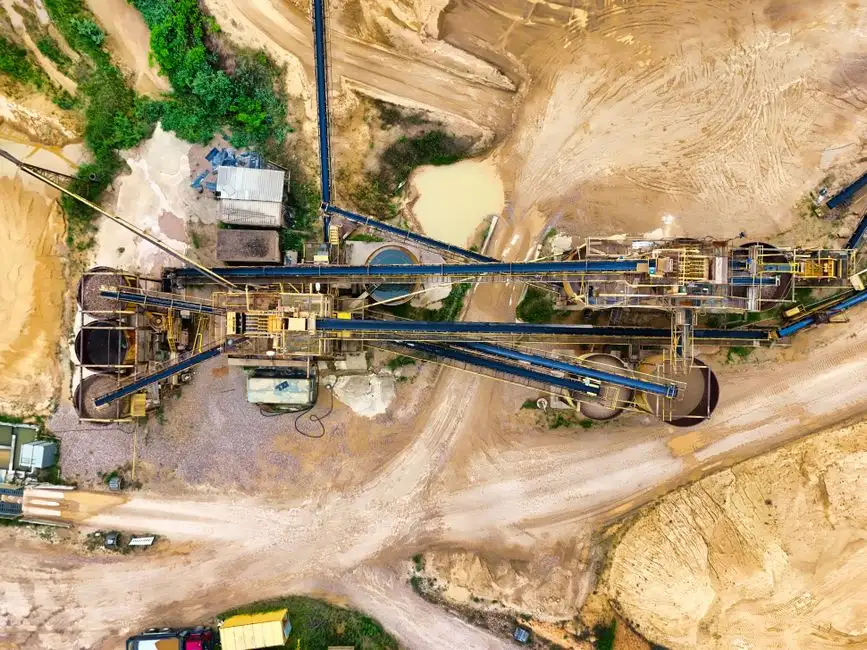
DAF delivers 95-99% TSS removal and 98-99% oil/grease removal on typical Marion metal-finishing and mineral-processing streams, versus 80-90% TSS and 50-70% oil/grease for a clarifier. The gap is widest on colloidal metal hydroxides generated after pH adjustment: those particles are too small and too low-density to settle in a reasonable clarifier retention window, so they pass through and show up as dissolved-metal excursions in the effluent.
Footprint and energy requirements differ based on the separation mechanism. DAF operates at 4-7 m/h hydraulic loading for mining, while clarifiers run 1-2 m/h, so an equal-flow clarifier train needs 30-50% more tank volume. DAF consumes 0.2-0.5 kWh/m³ driven by the recycle pump and air compressor; clarifiers sit at 0.1-0.3 kWh/m³. DAF also tolerates hydraulic surges better because bubble-particle contact is fast; clarifier efficiency drops sharply when HLR spikes above 2 m/h, sending a solids slug downstream.
| Metric | DAF | Clarifier / Lamella | Source |
|---|---|---|---|
| TSS removal | 95-99% | 80-90% | hydropurewater 2026 |
| Oil & grease removal | 98-99% | 50-70% | hydropurewater 2026 |
| Hydraulic loading rate | 4-7 m/h (mining) | 1-2 m/h | hydropurewater 2026 |
| Footprint at equal flow | Baseline | +30-50% | hydropurewater 2026 |
| Energy use | 0.2-0.5 kWh/m³ | 0.1-0.3 kWh/m³ | hydropurewater 2026 |
| Surge tolerance | High (fast contact) | Low (long retention) | Engineering judgment |
| Colloidal hydroxide capture | Yes (with flocculant) | Poor below ~50 μm | Engineering judgment |
2026 Cost Model: CAPEX and OPEX for a 100 m³/h Marion Mining Plant
For a 100 m³/h (~440 gpm) mining plant, 2026 DAF CAPEX typically lands $180,000-$280,000. The breakdown is roughly 60% core equipment (tank, saturation system, recycle pump, skimmer), 20% installation, 10% civil works, and 10% commissioning; a modular skid unit trims CAPEX by 15-20% and install time by up to 30%. DAF OPEX runs $0.08-$0.25/m³, with energy at ~40% and chemicals (lime, anionic polymer) at ~30% of the bill. A comparable clarifier train lands 30-50% lower OPEX on simple streams, but the moment you add polymers to chase colloidal metals the OPEX gap closes quickly and footprint penalties remain.
Payback for a mining DAF retrofit is typically 2-4 years, driven by reduced POTW surcharges on TSS/COD/FOG, avoided IDEM fines, and water-reuse credits for streams that previously went to drain. The DAF system is a modular skid configuration worth quoting when footprint and install time matter on a Q3 2026 capex window.
| Cost item | DAF (100 m³/h, 2026) | Clarifier / Lamella (100 m³/h, 2026) |
|---|---|---|
| CAPEX (installed) | $180,000-$280,000 | $120,000-$200,000 (est.) |
| Modular skid savings | 15-20% CAPEX, ~30% install time | Limited skid options |
| OPEX | $0.08-$0.25/m³ | 30-50% lower on simple streams; rises with polymer dosing |
| OPEX driver | ~40% energy, ~30% chemicals | ~60% energy, low chemicals |
| Typical payback | 2-4 years (POTW + fine avoidance) | <2 years on simple grit streams |
When a Clarifier Still Wins, and Why Most Marion Plants Run a Hybrid
A clarifier or lamella thickener is the right call when upstream mine water is dominated by settleable grit, silica, and coarse tailings with TSS above 5,000 mg/L and few colloidal fines. In that envelope, gravity removes 90% of bulk solids at the lowest cost per cubic meter, with no chemical conditioning required.
The 2026 reality in Marion metals plants involves hybrid flowsheets: a primary clarifier pulls out grit and bulk TSS, then pH adjustment and a DAF polish step capture the colloidal metal hydroxides and FOG that the clarifier leaves behind. The hybrid arrangement is what IDEM permit reviewers increasingly expect for facilities with both high TSS and metal-precipitation loads. For the primary stage in such a train, the HydropureWater high-efficiency sedimentation tank (lamella clarifier) is the unit most often specified as the grit-removal front end.
Decision Matrix: Choosing DAF, Clarifier, or Hybrid for Your Marion Stream
Mapping influent characteristics to the correct technology is the most efficient way to justify equipment selection to leadership. Use the matrix below as a reference for your planning.
| Wastewater profile | Primary choice | Rationale |
|---|---|---|
| High colloidal metals + low settleable solids (post-precipitation) | DAF | Micro-bubbles float colloidal hydroxides; clarifiers miss them |
| High grit + bulk TSS (>5,000 mg/L), low metals | Clarifier or lamella thickener | Gravity settles dense particles at lowest $/m³ |
| Mixed: FOG, metal precipitates, and grit | Hybrid (clarifier → DAF) | Each unit does what it does best; matches IDEM expectations |
| Tight footprint or flow surges | DAF | 4-7 m/h HLR; tolerates hydraulic spikes |
| Lowest OPEX on simple settleable stream | Clarifier | 0.1-0.3 kWh/m³, no chemistry |
| Effluent <2 mg/L dissolved metals required | DAF (with pH + polymer) | Clarifier-only rarely hits colloidal metal limits |
For deeper flowsheet-level design context, the mineral processing effluent treatment plant design guide covers the downstream stages this matrix feeds into.
Compliance, Pretreatment, and What IDEM/EPA Expect in 2026
Indiana enforces 327 IAC 5 and applies EPA Region 5 categorical standards under 40 CFR Part 467 (nonferrous metals) and Part 420 (iron and steel), with typical dissolved-metal limits of 1-2 mg/L for lead, zinc, copper, and total metals. DAF paired with chemical precipitation reliably meets 0.5-2 mg/L dissolved-metal envelopes; clarifier-only systems routinely exceed those limits on colloidal streams and trigger permit excursions. Marion plants discharging to the Marion Municipal Utilities POTW also pay local surcharges on TSS, COD, and FOG, so the higher removal efficiency of a DAF polish stage directly lowers monthly surcharges.
IDEM reviewers now expect documented pilot data and treatability studies for permit modifications that change primary treatment chemistry. A modular skid reduces the pilot-to-permit timeline, and an automatic chemical dosing system maintains the pH and polymer dose stability required for compliance. If your facility is adjacent to the Grant County metals corridor and you are weighing alternative chemistries for the polish step, the engineering spec for electrocoagulation for heavy metal wastewater is a useful side-by-side reference. For sister-site context in nearby Muncie, the DAF or clarifier for fabricated metals in Muncie, IN guide applies the same framework to a different wastewater profile.
Frequently Asked Questions
Is DAF or a clarifier better for metals removal in Marion, IN?
DAF is the stronger primary choice for metals streams because colloidal metal hydroxides formed after pH adjustment to 7-9 are too small and too low-density to settle reliably; micro-bubbles attach and float them, achieving 95-99% TSS and 98-99% oil/grease removal.
What is the 2026 cost of a DAF system for 100 m³/h mining wastewater?
CAPEX typically lands $180,000-$280,000 installed, with OPEX of $0.08-$0.25/m³
Frequently Asked Questions
DAF or clarifier for mining wastewater in Marion, IN?
The choice depends on the specific gravity and particle size of the suspended solids in your Marion facility. Dissolved Air Flotation (DAF) is superior for mining wastewater containing oil, grease, or low-density solids that settle at a rate slower than 0.05 cm/s. Clarifiers are generally more effective for high-density mineral slurries with settling velocities exceeding 0.1 cm/s, offering lower operational energy costs but requiring a larger physical footprint for the same hydraulic loading rate.
How much does a DAF system cost for metals wastewater in 2026?
In 2026, a standard industrial DAF system for mining applications typically ranges from $85,000 to $250,000 for equipment alone, depending on throughput capacity and material metallurgy, such as 304 vs. 316 stainless steel. When accounting for installation, auxiliary chemical dosing skids, and integration into existing Marion municipal pre-treatment infrastructure, total project costs generally range between $150,000 and $450,000.
What is the best TSS removal method for mining wastewater?
For mining wastewater, DAF is often the most efficient method for achieving Total Suspended Solids (TSS) removal rates of 90% to 98% when dealing with dispersed particles or metal hydroxides. However, if the influent contains high concentrations of heavy, non-floatable grit or coarse tailings, a primary circular clarifier or lamella settler is preferred to handle higher mass loading without the risk of system blinding or excessive sludge volume.
Can a clarifier meet EPA metals pretreatment limits?
A clarifier can meet EPA metals pretreatment limits provided it is coupled with an effective chemical precipitation stage and a downstream filtration unit. While a clarifier can reduce TSS, it is often insufficient on its own to reach low-ppb (parts per billion) concentrations for dissolved metals like lead, cadmium, or copper required by the Clean Water Act, necessitating the use of flocculants and subsequent media or membrane filtration to achieve compliance.
What coagulants are used in mining DAF systems?
Mining DAF systems typically utilize inorganic coagulants such as Ferric Chloride or Aluminum Sulfate (Alum) to neutralize particle charges and facilitate micro-floc formation. In 2026, high-molecular-weight anionic polymers are frequently added to bridge these micro-flocs into larger, floatable aggregates, ensuring that the air-bubble-to-particle attachment efficiency is optimized for rapid separation in the DAF contact zone.