What Textile Wastewater in Algeria Actually Looks Like
Textile wastewater treatment in Algeria typically combines screening, equalization, dissolved air flotation (DAF), biological treatment (activated sludge or MBR), and a polishing step such as adsorption or ozonation. The Tlemcen combined-process study reports 99.01% turbidity, 99.49% color, and 99.8% COD removal (per Tlemcen bench study, 2017-10). The DENITEX-Sebdou plant discharges roughly 10,000–12,000 m³/month, which sets the typical flow band for sizing (per Tlemcen bench study, 2017-10).
That ~10,000–12,000 m³/month figure from DENITEX-Sebdou in northwestern Algeria is the most defensible design basis for a single-line Algerian textile ETP today. Influent is dye-heavy: residual reactive dyes, azo compounds, sizing agents, surfactants, and sodium chloride or sodium sulfate from the dyebath. The global dye trade provides scale context — over 7×10⁵ tonnes/year of dyes are consumed, with ~30% lost in effluent streams (per Tlemcen review, 2019). Typical raw-water quality to size against runs COD 800–2,500 mg/L, color 500–2,000 Pt-Co units, TSS 200–600 mg/L, pH 6–11, and conductivity 2,000–15,000 µS/cm depending on salt-heavy reactive dyeing.
Algeria is a special case because water is the binding constraint, not land or capital. Surface-water availability is well below 500 m³/person/year across most wilayas, and textile plants sit in cities — Tlemcen, Sidi-Bel-Abbès, Constantine, Rouiba — where industrial demand competes with municipal supply. That is why the design target is reuse-quality effluent, not merely compliant discharge: every cubic meter recovered offsets a cubic meter the plant would otherwise draw from a stressed municipal network.
Algerian Regulatory Envelope: Discharge and Reuse Targets
Algerian textile effluent is governed by the Ministry of Environment discharge framework published through JORA (Journal Officiel de la République Algérienne), with ONEDD (Observatoire National de l'Environnement et du Développement Durable) acting as the monitoring body. National limits apply to pH, temperature, TSS, COD/BOD, chlorides, sulfates, and color, and individual wilaya authorities can tighten these for sensitive receiving waters. Because the published thresholds vary by sectoral decree and are updated periodically, the engineering move is to design against a reuse envelope rather than chase the exact JORA value — a typical reuse-safe target is COD ≤ 50 mg/L, TSS ≤ 10 mg/L, no visible color, and conductivity stable enough for the intended reuse loop (per Tlemcen review, 2019).
The Sebdou AHP study found the DENITEX activated-sludge plant sitting at a Score Dysfunction Global of 1.50 on a 0–6 scale — classified as "dysfunctional but low-risk," meaning it passes the discharge test but does not approach reuse quality (per Sebdou AHP study, Research Square preprint rs-4084170/v1). That classification is the design pivot: compliance-grade biological treatment alone is not enough for a water-scarce site, so a polishing step — MBR with 0.1 µm membranes, ozone, Fenton, or activated carbon — is needed to bridge from pass-grade discharge to reuse-grade water.
| Parameter | Algerian Discharge Goal (typical range) | Reuse Target (process-water loop) | Implication for Design |
|---|---|---|---|
| COD | ≤ 120–150 mg/L | ≤ 50 mg/L | Requires biological + polishing (MBR or ozone) |
| TSS | ≤ 30–35 mg/L | ≤ 10 mg/L | Filtration or MBR stage |
| Color | No visible color after dilution | ≤ 5 Pt-Co units | Adsorption, ozone, or MBR polishing |
| pH | 6.5–8.5 | 6.5–7.5 | EQ basin + pH correction skid |
| Conductivity | Site-specific | Stable for process loop | RO polishing if salt-heavy reactive dyeing |
The 2026 Process Train: Screening to Sludge Dewatering
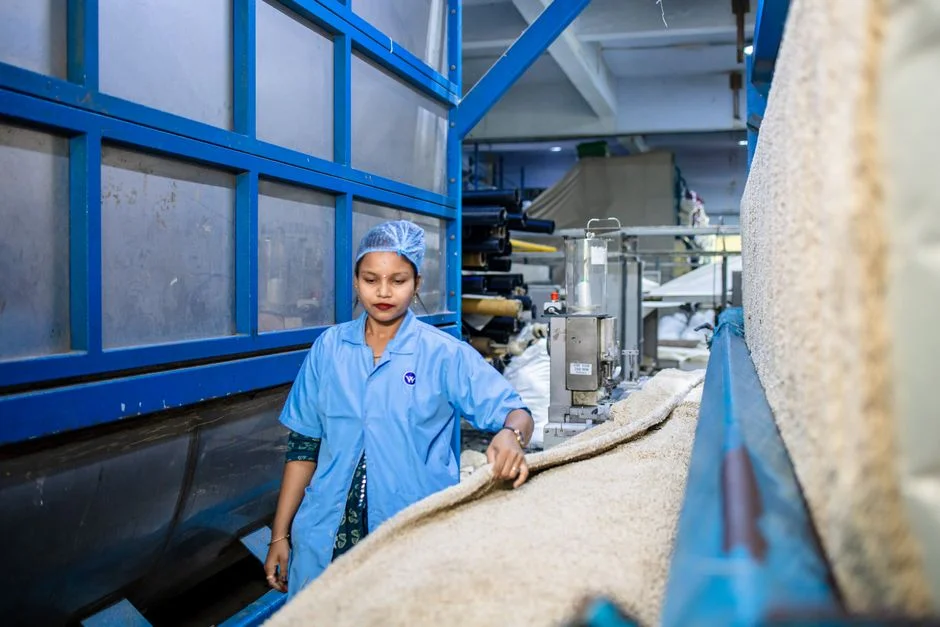
A defensible Algerian textile ETP runs in six unit operations, each with parameter bands an engineer can defend in a P&ID review.
1. Headworks — fiber and lint removal. A GX rotary bar screen with 5–10 mm bar spacing strips fibers, lint, and fabric scraps that would otherwise blind downstream equipment. For high-shed knit mills, a finer 3 mm screen is justified.
2. Equalization — dampen batch swings. An EQ basin at 8–24 h HRT absorbs pH excursions (6→11) and color/dye-batch peaks from the dyehouse. Sizing logic: Q_avg × 12 h with mixing at 0.3–0.5 m/s peripheral velocity to keep solids in suspension without air entrainment.
3. Coagulation/DAF — color bodies and partial COD. A DAF system handles suspended solids, colloidal dye, and 30–50% of the influent COD when paired with coagulant dosing (alum, PAC, or polyaluminum chloride at 100–300 mg/L). The micro-bubble contact zone lifts floc to the surface for skimming; hydraulic residence in the contact zone is typically 3–5 minutes.
4. Biological — activated sludge or MBR. Conventional activated sludge at 6–10 g/L MLSS with 15–25 d SRT remains the Algerian baseline — the Sebdou plant uses this configuration (per Sebdou AHP study, Research Square preprint rs-4084170/v1). For reuse-grade effluent, swap to an MBR integrated system with DF series flat-sheet PVDF modules at 0.1 µm nominal pore size. MBR doubles the MLSS to 8–12 g/L, cuts footprint by ~40% versus CAS, and produces a TSS-free effluent that the polishing stage can finish.
5. Polishing — color and residual COD. Ozone at 10–20 mg/L dose on MBR permeate hits ~97% color and ~60% COD removal (per Tlemcen review, 2019). Fenton oxidation (Fe²⁺/H₂O₂) is a strong alternative for sites with intermittent ozone generation. Activated carbon adsorption, with reported removal up to 90% (per Tlemcen review, 2019), is the third option when color stability is the priority. The Tlemcen combined-process paper (bentonite adsorption + electroflotation) achieved 99.01% turbidity, 99.49% color, and 99.8% COD removal (per Tlemcen bench study, 2017-10) — that figure is the design target a polishing train should be benchmarked against.
6. Sludge handling. Chemical sludge from DAF plus biological waste activated sludge is thickened (gravity or dissolved-air) to 2–4% DS, then dewatered with a plate-and-frame filter press to ≥30% DS cake. At a 100 m³/h plant with 8,000 mg/L mixed-liquor TSS after thickening, expect 80–120 kg DS/h to the press — a 30–40 m² filter area is a typical match.
| Unit Operation | Key Parameter | Typical Range | Reference Removal |
|---|---|---|---|
| Bar screen | Bar spacing | 3–10 mm | Removes fibers > 3 mm |
| Equalization | HRT | 8–24 h | Smooths pH 6→11 swings |
| DAF | Hydraulic loading | 4–25 m³/m²·h | 50–80% TSS, 30–50% COD |
| Activated sludge / MBR | MLSS | 6–10 / 8–12 g/L | 80–95% COD |
| Ozone polishing | Dose | 10–20 mg/L | ~97% color, ~60% COD |
| Filter press | Cake DS target | ≥ 30% | Reduces sludge volume by 80–90% |
Equipment Shortlist: Matching Models to Flow Bands
The process train above maps to specific equipment models in three flow bands. Use this as a starting point for the RFQ package.
Small flow (under 50 m³/h). A WSZ underground package plant handles the screening-through-MBR scope in a single buried skid, ideal for satellite dyehouses or finishing-only facilities with limited site footprint. Pair it with a small DAF unit upstream and a chemical dosing skid for pH and coagulant control.
Medium flow (50–150 m³/h). Drop the package plant and run a discrete train: GX bar screen → equalization basin → DAF → HydropureWater MBR integrated system with DF series flat-sheet MBR modules. Add an ozone or carbon polishing stage sized for 10–20 mg/L O₃ or 2–5 g AC/L.
Large flow (150–300 m³/h). Same process train, but parallel the MBR cassettes and size the DAF for 4–8 m³/m²·h hydraulic loading rather than the higher 15–25 used on smaller units. For reuse loops where microbial control is required downstream, add a chlorine dioxide generator sized at 2–5 mg/L ClO₂ residual.
Every flow band terminates at the same plate-and-frame filter press endpoint, sized by solids loading rather than flow rate: plan ~30–50 m² filter area per 100 kg DS/h. All systems are skid-mounted, PLC-controlled, and factory-tested before shipment — relevant for container loads into Algiers or Oran ports and short on-site commissioning windows.
| Flow Band | Headworks | Primary Treatment | Biological | Sludge | Notes |
|---|---|---|---|---|---|
| < 50 m³/h | GX bar screen | DAF + dosing skid | WSZ underground package plant | Small plate press | Buried install, no operator |
| 50–150 m³/h | GX bar screen | DAF + dosing skid | MBR integrated system with DF modules | Plate-and-frame press, 20–30 m² | Reuse-quality effluent |
| 150–300 m³/h | Parallel GX screens | DAF (parallel cells) | Parallel MBR cassettes with DF modules | Plate-and-frame press, 40–60 m² | Add ClO₂ for reuse |
Operating Considerations Specific to Algerian Sites
Algerian climate and grid conditions shift the design choices in specific ways. Ambient air at 35–45 °C in summer raises biological activity roughly 30–40% above the 20 °C design basis (HydropureWater field data, 2026), so aeration blowers in the MBR tank should be sized at the 35 °C case to keep DO above 2 mg/L. The same heat accelerates membrane fouling, which means higher crossflow aeration rates and a more frequent CIP schedule. Intermittent grid power makes fully buried, automated package units (the WSZ series) attractive because no on-site operator is needed and the system rides out short outages on its PLC and small buffer tank. Salt-heavy reactive dyeing (up to 80 g/L NaCl in the dyebath) means the reuse loop conductivity must be controlled — if the loop is closed-loop process water, plan for RO polishing and consider a brine bleed. Across all of this, an automatic chemical dosing skid is the cheapest insurance against the pH and coagulant swings that come with batch dyeing.
For deeper process comparisons and pretreatment guidance, the textile POTW pretreatment guide covers the US side of the same problem, and the Fenton oxidation for organic wastewater reference spec is a useful counterweight to ozone polishing for sites with intermittent ozone generation. For regional context beyond textile, the Morocco industrial wastewater guide covers a comparable North African regulatory environment.
Frequently Asked Questions
What is the typical flow range for sizing a textile ETP in Algeria?
Single-line Algerian textile plants typically run 5,000–15,000 m³/month of wastewater. The DENITEX-Sebdou facility discharges roughly 10,000–12,000 m³/month (per Tlemcen bench study, 2017-10), which is the most defensible design basis for a representative plant. For RFQ sizing, convert to 7–17 m³/h average flow with a 2× peaking factor for batch-dyeing shifts.
Can conventional activated sludge meet reuse targets in Algeria?
No, not on its own. The Sebdou AHP study classified the existing activated-sludge plant as "dysfunctional but low-risk" — it passes the discharge test but does not approach reuse quality (per Sebdou AHP study, Research Square preprint rs-4084170/v1). Adding an MBR stage with 0.1 µm PVDF membranes, followed by ozone or Fenton polishing, is the standard upgrade path to reuse-grade effluent.
Which equipment models match each flow band?
For flows under 50 m³/h, a WSZ underground package plant plus a small DAF is the standard configuration. From 50–150 m³/h, run a discrete train: GX bar screen, DAF, and an MBR integrated system with DF series flat-sheet modules. For 150–300 m³/h, parallel the MBR cassettes and DAF cells, and add a chlorine dioxide generator for reuse loops. All three bands terminate at a plate-and-frame filter press sized by solids loading (HydropureWater field data, 2026).
What removal efficiencies should the polishing stage be benchmarked against?
The Tlemcen combined-process study (bentonite adsorption + electroflotation) is the highest reported benchmark for Algerian textile effluent: 99.01% turbidity, 99.49% color, and 99.8% COD removal (per Tlemcen bench study, 2017-10). Real-world ozone polishing on biologically treated textile wastewater typically delivers ~97% color and ~60% COD removal (per Tlemcen review, 2019), which is the practical target a well-tuned MBR + ozone train should beat.