
The Two-Layer Compliance Ceiling for Decatur Textile Plants
Textile and dyeing plants near Decatur, IL face a two-layer compliance stack: the federal categorical ceilings under 40 CFR Part 408 and the local sewer-use ordinance enforced by the Sanitary District of Decatur (SDD) pretreatment program. 40 CFR Part 408 covers five textile subcategories — Dyeing, Finishing, Printing, Hosiery, and Knit Fabric — and sets daily-maximum pollutant loads by subcategory, with BOD running 84–432 lb per 1,000 lb of product depending on the subcategory. The SDD's online pretreatment page is currently a stub, so the binding local numbers — including any local tightening on sulfide, total chromium, color, or sulfate — must be confirmed directly with the SDD pretreatment coordinator before the P&ID is frozen.
The regulatory frame is different from a border POTW because Decatur's receiving water is the Sangamon River. Local limits reflect Illinois EPA water-quality standards and any TMDL-driven tightening, not the 30/30 floor that border POTWs use to protect an already-impaired reach. Brand-level standards such as the ZDHC Manufacturing Restricted Substances List (MRSL) sit on top of that stack as voluntary input-chemistry audits, but they do not change the legal ceiling. A 2026 Decatur pretreatment design must satisfy, in order of legal weight: SDD local limits → 40 CFR Part 408 categorical limits → ZDHC MRSL input chemistry.
Why Textile Influent Is the Hardest Stream a Decatur POTW Will See
Textile influent contains high variability, and color is the visible problem but not the mass-balance driver. The textile industry accounts for roughly 20% of global wastewater and consumes about 200 L of process water per kilogram of textile (per World Bank / Springer critical review, 2018). Azo dyes alone represent about 50% of the global dye market, with typical discharge dye concentrations running 10–50 mg/L across surveyed dye houses (Laing 1991, as cited in the Springer review). Reactive-dye baths layer on 1,000–10,000 mg/L of salt and sulfate on top of the color load, which is the load that drives the salt-swing risk in any downstream biological or electrochemical stage.
Auxiliary pollutants dominate the mass balance even when color is the visible problem. Sizing starches such as polyvinyl alcohol (PVA) and carboxymethyl cellulose (CMC) push BOD and COD; sodium sulfate from reactive-dye baths adds non-biodegradable salt; sulfur dyes produce sulfide, which is toxic and odorous above 1 mg/L — the typical 40 CFR 408 subcategory ceiling; and mordant dyes carry hexavalent chromium that hits the 40 CFR total-Cr ceiling fast. The operational envelope is equally punishing: pH swings 3–12, temperature 30–60 °C, and surfactant foam that routinely knocks out biological reactors when DAF is skipped or under-sized (per Springer review, 2018). A 2026 Decatur train is built around the influent profile, not around a single piece of equipment.
The 2026 Decatur Train: Four Stages, Matched to a Number
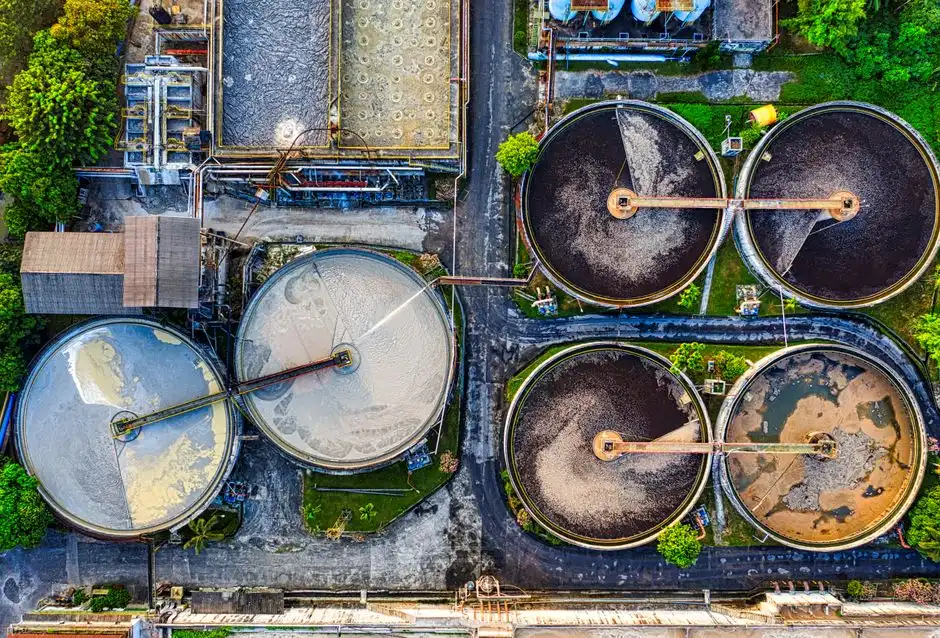
The working pretreatment train for a 2026 Decatur dye house is a four-stage sequence: rotary screening → dissolved air flotation (DAF) → equalization plus anaerobic/aerobic biology → advanced oxidation or membrane polishing. Matching each stage's removal efficiency to a specific downstream number ensures the system functions effectively.
Stage 1 — Screening. A rotary bar screen with 2–6 mm openings removes lint, rags, packaging, and loose fiber before they blind the DAF or wrap biological-reactor mixers. Headworks screening is the cheapest load reduction in the train; skipping it costs real money downstream in wrapped impellers and plugged nozzles.
Stage 2 — DAF. A micro-bubble dissolved air flotation system targets suspended solids, oils, and entrained color bodies, with a typical operating range of 4–300 m³/h, hydraulic residence time of 20–30 minutes, and 60–80% TSS removal with coagulant aid. A PLC-controlled chemical dosing skid upstream of the DAF holds those numbers when the influent swings, and the DAF also buffers downstream biology against surfactant foam and dye-bath overflow.
Stage 3 — Equalization + biological. A 4–8 h HRT buffer tank neutralizes pH and temperature, then biology takes over. High-COD dye effluent goes to a UASB or anaerobic MBR (AnMBR) for bulk COD reduction, followed by aerobic activated sludge or an MBR membrane bioreactor with 24–48 h aerobic HRT. MBRs hold the tightest TSS numbers and tolerate the salt and temperature swings that knock out conventional activated sludge, which is why they are the safer choice for reactive-dye operations near Decatur. For an operational read on membrane issues, see the MBR troubleshooting guide.
Stage 4 — Polish. AOP (Fenton, ozone, or H₂O₂/UV) or UF/RO knocks residual color, sulfide, and metals below the daily-max numbers. Fenton is the workhorse for reactive-dye effluent that has already passed through biology; UF/RO is preferred when the plant reuses water back into the dye house. The effluent targets a Decatur plant should specify on the P&ID are summarized below.
| Parameter | Design effluent target (mg/L or Pt-Co) | Source |
|---|---|---|
| BOD | < 30 mg/L | Typical POTW local limit, 40 CFR Part 408 subcategory |
| TSS | < 30 mg/L | Typical POTW local limit, 40 CFR Part 408 subcategory |
| COD | < 150 mg/L | Reactive-dye polish design target |
| Sulfide | < 1 mg/L | 40 CFR Part 408 subcategory ceiling |
| Total Cr | < 1 mg/L | 40 CFR Part 408 subcategory ceiling |
| Color | < 50 Pt-Co | Typical local POTW color limit |
Sizing the Train to a Decatur Plant's Flow and Dye Mix
Plant size and dye mix drive the train configuration. The table below maps a Decatur-area flow range to a default train and a binding design constraint; it is a starting point, not a replacement for site-specific influent testing. The binding number the engineer must hit is the SDD local limit, which in most cases tightens 40 CFR Part 408 on a parameter-by-parameter basis.
| Plant profile | Flow (m³/d) | Default train | Binding design constraint |
|---|---|---|---|
| Small dye house, reactive knit | ≤ 100 | Equalization + DAF + packaged MBBR or MBR | SDD local color and Cr limit; no AOP needed if biology alone clears |
| Mid-size denim/finishing | 100–1,000 | UASB + DAF + Fenton or ozone AOP + filter press | Sulfide < 1 mg/L, sulfate load, indigo/sulfur color |
| Large dye house, tight POTW | > 1,000 | Full MBR + UF/RO + chlorine dioxide + multi-media filter | TSS < 30 mg/L, reuse for cooling-tower makeup |
Operational requirements apply to all three sizes. Sulfide is controlled by pre-oxidation with H₂O₂ or NaOCl upstream of the DAF, followed by biological polishing to drive residual sulfide below 1 mg/L; Fenton at the polish stage is the most reliable option for indigo and sulfur-denim lines. DAF float and settled sludge must be routed to a plate-and-frame filter press or sludge thickener and dewatered to > 20% dry solids before offsite disposal — sending DAF float directly to the sanitary sewer is a common SDD permit violation. Large plants evaluating a discharge-to-cooling-tower reuse loop should also review the forward osmosis OPEX benchmark before locking in the RO train.
The 2026 Risk Layer: TTHM and Bromoform From Salt-Aided Electrochemistry
The June 2026 UMass Amherst study by Kuszewski et al. (Journal of Hazardous Materials, DOI 10.1016/j.jhazmat.2026.142075) provides operational data that ties salt-aided electrochemical polish in textile plants to trihalomethane and bromoformation. The paper found that NaCl-supported electro-oxidation of Azo dyes produces chloride-based trihalomethane byproducts at hundreds of ppb, and that brominated textile dyes push bromoform to 526 ppb — more than 10× the 80 ppb EPA total trihalomethane (TTHM) benchmark in drinking water.
The regulatory status is often overlooked: the EPA does not yet set a textile-wastewater TTHM limit, but any plant draining to a POTW whose biosolids or outfall feeds a drinking-water intake — and Sangamon River basin intakes downstream of Decatur make this directly relevant — cannot ship salt-laden polish effluent without downstream GAC adsorption or RO polish. The paper laid out three mitigation paths: switch the supporting electrolyte from NaCl to sodium sulfate (drop-in, slower kinetics, no new electrodes); switch to bismuth or titanium catalysts (cuts byproducts, caps throughput, adds catalyst-replacement cost); or continue with NaCl but add GAC polish and worker ventilation. The downstream GAC train typically sits after a multi-media filter that protects the carbon bed and the RO membranes from fouling.
Practical guidance for any Decatur plant specifying a new electrochemical polisher in 2026: do not select salt-aided electrocoagulation without a downstream GAC or RO polish step plus a local exhaust plan for worker chloroform and bromoform exposure.
Cost Lens: Where the Money Goes in a Decatur Pretreatment Upgrade
The cost rule of thumb at any US textile POTW remains consistent: DAF first because it cuts load efficiently at 4–300 m³/h; AOP is expensive in reagent (Fenton iron, ozone power) and in sludge (Fenton iron cake, ozonation off-gas). Over-engineering AOP upstream of a working biology stage wastes reagent and creates more solids to dewater through the filter press. For large dye houses, reuse of MBR + UF/RO permeate for cooling-tower makeup provides a strong CAPEX offset because it reduces both intake charges and sewer flow — a comparison to alternative reuse architectures is laid out in the textile pretreatment guide for adjacent POTW jurisdictions. The most overlooked line item in a Decatur upgrade ROI is the SDD surcharge schedule for BOD, TSS, and flow exceeding the local ordinance limits.
Frequently Asked Questions
What pretreatment limits does the Sanitary District of Decatur enforce for textile and dye-house discharge?
40 CFR Part 408 categorical daily-max limits apply, then the SDD's local sewer-use ordinance tightens on a parameter-by-parameter basis. Typical categorical daily-max targets are BOD 84–432 lb per 1,000 lb of product by subcategory, plus sulfide < 1 mg/L and total Cr < 1 mg/L. The SDD's online pretreatment page is currently a stub, so the binding local numbers — including any tightening on color, sulfate, or flow — must be confirmed directly with the SDD pretreatment coordinator before the P&ID is finalized.
Can a small Decatur dye house meet POTW limits with biology alone, or
Frequently Asked Questions
What pretreatment limits does the Sanitary District of Decatur enforce for textile and dye-house discharge?
The Sanitary District of Decatur (SDD) enforces local limits based on the protection of the municipal treatment process and biosolids quality. For textile facilities, this typically includes a pH range of 5.0 to 11.0, a maximum temperature of 140°F (60°C), and specific mass-based or concentration-based limits for heavy metals such as chromium (0.5 mg/L), copper (1.0 mg/L), and zinc (2.0 mg/L). Additionally, BOD and TSS surcharges are applied based on concentrations exceeding 250 mg/L for each parameter.
Can a small Decatur dye house meet POTW limits with biology alone, or is AOP required?
Biological treatment alone is generally insufficient for modern dye-house effluent due to the presence of recalcitrant synthetic dyes and high concentrations of non-biodegradable surfactants. While aerobic or anaerobic lagoons can reduce BOD, Advanced Oxidation Processes (AOP) using ozone or hydrogen peroxide combined with UV are required to break down complex molecular bonds and achieve the color removal standards necessary to meet SDD’s aesthetic and secondary treatment requirements.
Is salt-aided electrocoagulation still an option for textile polish in 2026?
Salt-aided electrocoagulation remains a viable polishing step in 2026, particularly for facilities managing high-conductivity waste streams. By adding sodium chloride, operators increase the ionic strength of the effluent, which enhances the formation of metal hydroxides and improves the destabilization of colloidal dye particles. However, this method must be carefully monitored to ensure that the resulting increase in Total Dissolved Solids (TDS) does not exceed SDD’s specific conductivity or chloride discharge thresholds.
What is the minimum equipment list for a Decatur dye house to clear 40 CFR Part 408 daily-max?
To comply with 40 CFR Part 408, a facility must implement a primary treatment train consisting of an equalization tank for flow and load balancing, a pH neutralization system using automated acid/base dosing, and a solids separation unit, such as a Dissolved Air Flotation (DAF) system or a high-rate clarifier. Furthermore, continuous flow monitoring and automated 24-hour composite sampling equipment are mandatory to provide the data required for periodic reporting to the Sanitary District of Decatur.
How is DAF float sludge handled so the plant does not violate SDD discharge rules?
DAF float sludge must be mechanically dewatered using a filter press or centrifuge to achieve a minimum solids content of 20-25% before disposal. Under SDD regulations, textile plants are strictly prohibited from discharging sludge solids or concentrated backwash water directly into the sanitary sewer, as this constitutes a slug load that can disrupt the municipal treatment plant's biological process. All dewatered sludge must be hauled off-site by a licensed waste contractor for landfill disposal or incineration.