
Why Textile Effluent Is a Distinct Compliance Problem in Nepal
Textile wastewater is not a generic industrial wastewater problem, and a municipal ETP template fails on it within the first week. Effluent composition shifts dramatically across fiber type — cotton carpet, synthetic, denim — and across wet-processing stages including desizing, scouring, bleaching, dyeing, printing, and finishing (Azanaw et al., Case Studies in Chemical and Environmental Engineering, 2022). A Nepali dyeing house typically discharges effluent with COD 800–2,500 mg/L, BOD₅ 200–800 mg/L, color 500–2,500 Pt-Co units, TDS 1,500–6,000 mg/L, pH 8–11, and temperature 30–60 °C. Those values sit well above municipal sewage ranges and breach Nepal's inland discharge limits in nearly every parameter if released untreated.
When those loads reach the Bagmati, Bishnumati, or Kosi tributaries — the receiving waters for Kathmandu Valley and Tarai clusters — the consequence is immediate. High color blocks light transmission; high BOD strips dissolved oxygen; high TDS and residual salts render the water unfit for downstream irrigation or drinking-water abstraction. Field evidence from the New Road corridor and Kathmandu factories documents hundreds of kilograms of fabric waste per month generated alongside process effluent (Roots of Circularity / Rekriti, 2025), confirming the scale of the pollution pressure the Bagmati basin already absorbs. Generic municipal ETPs are designed for BOD/COD ratios near 0.5 with stable flow; textile effluent arrives with BOD/COD ratios below 0.3, salt-induced toxicity to biomass, and color bodies that pass straight through activated sludge. That mismatch is why a textile-specific flowsheet — engineered for color, salt, and hydraulic shock — is non-negotiable.
Nepal's 2026 Discharge Standards for Textile Industry
Nepal's 2026 compliance floor for textile factories discharging to inland surface water is the Industrial Effluent Discharge Schedule 5, which sets COD ≤250 mg/L, BOD₅ ≤100 mg/L, TSS ≤50 mg/L, filterable color ≤100 Pt-Co at 1:20 dilution, pH 6.5–8.5, and residual chlorine ≤1 mg/L (Nepal Gazette, Schedule 5). Factories discharging to a public sewer follow the looser Schedule 6 thresholds, while Schedule 9 governs irrigation reuse. Kathmandu Valley plants are additionally bound by the Department of Environment consent-letter conditions and the Bagmati River Basin Improvement Project ambient targets, which are tighter than the Schedule 5 numbers on dissolved oxygen and color in practice.
Department of Environment inspectors in 2026 routinely test the following parameters during a textile-facility audit: COD, BOD, TSS, pH, color, temperature, residual chlorine, and oil & grease. A grab sample failing color or TDS is enough to trigger a non-compliance notice, which is why every later process spec in this guide is traceable back to one of these parameters.
| Parameter | Schedule 5 (inland surface) | Schedule 6 (public sewer) | Schedule 9 (irrigation reuse) |
|---|---|---|---|
| COD (mg/L) | ≤250 | ≤500 | ≤200 |
| BOD₅ (mg/L) | ≤100 | ≤200 | ≤100 |
| TSS (mg/L) | ≤50 | ≤200 | ≤100 |
| Color (Pt-Co, 1:20) | ≤100 | ≤200 | ≤100 |
| pH | 6.5–8.5 | 6.0–9.0 | 6.5–8.5 |
| Residual chlorine (mg/L) | ≤1.0 | ≤1.0 | — |
| Temperature (°C) | ≤40 | ≤45 | ≤40 |
Influent Characterization for a Typical Nepali Dyeing or Carpet Plant
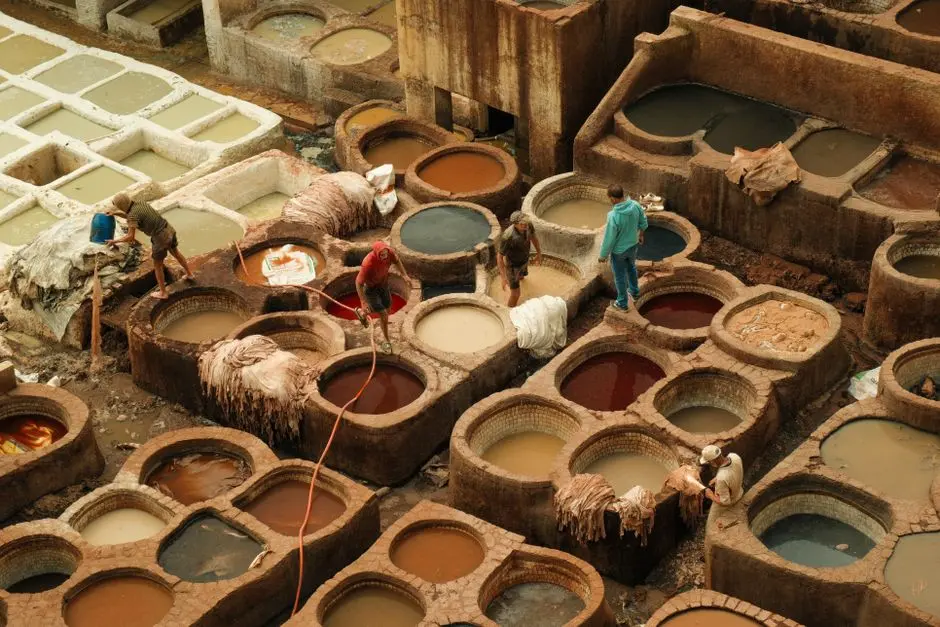
A representative 100 m³/d Kathmandu dyeing house generates influent at COD 1,500 mg/L, BOD 450 mg/L, TSS 350 mg/L, color 1,200 Pt-Co, TDS 3,800 mg/L, and pH 9.5 — a profile that fails Schedule 5 by a factor of 6 on COD and 12 on color. The hydraulic regime is equally punishing: the day-shift to night-shift flow ratio is 2.2:1, and during the July–August monsoon, combined sewer infiltration can double the inflow when factory drains back up.
Three process streams dominate the load. Reactive dye rinse water carries the highest color and salt burden — sodium chloride and sodium sulfate are added at 50–100 g/L to drive dye exhaustion, so the effluent routinely carries TDS above 4,000 mg/L. Caustic scouring liquor pushes pH to 11–12 and demands neutralization before biological treatment. Softener and stenter condensates arrive hot (50–60 °C) and slightly acidic, and a heat exchanger or cooling tower is normally required to bring the mixed stream into the 30–38 °C window that biomass tolerates. The design implication is fixed: equalization must hold at least 8 hours of peak flow, and the biological stage must survive a 2× hydraulic shock without losing MLSS.
The 2026 Reference Flowsheet: DAF → Equalization → Biological → MBR → Disinfection
The flowsheet below is sized for a 100 m³/d Kathmandu dyeing house and meets Schedule 5 for inland surface discharge. Each step links to a defensible design parameter rather than vendor hand-waving.
Step 1 — Screening. A rotary mechanical bar screen with 5 mm spacing strips fiber lint, rags, and plastic before the DAF, protecting downstream pumps and nozzles.
Step 2 — DAF pre-treatment. A DAF pre-treatment unit in the 4–300 m³/h range generates 20–80 μm micro-bubbles at a surface loading of 5–20 m³/m²·h, removing 80–95% of TSS, 70–90% of oil & grease, and a large fraction of color-bound colloids. Coagulant (PAC 50–150 mg/L) and flocculant (PAM 0.5–2 mg/L) are injected via an automatic chemical dosing skid.
Step 3 — Equalization. 8–12 hours of mechanical mixing with pH correction to 6.5–8.5 using sulfuric acid or CO₂. Sized to absorb the 2.2:1 day/night swing plus a monsoon buffer.
Step 4 — Biological treatment. Either extended-aeration activated sludge (MLSS 4,000–5,000 mg/L, SRT 20–30 days) or a hybrid anaerobic-aerobic train for higher-strength dye baths. The long SRT is deliberate: textile recalcitrant COD requires slow-growing organisms to break down azo and anthraquinone chromophores.
Step 5 — MBR polishing. The integrated MBR system uses DF series PVDF flat-sheet membrane modules with 0.1 μm pore size, operated at 12–18 LMH flux. The MBR replaces the secondary clarifier, delivers effluent TSS <2 mg/L and COD ≤50 mg/L, and concentrates MLSS to 8,000–12,000 mg/L for a smaller footprint.
Step 6 — Multi-media filtration. A multi-media filter protects downstream RO if the plant targets water reuse.
Step 7 — Disinfection. A ClO₂ disinfection generator holds residual chlorine at ≤1 mg/L and suppresses residual color. NaOCl is avoided because it forms trihalomethanes with dye residues; ClO₂ does not.
| Stage | Equipment | Key Parameter | Typical Performance |
|---|---|---|---|
| 1. Screening | GX rotary bar screen | 5 mm spacing | Removes lint, rags, plastic |
| 2. DAF | DAF, 4–300 m³/h | 5–20 m³/m²·h surface loading | 80–95% TSS, 70–90% O&G removal |
| 3. Equalization | Concrete / HDPE-lined tank | 8–12 h HRT, pH 6.5–8.5 | Hydraulic & pH buffering |
| 4. Biological | Extended aeration | SRT 20–30 d, MLSS 4,000–5,000 mg/L | 60–80% COD reduction |
| 5. MBR | DF-150 PVDF flat sheet | 0.1 μm, 12–18 LMH | Effluent TSS <2 mg/L, COD ≤50 mg/L |
| 6. Polishing | Multi-media filter | Sand + anthracite + garnet | TSS <1 mg/L; RO protection |
| 7. Disinfection | ClO₂ generator | Residual Cl₂ ≤1 mg/L | Color suppression, microbial kill |
Equipment Sizing for a 100 m³/d Kathmandu Textile Plant
The reference plant takes the 100 m³/d design flow and converts it to a bill of materials. The 38 kW connected load is dominated by aeration blowers — roughly 28 kW — which drives the case for variable-frequency drives in the OPEX section below.
| Unit Operation | Specification | Quantity / Size |
|---|---|---|
| Bar screen | GX series, 5 mm spacing | 1 unit |
| DAF | DAF-10, recycle ratio 20–30% | 1 unit, 10 m³/h, 2.5 m diameter |
| Equalization tank | Concrete or HDPE-lined, 8 h HRT | 40 m³ |
| Aerobic bioreactor | F/M 0.08–0.15 kg BOD/kg MLSS·d | 120 m³ total |
| MBR tank + modules | DF-150, 12 Nm³/h aeration per module | 25 m³ tank, 2 × 150 m² modules |
| Sludge dewatering | Plate and frame filter press, 8–12% dry cake | 5 m² filtration area |
| Connected power | ~38 kW total | ~28 kW for aeration |
2026 CAPEX and OPEX in NPR for a Packaged Textile ETP
A turnkey 100 m³/d packaged textile ETP in Nepal lands in the NPR 12–22 million range in 2026, covering equipment, civil works, installation, and commissioning but excluding land (HydropureWater field data, 2026). The variance is driven mainly by tank material (concrete vs. HDPE-lined) and whether a containerized skid is specified. For a comparable South Asian benchmark, the 2026 Kandy WTP cost breakdown shows similar unit-cost scaling for industrial effluent packages.
Monthly operating cost breaks down as follows. Power: NPR 450,000–600,000, which is the largest line and the one most exposed to load-shedding; a grid-plus-diesel hybrid with a small rooftop solar tie-in materially reduces it. Chemicals (PAC, PAM, acid, ClO₂): NPR 280,000–380,000. Membrane replacement reserve: NPR 180,000–250,000 — set aside annually but amortized monthly, since DF modules typically need replacement at 4–6 years. Labor: NPR 320,000–450,000 for a 3-shift operator crew. Sludge disposal: NPR 60,000–120,000 depending on cake dryness and hauler distance. Total monthly OPEX lands at NPR 1.4–2.1 million, or roughly NPR 460–700 per m³ treated.
Two levers compress the OPEX. A 50% water-reuse loop via RO polish cuts freshwater draw — and Kathmandu's municipal water tariff — by half. For carpet exporters bound by ZLD-style buyer standards, the same RO skid can be pushed to near-zero liquid discharge, with the brine sent to a solar evaporator or crystallizer.
| Cost Item | Monthly NPR | Notes |
|---|---|---|
| CAPEX (turnkey, 100 m³/d) | 12,000,000–22,000,000 (one-time) | Excludes land |
| Power | 450,000–600,000 | Includes diesel for load-shedding |
| Chemicals (PAC/PAM/acid/ClO₂) | 280,000–380,000 | Dose-driven |
| Membrane replacement reserve | 180,000–250,000 | DF modules, 4–6 year life |
| Labor (3-shift) | 320,000–450,000 | Operator + helper |
| Sludge disposal | 60,000–120,000 | Cake to off-site landfill |
| Total monthly OPEX | 1,400,000–2,100,000 | ~NPR 460–700/m³ |
Frequently Asked Questions About Textile Wastewater Treatment in Nepal
What is the 2026 Nepal discharge standard for textile effluent COD and color?
Under Schedule 5 of the Nepal Gazette Industrial Effluent Discharge standards, textile factories discharging to inland surface water must hold COD ≤250 mg/L and filterable color ≤100 Pt-Co at 1:20 dilution, with pH 6.5–8.5 and residual chlorine ≤1 mg/L.
How much does a 100 m³/d textile ETP cost in Nepal in 2026?
A turnkey 100 m³/d packaged textile ETP runs NPR 12–22 million in CAPEX and NPR 1.4–2.1 million per month in OPEX, or roughly NPR 460–700 per m³ treated, based on HydropureWater field data from 2026.
Why is MBR preferred over a conventional clarifier for textile wastewater?
DF series PVDF flat-sheet MBR modules at 0.1 μm pore size and 12–18 LMH flux deliver effluent TSS <2 mg/L and COD ≤50 mg/L, retain slow-growing biomass needed to break down reactive dye chromophores, and tolerate the 2× hydraulic shock common in monsoon-affected Kathmandu plants.
Can a Kathmandu dyeing house reuse treated effluent in 2026?
Yes — with a multi-media filter plus RO polish downstream of the MBR, plants routinely achieve 50% reuse; for carpet exporters, the loop can be pushed to near-zero liquid discharge using RO and a brine evaporator.
Further Reading
Frequently Asked Questions
What is the cost of setting up a textile ETP in Nepal in 2026?
For a medium-scale textile unit in Nepal, capital expenditure (CAPEX) for a standard Effluent Treatment Plant (ETP) typically ranges from NPR 1.5 crore to NPR 4.5 crore, depending on the daily flow capacity. This estimate includes civil works, mechanical equipment, and electrical instrumentation, but excludes land acquisition costs and specialized tertiary treatment modules.
Which treatment process is best for reactive dye wastewater in Kathmandu?
Advanced Oxidation Processes (AOPs) combined with biological treatment are currently the most effective for reactive dye effluents. Given the high salinity and recalcitrant nature of reactive dyes, a process chain consisting of coagulation-flocculation, aerobic biological treatment, and a final Fenton’s reagent oxidation stage is recommended to meet color removal requirements.
What are Nepal's discharge limits for textile industry effluent?
Under the Generic Standards for Industrial Effluents, the Department of Environment (DoE) mandates a Chemical Oxygen Demand (COD) limit of 250 mg/L and a Biological Oxygen Demand (BOD) of 30 mg/L for discharge into inland surface waters. Additionally, the pH must be maintained between 5.5 and 9.0, and Total Suspended Solids (TSS) must not exceed 50 mg/L.
Is MBR necessary for a small dyeing house in Nepal?
Membrane Bioreactor (MBR) technology is generally not considered mandatory for small dyeing houses unless the facility faces severe space constraints or intends to implement ZLD (Zero Liquid Discharge). For most small-scale operations, a conventional Activated Sludge Process (ASP) paired with a robust secondary clarifier is sufficient to meet regulatory compliance if managed correctly.
How much does textile wastewater treatment cost per cubic meter in Nepal?
The operational expenditure (OPEX) for treating textile wastewater in Nepal currently ranges from NPR 45 to NPR 95 per cubic meter. This cost is driven primarily by electricity consumption for aeration, chemical dosing for neutralization and coagulation, and periodic sludge disposal fees incurred by the facility.