Why Abidjan Changes the Cooling-Water Math
The same data center P&ID that works in Frankfurt or Dublin under-specifies the water side in Abidjan. A site on the Ébrié Lagoon coast runs at an average wet-bulb temperature of 26–28 °C year-round, versus 18–22 °C in Northern Europe, which raises cooling-tonnage per MW of IT load by roughly 15–25% and increases the volume of blowdown that has to be treated or reused. More than 5,300 data center facilities exist worldwide, per Statista as cited in ASCE's March 2024 Civil Engineering Source feature, and the industry directly or indirectly draws water from 90% of U.S. water resources (Environmental Research Letters, 2021-05). West-African tropical cities are the next demand frontier, but the operating envelope is harsher than anything in those published datasets.
Grid water in Abidjan is the second constraint. SODECI/urban supply is intermittent, pressure drops in the dry season, and a 5–20 MW data hall cannot rely on continuous potable make-up. The Uptime Institute's 2021 survey found that only 51% of operators tracked their water use — the Abidjan site should be in the 49% that does, both for ESG reporting and for sizing blowdown reuse. The 49% who did measure were already logging flow, pH, conductivity, free ClO2, and TSS — exactly the parameters the District d'Abidjan pre-treatment envelope requires (per Uptime Institute, 2021). The business case for treatment equipment is therefore not "compliance overhead" — it is grid-water insurance and the cheapest insurance a tropical colocation or hyperscale site can buy.
The Three Wastewater Streams a 2026 Abidjan Data Center Produces
Procurement collapses sanitary and process streams into a single design roughly half the time on African builds. The audit below lets the engineer verify the scope before the P&ID is frozen.
Stream 1 — Sanitary wastewater. Office/lab load from staff and visitors, typically 50 L/person/day, with peak factors of 2.5–3.0 during shift handover. Flow is small but the BOD/COD ratio is conventional municipal strength, and the site footprint on Plateau or Vridi is constrained enough that a buried packaged plant is the default.
Stream 2 — Cooling-tower blowdown. The dominant stream by mass. A closed-loop cooling tower at 6–8 cycles of concentration in Abidjan (versus 3–4 in temperate climates) discharges at 1,500–3,500 mg/L TDS, with elevated silica (typically 40–120 mg/L as SiO₂), phosphate scale inhibitors, and residual oxidizing biocides. The chemistry — not just the volume — drives the unit-operation choice.
Stream 3 — Once-through or adiabatic cooling water (where used). Only viable where seawater or lagoon water is available and where heat-rejection rules allow it. ANDE and the District d'Abidjan increasingly push designers away from once-through designs and toward closed-loop + blowdown reuse, so this stream is shrinking in 2026 scopes but still appears on coastal sites.
Stream 4 (optional) — Rainwater and condensate harvest. Abidjan rainfall exceeds 1,500 mm/year, so roof-collected rainwater is a legitimate cooling make-up supplement. It must pass multi-media filtration and disinfection before blending with the cooling loop.
| Stream | Typical flow (m³/day, 5 MW site) | Key parameter | Typical range | Discharge path |
|---|---|---|---|---|
| Sanitary | 5–15 | BOD / COD | 150–300 / 250–500 mg/L | SONAPH sewer (indirect) |
| Cooling-tower blowdown | 30–80 | TDS / Silica (SiO₂) | 1,500–3,500 / 40–120 mg/L | Recycle to cooling via RO, brine to sewer |
| Once-through (if used) | 200–600 | Temperature / TDS | 32–38 °C / 50–500 mg/L | Returned to source with ANDE permit |
| Rainwater/condensate | 10–30 | TSS / TOC | 5–20 mg/L / 2–8 mg/L | Blended to cooling make-up |
Cooling-Blowdown Treatment Train: From DAF to Side-Stream RO
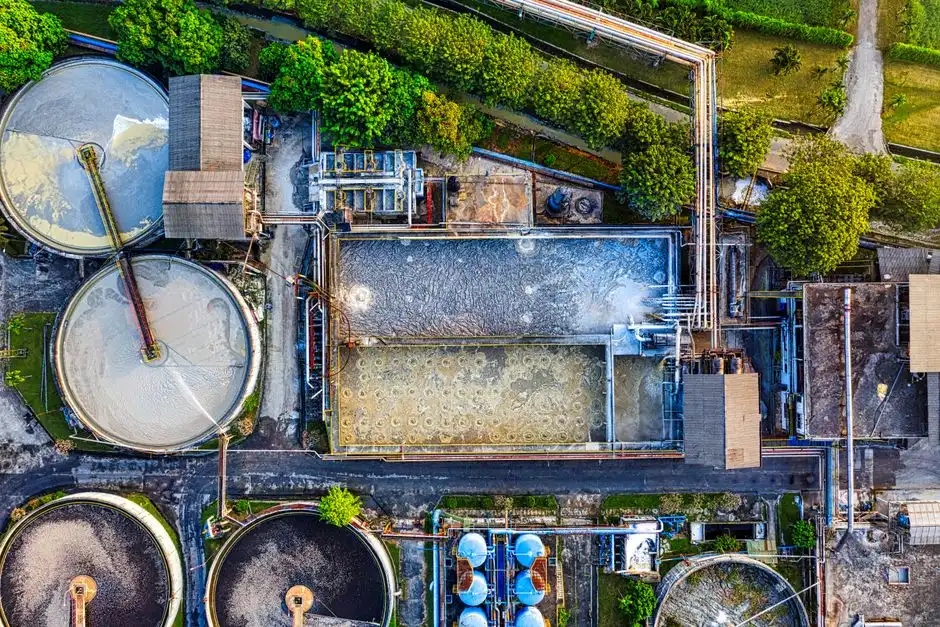
The unit-operation train below is sized for a 5–20 MW data hall on the Abidjan coast. It is sequenced so each stage removes the contaminant class that would blind the next.
Step 1 — Mechanical bar screening. A GX-series rotary mechanical bar screen at 3–6 mm aperture protects downstream blowdown piping from tower-fill debris, leaves, and macro-fouling carried in by the high atmospheric dust load during the Harmattan. African sites that skip this step typically regret it within 12 months.
Step 2 — DAF for suspended solids, silica colloids, and inhibitor carryover. A dissolved air flotation unit at 25–40 m³/h removes the colloidal silica and phosphate-inhibitor residue that would otherwise foul RO pre-filters. Hydraulic retention time 20–30 min, recycle ratio 20–30%, float scraper speed 0.5 m/min. This is the unit operation that bridges blowdown chemistry and water reuse.
Step 3 — Side-stream MBR. An MBR membrane bioreactor system built on DF-series flat-sheet submerged MBR modules (PVDF, 0.1–0.2 μm nominal pore) polishes organics and brings TSS to <5 mg/L before RO. The flat-sheet geometry tolerates the surfactant and biocide residuals that blind tubular or hollow-fibre pre-filters, and operates at flux 15–25 L/m²·h with backwash every 30 min.
Step 4 — Brackish-water RO. A side-stream RO unit on the MBR permeate recovers 60–80% of the blowdown as cooling make-up at recovery rates of 65–75%. The concentrate is mineralized and discharged to the SONAPH sewer. The reuse logic mirrors Google's 1.3 million sq ft Douglas County, Georgia campus, which takes treated utility effluent and re-treats it for cooling, per ASCE 2024.
Step 5 — ClO2 disinfection. An on-site ClO2 generator on the recycled cooling make-up and the sanitary polishing loop controls Legionella at 0.5–1.0 mg/L free ClO2 with substantially lower trihalomethane formation than chlorine — important because the discharge point is the Ébrié Lagoon watershed.
| Stage | Unit operation | Removes | Typical outlet | Operating envelope |
|---|---|---|---|---|
| 1 | Rotary bar screen | Debris > 3 mm | Macro-solids free | 3–6 mm aperture, auto-clearing |
| 2 | DAF | Colloidal silica, oils, inhibitor residue | TSS 20–40 mg/L | HRT 20–30 min, recycle 20–30% |
| 3 | MBR (DF flat-sheet) | Organics, residual TSS | TSS <5 mg/L, COD <50 mg/L | Flux 15–25 L/m²·h, PVDF 0.1 μm |
| 4 | RO (side-stream) | Dissolved salts, silica | TDS <50 mg/L permeate | Recovery 65–75%, feed pressure 10–15 bar |
| 5 | ClO2 generator | Legionella, coliforms | 0.5–1.0 mg/L free ClO2 | Yield ≥90% from NaClO2 + HCl |
Sanitary Sewage Treatment for the Abidjan Site
Keep the sanitary scope separate from the blowdown train. A WSZ-series A/O packaged sewage plant at 1–80 m³/h is the default because the staff population is small, the site footprint is tight, and the District d'Abidjan pre-treatment envelope has to be met continuously. Design influent: COD 250–500 mg/L, BOD 150–300 mg/L, NH₃-N <40 mg/L. Design effluent: COD ≤50 mg/L, BOD ≤20 mg/L, TSS ≤20 mg/L, NH₃-N ≤5 mg/L — values aligned with typical SONAPH/ANDE indirect-discharge expectations for 2026 (per District d'Abidjan pre-treatment envelope).
For a hyperscale campus producing >50 m³/day of sanitary waste, scale to an MBR block with PVDF flat-sheet modules. The MBR footprint is roughly 60% smaller than a conventional activated-sludge plant at the same load, and the polished effluent can be reused for landscape irrigation on-site. Sludge handling for either option uses a plate-and-frame filter press at 1–5 m² filtration area, dewatering waste activated sludge to >22% dry solids for off-site transport to a licensed waste receiver in the District d'Abidjan.
Local Compliance: Côte d'Ivoire Discharge and Pre-Treatment Rules
Direct discharge to surface water in the Ébrié Lagoon watershed is regulated by ANDE. The practical path for most 2026 data-center sites is indirect discharge to the SONAPH/urban sewer with pre-treatment to the local Arrêté envelope. Cooling-tower blowdown chemistry must meet pH 5.5–9.5, temperature <40 °C, oil and grease <50 mg/L, total residual chlorine <1 mg/L, and no visible foaming at the discharge point (per District d'Abidjan sewer pre-treatment envelope). ClO2 post-disinfection is preferred over Cl₂ for this reason — it leaves no chloramine residual and avoids the foaming associated with quaternary-amine biocides at the manhole.
Operators should maintain a daily log of flow, pH, conductivity, free ClO2, and TSS — the same five parameters the 49% of operators who tracked water in the 2021 Uptime survey were already measuring. Permit planning has to assume the worst-case blowdown during the Harmattan (Dec–Feb), when ambient humidity drops and cycles of concentration have to rise, pushing blowdown TDS up by roughly 20–30% above the design mean.
Equipment Selection: Matching Units to the Three Streams
The matrix below converts the narrative into a procurement-ready line list. Each row maps one stream to a unit-operation chain with a typical flow window for a 5–20 MW Abidjan site.
| Stream | Train | Primary equipment | Typical flow window |
|---|---|---|---|
| Cooling-tower blowdown | Screen → EQ → DAF → Lamella → MBR → RO → ClO2 | GX screen, DAF, DF MBR modules, side-stream RO, ClO2 | 30–80 m³/day |
| Sanitary sewage | A/O packaged → Lamella → ClO2 → plate press | WSZ A/O plant, sedimentation tank, ClO2 generator, filter press | 5–15 m³/day (>50 m³/day → MBR block) |
| Rainwater/condensate make-up | Multi-media → cartridge → blend tank + ClO2 residual | Multi-media filter, cartridge polish, ClO2 residual | 10–30 m³/day |
| Chemical conditioning (all streams) | Antiscalant, pH correction, biocide feed | Automatic chemical dosing skids | Skid-mounted, PLC-controlled |
Specify a multi-media filter ahead of the rainwater/condensate blend tank to strip TSS, and a high-efficiency sedimentation tank as a polish step on the sanitary line before ClO2. For guidance on how AWS handles a comparable scope at hyperscale, see the AWS hyperscale data center wastewater treatment brief; for an operator-side view of the same problem, the Digital Realty data center wastewater treatment guide is the most directly comparable 2026 reference. For a neighbouring East-African case with similar grid-water stress, the Kigali industrial wastewater engineering guide covers the same DAF → MBR → RO logic at comparable scale.
Frequently Asked Questions
What cycles of concentration should a cooling tower in Abidjan run at?
Closed-loop towers on the Abidjan coast should be designed for 6–8 cycles of concentration, versus 3–4 in temperate climates, because the higher wet-bulb temperature forces more evaporation per ton of rejection. At 8 cycles, blowdown TDS typically lands at 2,500–3,500 mg/L with silica at 80–120 mg/L as SiO₂, which is the chemistry that drives the DAF → MBR → RO train.
Is ClO2 better than chlorine for Legionella control in tropical data centers?
Yes, for discharge to the Ébrié Lagoon watershed. ClO2 controls Legionella at 0.5–1.0 mg/L free residual with substantially lower trihalomethane formation, leaves no chloramine residual at the manhole, and keeps the SONAPH sewer's <1 mg/L total residual chlorine envelope (per District d'Abidjan pre-treatment envelope). An on-site ClO2 generator produces it on demand from NaClO₂ + HCl.
How does the Abidjan design compare to Google's Douglas County reuse model?
The reuse logic is identical: take a treated effluent stream and re-treat it for cooling. Google's 1.3 million sq ft Douglas County, Georgia campus takes treated utility effluent and further treats it for cooling (per ASCE 2024); an Abidjan site applies the same logic in-house to its own cooling-tower blowdown, recovering 60–80% via side-stream RO and sending only the brine to the SONAPH sewer.
What is the minimum compliance envelope the District d'Abidjan enforces for indirect discharge?
Indirect discharge to the SONAPH sewer in 2026 requires pH 5.5–9.5, temperature <40 °C, oil and grease <50 mg/L, total residual chlorine <1 mg/L, and no visible foaming (per District d'Abidjan sewer pre-treatment envelope). The 51% of operators tracked by the 2021 Uptime Institute survey were already measuring flow, pH, conductivity, free ClO2, and TSS — the exact five parameters an Abidjan site should log daily.