Why Pharmaceutical Effluent in Azerbaijan Demands a Dedicated Treatment Train
Azerbaijan's domestic pharmaceutical manufacturing is scaling inside the Sumgait Chemical Industrial Park, Pirallahi free zone, and Hacıqabul industrial zone, and every new API line now triggers a MENR review under the 2021 Environmental Code. That regulatory shift puts Caspian Basin ecotoxicity rules and discharge limits directly in front of process engineers who previously discharged to municipal sewer with minimal pre-treatment. Standard activated sludge, designed for BOD/COD >0.5 and low solvent load, fails on streams running COD 5,000–25,000 mg/L with BOD/COD of 0.2–0.4, sulfate 1,000–4,000 mg/L, and trace APIs that pass through conventional biology unchanged.
The influent also swings 3× across API shifts — production campaigns for one product release high-COD mother-liquor streams while cleaning-in-place sends solvent-bearing rinses through the same header (per ScienceDirect, 2020, on fluctuating characteristics of pharma effluent). Without 24–48 h equalization and real-time pH/COD monitoring, downstream Fenton dosing misses by 30–40% and the MBR clogs. MENR targets confirm the scale of the gap: COD must drop below 250 mg/L for sewer discharge and below 50 mg/L for direct surface-water or Caspian tributary release. Conventional biology only removes 40–60% of influent COD, so a dedicated train — equalization, DAF, advanced oxidation, MBR, RO or ClO₂ polishing — is the only defensible path.
Influent Characterization: Parameters That Drive Equipment Sizing
Design starts with the production-facility outlet, not the combined neutralization tank. Composite samples drawn downstream of the neutralization tank smooth out the batch spikes that drive equipment sizing errors, because shifting flows across API batches distort any averaged result (per ScienceDirect sampling-point findings, 2020). For a typical Azerbaijani API plant, the parameter envelope is:
| Parameter | Typical Influent | MENR Discharge Target |
|---|---|---|
| COD (mg/L) | 5,000–25,000 | <250 (sewer) / <50 (surface water) |
| BOD (mg/L) | 1,000–10,000 | <25 |
| BOD/COD ratio | 0.2–0.4 | — |
| TSS (mg/L) | 500–3,000 | <35 |
| Sulfate (mg/L) | 1,000–4,000 | <500 |
| pH | 2–11 (batch swings) | 6.5–8.5 |
| Oil & grease (mg/L) | 200–1,500 | <10 |
| Total nitrogen (mg/L) | 100–800 | <45 |
| Total phosphorus (mg/L) | 10–80 | <2 (nutrient-removal zones) |
| Residual solvents (mg/L) | 50–500 (methanol, acetone, DCM) | site-specific MENR clause |
| Ecotoxicity vs. Daphnia magna | TU > 8 | TU < 2 (Caspian tributaries) |
At 500 m³/day and COD 15,000 mg/L, the daily COD load is 7,500 kg/day — equivalent to a 150,000-PE municipal plant, which justifies industrial-grade biological and AOP capacity rather than a packaged biological skid. Sulfate above 1,500 mg/L rules out standard anaerobic UASB because sulfide toxicity suppresses methanogens at S²⁻ above 200 mg/L, pushing the design toward aerobic MBR with pre-oxidation. Antibiotic residues and endocrine-active compounds require a dedicated polishing stage (RO or activated carbon) before any Caspian Basin discharge point.
The 2026 Reference Treatment Train: Equalization → DAF → Fenton → MBR → RO/ClO2
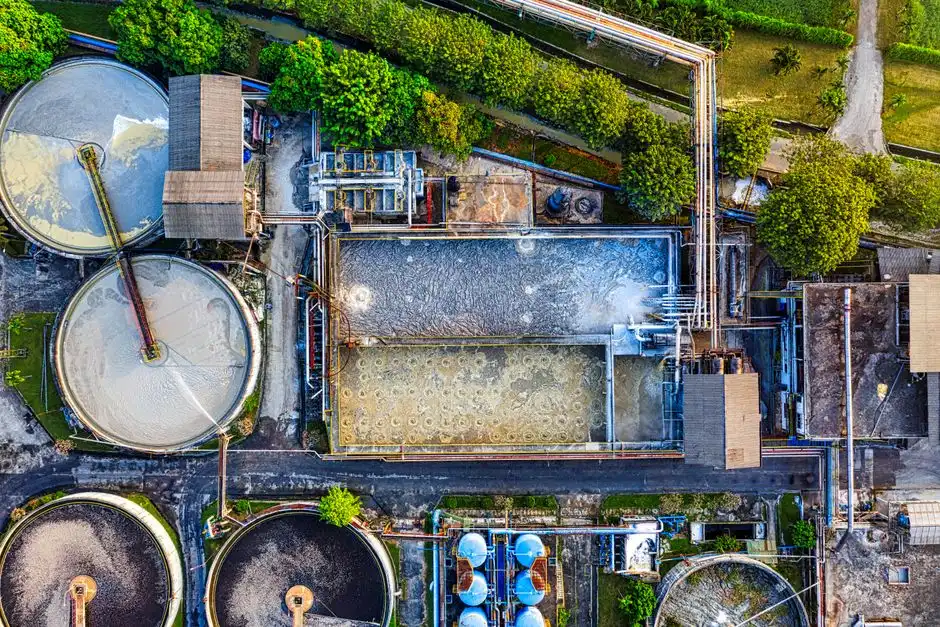
The train that fits Azerbaijani mid-strength API streams runs EQ → DAF → pH adjust → Fenton reactor → neutralization → MBR → intermediate tank → RO or ClO₂ → discharge or reuse. Stage-wise performance:
| Stage | Unit Operation | Key Parameter | Verified Removal / Performance |
|---|---|---|---|
| 1 | Equalization (24–48 h HRT) | Mechanical mixing, pH probe | COD swings damped from 25,000 to 8,000–12,000 mg/L feed; Fenton reagent demand cut 30–40% |
| 2 | DAF pre-treatment (4–300 m³/h) | Micro-bubble, auto skimmer | 90–95% TSS, 70–85% oil & grease removal; protects downstream Fenton and MBR membranes |
| 3 | Fenton / Electro-Fenton AOP | H₂O₂:Fe 0.5–1.5× stoichiometric, pH 3.0–3.5, 60–90 min | 4–62% COD reduction depending on H₂O2:Fe ratio; 8% TOC reduction via Electro-Fenton (per ScienceDirect, 2020) |
| 4 | Submerged MBR (PVDF 0.1 μm) | DF series flat-sheet modules | Residual COD <300 mg/L, TSS <5 mg/L; 60% smaller footprint than conventional clarifier + aeration basin |
| 5 | RO polishing or ClO₂ disinfection | 95% RO recovery or 50 g/h–20,000 g/h ClO₂ | RO permeate COD <50 mg/L, TDS <500 mg/L for Caspian tributaries; ClO₂ for sewer-discharge plants |
Equalization with 24–48 h HRT is the cheapest insurance in the train; without it, Fenton reagent consumption rises sharply during API batch peaks. The DAF pre-treatment unit drops TSS and emulsified solvents before the Fenton reactor, where the contact time and Fe²⁺/H₂O₂ ratio determine hydroxyl-radical yield. A submerged MBR system sized to the post-Fenton flow then strips residual COD and TSS to the polishing step. Electro-Fenton is the right AOP for sites with stable power and tighter TOC targets; classic Fenton is the workhorse for sewer-discharge plants. Fenton coagulation sludge and MBR waste sludge are then dewatered together on a plate-and-frame press before off-site disposal.
Equipment Selection Checklist Sized for 50–2,000 m³/day Plants
The shortlist below is vendor-neutral on capacity sizing and is anchored to the operating envelope of an Azerbaijani API plant. Selection rule: size the DAF to 1.25× peak hourly flow with one standby unit, because flow spikes 25–35% after Fenton neutralization when pH-adjust lime is added.
| Equipment | Model / Series | Capacity | Selection Logic |
|---|---|---|---|
| Equalization tank | Coated carbon steel or RCC | 24–48 h HRT at design flow | Mechanical mixers, pH probe, level instrumentation |
| DAF unit | DAF 4–300 m³/h | 1.25× peak hourly flow + standby | Micro-bubble generator, automatic skimmer |
| Fenton reactor | FRP-lined or rubber-lined CS | 60–90 min HRT | Paired with PLC-controlled chemical dosing for H₂O₂:Fe and pH |
| MBR modules | DF series PVDF flat-sheet, 0.1 μm | 80–225 m² per cassette; 32–135 m³/day per unit | Scale by parallel cassettes; submerged design minimizes footprint |
| RO polishing | Industrial RO, 95% recovery | 1.2× MBR permeate | Energy-recovery turbine, automatic CIP; sized for design recovery rate |
| Disinfection | Chlorine dioxide generator | 50 g/h–20,000 g/h | Final barrier for sewer-discharge plants or as RO backup |
| Sludge dewatering | Plate-and-frame filter press | 1–500 m² filtration area | Polymer dosing for cake dryness >25%; handles Fenton + MBR sludge |
Below 200 m³/day, a single DAF and one MBR cassette train handle the load. Between 500 and 1,000 m³/day, parallel MBR cassettes become the norm; Fenton reactors are often paired for redundancy because unplanned downtime on a single reactor compromises the whole biological step downstream. Above 1,000 m³/day, a dedicated sludge-handling building and RO energy-recovery package become economic. For deeper DAF selection trade-offs, the DAF engineering trade-offs guide covers micro-bubble versus dissolved-air sizing in detail.
2026 CAPEX, OPEX and Payback for an Azerbaijani Pharma Effluent Plant
CAPEX scales sub-linearly with flow; OPEX per cubic meter falls as Fenton reagent consumption stabilizes and labor spreads over more throughput. Benchmarks for 2026 (USD/m³/day of nameplate capacity, turnkey):
| Plant Size (m³/day) | CAPEX (USD/m³/day) | Total CAPEX (USD) | OPEX (USD/m³ treated) |
|---|---|---|---|
| 50 | $3,500–5,000 | $175,000–250,000 | $1.10–1.60 |
| 200 | $2,400–3,400 | $480,000–680,000 | $0.95–1.40 |
| 500 | $2,200–3,600 | $1.1–1.8M | $0.85–1.30 |
| 1,000 | $1,900–2,800 | $1.9–2.8M | $0.75–1.15 |
| 2,000 | $1,700–2,500 | $3.4–5.0M | $0.65–1.00 |
OPEX breakdown at 500 m³/day: electricity $0.20–0.30/m³ at Caspian-region industrial tariffs, H₂O₂ + FeSO₄ $0.30–0.45, sludge disposal $0.10–0.20, labor and consumables $0.25–0.35 — totaling $0.85–1.30/m³ (HydropureWater field data, 2026). Fenton reagent is the dominant swing variable, accounting for 35–45% of OPEX; H₂O₂ price volatility and inland iron-sulfate logistics are the two largest risk items. Payback versus off-site hazardous-waste haulage at $8–15/m³ in Azerbaijan is 3–5 years at 500 m³/day, dropping to 2–3 years above 1,000 m³/day because the OPEX gap widens.
MENR Permitting, Caspian Basin Compliance and the 2021 Environmental Code
Azerbaijan's 2021 Environmental Code (entered force 2022, replacing the 1999 Law on Environmental Protection) consolidated MENR discharge permitting, EIA, and integrated pollution prevention into one instrument. Pharmaceutical plants above defined capacity thresholds now require an EIA and a Complex Environmental Permit before commissioning — and the permit binds the operator to specific numerical discharge limits, not just "best practicable technology" language. Key limits: COD <250 mg/L to municipal sewer, COD <50 mg/L to surface water including Caspian tributaries; BOD <25 mg/L; sulfate <500 mg/L; total nitrogen <45 mg/L; pH 6.5–8.5. Discharge of mercury, cadmium, and persistent organics is banned outright.
Caspian Basin obligations add an ecotoxicity layer that the Polish and EU-derived influent tables do not capture: Daphnia magna and fish bioassay testing on final effluent is mandatory, and quarterly self-monitoring through an accredited MENR-approved lab is the enforcement norm. The practical design consequence is to build ecotoxicity passivation into the polishing stage — RO permeate or post-ClO₂ activated-carbon polish — so that a single API batch spike does not trigger permit revocation. For a 500 m³/day plant, this typically adds 8–12% to the polishing CAPEX but is the cheapest insurance against permit suspension.
Phased Delivery: Pilot Container → Full-Scale MBR → Optional ZLD Upgrade
Single big-bang CAPEX commitments are rare in the Caspian region because lenders want pilot data before disbursement. A milestone-based path de-risks both the technology choice and the MENR review. Phase 1 (months 1–4) deploys a containerized 20–50 m³/day pilot skid with EQ, DAF, Fenton, and MBR to verify removal percentages on the actual API mix — this is also the data package the MENR reviewer expects to see in the EIA. Phase 2 (months 5–12) scales to the full 500 m³/day plant based on pilot effluent quality, with PLC/SCADA integration and MENR permit submission in parallel. Phase 3 (optional, year 2+) is a ZLD upgrade with RO concentrate crystallization, justified if Caspian Basin direct-discharge rules tighten or if reuse for CIP becomes economically attractive above $0.50/m³ water cost. For ongoing operations, the pharma wastewater plant O&M guide covers Fenton dosing calibration and MBR cassette cleaning intervals in detail.
Frequently Asked Questions
What is the typical CAPEX for a 500 m³/day pharmaceutical effluent treatment plant in Azerbaijan in 2026?
A turnkey 500 m³/day plant lands at $1.1–1.8M total CAPEX, or $2,200–3,600 per m³/day of nameplate capacity, covering equalization, DAF, Fenton, MBR, and RO polishing (HydropureWater field data, 2026).
What MENR COD limit applies to direct discharge into Caspian Basin surface water?
MENR requires COD <50 mg/L, BOD <25 mg/L, sulfate <500 mg/L, and pH 6.5–8.5 for direct surface-water discharge, plus Daphnia magna ecotoxicity testing per the 2021 Environmental Code.
How effective is Fenton oxidation for pharmaceutical wastewater?
Fenton and Electro-Fenton AOPs deliver 4–62% COD reduction and 8% TOC reduction depending on H₂O₂:Fe ratio and reaction time, per ScienceDirect efficacy data (2020); they are the standard pre-treatment before MBR in Azerbaijani API plants.
Why is standard activated sludge insufficient for pharmaceutical effluent?
Standard activated sludge reaches only 40–60% COD removal on pharma streams with BOD/COD 0.2–0.4 and sulfate 1,000–4,000 mg/L, and it does not remove residual solvents, antibiotics, or endocrine-active compounds that trigger MENR ecotoxicity failures.
What is the payback period versus off-site hazardous-waste haulage in Azerbaijan?
On-site treatment pays back in 3–5 years at 500 m³/day and 2–3 years above 1,000 m³/day, because off-site haulage runs $8–15/m³ versus on-site OPEX of $0.85–1.30/m³.
Related Equipment
- industrial RO polishing — specifications, capacity range, and technical data