
Why a Filter Press Is the Workhorse for Dyehouse Sludge
A 100 m³/d dyehouse clarifier underflow running 2–5% dry solids (DS) generates 2–5 tonnes of wet sludge per day, or roughly one 10 m³ truckload every 48–72 hours, before any dewatering. At a typical disposal tariff of $25–$60 per wet ton (industry benchmark, 2026), that is $50–$300 per day of haulage before the cake ever leaves the gate. A filter press for textile dyeing wastewater cuts that volume by 75–90% and pushes solids into a stackable cake, which is why mechanical dewatering has displaced drying beds and decanter centrifuges in most Indian, Chinese, and Southeast Asian dyehouses by 2026.
The process train runs equalization → coagulation / DAF clarifier → sludge thickener → lamella clarifier upstream of the press for polishing → filter press → cake handling, with the filtrate recycled to the dyeing bath or RO feed. As described on the top-ranking DAZHANG product page, "filter presses separate solid waste such as dye particles from wastewater generated during textile dyeing. The equipment compresses sludge to enable water" recovery — a framing that the Jul 7 2026 textile-dewatering guide extends to whole-mill sludge management rather than just solids capture. Three failure modes a press resolves: (1) high sludge volume breaking the disposal budget, (2) reactive-dye color bleeding back from biological treatment, and (3) BOD/COD bleed-back when supernatant is recycled. Press filtrate typically runs 50–200 mg/L TSS, low enough to return to the reuse loop.
Textile Dyeing Wastewater Characteristics by Fiber and Dye Class
Cake dryness, polymer demand, and cycle time all shift with the fiber–dye pair, so the first engineering move is to identify which bucket the mill sits in. Reactive-dye cotton sludge carries the highest color load (often 2000–5000 Pt-Co units in the underflow) and sulfate-rich chemistry from sodium sulfate and Glauber salt used in the dye bath; biological sludge index (BSI) sits at 0.4–0.6 because hydrolysed reactive dye resists biological oxidation and accumulates in the wasted activated sludge. Polyester + disperse dye generates a very different stream: low-solubility dye particles, finishing oils, and carrier residues (often aromatic or phthalate-based) that coat the sludge and reduce filterability. Effluent temperature above 60 °C from the dyebath and pH swings of 4.5–8.0 further complicate dewatering. Acrylic + cationic dye routes introduce a charge-conflict risk: the sludge already carries a positive charge from cationic dye and cationic softener residues, which directly interferes with cationic polyacrylamide dosing. Blended cotton-poly mills — the most common real-world case in South Asia — see both biological and chemical solids in the same underflow, which drives combined polymer demand and longer cycle times than either single-fiber stream.
| Fiber / Dye Route | Sludge DS from Clarifier | Color (Pt-Co) | Filtration Resistance | Polymer Class |
|---|---|---|---|---|
| Cotton + reactive | 1.5–3.0% | 2000–5000 | Moderate | Cationic PAM |
| Polyester + disperse | 2.0–4.0% | 500–1500 | High (oil-coated) | Anionic / non-ionic PAM |
| Acrylic + cationic | 1.0–2.5% | 800–2500 | Variable | Anionic PAM (charge conflict risk) |
| Cotton-poly blend | 2.0–3.5% | 1500–3500 | Moderate–high | Cationic + anionic (dual) |
Chamber vs. Membrane Filter Press: Which Plate Type Fits Which Dyehouse
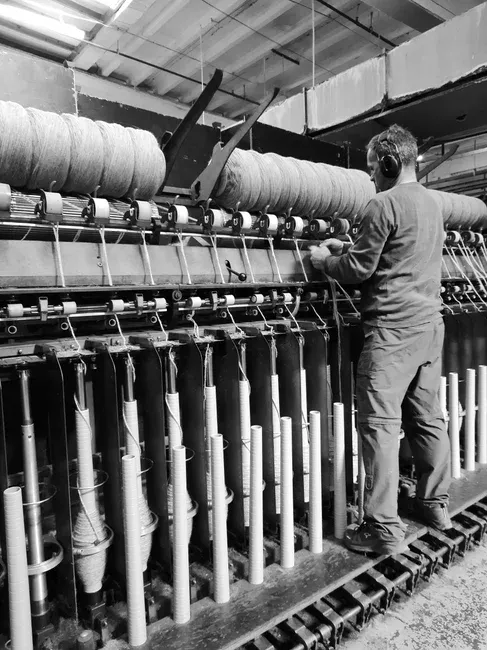
Recessed-chamber (plate-and-frame) presses operate at 6–15 bar feed pressure and produce a 25–35 mm cake at 30–40% DS — adequate for cotton/reactive mills sending cake to landfill or composting, and the lowest CAPEX option. The HydropureWater plate and frame filter press ships in this configuration and suits most biological-sludge duty. Membrane (diaphragm) presses add a secondary squeeze at 15–30 bar after the filtration cycle, mechanically compressing the cake against the recessed plate to drive out bound water. The result is 30–45% DS on cotton/reactive and 45–55% DS on polyester/disperse — a step change that matters when the cake feeds a cement kiln, a paddle dryer, or an evaporator in a ZLD train. Membrane presses also cut polymer demand by 20–30% because the mechanical squeeze recovers filtration performance that would otherwise need more flocculant (HydropureWater field data, 2025–2026).
| Parameter | Chamber (Recessed) | Membrane (Diaphragm) |
|---|---|---|
| Feed pressure | 6–15 bar | 6–15 bar feed + 15–30 bar squeeze |
| Cake thickness | 25–35 mm | 30–45 mm |
| Cake DS — cotton/reactive | 30–40% | 40–45% |
| Cake DS — polyester/disperse | 35–42% | 45–55% |
| Cycle time | 90–180 min | 60–120 min |
| Polymer demand | Baseline | 20–30% lower |
| CAPEX index (per m²) | 1.0× | 1.3–1.5× |
A 50 m² chamber press running 2 cycles/day handles about 6–10 m³ of thickened sludge; the same press in membrane configuration runs 3 cycles/day at shorter cycle times. Automatic PLC-controlled plate shifting, cloth-wash, and drip trays reduce operator exposure to reactive-dye cake and are now standard on units above 30 m² in most 2026 textile tenders.
Sizing the Filter Press for a Textile Plant
The sizing rule of thumb for textile sludge is roughly 1 m² of filter area per 8–12 kg of dry solids per cycle, with chamber presses at the higher kg/m² end (because cake is thinner and wetter) and membrane presses at the lower end (because the squeeze extracts more water per m²). For a 100 m³/d dyehouse producing 2–5 tDS/d, the math points to a 50–80 m² press running 2–3 cycles/day, depending on influent concentration and target cake dryness. Catalog range of 1–500 m² lets the same platform scale from a 50 m³/d pilot to a 5000 m³/d integrated mill, which simplifies spares and operator training. Build in 15–20% spare area over the nominal calculation to absorb reactive-dye shock loads (a 2× color spike from a red-out batch), finishing-effluent variability, and polymer optimization cycles. A more detailed mechanical and hydraulic check is covered in the filter press installation and commissioning field guide, which walks through line sizing, pump curve matching, and pressure-transmitter calibration.
Polymer Conditioning and Operating Parameters for Dye Sludge
Cationic polyacrylamide (CPAM) of medium-to-high charge density (50–70% cationicity, 8–12 million molecular weight) is the default for biological plus reactive-dye sludge because the cationic charge neutralizes the anionic dye-hydrolysate colloids. Anionic polyacrylamide (APAM) is preferred for disperse and finishing sludge, where the solids are already anionic or neutral. A automatic polymer dosing skid with a static or dynamic mixer ahead of the press keeps the dose in the 3–8 kg active polymer per ton of dry solids window, prepared as a 0.1–0.3% stock solution and aged 30–60 minutes before dosing. The Capillary Suction Time (CST) test is the operating window that ties chemistry to mechanical performance: feed CST of 60–120 seconds typically drops below 20 seconds after a well-tuned polymer dose, and any reading above 25 seconds at the press feed signals an under-dosed or charge-mismatched flocculant. Filter cloth selection is part of the operating envelope: polypropylene monofilament for reactive-dye service where acid/alkali exposure is common, polyester for high-temperature disperse lines, with cloth life running 600–1200 cycles before blinding forces rotation.
| Parameter | Recommended Range | Notes |
|---|---|---|
| CPAM dose (cotton/reactive) | 3–6 kg/tDS | 0.1–0.2% stock, age 45 min |
| APAM dose (polyester/disperse) | 4–8 kg/tDS | 0.2–0.3% stock, age 30 min |
| Feed CST target | < 20 s | From 60–120 s raw |
| Cloth material (reactive) | PP monofilament | pH 2–12 resistance |
| Cloth material (disperse) | Polyester | Up to 80 °C service |
| Cloth life | 600–1200 cycles | Rotate, do not replace single |
2026 CAPEX and OPEX for a Textile Filter Press
CAPEX for an automatic hydraulic filter press in 2026 runs $35,000–$120,000 per 50 m² of filtration area, with the spread driven by plate material (PP vs. stainless), automation level (manual plate shifting vs. full PLC with cloth-wash), and frame size (small-footprint 30 m² vs. heavy-duty 200 m²+). OPEX for a well-tuned unit breaks down as polymer 40–55%, cloth replacement 15–20%, energy 10–15%, and labor and wash-water 15–25% (HydropureWater field data, 2026). Translated to per-ton-dry-cake terms, OPEX of $4–$9/tDS on the press compares with $25–$60/tDS for hauling un-dewatered sludge, so payback on the CAPEX differential typically falls under 18 months for any mill producing more than 1 tDS/d. The ZLD tie-in is where membrane presses earn their premium: 45–55% DS cake feeds a paddle dryer or mechanical vapor recompression evaporator at below 1.2 kWh per kg of water removed, against 1.8–2.5 kWh/kg for 30% DS chamber-press cake.
| Cost Item | Chamber Press | Membrane Press |
|---|---|---|
| CAPEX per 50 m² (2026) | $35,000–$70,000 | $55,000–$120,000 |
| OPEX per tDS | $5–$9 | $4–$8 |
| Polymer share of OPEX | 45–55% | 35–45% |
| Evaporator energy (downstream) | 1.8–2.5 kWh/kg water | < 1.2 kWh/kg water |
| Payback vs. raw haulage | 12–18 months | 14–22 months |
Selection Framework: Matching Press Type to Discharge and Reuse Targets

The decision tree starts with the disposal or reuse pathway, not the press itself, because the cake dryness target is dictated by the downstream gate. For landfill disposal in a mill with stable cotton/reactive effluent, a chamber press at 30–35% DS is the lowest-CAPEX fit and passes most municipal leachate thresholds. For co-processing in a cement kiln or brick kiln, where calorific value must exceed 1500 kcal/kg DS and chloride sits below 2%, the 40–45% DS band forces a membrane press with a controlled squeeze cycle. For on-site ZLD or evaporator feed, the 45–55% DS window is mandatory to keep evaporator energy under 1.5 kWh per kg of water removed; a membrane press is the only practical route. Reading the tree end-to-end: characterize influent → set polymer dose and CST target → select plate type → confirm DS meets disposal or ZLD spec → size plate area at 8–12 kg DS per m² per cycle → add 15–20% spare area. A broader sludge dewatering equipment selection guide walks the same logic across industries and is a useful cross-check for procurement teams comparing textile bids against bids from tannery or F&B plants.
Frequently Asked Questions
What cake dryness does a chamber press deliver on cotton/reactive sludge? 30–40% DS, typically 32–36% in well-tuned operation with CPAM dose at 3–6 kg/tDS and a 90–150 minute cycle.
What cake dryness does a membrane press deliver on polyester/disperse sludge? 45–55% DS after the 15–30 bar squeeze cycle, against 35–42% DS for a chamber press on the same feed.
What polymer dose and confirmation test should a mill run? 3–8 kg of active CPAM or APAM per ton of dry solids, prepared as 0.1–0.3% stock. Confirm with a jar test and a CST target of under 20 seconds at the press feed (raw feed typically 60–120 s).
When does a membrane press beat a chamber press? When the cake feeds a cement kiln, a paddle dryer, or an evaporator in a ZLD train, because the 45–55% DS band cuts downstream energy by 30–50% and reduces polymer demand by 20–30%.
How much filter area does a 100 m³/d dyehouse need? 50–80 m² at 2–3 cycles/day for a feed of 2–5 tDS/d, with 15–20% spare area. A 50 m² membrane press running 3 cycles/day handles roughly 1.5–2.5 tDS/d.
How do you extend filter cloth life in reactive-dye service? Post-cycle wash with potable water at 2–3 bar, pH control to 6–8 between batches, scheduled rotation of cloths across plates, and replacement at 600–1200 cycles before blinding drives cycle time above target.