What Counts as a Municipal Sewage Treatment Plant in Portugal in 2026?
A municipal sewage treatment plant in Portugal in 2026 must comply with EU Urban Waste Water Directive 91/271/EEC and Portuguese Decree-Law 152/97, with BOD5 ≤25 mg/L, COD ≤125 mg/L, and TSS ≤35 mg/L for discharges to sensitive areas under PENSAARP 2030. Typical 2026 process trains combine screening, grit removal, primary clarification, biological treatment (ASP, SBR, MBBR, or MBR), and UV or chlorine disinfection, with CAPEX from €0.12M (1,000 PE) to over €36M (200,000+ PE flagship projects such as Barcelos WWTP, NORTE 2030).
Under Decreto-Lei 152/97 — Portugal's transposition of EU Directive 91/271/EEC — a municipal WWTP is defined as any facility serving an agglomeration of 2,000 population equivalents (PE) or more, with stricter monitoring and nutrient-removal obligations kicking in at 10,000 PE and again at 100,000 PE. Plants below 2,000 PE fall outside the Decree-Law's binding effluent limits but remain subject to ERSAR quality-of-service targets and APA discharge permits. The 2026 reference benchmark is the Barcelos WWTP (Rittma, July 2025): €36.2M total investment, €25.3M ERDF co-financed, listed as a PENSAARP 2030 priority, treating wastewater from one of the densest textile-valley catchments in the Cávado basin.
Influent characteristics for a typical Portuguese mixed-sewer catchment run at BOD5 200–350 mg/L, COD 400–700 mg/L, TSS 250–450 mg/L, TKN 30–60 mg/L, and TP 4–10 mg/L (typical Iberia municipal range; values consistent with AdP and ERSAR-reported utilities). Combined-sewer overflows in Lisbon, Porto, and Coimbra still produce 3–6× hydraulic peaks during sustained rainfall, which is why equalization tanks and storm-handling logic drive a large share of headworks CAPEX in Iberian tenders.
Portugal's 2026 Compliance Stack: EU Directive 91/271/EEC, Decreto-Lei 152/97 & PENSAARP 2030
EU Directive 91/271/EEC sets the binding effluent ceiling for discharges to sensitive areas, which covers most coastal and estuarine Portuguese catchments: BOD5 ≤25 mg/L, COD ≤125 mg/L, TSS ≤35 mg/L, total P ≤2 mg/L (10,000–100,000 PE) or ≤1 mg/L (>100,000 PE), total N ≤15 mg/L (10,000–100,000 PE) or ≤10 mg/L (>100,000 PE). Decreto-Lei 152/97 transposes those limits and layers on Portuguese monitoring, self-control, and reporting duties — including 24-h composite sampling and APA reporting for any plant ≥10,000 PE.
PENSAARP 2030 (Plano Estratégico de Abastecimento de Água e Gestão de Águas Residuais e Drenagem 2030) is the national investment plan that ranks which WWTPs get co-financing under Portugal 2030. It explicitly prioritizes nutrient removal, energy recovery, and water reuse — Barcelos WWTP is cited as a flagship on this basis. For a 2026 tender, PENSAARP 2030 is the document that tells you whether your project is in the funded pipeline or not.
| Parameter | EU Directive 91/271/EEC (sensitive areas) | Decreto-Lei 152/97 (PT transposition) | PENSAARP 2030 design driver |
|---|---|---|---|
| BOD5 | ≤25 mg/L | ≤25 mg/L | ≤15 mg/L for reuse |
| COD | ≤125 mg/L | ≤125 mg/L | ≤90 mg/L for reuse |
| TSS | ≤35 mg/L | ≤35 mg/L | ≤10 mg/L for reuse |
| Total N (10,000–100,000 PE) | ≤15 mg/L | ≤15 mg/L | Drives biological nutrient removal |
| Total N (>100,000 PE) | ≤10 mg/L | ≤10 mg/L | Drives biological nutrient removal |
| Total P (10,000–100,000 PE) | ≤2 mg/L | ≤2 mg/L | Drives P precipitation |
| Total P (>100,000 PE) | ≤1 mg/L | ≤1 mg/L | Drives tertiary polishing |
For tenders that touch a hospital or laboratory wastewater stream, the medical wastewater treatment system provides a reference platform certified to EU Directive 91/271/EEC limits — useful as a cross-reference when the same utility is upgrading a satellite treatment train.
Process Train: How a Modern Portuguese Municipal WWTP Is Built
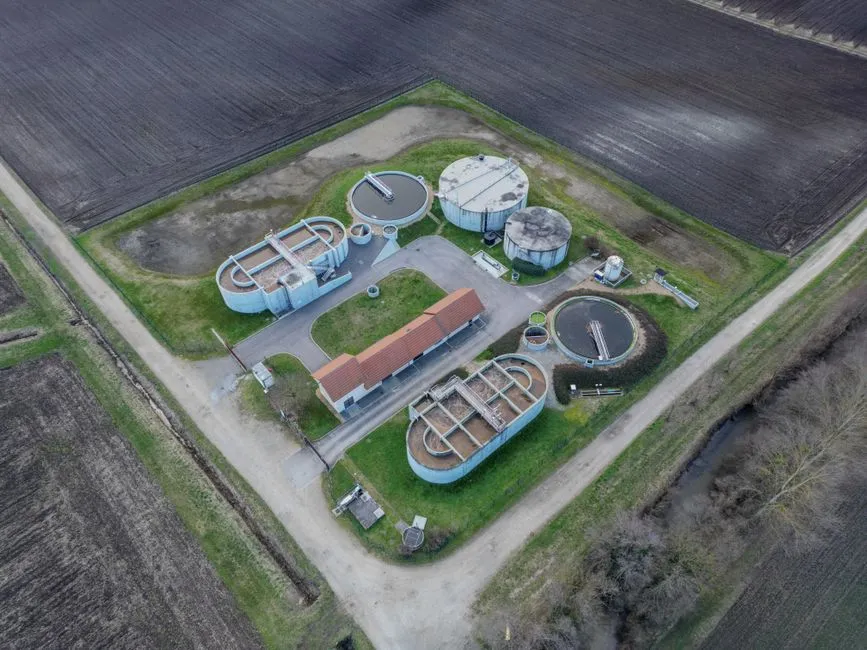
Stage 1 — Preliminary treatment. A GX-series rotary mechanical bar screen for municipal headworks with 6–10 mm aperture handles rags, wipes, and grit, followed by an aerated grit chamber sized at 15–20 m³/(m²·h) for typical Iberian mixed sewage. Stage 2 — Primary clarification uses a high-efficiency lamella clarifier for primary treatment at surface loading 20–40 m/h, removing 50–70% of TSS and 25–40% of BOD5 before the biological stage.
Stage 3 — Biological treatment is where the process decision is made (compared in the next section). Stage 4 — Tertiary polishing covers sand filtration or MBR permeate, chemical P precipitation with automatic dosing, and biological N via nitrification/denitrification. Stage 5 — Disinfection. UV is the default, but an on-site ClO2 generator for WWTP disinfection sized from 50–20,000 g/h is the lower-fouling option for plants reusing effluent or struggling with UV transmittance in the 30–50% range. Stage 6 — Sludge handling. A plate-and-frame filter press for WWTP sludge dewatering (1–500 m² chamber area) dewaters thickened sludge to ~22–25% dry solids, which keeps transport cost per ton DS inside the typical Iberian 2026 range of €110–180/ton DS.
Flow equalization sits between Stage 1 and Stage 2 in any combined-sewer catchment; sizing is normally 4–8 h of average dry-weather flow. For an integrated skid alternative in this part of the train, the Portugal-specific MBR engineering guide with 2026 cost and ROI data covers the MBR-side scope in detail.
Choosing the Right Biological Process: ASP vs SBR vs MBBR vs MBR
Process selection in a 2026 Portuguese tender is driven by three constraints: available footprint, effluent quality target (Directive 91/271/EEC vs reuse-ready), and CAPEX ceiling. The table below compares the four biological options on the parameters a tender evaluator will scrutinize.
| Process | MLSS (mg/L) | SRT (days) | Effluent BOD5/COD (mg/L) | Energy (kWh/m³) | Footprint vs CAS | CAPEX index | Best fit |
|---|---|---|---|---|---|---|---|
| ASP (conventional) | 2,000–4,000 | 5–15 | ≤25 / ≤125 | 0.3–0.6 | 1.0× | 1.0 | Greenfield, land available, ≥50,000 PE |
| SBR (batch) | 3,000–5,000 | 10–25 | ≤20 / ≤110 | 0.3–0.5 | 0.7–0.8× | 1.0–1.1 | <50,000 PE towns, variable load |
| MBBR | attached (carriers) | 5–25 | ≤25 / ≤125 | 0.3–0.6 | 0.6–0.8× | 1.0–1.2 | Retrofits, load swings, no membrane |
| MBR | 8,000–12,000 | 15–30 | ≤5 / ≤30 (reuse-ready) | 0.5–0.9 | ~0.4× | 1.4–1.8 | Space-constrained or reuse target |
Decision rule for a Portuguese tender: greenfield site with available land and lowest CAPEX target → ASP; existing tanks being repurposed or seasonal load swings → MBBR; small-to-mid towns below 50,000 PE wanting simple operation → SBR; dense urban sites, harbor districts, or any plant chasing reuse revenue under PENSAARP 2030 → MBR. The integrated MBR system for space-constrained Portuguese WWTPs paired with a DF-series PVDF flat-sheet MBR membrane module is the typical 2026 retrofit configuration; MBR effluent is consistent with Decreto-Lei 152/97 reuse thresholds without a separate sand filter. For a supplier-evaluation lens on this choice, the supplier selection framework for Southern-European WWTP tenders provides a comparable benchmark.
2026 CAPEX and OPEX Benchmarks for Portuguese Municipal WWTPs
The table below consolidates 2026 CAPEX ranges by plant size in Portugal. The upper end of the 200,000+ PE band is anchored by the Barcelos WWTP (Rittma, July 2025) at €36.2M total / €25.3M ERDF co-financed. Values are turnkey mechanical, electrical, civil-included; land cost is excluded.
| Plant size (PE) | CAPEX range (2026) | Typical process | Funding route |
|---|---|---|---|
| 1,000 | €0.12–0.4M | Package plant (SBR/ASP) | Municipal budget / CCDR |
| 5,000 | €0.6–1.5M | SBR or MBBR | Portugal 2030 (50–65% ERDF) |
| 10,000 | €1.5–3.5M | SBR or MBBR + tertiary | Portugal 2030 / NORTE 2030 |
| 50,000 | €8–18M | ASP or MBBR with N/P | Portugal 2030 / NORTE-CENTRO 2030 |
| 100,000 | €18–30M | ASP + tertiary + sludge | Portugal 2030 (priority axis) |
| 200,000+ flagship | €30–45M | ASP/MBBR + MBR polishing + reuse | NORTE 2030 / ERDF (Barcelos: €36.2M) |
OPEX for biological nutrient removal plants in Portugal runs 0.18–0.62 €/m³ in 2026, with energy at 35–50% of OPEX and sludge disposal at 15–25% (HydropureWater field data, 2026; consistent with ERSAR-reported AdP tariff ranges). OPEX is running 8–15% above 2022 baseline due to Portuguese electricity tariff escalation under the Iberian energy market redesign. Portugal 2030 / NORTE 2030 / CENTRO 2030 ERDF co-financing typically covers 50–70% of CAPEX for priority WWTPs, which is why a project's PENSAARP 2030 ranking directly drives feasibility.
Supplier & Equipment Selection Checklist for a 2026 Portugal Tender
Compliance. Confirm EN 12255-series compliance for treatment plant equipment, CE marking, and explicit reference to Decreto-Lei 152/97 monitoring requirements. Process guarantees. Insist on BOD5, COD, TSS, TN, and TP guarantees at design load and at 130% hydraulic load; reject any vendor that will not guarantee TP ≤2 mg/L (≤1 mg/L for >100,000 PE). Energy. Demand kWh/m³ at design and at average load — PENSAARP 2030 expects <0.5 kWh/m³ for plants ≥10,000 PE. Sludge. Target ≥22% dewatered cake DS, polymer dose ≤5 kg/ton DS, and a clear filter-press vs centrifuge trade-off. Aftermarket. Spare-parts lead time ≤48 h inside EU, Portuguese or Iberian service presence, and SCADA/remote-monitoring on the same control layer covered in the PLC/SCADA architecture for 2026 municipal WWTPs.
For the small-village and decentralized segment of the same tendering pipeline, the WSZ underground integrated sewage treatment package plant covers 1–80 m³/h at A/O contact-oxidation spec and meets Decreto-Lei 152/97 limits for agglomerations below 2,000 PE.
Frequently Asked Questions

What are the 2026 discharge limits for a municipal sewage treatment plant in Portugal? For plants ≥10,000 PE discharging to sensitive areas: BOD5 ≤25 mg/L, COD ≤125 mg/L, TSS ≤35 mg/L, total N ≤15 mg/L, total P ≤2 mg/L, per EU Directive 91/271/EEC transposed by Decreto-Lei 152/97. Plants >100,000 PE tighten to total N ≤10 mg/L and total P ≤1 mg/L.
MBR or ASP for a Portuguese municipal tender? Choose ASP for greenfield sites ≥50,000 PE where land is available and CAPEX is the binding constraint. Choose MBR for space-constrained urban sites or any plant chasing PENSAARP 2030-aligned water reuse, accepting 0.5–0.9 kWh/m³ and 1.4–1.8× the ASP CAPEX index.
What package plant size suits a small Portuguese village? The WSZ underground integrated package plant (1–80 m³/h, A/O contact oxidation) covers agglomerations below 2,000 PE and meets Decreto-Lei 152/97 monitoring at 0.12–0.4M€ CAPEX for the 1,000 PE class.
Who pays for sludge disposal? The WWTP operator — typically the municipality or a concessionaire (AdP, Águas do Norte, SIMARSUL) — is responsible under Decreto-Lei 276/2009 for transport and final disposal. Plan for €110–180/ton DS at 22–25% dry solids after a plate-and-frame filter press.
When does a Portuguese WWTP need a reuse permit? Any discharge to a third-party reuse scheme (irrigation, industrial reuse, aquifer recharge) requires an APA reuse permit under Lei 58/2005 and Decreto-Lei 119/2019. Effluent targets tighten to TSS ≤10 mg/L and BOD5 ≤15 mg/L — typically requiring MBR or sand-filter + UV polishing.