2026 Slaughterhouse Wastewater Discharge Limits: US, EU, China & India Compared
Slaughterhouse wastewater discharge standards in 2026 set strict numeric limits on BOD (≤30 mg/L EU/China, ≤25 mg/L EPA poultry products), COD (≤125 mg/L China, ≤100 mg/L CPCB India), total suspended solids (≤30–60 mg/L), total nitrogen (≤103 mg/L EPA poultry monthly max), oil and grease (≤10–15 mg/L), and fecal coliform (≤400 MPN/100 mL). A treatment train of DAF → biological (MBBR or MBR) → ClO₂/UV disinfection reliably achieves these limits at 50–2,000 m³/day flows, and that is the single spec most plants are buying against this year. Penalties for non-compliance in 2026 range from $10,000/day administrative orders under the US Clean Water Act to immediate operating-license suspension in EU member states and China, which is why every parameter below has an engineering owner in the treatment train.
| Parameter | US EPA (2004 ELG, 40 CFR 432) | EU (UWWTD 91/271/EEC + 2024 revision) | China GB 13457-2024 | India CPCB (Jun 2026) |
|---|---|---|---|---|
| BOD₅ | ≤26 mg/L daily max, ≤30 mg/L 30-day avg (poultry) | ≤25 mg/L (sensitive areas) | ≤30 mg/L | ≤30 mg/L (per CPCB Jun 27 2026) |
| COD | ≤150 mg/L (poultry) | ≤125 mg/L | ≤125 mg/L | ≤100 mg/L |
| TSS | ≤43 mg/L daily max, ≤50 mg/L 30-day avg (poultry) | ≤35–60 mg/L | ≤60 mg/L | ≤30 mg/L (proposed tightening) |
| O&G (FOG) | ≤15 mg/L (poultry) | ≤10 mg/L (sensitive areas) | ≤15 mg/L | ≤10 mg/L |
| Total Nitrogen | ≤103 mg/L monthly max (poultry) | ≤15 mg/L (2024 revision for plants >1,000 m³/day) | ≤40 mg/L | ≤50 mg/L |
| Fecal Coliform | ≤400 MPN/100 mL (any time) | ≤200 CFU/100 mL (recreational waters) | ≤1,000 MPN/100 mL (GB 8978) | ≤400 MPN/100 mL |
Two 2026 tightening drivers to flag: the EU's revised Urban Wastewater Treatment Directive (Directive 2024/3019) added stricter N and P limits for agglomerations above 1,000 m³/day, and China revised GB 8978-2025 with total phosphorus ≤1.0 mg/L in sensitive lake and river basins. Both standards take effect in 2026, so a plant specced to old 2018 limits will be non-compliant within 12 months.
Why Slaughterhouse Effluent Is Uniquely Hard to Treat
Slaughterhouse wastewater is not a generic food-processing stream — it is a high-strength, four-fraction mixture that swings harder than almost any other industrial effluent. A typical beef or pork kill floor produces BOD in the 1,500–2,500 mg/L range, COD 3,000–6,000 mg/L, TSS 800–2,000 mg/L, O&G 200–800 mg/L, and total nitrogen 150–300 mg/L (per Australian Meat Processing Industry review, May 2017, ScienceDirect). Those numbers are 5–10× higher than municipal sewage, and the variability is the real problem: blood and paunch discharges arrive in slug loads, not steady flow.
| Stream Fraction | Typical BOD (mg/L) | Dominant Pollutants | Handling Approach |
|---|---|---|---|
| Blood water (bleed tunnels) | 20,000–60,000 | Protein-bound nitrogen, BOD | Segregated capture, often coagulated separately |
| Paunch/manure contents | 5,000–15,000 | Cellulose, undigested feed, pathogens | Solid separation first (bar screen / DAF) |
| Fat trimmings / FOG | 800–2,000 | Emulsified fats, suspended globules | DAF with coagulant + flocculant |
| Floor & carcass wash water | 500–1,500 | Dilute blood, grit, hair | Equalization + biological |
| Combined raw effluent | 1,500–2,500 | All of the above | Full treatment train |
The CPCB effluent discharge snippet (dated Jun 27 2026) describes the dominant TSS contributors as blood clots, fat globules, intestinal contents, and bone particles — each behaves differently in a clarifier or DAF cell, which is why a single settling step will not meet 30–60 mg/L TSS. Pathogen load is equally severe: fecal coliform routinely exceeds 10⁶ MPN/100 mL in raw effluent, so a downstream disinfection step is non-negotiable for surface water discharge. The combined effect is a stream that fouls membranes quickly, hammers biological kinetics with FOG shocks, and carries enough organic nitrogen to push effluent TN above 50 mg/L if nitrification is not engineered deliberately.
The Standard Treatment Train: DAF → Biological → Disinfection
Five unit operations cover the parameter map in 2026, and each one owns a specific discharge limit. Skipping or undersizing any stage guarantees a compliance gap.
Stage 1 — Coarse screening. A GX rotary bar screen at 2–6 mm aperture removes hair, bone fragments, and paunch solids before they hit pumps or membranes. This is not a discharge-parameter stage, but it is the unit that keeps the rest of the train alive during kill-floor surges.
Stage 2 — Dissolved Air Flotation (DAF). This is the FOG and TSS workhorse. Field data on slaughterhouse DAF units shows 80–95% O&G removal and 60–90% TSS removal at hydraulic capacities of 4–300 m³/h, with chemical dosing of PAC (polyaluminum chloride) 50–150 mg/L and anionic PAM 1–3 mg/L (per ResearchGate DAF performance table, 2017 Australian meat processing review). A DAF system sized at 20–30% of peak hourly flow is the standard configuration; air-to-solids ratio of 0.02–0.05 is the operating window.
Stage 3 — Equalization and pH adjustment. Slaughterhouse effluent pH swings between 5 and 11 across a kill cycle, and flow can vary 3–4× between active hours and clean-down. An EQ tank sized at 8–12 hours of average flow with mechanical mixing and CO₂/dosing trim is mandatory ahead of the biological stage.
Stage 4 — Biological: MBBR or MBR. Both target the residual BOD/COD/TN after DAF. MBBR achieves BOD <30 mg/L at HRT 6–10 hours and tolerates load swings better, while MBR delivers BOD <10 mg/L and TSS <5 mg/L in a smaller footprint with a UF membrane module. A packaged HydropureWater MBR integrated system at 10–2,000 m³/day covers the mid-size plant band that most new slaughterhouse builds in 2026 fall into. For a deeper dive on MBBR engineering specifics, see the MBBR design for meat processing wastewater 2026 guide.
Stage 5 — Disinfection. To hit fecal coliform ≤400 MPN/100 mL, a ClO₂ generator at 2–5 mg/L residual for 30 minutes contact time is preferred over NaOCl because ClO₂ is more effective at high TSS and does not form trihalomethanes. UV at 40 mJ/cm² is an alternative for plants targeting water reuse.
Process Comparison: MBBR vs MBR for Meat Processing Biological Stage
For a procurement lead comparing CAPEX, the MBBR vs MBR decision is the single biggest call. Both outperform conventional activated sludge by 60% on footprint; the differentiator is reuse, not BOD removal.
| Criterion | MBBR | MBR |
|---|---|---|
| Effluent BOD | 20–30 mg/L | <10 mg/L |
| Effluent TSS | 20–40 mg/L | <5 mg/L |
| CAPEX (installed) | $150–$600 per m³/day | $400–$1,200 per m³/day |
| OPEX (energy) | 0.5–0.8 kWh/m³ | 1.0–1.8 kWh/m³ |
| Load swing tolerance | High (biofilm buffer) | Moderate (membrane fouling risk) |
| Water reuse potential | Limited | High — pairs with RO for 75–95% recovery |
| Best fit | <500 m³/day, no reuse | >500 m³/day or reuse target |
The DF-series MBR module and packaged skid versions of either system are both common. Decision rule from field projects: choose MBBR when flow is under 500 m³/day and the discharge point is a municipal sewer with no reuse mandate; choose MBR when flow is above 500 m³/day, plant is in a water-stressed region, or the EHS team has a reuse target locked into the permit. CAPEX differential of $250–$600 per m³/day typically pays back inside 3–5 years through reduced freshwater purchase and sewer discharge fees in water-scarce regions.
2026 CAPEX & OPEX Benchmarks for a Compliant Slaughterhouse Plant
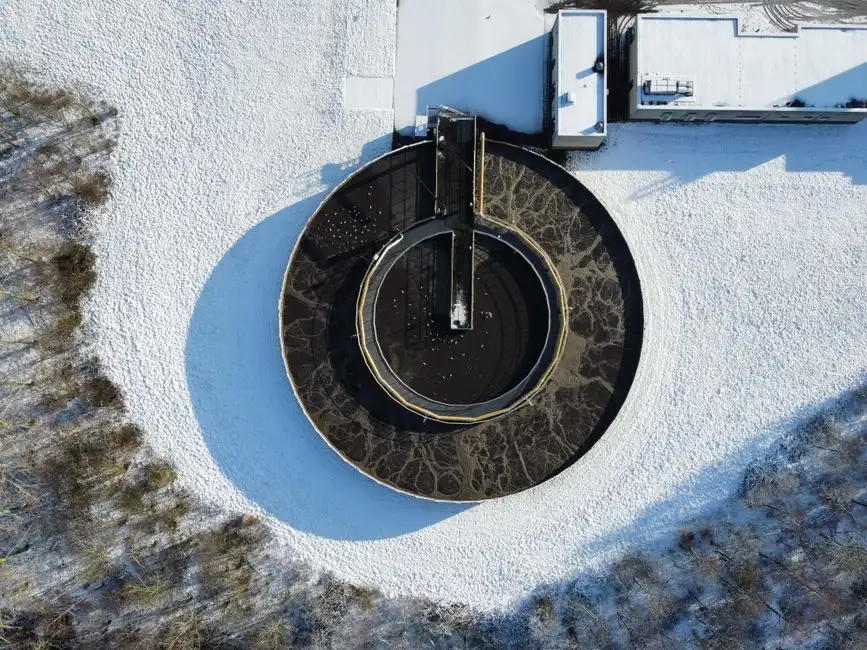
Budget numbers procurement leads can quote against: a complete DAF + biological + disinfection train for a 50–2,000 m³/day slaughterhouse runs $80,000–$1,200,000 installed (HydropureWater 2026 skid-mounted turnkey data), with most 200–500 m³/day mid-size plants landing in the $250,000–$550,000 band. That figure includes civil works allowance, instrumentation, and commissioning.
| Cost Driver | 2026 Range (USD) | Notes |
|---|---|---|
| Total treatment train CAPEX | $80,000–$1,200,000 | Scales with flow and MBR vs MBBR choice |
| OPEX (per m³ treated) | $0.25–$0.85 | Chemicals + energy + sludge hauling |
| Sludge dewatering (plate press) | $15,000–$150,000 | Scales with filter area; cake 25–30% DS |
| Sludge hauling | $40–$130 per ton wet | Industry benchmark, 2026 |
| Energy — DAF | 0.3–0.5 kWh/m³ | Saturation pump dominant |
| Energy — MBBR | 0.5–0.8 kWh/m³ | Aeration dominant |
| Energy — MBR | 1.0–1.8 kWh/m³ | Membrane air scour adds 0.3–0.5 kWh/m³ |
Sludge management is the second budget line item and the easiest to under-spec. A HydropureWater plate-and-frame filter press producing 25–30% dry solids cake is standard for 50–500 m³/day plants, with chemical conditioning by an automatic polymer dosing system at 0.2–0.5% dry solids polymer addition. For higher-throughput operations comparing alternatives, the screw press for meat processing wastewater pricing 2026 comparison is worth pulling into your RFQ. PLC-based monitoring of pH, DO, and flow is no longer optional in 2026 — most jurisdictions require continuous effluent telemetry; the PLC control for food processing wastewater plants 2026 guide covers the architecture and I/O list.
Frequently Asked Questions
What is the fecal coliform limit for slaughterhouse discharge in 2026? US EPA 2004 ELG sets ≤400 MPN/100 mL at any time for poultry products (40 CFR 432.12), China GB 8978-2025 allows ≤1,000 MPN/100 mL, and India CPCB matches EPA at ≤400 MPN/100 mL. The strictest standard is the EU recreational-water limit at ≤200 CFU/100 mL, which applies to plants discharging near bathing waters.
Which plants does the EPA 2004 ELG actually cover? The 2004 Effluent Limitations Guidelines apply to poultry, beef, and pork processors discharging more than 250,000 gallons per day (≈950 m³/day). EIP's 2024 review of 98 direct-discharge plants found flows from 250,000 to 5,300,000 gal/day (≈950 to 20,000 m³/day) — that is the band the standard was written for, and most mid-size plants in 2026 sit inside it.
What is the current China slaughterhouse standard? GB 13457-2024 supersedes the 1996 version and is the controlling standard for abattoir effluent discharge to municipal sewers; the 2025 GB 8978 revision tightens TP to ≤1.0 mg/L in sensitive basins. A 2026 plant spec should reference GB 13457-2024, not the 1996 number, when bidding into Chinese supply chains.
Can slaughterhouse wastewater be reused on-site? Yes. MBR effluent paired with RO polishing achieves 75–95% RO recovery and supports on-site reuse for wash-down, boiler feed, and landscape irrigation. Capital cost is higher ($400–$1,200/m³ for the MBR stage alone), but payback in water-stressed regions is typically 3–5 years.
How is slaughterhouse sludge handled? Slaughterhouse sludge is high-protein (4–6% N on dry basis) and is well-suited to anaerobic digestion with biogas yield of 0.25–0.40 m³/kg VS. For plants without AD, a plate-and-frame filter press dewatered to 25–30% DS is the standard disposal form for off-site rendering or landfilling.