Why Turkmenistan's Municipal Sewage Plants Need Arid-Climate Engineering
The EGESIS Turkmenbashi international harbor WWTP, completed as an integrated port-municipal facility, is the most recent documented municipal-scale wastewater project in the country and proves the buildability of mid-capacity plants in Turkmenistan. What it does not prove is that a 20,000 m³/day plant designed to European defaults will work. Karakum Canal water, at roughly 13 km³/yr the only large reuse source in the country, carries TDS historically measured at 400–700 mg/L and rising past 1,000 mg/L in the lower Mary and Dashoguz reaches; sewage blending into the canal system must therefore meet a TDS ≤1,000 mg/L ceiling or be discharged to desert drainages under different compliance rules. Climate imposes design constraints the European template ignores: open-water evaporation of 1,500–2,000 mm/yr shrinks any uncovered aeration basin, ambient peaks of 40–45°C in July–August push aeration tower performance off its catalog curve, and sewage itself sits at 22–25°C in summer and 10–14°C in winter, narrowing the safety margin for nitrification. Ashgabat's metro area passed 1 million population in the last census cycle, and the legacy 5,000–15,000 m³/day plants cannot be stretched to the 20,000–50,000 m³/day tier the next decade will require; the engineering gap is sizing, not feasibility. For a regional CAPEX/OPEX comparison in the same arid-climate band, see the Tabriz wastewater treatment plant cost 2026 reference.
Influent and Effluent Design Parameters for Turkmen Municipal Sewage
Designers working in Ashgabat, Turkmenbashi, Mary, and Dashoguz should size to a single municipal influent envelope: BOD 200–350 mg/L, COD 400–600 mg/L, TSS 250–400 mg/L, NH₄-N 30–50 mg/L, TN 40–60 mg/L, TP 5–10 mg/L, pH 7.0–8.2, and sewage temperature 10–25°C across the seasonal swing. Peak hourly peaking factors run 1.8–2.2 for cities under 200,000 population, dropping to 1.5–1.7 for Ashgabat-class networks with larger collection catchments and better diurnal damping. Two compliance pathways govern effluent design. The first is Karakum Canal reuse, which sets a hard TDS ≤1,000 mg/L ceiling alongside BOD ≤15 mg/L, COD ≤80 mg/L, TSS ≤30 mg/L, and NH₄-N ≤5 mg/L; the second is inland surface discharge to desert drainages, which is conventionally referenced against EU Directive 91/271/EEC thresholds (BOD ≤25 mg/L, COD ≤125 mg/L, TSS ≤35 mg/L for sensitive discharges) but typically runs more leniently under national sanitation norms. TDS is the differentiator that decides pathway eligibility: sewage entering plants in Mary and Dashoguz often arrives at TDS 800–1,200 mg/L because of groundwater infiltration into aging vitrified clay sewers, and any reuse obligation above the 1,000 mg/L ceiling forces either a blending strategy with canal water or pretreatment-stage reverse osmosis, both of which reshape the CAPEX conversation.
| Parameter | Influent design | Karakum Canal reuse limit | Inland discharge (per EU 91/271/EEC) |
|---|---|---|---|
| BOD | 200–350 mg/L | ≤15 mg/L | ≤25 mg/L |
| COD | 400–600 mg/L | ≤80 mg/L | ≤125 mg/L |
| TSS | 250–400 mg/L | ≤30 mg/L | ≤35 mg/L |
| NH₄-N | 30–50 mg/L | ≤5 mg/L | — |
| TN | 40–60 mg/L | — | ≤15 mg/L (sensitive zones) |
| TP | 5–10 mg/L | — | ≤2 mg/L (sensitive zones) |
| TDS | 400–1,200 mg/L | ≤1,000 mg/L | — |
| pH | 7.0–8.2 | 6.5–8.5 | — |
| Temperature | 10–25°C | — | — |
Process Selection: MBR vs SBR vs Conventional Activated Sludge
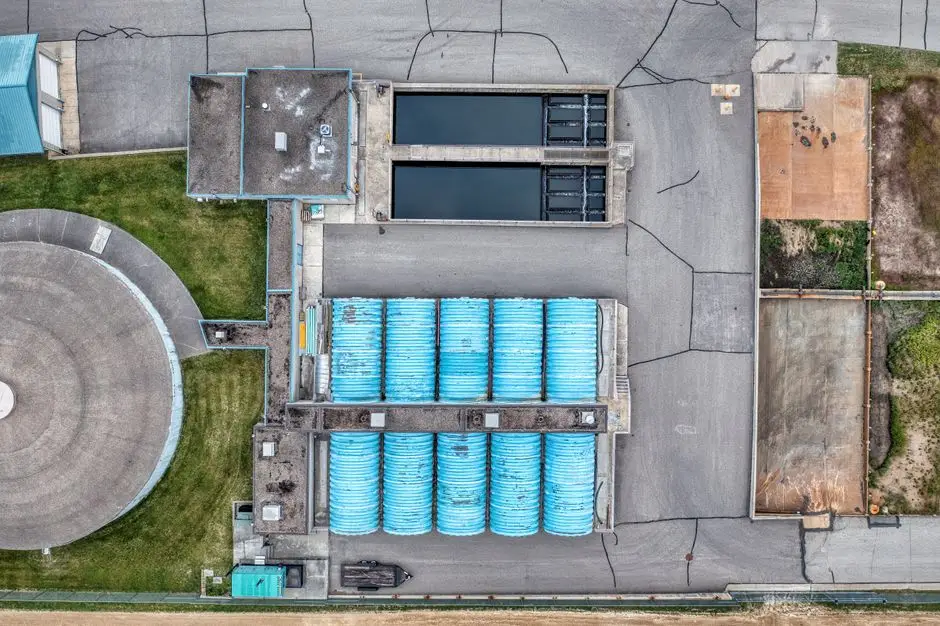
Three process trains are realistic for the 5,000–50,000 m³/day band in Turkmenistan: MBR, SBR (frequently specified as CASS in Central Asia EPC documentation), and conventional A²/O with secondary clarification. MBR is the smallest-footprint option at 0.15–0.25 m² per m³/day, delivers effluent BOD under 5 mg/L, runs at sludge yield 0.25–0.35 kg TSS per kg BOD removed, costs US$350–450 per m³/day in CAPEX and US$0.09–0.13/m³ in OPEX, and is the only train that reliably holds TDS-tolerant nitrification at summer sewage temperatures above 22°C. SBR (CASS) is the budget choice: footprint 0.35–0.50 m² per m³/day, effluent BOD 15–25 mg/L, sludge yield 0.4–0.5 kg/kg, CAPEX US$220–300 per m³/day, OPEX US$0.05–0.08/m³. Conventional A²/O with a secondary clarifier is the largest-footprint train at 0.45–0.60 m² per m³/day, gives effluent BOD 20–30 mg/L at sludge yield 0.45–0.55 kg/kg, and runs CAPEX US$200–270 per m³/day with OPEX US$0.06–0.09/m³; its size rules it out for Ashgabat-area sites where land carries premium pricing, and it should be reserved for sub-10,000 m³/day plants with confirmed desert-drainage discharge. The selection rule: MBR for any plant with a reuse obligation, a footprint constraint, or influent TDS approaching 1,000 mg/L; SBR for budget-constrained tenders where BOD-only compliance is contractually sufficient; A²/O only where land is cheap and discharge to desert drainages is contractually secure. A packaged MBR membrane bioreactor system is the most frequently specified train in current Turkmenistan EPC tenders above the 10,000 m³/day threshold.
| Criterion | MBR | SBR (CASS) | Conventional A²/O |
|---|---|---|---|
| Footprint (m²/m³/day) | 0.15–0.25 | 0.35–0.50 | 0.45–0.60 |
| Effluent BOD (mg/L) | <5 | 15–25 | 20–30 |
| Sludge yield (kg/kg BOD) | 0.25–0.35 | 0.40–0.50 | 0.45–0.55 |
| CAPEX (US$/m³/day) | 350–450 | 220–300 | 200–270 |
| OPEX (US$/m³) | 0.09–0.13 | 0.05–0.08 | 0.06–0.09 |
| TDS tolerance | High | Moderate | Moderate |
Headworks, Pre-Treatment, and Sludge Handling for Turkmen Plants
Upstream of the biological stage, Turkmen sewage carries 30–50% more inorganic grit than European averages because of sandy-soil infiltration and street wash during dust events; fine screening at 3–6 mm with a rotary mechanical bar screen is the minimum viable headworks specification. For plants receiving mixed industrial-municipal flow — relevant in Turkmenbashi (refinery, petrochemical port) and Mary (textile, fertilizer) — a DAF pre-treatment stage ahead of the bioreactor removes emulsified oils and floatable solids that would otherwise foul membranes and disrupt SBR cycle timing. Aerated grit chambers sized at 2–3 minute retention deliver 90–95% sand removal at peak flow, which is the correct target for a downstream MBR that cannot tolerate grit breakthrough into the membrane tank. Primary sedimentation should use a high-efficiency sedimentation tank with lamella plates running at 20–40 m/h surface loading rate, achieving roughly 30% chemical consumption reduction versus a conventional clarifier. Sludge dewatering is the downstream bottleneck: a plate and frame filter press with 1–500 m² filtration area produces 22–28% DS cake, fits the 20,000 m³/day class with multiple units in parallel, and is the dewatering standard in current Central Asia tender documents.
2026 CAPEX and OPEX Benchmarks for a Turkmenistan WWTP
For a 20,000 m³/day plant in 2026, MBR CAPEX benchmarks at roughly US$7.0M, SBR (CASS) at US$4.4M, and conventional A²/O at US$3.8M; the same processes at 5,000 m³/day run US$2.0M, US$1.3M, and US$1.1M respectively, scaling to US$17.5M, US$10.8M, and US$9.5M at 50,000 m³/day. OPEX for an MBR plant breaks down as energy 45–55%, labor 15–20%, chemicals 8–12%, sludge disposal 10–15%, and membrane replacement 5–8%, with the latter line item being the structural difference versus SBR or A²/O which carry no membrane replacement burden. Add 15–20% contingency for logistics in Dashoguz and Mary, where overland equipment transport from Ashgabat or the Caspian port adds US$80,000–150,000 against an Ashgabat build; this is a hard line item, not a soft allowance. For digesters and aeration basins, GLS bolted steel tanks (18,000 m³ equivalent units have shipped to Central Asia) offer a 20–30% CAPEX reduction against poured RCC construction, provided the epoxy coating is rated for the 40–45°C summer ambient. Chemical dosing for nutrient polishing should be specified as an automatic chemical dosing system sized to the TP removal demand of 5–10 mg/L influent. All figures are 2026 USD on a turnkey EPC basis, excluding land acquisition and grid-connection upgrades.
| Capacity (m³/day) | MBR CAPEX | SBR CAPEX | A²/O CAPEX |
|---|---|---|---|
| 5,000 | ~US$2.0M | ~US$1.3M | ~US$1.1M |
| 10,000 | ~US$3.8M | ~US$2.4M | ~US$2.0M |
| 20,000 | ~US$7.0M | ~US$4.4M | ~US$3.8M |
| 50,000 | ~US$17.5M | ~US$10.8M | ~US$9.5M |
Supplier Evaluation Checklist for Turkmenistan EPC Procurement
Six criteria separate credible bidders from the rest in Turkmenistan municipal tenders. (1) Central Asia or CIS project reference within the last 5 years, with operational handover documentation in Russian or Turkmen; (2) process-specific track record in MBR or the nominated train, with at least three operating references above 10,000 m³/day; (3) bilingual engineering documentation in Russian and English, including P&IDs, GA drawings, and O&M manuals; (4) commissioning support physically present in Ashgabat or Turkmenbashi, not remote-expat; (5) 24-month spare parts commitment with bonded stock in-country; (6) containerized or skid-mounted options for remote sites where civil-build permits are delayed. The EGESIS Turkmenbashi precedent is the standard for harbor-integrated municipal EPC delivery in the country and the closest analogue to a current 20,000 m³/day tender. A common procurement pitfall: containerized package plants are often rated to 40°C ambient, and the Mary and Dashoguz 45°C summer peaks require a documented derating or an insulated enclosure, which bidders rarely include in base pricing. Disinfection should be specified as a ClO₂ disinfection generator sized from 50 g/h up to 20,000 g/h, with on-site generation to avoid the chlorine transport restrictions that complicate desert logistics. For remote sub-10,000 m³/day sites, an integrated underground sewage treatment package with buried bioreactor is a defensible alternative.
Frequently Asked Questions
Which is better for a 20,000 m³/day plant in Turkmenistan — MBR or SBR? MBR is the correct choice when the plant has a Karakum Canal reuse obligation, site footprint is constrained, or influent TDS runs 800–1,200 mg/L; it delivers effluent BOD under 5 mg/L, occupies 0.15–0.25 m² per m³/day, and costs US$7.0M CAPEX in 2026 USD. SBR is defensible only when reuse is off the table and BOD-only compliance is contractually sufficient, cutting CAPEX to roughly US$4.4M.
What are the Karakum Canal reuse limits for treated sewage in 2026? Karakum Canal reuse requires TDS ≤1,000 mg/L, BOD ≤15 mg/L, COD ≤80 mg/L, TSS ≤30 mg/L, and NH₄-N ≤5 mg/L; plants in Mary and Dashoguz with influent TDS above 800 mg/L will not meet the TDS ceiling without blending or RO pretreatment, and should default to discharge-to-desert-drainage permitting instead.
What is the 2026 CAPEX for a 20,000 m³/day municipal WWTP in Turkmenistan? Turnkey EPC CAPEX in 2026 USD benchmarks at US$7.0M for MBR, US$4.4M for SBR (CASS), and US$3.8M for conventional A²/O, before a 15–20% logistics contingency for non-Ashgabat sites and excluding land plus grid-connection costs.
How is sludge handled in arid-climate Turkmenistan WWTPs? Mechanical dewatering with plate and frame filter presses producing 22–28% DS cake is the standard; the cake is either sent to engineered landfill or co-fired in cement kilns at Mary and Balkanabat, with no ocean-outfall option and limited agricultural reuse due to the 1,500–2,000 mm/yr evaporation-driven salinity buildup.
Containerized or civil-build delivery — which fits a Turkmenistan tender? Containerized package plants fit 500–5,000 m³/day remote sites with compressed timelines, but require documented 45°C ambient derating for Mary and Dashoguz; civil-build delivery is mandatory above 10,000 m³/day, where buried bioreactors or RCC basins with GLS bolted-steel digesters are the standard 2026 configuration.