Why EV Battery Manufacturing Wastewater Breaks Conventional Treatment
EV battery zero liquid discharge has shifted from an option to a specification requirement because cell and cathode active material (CAM) plants produce a wastewater matrix that conventional biological and single-pass RO trains were never designed to handle. A 50 GWh gigafactory generates 2,500–3,500 m³/day of mixed effluent split across four streams: NMP (N-methyl-2-pyrrolidone) condensate from electrode coating dryers, cathode precursor washwater loaded with Ni/Co/Mn/Li salts at 500–5,000 mg/L, electrolyte-mixing scrubber water, and formation/aging wastewater containing LiPF6 hydrolysis products.
Fluoride is the contaminant that disqualifies biology. Electrolyte-derived wastewater carries F⁻ at 1,500–2,500 mg/L — 30–50x the ~50 mg/L threshold at which activated sludge and MBR biomass lose activity. MBR alone cannot do the job. NMP at 2,000–10,000 mg/L is biodegradable but slow (40–60 day HRT) and chemically valuable at $4–6/kg recovered, so the design bias is toward recovery, not oxidation. Lithium, cobalt, and nickel salts sit at concentrations 10–100x typical industrial brine, putting generic ZLD economics under stress.
Demand context is now structural. The IEA's 2024 Global EV Outlook baseline projects lithium-ion demand above 2,000 GWh by 2030, with 40+ new gigafactories in planning or construction by 2026 — each requiring a ZLD system before first production runoff. The Springer 2021 four-process ZLD comparison (Able et al., Clean Technologies and Environmental Policy, 2021) remains the academic baseline for thermal brine trains, but it models seawater and oilfield brines with no F⁻ or NMP. Battery plants need a customized train: chemical precipitation front-end, two-pass RO, MVR/MEE evaporation, and forced-circulation crystallization producing NaCl/Li₂CO₃-grade solids at ≥98% purity. For technology context, see the broader 2026 industrial wastewater treatment market and compliance outlook.
2026 Process Flow: The Five-Stage ZLD Train for Battery Plants
The defensible 2026 process flow for an EV battery ZLD system is a five-stage train that takes raw cell/CAM plant effluent from the equalization basin to dry salt stack with 95–99% water recovery and 0 m³/day liquid discharge. Each stage has a specific load reduction target; the numbers below are the sizing basis for a 3,000 m³/day plant.
| Stage | Unit Operation | Inlet / Outlet Key Parameters | Design Target |
|---|---|---|---|
| 1 | Equalization + HydropureWater DAF system | TSS 200–800 mg/L → <30 mg/L; oil <5 mg/L; graphite and PVDF binder removed | Flow balance ±10%; 4–300 m³/h per DAF unit |
| 2 | Chemical precipitation (lime/CaCl₂) + HydropureWater MBR system polish | F⁻ 2,000 mg/L → <50 mg/L; COD 800–1,500 mg/L → <60 mg/L | CaF₂ sludge to filter press; MBR as COD polish, not fluoride workhorse |
| 3 | Two-pass RO with HydropureWater industrial RO system | Recovery 75–85% (BWRO) + high-pressure pass at 80–90 bar | Combined recovery up to 95% per published HydropureWater RO specification; permeate conductivity <50 µS/cm |
| 4 | MVR mechanical vapor recompression evaporator | 5–25 wt% TDS → 25–30 wt% TDS concentrate | 60–70% steam reduction vs MEE; specific steam 0.02–0.05 kg/L evaporated |
| 5 | Forced-circulation crystallizer + ATFD | 30–50 wt% slurry → dry salts <0.5% moisture | ≥98% NaCl/Li₂CO₃-grade purity; 4–8 h residence; seeded slurry |
Mass balance for a 50 GWh plant: 3,000 m³/day influent compresses to 30–80 m³/day wet solids and zero liquid discharge. The Nature Communications 2021 solar crystallizer field result of 48.0 kg/m²/day (Zhang et al., Nat. Commun., 2021) is the energy-efficiency benchmark driving new hybrid MVR-solar designs in 2026 RFPs, though solar alone still cannot meet year-round duty in northern gigafactory sites (Shanxi, Saxony, Nevada). The full train mirrors the hybrid architecture described in the Silicon Wafer Wastewater Treatment 2026 hybrid process design and ZLD cost breakdown, adapted for battery-specific contaminants.
Equipment Selection: MVR vs MEE vs ATFD for Battery Brine
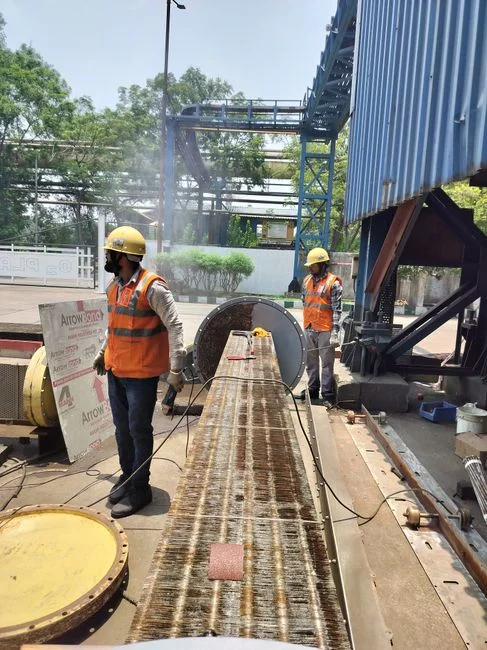
Choosing the thermal train is the single largest CAPEX/OPEX decision in a battery ZLD design. The decision is driven by brine TDS profile, electricity price, and whether lithium/NMP recovery is in scope.
| Parameter | MVR | MEE (3–6 effects) | ATFD (agitated thin film dryer) |
|---|---|---|---|
| Best feed TDS range | 5–25 wt% | 3–20 wt% | 30–50 wt% (final concentrate) |
| Specific steam/energy | 0.02–0.05 kg steam per L evaporated | 0.15–0.30 kg steam per L | 1.2–1.8 kWh per kg water evaporated |
| OPEX vs MVR (per m³) | Baseline | +20–30% | N/A — used only as polisher |
| F⁻ and NMP fouling tolerance | Moderate; needs anti-foul metallurgy | High; easier to clean | Very high; short residence |
| Power requirement | Stable electricity <$0.06/kWh preferred | Steam plant (gas/biomass) preferred | Electric; tolerates intermittent power |
| Capital intensity | Higher (compressor, titanium tubes) | Moderate | Lower per unit, but adds to train |
| Recommended metallurgy for F⁻ | Titanium Gr.2 or Duplex 2205 | Rubber-lined carbon steel acceptable | Duplex 2205 |
Operating rule for 2026 designs: MVR is the workhorse for stable 5–25 wt% brine at sites with electricity below $0.06/kWh; MEE is the fallback for variable feed or steam-rich sites; ATFD handles the final 30–50 wt% pasty concentrate and produces free-flowing salts at <0.5% moisture. A forced-circulation crystallizer with seeded slurry, 4–8 hour residence, and 98%+ purity is required whenever NaCl or Li₂CO₃ is the targeted product. The reference equipment package — forced-circulation evaporator, ATFD, and wiped-film evaporator (WFE) for NMP recovery — is documented in the Top 5 vendor's equipment train.
2026 CAPEX and OPEX Benchmarks per m³/day Capacity
Procurement teams need a defensible cost envelope before issuing RFQs. The 2026 numbers below are turnkey installed prices for a complete five-stage ZLD train including civil works, instrumentation, and commissioning.
| Capacity | Region | Turnkey CAPEX (USD) | OPEX (USD/m³ treated) | Value-Recovery Offset |
|---|---|---|---|---|
| 500 m³/day (10 GWh plant) | China / EU | $4M–$9M | $1.8–$2.6 | NMP + Li₂CO₃ credits: 20–35% |
| 3,000 m³/day (50 GWh plant) | China / EU | $8M–$18M | $2.0–$3.2 | 25–40% net OPEX reduction |
| 3,000 m³/day (50 GWh plant) | North America | $14M–$25M (40–60% premium for labor, UL/CE) | $2.4–$3.6 | Same offsets, higher absolute savings |
| 10,000 m³/day (200 GWh mega-plant) | China / EU | $25M–$55M (economies of scale) | $1.6–$2.4 | 30–45% net OPEX reduction |
OPEX is dominated by electricity (45–55%), chemicals (15–20%, antiscalant and CaCl₂), labor (10–15%), and consumables including membrane replacement every 3–5 years. Two value-recovery lines change the equation: NMP reclamation at $4–6/kg can cut net OPEX by 25–40% on plants processing more than 50 tons/day of electrode coating, and lithium recovery from cathode washwater at LiOH/Li₂CO₃ spot prices of $13–22/kg (2026) can generate $2M–$5M annual revenue from a 50 m³/day Li-bearing stream. Cost of inaction is now material: combined water purchase and wastewater surcharges in water-stressed hubs (Shanxi, Nevada, Saxony) reach $4–$8/m³, putting ZLD break-even at 4–7 years before lithium credits are counted. Solids handling from the precipitation and crystallizer stages is sized using a HydropureWater plate and frame filter press for the CaF₂ cake and a HydropureWater chemical dosing system for lime and antiscalant control. For ROI modeling on the resource-recovery side, the 2026 resource recovery technologies and ROI benchmark is the working reference.
2026 Compliance Matrix: EU, China, and US Discharge & Reuse Rules
A ZLD design must be defensible against three regulatory regimes simultaneously. The matrix below maps the binding 2026 limits to the ZLD train's actual output.
| Regulation | Scope | Key Parameter | Limit | ZLD Train Performance |
|---|---|---|---|---|
| EU Battery Regulation 2023/1542 | EV batteries placed on EU market from 2027 | Carbon-footprint declaration; water-stress-based recycling efficiency | Quantitative water footprint disclosure | 95–99% reuse data is direct compliance evidence |
| China GB 30485 | Cathode material production wastewater | F⁻ / COD / NH3-N / SS | F⁻ ≤ 15 mg/L; COD ≤ 200 mg/L; NH3-N ≤ 30 mg/L; SS ≤ 70 mg/L | Zero liquid discharge; all parameters met at reuse point |
| US EPA 40 CFR 433 | Metal finishing point source | F⁻ daily max (non-PFAS) | 1.0 mg/L | Zero liquid discharge; solids classified under RCRA |
| US state overlay (CA, NY, NV) | Lithium, cobalt, nickel in effluent | Site-specific; increasingly <1 mg/L Li | <1 mg/L Li in many permits | Li recovered as Li₂CO₃ product, not discharged |
| UN 3480 transport rules | Lithium-bearing solid shipments | Class 9 hazardous goods | Proper shipping name + UN 3480 | Recovered Li₂CO₃ meets Class 9 packaging |
Zero liquid discharge sidesteps every numeric effluent limit because there is no effluent. The remaining compliance burden sits in three areas: the recovered water must meet process reuse specs (conductivity, F⁻, TOC), the crystallizer solids must be characterized for RCRA and UN 3480 transport, and the audit trail must demonstrate the recovery percentages claimed in any EU carbon-footprint declaration. A parallel engineering reference for trace-arsenic ZLD compliance is in the Microelectronics Arsenic Wastewater Treatment 2026 engineering blueprint.
Frequently Asked Questions
Q1. What is the minimum ZLD train size for a 10 GWh battery plant?
A: Approximately 500 m³/day of influent, requiring a turnkey CAPEX of $4M–$9M at 2026 China/EU prices.
Q2. Can MBR alone treat battery wastewater?
A: No. Fluoride at 1,500–2,500 mg/L inactivates biomass; MBR is a polish step after chemical F⁻ precipitation, not a primary treatment.
Q3. How long does an MVR evaporator last in battery ZLD service?
A: 10–15 years with annual tube cleaning; titanium Grade 2 or Duplex 2205 metallurgy is required for F⁻ service.
Q4. Is lithium recovery from ZLD brine economically viable in 2026?
A: Yes, at Li₂CO₃ prices above $13/kg and stream concentrations above 500 mg/L Li, payback is 3–5 years.
Q5. Does ZLD eliminate PFAS liability?
A: Not automatically. PFAS concentrate in the crystallizer solids requires additional thermal destruction; PVDF binder in the feed does not break down to PFAS, but LiPF6 electrolyte hydrolysis does produce trace PFOA/PFNA precursors that must be tracked in the mass balance.