What MBBR Is and Why It Fits Slaughterhouse Wastewater
MBBR (Moving Bed Biofilm Reactor) treats slaughterhouse wastewater by circulating 500–750 kg/m³ of plastic carrier media in an aerated tank, where biofilm removes 80–95% of COD and 85–97% of BOD from raw effluent (typically 2,000–8,000 mg/L COD, 1,000–4,000 mg/L BOD). For 2026 design, MBBR runs at 3–8 g COD/m²·d organic loading, 6–24 hour HRT, and 2–4 mg/L dissolved oxygen, handling FOG, blood, and paunch manure surges better than conventional activated sludge in the same footprint.
The reactor is mechanically simple: an aerated or mechanically mixed tank filled to 30–70% of its working volume with free-floating HDPE or PP carriers (typical bulk density 500–750 kg/m³, protected surface area 500–1,200 m²/m³). Aeration keeps the media in suspension and transfers oxygen to a fixed biofilm that colonizes the carrier's internal protected surfaces. Because the biomass stays attached, it does not wash out under hydraulic surges the way flocs do in a clarifier-coupled CAS basin.
Slaughterhouse wastewater characteristics from the SHWW literature (Springer/Scientific Research Publishing characterization studies) make it a strong fit for biofilm: COD 2,000–8,000 mg/L, BOD 1,000–4,000 mg/L, FOG 200–1,500 mg/L, total nitrogen 100–400 mg/L, and temperatures of 30–45 °C from hot process water and paunch handling. FOG slugs, blood dumps from the kill floor, and cleaning-chemical spikes are routine — exactly the conditions where biofilm's protected surface outperforms suspended-growth systems. MBBR also operates as a pure biofilm process with no sludge recirculation and no clarifier coupling required, reducing footprint by 30–50% versus conventional activated sludge for the same BOD load. A dissolved air flotation system for FOG removal is the standard pairing upstream.
MBBR Design Parameters for Abattoir and Poultry Effluent
For high-strength abattoir and poultry processing wastewater, a properly sized MBBR runs at 3–8 g COD/m²·d organic loading, with a two-stage roughing + polishing configuration able to push to 10–12 g COD/m²·d when the influent is well-screened and FOG is controlled below 150 mg/L. Hydraulic retention time sits at 6–24 hours total, typically split as 4–8 hours in stage 1 and 4–8 hours in stage 2 for raw SHWW above 5,000 mg/L COD. Dissolved oxygen is held at 2–4 mg/L for carbonaceous BOD removal; if nitrogen removal is required, a 0.5–1.5 mg/L anoxic zone precedes the aerobic stage.
Media filling ratio is 30–40% for standard duty and 60–70% for compact high-strength retrofits, with the trade-off that higher fill raises mixing energy and carrier attrition. The temperature window for mesophilic biofilm is 15–35 °C, but slaughterhouse streams are often 25–40 °C, which accelerates biofilm kinetics 20–40% versus cold municipal duty. Media spec: HDPE or PP, density 0.94–0.97 g/cm³ (slightly buoyant to fluidize), protected surface area 500–1,200 m²/m³, typical 10–25 mm carrier diameter. As a baseline reference, an anaerobic fixed-bed reactor on SHWW (Springer Open 2017) achieved optimum at 2 g COD/L·d with 75% SHWW + 25% hydrolyzed grease — a useful anaerobic-roughing comparison for plants considering an anaerobic + aerobic MBBR train.
| Parameter | Standard Duty | High-Strength / Two-Stage | Notes |
|---|---|---|---|
| OLR (g COD/m²·d) | 3–8 | 8–12 | Based on protected surface area |
| HRT (h) | 12–24 | 6–12 | Split across stages |
| DO (mg/L) | 2–4 | 2–4 | 0.5–1.5 anoxic if N removal |
| Media filling (%) | 30–40 | 50–70 | Higher fill = more mixing energy |
| Temperature (°C) | 15–35 | 25–40 | SHWW runs warm naturally |
| Media density (g/cm³) | 0.94–0.97 | 0.94–0.97 | HDPE / PP, slightly buoyant |
| Carrier size (mm) | 10–25 | 10–25 | Larger = less fouling risk |
| Surface area (m²/m³) | 500–800 | 800–1,200 | Protected (not total) area |
Pre-Treatment: Protecting the MBBR from FOG, Blood, and Solids
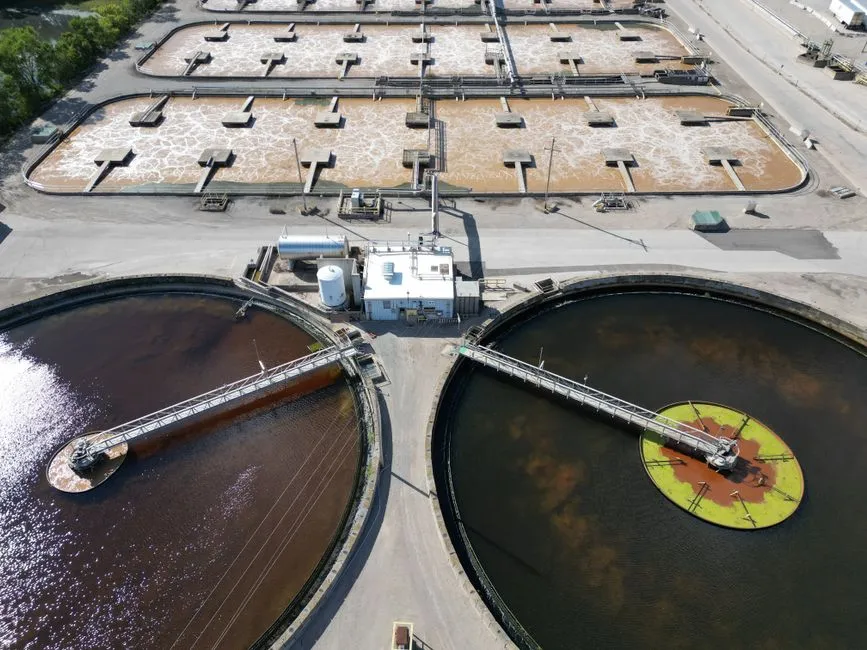
An MBBR will underperform badly on slaughterhouse duty if pre-treatment is skipped. The biofilm can absorb FOG, but sustained FOG above ~150 mg/L in the reactor causes carrier coating, oxygen-transfer loss, and biomass sloughing. Three upstream stages are non-negotiable on a real plant.
First, a rotary bar screen for solids removal at 3–6 mm opening pulls out paunch manure, feathers, offal, and bone fragments that would otherwise blind the media and clog diffusers. Second, a dissolved air flotation system for FOG removal cuts FOG 60–85% and TSS 50–80% before the biological stage; DAF is the single most important pre-treatment step. Third, an equalization basin sized at 8–24 hours of flow buffers batch discharges from kill-floor drains, which routinely dump in slugs of 8,000+ mg/L COD over 15–30 minutes. pH adjustment to 6.5–8.0 is also required: blood depresses pH during peak loads and will inhibit nitrification if not corrected. A grease trap or grit chamber ahead of DAF further reduces loadings on poultry plants with high feather and fat content, where raw FOG can exceed 2,000 mg/L.
Removal Performance: COD, BOD, FOG, and Ammonia Benchmarks
MBBR on properly pre-treated slaughterhouse wastewater delivers 80–95% COD removal (2,000–8,000 mg/L → 100–400 mg/L effluent), 85–97% BOD removal (1,000–4,000 mg/L → 30–120 mg/L effluent), and effluent FOG of 10–40 mg/L after upstream DAF — comfortably meeting a 30 mg/L BOD discharge standard in most jurisdictions. Ammonia removal in a single-stage carbonaceous MBBR is 50–80%; for full nitrification a second aerobic stage at longer HRT is needed, or an MBBR-IFAS hybrid with carriers in the nitrification basin.
Sludge yield is the often-overlooked performance advantage: 0.2–0.4 kg TSS per kg COD removed for MBBR, versus 0.4–0.6 for conventional activated sludge, because biofilm biomass stays attached rather than being wasted from the clarifier underflow. Lower waste sludge volume directly reduces downstream dewatering cost and landfill or rendering disposal tonnage — a meaningful OPEX line for a 500 m³/d plant producing 5–8 dry tons of sludge per day.
| Parameter | Influent (SHWW) | MBBR Effluent | Removal (%) | Compliance Target |
|---|---|---|---|---|
| COD (mg/L) | 2,000–8,000 | 100–400 | 80–95 | <250 typical sewer |
| BOD (mg/L) | 1,000–4,000 | 30–120 | 85–97 | <30 strict discharge |
| FOG (mg/L) | 200–1,500 | 10–40 | 95+ (with DAF) | <50 standard |
| NH₃-N (mg/L) | 50–200 | 20–80 | 50–80 (1-stage) | <10 with 2-stage |
| TSS (mg/L) | 500–3,000 | 50–200 | 80–95 | <30 strict |
| Sludge yield (kg TSS/kg COD) | — | 0.2–0.4 | — | vs CAS 0.4–0.6 |
MBBR vs SBR vs IFAS vs Activated Sludge for Slaughterhouse Duty
The right process depends on flow pattern, peak load factor, discharge limit, and operator skill. MBBR vs SBR: SBR has lower CAPEX for intermittent flows under 200 m³/d but MBBR handles continuous high-strength flow and FOG surges without the cycle-time penalty. MBBR vs IFAS: IFAS adds carriers into a CAS basin to push MLSS and nitrification in one tank, but operation is more complex; pure MBBR is the cleaner retrofit for existing equalization basins. MBBR vs conventional activated sludge: MBBR is more compact, more resilient to blood and cleaning-chemical slug loads, and produces 30–50% less waste sludge. MBBR vs MBR: MBR delivers near-reuse effluent (COD <50 mg/L) but CAPEX is 2–3× higher and FOG residuals foul membranes quickly — the cost-optimized pair for sewer-discharge duty is MBBR plus a polishing DAF.
For plants considering IFAS or MBR as alternatives, the IFAS for slaughterhouse wastewater cost guide and the MBR replacement cost benchmarks lay out the trade-offs in detail.
| Process | Footprint | Resilience to FOG Slugs | Operator Skill | Effluent BOD (mg/L) | Best Fit |
|---|---|---|---|---|---|
| MBBR | Small | High | Low | 30–120 | 50–5,000 m³/d continuous |
| SBR | Medium | Medium | Medium | 20–80 | <200 m³/d intermittent |
| IFAS | Medium | High | Medium–High | 15–60 | N-removal in one tank |
| CAS | Large | Low | High | 30–150 | Greenfield, large flow |
| MBR | Medium | Low (FOG fouls) | High | <10 | Reuse-quality discharge |
2026 Cost Benchmarks: CAPEX, OPEX, and Media Replacement
For 2026 procurement, a complete MBBR train (tank, carriers, blowers, diffusers, controls) runs $320–$780 per m³ of daily treatment capacity, with the higher end reflecting stainless tanks, packaged skids, and integrated controls. OPEX sits at $0.18–$0.42 per m³ treated, dominated by aeration energy (60–70% of OPEX) at 0.25–0.55 kWh/m³. Blower sizing follows the rule of 30–60 Nm³ air per kg BOD removed for coarse-bubble, or 20–40 Nm³ for fine-bubble diffuser grids — fine-bubble cuts energy roughly 30% but requires more aggressive FOG control upstream.
HDPE/PP media lasts 10–15 years in service; budget 5–8% of media CAPEX annually as a lifecycle replacement reserve. Sludge handling downstream of MBBR is the secondary OPEX driver — a filter press for MBBR waste sludge dewatering is the standard pairing, running lower volume per kg COD removed than CAS but similar $/dry ton. The scale lever matters: a 50 m³/d plant sits near the upper CAPEX/m³ bound; a 500 m³/d plant approaches the lower bound. For plants also scoping MBR as an alternative, the MBR replacement cost benchmarks give a side-by-side 2026 cost reference.
| Cost Item | 2026 Range | Driver / Notes |
|---|---|---|
| CAPEX (complete train) | $320–$780 / m³·d | Stainless / skid pushes upper bound |
| OPEX (energy-dominated) | $0.18–$0.42 / m³ | 60–70% is aeration |
| Aeration energy | 0.25–0.55 kWh/m³ | Fine-bubble = ~30% savings |
| Blower sizing | 20–60 Nm³ air / kg BOD | Fine-bubble lower, coarse-bubble higher |
| Media life | 10–15 years | 5–8% CAPEX/yr reserve |
| Sludge dewatering | $/dry ton similar to CAS | But ~30% less volume |
Decision Framework: When to Specify MBBR for Your Plant
Specify MBBR when flow is 50–5,000 m³/d, influent COD is 1,500–10,000 mg/L, FOG is manageable with upstream DAF (<150 mg/L into reactor), footprint is constrained to 30–50% of a CAS basin, and operator skill is limited. Skip MBBR when the discharge limit requires reuse-quality effluent (specify MBR), flow is below 20 m³/d (a package SBR or package A/O plant for small abattoirs is cheaper), or influent FOG exceeds 2,000 mg/L consistently — in that case add an anaerobic pre-treatment stage (UASB or FBR) ahead of MBBR.
The retrofit sweet spot is real: an existing equalization or aeration basin can often be converted to MBBR by adding carriers and upgrading blowers, at 40–60% lower CAPEX than a greenfield build. Always pair the MBBR specification with a DAF upstream and sludge dewatering downstream; an isolated MBBR without pre/post treatment will underperform on slaughterhouse duty no matter how well it is sized.
Frequently Asked Questions
What COD removal can MBBR achieve on slaughterhouse wastewater? MBBR achieves 80–95% COD removal on properly pre-treated abattoir and poultry effluent, with 6–24 hours HRT at 2–4 mg/L DO. Effluent COD typically lands at 100–400 mg/L from 2,000–8,000 mg/L influent.
What is the typical MBBR media filling ratio for abattoir effluent? 30–40% filling is standard for SHWW duty; 60–70% is used in compact high-strength retrofits where the existing tank is volume-limited. Higher fill increases treatment capacity per m³ but raises mixing energy and carrier attrition.
Does MBBR need pre-treatment for FOG? Yes. FOG above ~150 mg/L in the reactor causes carrier coating and DO transfer loss, so a DAF upstream cutting FOG 60–85% is standard. Without DAF, MBBR performance on raw SHWW drops 20–30%.
How much does an MBBR system cost in 2026 for a slaughterhouse? 2026 CAPEX runs $320–$780 per m³ of daily capacity for a complete train; OPEX runs $0.18–$0.42 per m³ treated, with aeration at 60–70% of OPEX. A 500 m³/d plant sits near the lower CAPEX bound.
MBBR vs SBR for slaughterhouse wastewater — which is better? SBR is cheaper for intermittent flows under 200 m³/d; MBBR is the better pick for continuous high-strength flow with FOG and blood surges. For deeper process economics, see the IFAS for slaughterhouse wastewater cost guide and the broader resource recovery trends in industrial wastewater for context on 2026 technology selection.