Separate the Site's Wastewater Streams
The supplied research contains no Benguela facility wastewater inventory, so the matrix below is a design-basis template rather than a description of an existing or proposed site.
A Benguela data center should assign each waste stream an owner, destination and preliminary treatment route before selecting a combined treatment plant. Cooling operations should own cooling-tower blowdown, while pretreatment and reuse decisions depend on measured chemistry and the final discharge or reuse route.
| Stream | Ownership and preliminary route | Information required before design |
|---|---|---|
| Cooling-tower blowdown | Cooling operations team; characterize before discharge or reuse. | Source-water, circulating-water and representative blowdown analyses, including cooling chemicals. |
| Sanitary wastewater | Route to a dedicated treatment train. | Staff and contractor population, fixture flows, characteristics and effluent destination. |
| Construction fill-and-flush water | Characterize before sewer acceptance. | Water source, discharge volume, construction materials and acceptance requirements. |
| Firefighting water | Hold for assessment and controlled release. | Storage capacity, possible contaminants, firewater-system chemistry and release route. |
| Process wastewater | Assess separately for each generating process. | Constituents, flow variation, batch discharge and intended destination. |
| Sludge or spent media | Evaluate with the parent treatment process. | Generation rate, hazardous characteristics, storage, transport and disposal route. |
University of Georgia Cooperative Extension lists corrosion-control chemicals, antiscalants, biocides, chlorine compounds and glycols among possible cooling-system additives. These additions must be included in the chemical assessment because they can alter the treatment decision. A data center cooling-blowdown treatment guide provides comparative context, while the 2026 engineering guide to data center wastewater treatment explains why separate routes are preferable.
Build the Cooling Water Balance Before Sizing Equipment
Equipment capacity cannot be selected until evaporation, drift and controlled blowdown flows are reconciled with the facility operating plan for an open evaporative cooling system.
- Establish the cooling-system configuration and whether it is open, closed or hybrid.
- Determine evaporation, drift and controlled blowdown under normal and off-design conditions.
- Separate average daily flow from peak hourly flow, startup conditions, cooling events and future-load cases.
- Reconcile the resulting water balance with vendor cooling calculations and backup-water arrangements.
The calculation package should record source-water quality, evaporation rate, cycles of concentration, chemical additions, operating hours, make-up-water source, redundancy requirements and expected future load. Blowdown flow depends directly on evaporation and the selected cycles of concentration; changing either changes the treatment duty. Because these cooling requirements vary by facility, the system architecture must be tailored to the specific site.
University of Georgia Cooperative Extension’s 2026 bulletin estimates that 75%–90% of data centers globally primarily use water-based cooling. That is market context, not a Benguela flow input. The same bulletin reports that closed-loop systems can use up to 70% less water than traditional open evaporative cooling, while requiring greater system complexity and potentially more electricity.
Neither architecture should therefore be assumed mandatory. Compare total water demand, electrical demand, backup requirements, operating complexity and the consequences of changing the cooling configuration. If the source-water chemistry requires treatment before use, the relevant industrial water softener system should be evaluated only after its duty and application limits are defined from measured water quality.
Match Treatment to Blowdown Chemistry and Reuse Goals
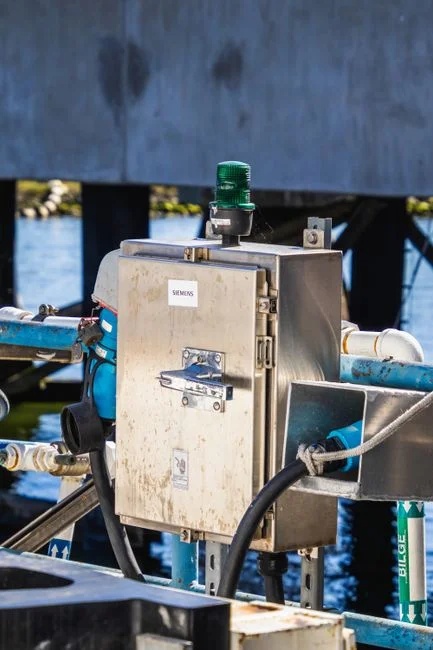
Cooling-blowdown treatment should be selected from source-water, circulating-water and representative blowdown analyses, not from pH or turbidity alone.
IDE Tech identifies cooling-tower blowdown as enriched with sparingly soluble salts associated with scale, including silica, calcium carbonate and calcium sulfate. The relevant decision is not simply whether blowdown can be discharged: it is whether it can be reused as cooling make-up at the quality required by the cooling system and chemical programme. A reuse concept must define the treated-water specification first and manage the resulting concentrate separately.
IDE Tech states that conventional brackish-water reverse osmosis commonly reaches 75%–80% recovery before scaling becomes unmanageable. This is comparative context, not a predicted recovery rate for Benguela cooling blowdown. Recovery depends on the actual feed chemistry, membrane configuration, operating controls and concentrate-management route.
| Measured condition | Treatment decision | Design constraint |
|---|---|---|
| Require treatment before membrane recovery | Consider ultrafiltration pretreatment for cooling-water reuse when the analysis supports it. | UF should protect the downstream membrane process; its applicability depends on feed chemistry and the reuse target. |
| Desalination is required for reuse | Consider the industrial reverse-osmosis system for cooling-blowdown reuse. | Define recovery from measured scaling potential and provide a route for concentrate. |
| Oil, grease, colloids or floatable contaminants are confirmed | Consider dissolved-air flotation treatment. | The supplied research does not establish that Benguela requires DAF. |
| Reuse requires disinfection | Consider a chlorine dioxide generator after microbial-risk and compatibility review. | Disinfection needs must come from the reuse risk assessment, not from a generic equipment catalogue. |
HydropureWater’s UF specification is 2,000–40,000 L/h with 0.03-micron PVDF membranes, automatic backwash and air scour. Its chlorine dioxide generator range is 50 g/h to 20,000 g/h. These are catalogue capacities, not recommendations for a Benguela data center; neither can be accepted without the site water balance and chemistry.
Plan Sanitary Wastewater and Construction Water Separately
Sanitary wastewater requires a dedicated duty calculation based on the number of staff and contractors, shift pattern, visitor use, fixture flows, wastewater characteristics and required effluent destination.
Two equipment concepts serve different scale and treatment arrangements. A buried WSZ package plant combines anoxic and aerobic biological contact oxidation, sedimentation and disinfection in one unit; HydropureWater rates it at 1–80 m³/h. An MBR system combines activated sludge with submerged PVDF membrane filtration below 1 μm; HydropureWater rates it at 10–2,000 m³/day. These values describe products, not Benguela sizing conclusions.
For a separate sanitary route, compare the underground integrated sewage treatment package with an MBR system for separate sanitary wastewater treatment. The comparison should consider land availability, burial conditions, odour control, operations, redundancy, effluent quality and the destination of residual sludge—not catalogue capacity alone.
Construction fill-and-flush water is temporary and variable. Characterize it and obtain sewer-acceptance requirements before discharge or sewer entry; do not merge it with sanitary flow during design. Firefighting water should also be handled through storage, assessment and controlled release rather than assumed to fit the cooling or sanitary treatment plant.
The engineering sequence is straightforward: establish the sanitary duty, compare package and biological treatment against the required destination, then issue a separate temporary-water acceptance protocol. This prevents construction flows from distorting the permanent treatment design.
Turn Site Data into a Supplier and Equipment Brief
A supplier brief should contain measured flows and chemistry, stated operating assumptions and the disposal route for every residual stream.
| Information to request | Why the supplier needs it | Required supplier response |
|---|---|---|
| Average and peak blowdown; cooling configuration; evaporation rate; cycles of concentration; operating hours; future load; redundancy | Defines the hydraulic and operating envelope. | State design flows, duty assumptions, operating envelope and redundancy. |
| Source-water, circulating-water and representative blowdown analyses; chemical inventory | Defines scaling, corrosion, fouling and treatment limits. | State chemistry limits, recovery or removal basis and control strategy. |
| Reuse target and final discharge route | Determines the required product-water quality and concentrate handling. | Identify the residual or concentrate route and sludge generation. |
| Utility, controls and operating requirements | Tests operability and integration with the cooling system. | List controls, utilities, access requirements and performance guarantees. |
Ask every bidder to identify the design flow, treated-water specification, water-chemistry envelope, recovery or removal basis, residual route, sludge generation, controls, redundancy and utility demand. The regional data center wastewater design considerations provide useful comparative context, but the Benguela site brief must remain controlling. Accurate site data is the only way to ensure the equipment meets operational requirements.
Keep catalogue figures separate from guarantees: HydropureWater lists UF capacity at 2,000–40,000 L/h, MBR capacity at 10–2,000 m³/day, and chlorine dioxide generator capacity at 50 g/h to 20,000 g/h. Local review is required for Benguela discharge, sewer-acceptance, environmental, construction and water-supply requirements because the supplied research does not establish applicable local limits. Use pilot testing or an extended water-balance review when source chemistry varies, reuse targets are stringent or the cooling configuration remains likely to change.
Frequently Asked Questions
What data are needed before sizing wastewater and cooling blowdown equipment for a Benguela data center?
Request average and peak blowdown, source-water and circulating-water analyses, cooling configuration, evaporation rate, cycles of concentration, chemical inventory, operating hours, reuse target, future load and redundancy requirements. These inputs should be issued in the site-data brief before a supplier commits to a fixed capacity.
How much does a wastewater and cooling blowdown treatment system cost?
The supplied research provides no project quotation, so no responsible Benguela price can be stated. Ask each supplier for an itemized offer covering equipment, installation, commissioning, controls, residuals, utilities, maintenance and any pilot work. Compare offers on the same measured flow, water chemistry, reuse target and discharge assumptions.
Which treatment technology should be selected for cooling blowdown reuse?
Select the train from measured source-water, circulating-water and blowdown chemistry. UF may be needed for membrane protection, while RO may be required when dissolved-salt reduction is necessary; DAF is justified only where relevant floatable contaminants are confirmed, and disinfection requires a reuse-specific microbial-risk assessment.
How should a buyer select a treatment supplier without relying on generic equipment capacity?
Check whether the supplier states design flows, water-chemistry limits, recovery or removal basis, residual route, sludge generation, controls, redundancy and utility requirements. Product ranges are catalogue boundaries, not project guarantees, and applicable Benguela discharge or sewer-acceptance requirements must be confirmed locally before selection.