What Orenburg's cooling configuration determines
The required treatment train for a data center in Orenburg depends on whether the facility uses evaporative cooling, closed-loop cooling, or both, and on whether the resulting wastewater will be discharged, reused, or evaporated to solids. In an evaporative system, water leaves by evaporation while dissolved salts and treatment chemicals remain, creating concentrated blowdown that requires explicit treatment or disposal. A closed-loop system normally produces less maintenance discharge, but the water inventory and treatment requirements still have to be verified.
Separate the project into four streams before selecting equipment: evaporative cooling-loop blowdown, closed-loop cooling maintenance discharge, residuals from makeup-water treatment, and domestic or tenant wastewater. These should not be combined into a single design flow unless their chemistry, variability and receiving routes are demonstrably compatible. Brown and Caldwell, in its 2026 data center water guidance, describes evaporative systems as continuously producing concentrated blowdown that requires treatment and discharge, or reuse.
UGA Extension reports that closed-loop cooling can reduce water consumption by up to 70% compared with traditional open evaporative cooling, although it costs more and requires greater system complexity. The same source estimates that 75% to 90% of data centers globally primarily use water-based cooling. These figures explain why architecture must be settled before treatment capacity is calculated; they do not establish the water demand or blowdown rate for an Orenburg facility.
The Orenburg project team must provide the planned IT load, cooling-system selection, available municipal and alternative water sources, local climate data and intended discharge route. Until those inputs and the actual source-water analysis are verified, no local flow, concentration or water-quality limit should be assumed. The treatment objective may resemble a Calamba data center blowdown-sizing guide, but Orenburg’s water, climate and receiving-route conditions must replace the place-specific inputs.
Build the site water balance before selecting equipment
Cooling-system vendor design data provides the basis for preliminary equipment sizing rather than a generic water-consumption factor. The project team should reconcile evaporation, drift, intentional blowdown, blowdown concentrate, makeup water, treatment-chemical additions, sludge and final discharge across minimum, normal and maximum operating cases.
- Record the number and configuration of cooling loops, design cooling duty, cycles of concentration, operating hours, expected utilization and minimum and maximum blowdown rates.
- Obtain representative source-water analyses covering hardness, alkalinity, calcium, magnesium, conductivity or TDS, chloride, sulfate, silica, turbidity, suspended solids, pH and temperature.
- Inventory every cooling chemical: biocide, corrosion inhibitor, scale inhibitor, pH adjuster and any product containing metals. Record dosing rates, residual concentrations and chemical-safety requirements.
- Identify the receiving route and reuse objective before defining the required outlet water quality.
Water Utility Report, last updated 2026-04-14, explains that recycled water can reduce pressure on drinking-water supplies but changes the chemistry challenge and may increase pretreatment, corrosion-control, scale-control and monitoring needs. The selected source water is therefore part of the treatment design, not merely a utility connection.
| Design input | Information required | Decision affected |
|---|---|---|
| Cooling configuration | Evaporative, closed-loop or hybrid; loop count; design duty; operating schedule | Presence and variability of blowdown |
| Water balance | Evaporation, drift, blowdown, makeup, concentrate and discharge | Hydraulic capacity |
| Source-water analysis | Representative laboratory results for the intended source | Softening, solids removal and membrane pretreatment |
| Chemical inventory | Products, dosing rates and expected residuals | Dosing, disinfection and discharge compatibility |
| Receiving route | Sewer, reuse, surface-water or zero-liquid-discharge destination | Treatment objective and permit scope |
Equipment can then be screened against verified needs. An industrial water-softener system may address hardness where verified results justify it, while treatment valves, media and replacement parts should be selected against the actual process and water chemistry. Until the Orenburg team supplies source-water and chemical data, generic ranges should not be treated as local facts.
Match the treatment train to blowdown chemistry
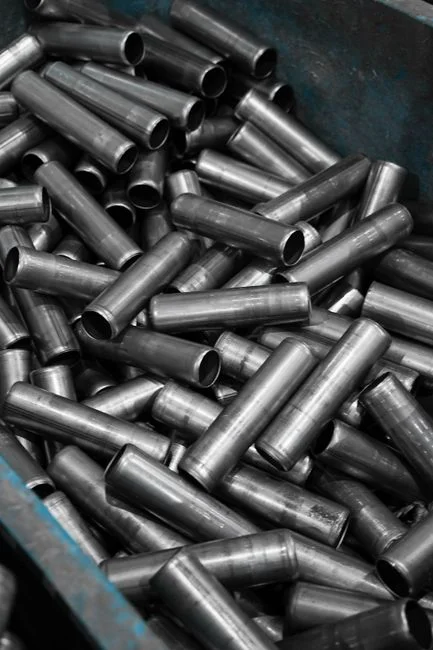
Cooling-tower blowdown is the water intentionally removed to prevent the buildup of minerals, salts, corrosion products, scale and biological growth within the cooling system. Water Utility Report, last updated 2026-04-14, describes it as concentrated wastewater left behind when cooling systems evaporate water because dissolved solids and treatment chemicals do not evaporate with it.
Assign treatment barriers by contaminant and operating objective rather than by equipment name:
- Suspended solids, colloids and floating material: use a rotary mechanical bar screen for wastewater pretreatment where debris protection is needed. Add a DAF system for cooling-blowdown pretreatment or clarification where flocculated solids require capture. Neither barrier, by itself, removes dissolved salinity.
- Hardness-driven scale and dissolved salts: evaluate softening, membrane treatment or another validated desalination route against the source analysis and required recovery. High-efficiency suspended-solids removal cannot substitute for dissolved-solids removal.
- Residual biocides, corrosion inhibitors and pH-control chemicals: control dosing and monitor residuals to protect the cooling system and satisfy the receiving route. A generic separator does not remove these dissolved constituents.
- Biological risk: evaluate UV or chlorine dioxide only after confirming the water chemistry, target organism, dose and discharge implications. The applicable equipment reference is a chlorine dioxide generator for industrial cooling loops.
- Zero-liquid-discharge or high recovery: Saltworks identifies modular evaporator-crystallizers as a treatment route. A thermal system must be assessed separately for energy demand, concentrate management, scale control, cleaning and redundancy.
Use sludge dewatering only when the selected solids-capture process creates a sludge stream that needs volume reduction or controlled disposal. A plate-frame filter press becomes relevant after solids have been captured and the residual characteristics of that sludge have been established.
| Barrier | Primary target | Required confirmation |
|---|---|---|
| Bar screen | Debris and floating material | Hydraulic solids loading and screenings route |
| DAF or clarification | Suspended and flocculated solids | Floc chemistry, sludge volume and dewatering need |
| Softening or desalination | Hardness and dissolved salts | Source analysis, recovery, concentrate and membrane pretreatment |
| Dosing and monitoring | Residual chemicals and pH | Cooling program, residual targets and receiving conditions |
| Disinfection | Biological control | Target, chemistry, dose and residual-discharge effect |
| Evaporator-crystallizer | Liquid discharge and solids recovery | Energy, scaling, solids handling and redundancy |
Choose discharge, reuse or zero-liquid-discharge treatment
Three receiving routes are available: controlled discharge to an authorized sewer or receiving system, on-site reuse for defined cooling or process duties, and zero-liquid-discharge treatment. The route must be selected before polishing requirements are finalized because each imposes a different water-quality specification and operating obligation.
For sewer discharge, request the Orenburg utility’s current discharge conditions, permitted pollutant limits, monitoring requirements, acceptance rules and any industrial-pretreatment charge. Sewer acceptance should not be assumed from dilution capacity or informal practice. Obtain the applicable agreement in writing and identify who controls flow, pH, conductivity, suspended solids, hardness, metals and chemical residuals.
For reuse, define the receiving equipment and its water-quality specification. Reuse cannot be selected from conductivity or clarity alone. Residual biocide, corrosion inhibitor, scale tendency, biological control and compatibility with the next process remain constraints. Where reclaimed or recycled makeup water is contemplated, Water Utility Report, last updated 2026-04-14, warns that it changes the chemistry challenge and may require more pretreatment, corrosion control, scale control and monitoring.
For zero liquid discharge, evaluate the concentrate and crystallization steps separately from the liquid-treatment train. The scope must cover energy demand, chemical cleaning, scale formation, solids handling, equipment redundancy and operator intervention. Saltworks supports modular evaporator-crystallizers as a route, but the supplied research contains no Orenburg-specific energy, cost or crystallized-product data.
| Route | Decision basis | Main procurement risk |
|---|---|---|
| Authorized discharge | Written receiving conditions and local acceptance | Treatment shown to meet conditions under peak discharge |
| On-site reuse | Named application and water-quality specification | Residual chemical or scaling incompatibility |
| Zero liquid discharge | No acceptable liquid discharge and validated thermal route | Unverified energy, scaling and solids-handling burden |
Water Utility Report, last updated 2026-04-14, also warns that multiple facilities relying on the same wastewater infrastructure can create a different risk from one small, well-managed discharge. The project should identify cumulative load, not only its own flows. For infrastructure-constrained comparisons, the data center wastewater treatment options for infrastructure-constrained sites illustrates the type of receiving-capacity diligence required.
Verify Russian compliance and operating controls
The applicable Orenburg discharge route and environmental conditions must be confirmed with the responsible Russian utility and environmental authorities. United States Clean Water Act and NPDES requirements should not be imported into an Orenburg permit package. UGA Extension describes NPDES permitting only as a United States example for direct discharges to waterways; it is not a statement of Russian law.
Build an approval register with one owner, document reference, validity condition and deadline for each item:
- water abstraction and source-water conditions;
- wastewater-discharge conditions and receiving-route approval;
- sewer acceptance and any industrial-pretreatment requirements;
- chemical storage, handling and emergency provisions; and
- disposal route for captured solids, sludge or concentrated residues.
Specify automatic monitoring according to the verified source water, chemical inventory and receiving route. Potential parameters include flow, pH, conductivity, turbidity, suspended solids, hardness and residual biocide. Control equipment and treatment media should be specified through treatment valves, media and replacement parts with confirmed compatibility and maintainability.
The operating record should cover blowdown adjustments, chemical dosing, media or membrane cleaning, sludge removal, bypass events and nonconforming discharges. UGA Extension’s community due-diligence questions provide a useful documentary test: baseline water testing, source- and receiving-water information, cumulative project load, and clear disclosure of discharge volumes and expected chemistry. The project should be able to answer each question with records.
Prepare the supplier scope and acceptance test
A comparable bid must state its complete design basis rather than quote an equipment package from an undefined flow. Require each bidder to identify the source-water assumptions, cooling configuration, number of loops, cycles of concentration, chemical inventory, minimum and maximum flow basis, discharge route, reuse objective and intended treatment barriers.
The commercial scope should also identify startup, operator training, controls integration, alarms, automatic backwash or cleaning, maintenance access, spare parts, chemical consumption, sludge handling and continuing operator support. These items affect reliability and total operating burden and should be evaluated separately from acquisition cost.
Set acceptance criteria against the agreed water-quality parameters, operating mode and receiving route. “Suitable for reuse” is not an acceptance criterion unless the receiving application and water-quality specification are explicit. Performance tests should also establish how the system behaves at minimum, normal and maximum flow and how chemical residuals are controlled.
HydropureWater’s DAF system for cooling-blowdown pretreatment is catalogued across 4–300 m³/h and 13 standard models, while its PLC-controlled chemical dosing skid provides automatic control. The bidder must show that the proposed configuration fits the Orenburg water balance, chemistry and treatment objective.
Frequently Asked Questions
How much wastewater and cooling blowdown treatment does an Orenburg data center need?
Size
Frequently Asked Questions
What wastewater treatment system does a data center in Orenburg need?
Due to the semi-arid continental climate of the Orenburg region, cooling towers operate under high evaporation rates, leading to significant concentration of dissolved solids. A robust system requires a combination of chemical precipitation for hardness removal, ultrafiltration (UF) to manage suspended solids, and reverse osmosis (RO) to reduce Total Dissolved Solids (TDS) to levels compliant with local municipal discharge standards.
Given the specific water chemistry of the Ural River basin, which often exhibits high alkalinity and sulfate concentrations, the system must include automated pH adjustment and anti-scalant dosing units to prevent scaling in heat exchangers and downstream treatment membranes.
How do I size a cooling-blowdown treatment system for a data center?
Sizing is determined by the cooling tower blowdown rate, which is calculated based on the Cycles of Concentration (CoC). For a typical 10 MW data center, if operating at 4.0 CoC, the blowdown volume is calculated as the evaporation loss divided by (CoC - 1). Designers must factor in a 20% safety margin to account for peak summer ambient temperatures in Orenburg, which can exceed 35°C, significantly increasing evaporation rates.
Engineers should utilize design flow rates based on peak heat load rather than average load. Systems should be modular to handle seasonal fluctuations, as blowdown rates will drop significantly during the winter months when the facility utilizes free cooling or reduced chiller loads.
Should an Orenburg data center choose sewer discharge, water reuse, or zero-liquid-discharge treatment?
The choice depends on the proximity to municipal infrastructure and local water scarcity regulations. Sewer discharge is the most cost-effective but requires meeting strict local discharge limits for TDS and heavy metals. Water reuse for landscape irrigation is viable in Orenburg's urban zones but requires advanced disinfection and secondary RO to meet sanitary requirements.
Zero-Liquid-Discharge (ZLD) is the most sustainable option and is increasingly favored due to tightening regional environmental oversight. While ZLD requires a higher initial capital expenditure (CAPEX) for evaporators or crystallizers, it mitigates long-term risks associated with rising municipal sewer tariffs and potential discharge permit revocations.
What should I include when comparing industrial wastewater-treatment suppliers?
Suppliers must provide documentation proving their systems comply with Russian GOST standards for industrial effluent. When evaluating bids, compare the "Total Cost of Ownership" (TCO) over a five-year period, specifically focusing on energy consumption per cubic meter of treated water and the frequency of membrane replacement required for the specific Orenburg water hardness levels.
Ensure the supplier offers a local service presence in the Orenburg or Volga Federal District region to guarantee rapid response times for chemical delivery and technical maintenance. Request verified case studies of systems operating in climates with similar seasonal temperature extremes to ensure the equipment is winterized against freezing.
What permits and discharge limits apply to data center cooling blowdown in Orenburg?
Discharge into municipal sewers is governed by Federal Law No. 416-FZ and local regulations set by Orenburg Vodokanal. Operators must obtain a "Permit for Discharge of Wastewater" which specifies maximum allowable concentrations (MAC) for pollutants, including sulfates, chlorides, and phosphates. Common limits for TDS in municipal systems are often capped at 1,000–1,500 mg/L.
Facilities discharging into surface water bodies must adhere to even stricter standards set by the Federal Agency for Water Resources. These permits require rigorous quarterly monitoring reports and adherence to the "Maximum Permissible Discharge" (MPD) norms, which are calculated based on the ecological capacity of the specific receiving water body.