How to Choose Between DAF and Clarification
For mining and metals factories in Autauga County, choose DAF when the target material is floatable or can be conditioned into flocculated particles; choose conventional or lamella clarification when heavy solids settle readily. DAF uses microbubbles to float conditioned solids for skimming, while lamella clarification uses gravity settling with inclined plates and sludge recirculation. The final selection should follow source-by-source wastewater testing, peak and batch-flow data, solids-mass loading, chemical conditioning, equalization needs, and sludge handling—not average flow or the equipment label alone. Mixed streams may require pretreatment or a sequence, but a DAF-followed-by-clarifier arrangement should be justified only by distinct contaminant fractions or a specific polishing need.
HydropureWater’s 2026 mining-wastewater guide frames the selection as a contaminant-behavior decision: favor flotation for floatable or flocculable loads and gravity separation for heavy, readily settleable solids. A DAF may be marketed as a “flotation clarifier,” but that name does not make it equivalent to a gravity-settling clarifier. The bid should identify the separation principle, target fraction, chemical assumptions, hydraulic profile, and downstream sludge route.
Dissolved metals also do not select the equipment by themselves. The 2026 guide states that reliable metal capture depends on conditioning metal-bearing solids and separating the resulting floc; total and dissolved analyses must therefore remain distinct. Before selecting a separator, obtain the site’s current permit and any applicable requirements from its sewer authority. The supplied research establishes no Autauga County numerical discharge limits, so another jurisdiction’s thresholds cannot be substituted.
| Observed contaminant behavior | Primary screening choice | Required procurement evidence |
|---|---|---|
| Floatable solids, free oil, or material that can be flocculated | DAF with chemical conditioning | Conditioning trial, bubble-to-particle assessment, skimmer and sludge capacity |
| Heavy sand, gravel, or readily settleable solids | Conventional or lamella clarification | Settleability and solids-density data, settling area, sludge collection design |
| Both light floatable and heavy settleable fractions | Pretreatment or a justified sequence | Stream-specific mass balance and distinct performance duties |
| Dissolved metals requiring precipitation or complexation | Conditioning followed by the appropriate solids separator | Total and dissolved metals results, pH and alkalinity range, analytical methods |
An industrial DAF system and a high-efficiency lamella clarifier should therefore be compared against the same measured wastewater, not against nominal catalog capacity.
What the Wastewater Must Tell You Before Equipment Selection
A representative characterization program—not one averaged sample—is the minimum basis for selecting mining-wastewater equipment. HydropureWater’s 2026 guide identifies flow, suspended solids, oils and greases, pH, metals, and variability across process, contact, and stormwater inflows as required subjects. The bid should define sampling locations, analytical methods, sampling frequency, and which sources contribute to each flow event.
Document each source’s flow contribution, peak flow, batch-discharge profile, washdown events, and stormwater contribution. Those facts determine equalization, gross-solids pretreatment, chemical demand, and whether a separator can handle transient loads. A single average flow conceals the duty that can overload a skimmer, sludge pump, or gravity collection system.
Separability matters as much as concentration. Collect TSS, particle-size distribution, settleability, solids density where available, and time-sequenced grab-sample results. These observations help distinguish heavy material from colloidal particles or solids that require flocculation. For oils and greases, document temperature, free-oil observations, and emulsion characteristics; an emulsified load cannot be judged from a visual skim test alone.
For metals, request total and dissolved results, pH range, alkalinity, and chemistry variability. Define whether “metals” in the equipment guarantee means total metal, dissolved metal, or particulate-bound metal. HydropureWater’s guide notes that reliable removal depends on conditioning the metal-bearing material and separating the resulting floc.
| Bid package input | Question answered | Downstream decision affected |
|---|---|---|
| Source-by-source flow, peak and batch profiles, stormwater contribution | What instantaneous and transient duties must the train handle? | Equalization, pretreatment, separator capacity |
| TSS, particle-size distribution, settleability, density, grab samples | Which contaminant fraction is being separated? | DAF versus gravity separation |
| Oils and greases, temperature, free oil, emulsion observations | Is the light fraction genuinely floatable? | DAF suitability and conditioning |
| Total and dissolved metals, pH, alkalinity | What chemistry is needed to create a separable fraction? | Precipitation, flocculation, materials |
| Expected sludge volume, moisture, storage time, dewatering and disposal route | Can the downstream solids system accept the selected separator’s residue? | DAF or lamella selection, auxiliary equipment |
Finally, document expected sludge volume, moisture content, storage time, dewatering method, and disposal route before selecting either separator. A complete review should follow the plant’s mining and metals wastewater pretreatment requirements and confirm which analytical results are permit conditions rather than general design assumptions.
DAF and Clarifier Mechanisms Compared
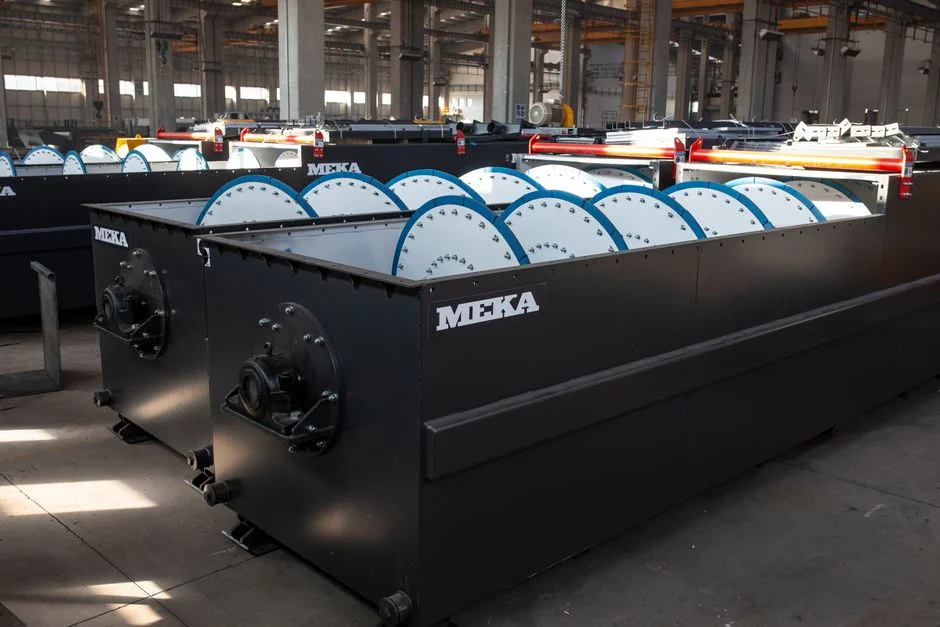
DAF and gravity clarifiers separate different contaminant fractions because they use different physical mechanisms. DAF dissolves air under pressure and releases it as microbubbles; the bubbles attach to suspended or conditioned particles, which rise and are removed by a skimmer. Heavier material settles into a bottom collection zone and is withdrawn separately. A conventional clarifier instead relies on gravity settling, while a lamella clarifier adds inclined plates within a more compact structure.
HydropureWater’s 2026 guide notes that coagulation and flocculation determine flotation performance by increasing particle size and the material’s ability to contact microbubbles. Accordingly, a PLC-controlled chemical dosing system should be reviewed as part of the process design, not purchased as an accessory. Lamella clarification may also use flocculation, but the conditioning objective must be defined according to the settling mechanism rather than copied from a DAF design.
| Design element | DAF | Conventional or lamella clarification |
|---|---|---|
| Separation principle | Microbubble flotation and surface skimming | Gravity settling; lamella units add inclined-plate separation |
| Preferred fraction | Floatable solids, FOG, oils, conditioned fines, and metal-bearing floc | Readily settleable solids, especially heavier fractions |
| Conditioning role | Creates particles large enough for effective bubble contact | May assist settling, but the flocculation objective differs |
| Primary solids route | Skimmed sludge to handling or dewatering | Bottom collection; lamella systems commonly use sludge recirculation |
| Critical comparison condition | Same wastewater, chemical assumptions, hydraulic profile, and performance criteria | |
Supplier claims establish available configurations, not universal design requirements. Clearwater specifies 30–50 micron microbubbles for its DAF systems in an April 27, 2026 publication, while DAF Corp advertises 20–40 micron bubbles for its generator. HydropureWater describes its lamella units as combining sludge recirculation, flocculation, and inclined-plate separation. Ask each bidder to connect its configuration to the measured particle behavior; neither a bubble-size claim nor the word “clarifier” proves suitability.
Match the Separator to Flow and Solids Loading
Both hydraulic flow and peak mass loading must fit the selected separator. HydropureWater’s 2026 guide gives a DAF hydraulic-loading range of 2–6 gpm/ft² as a screening reference only. The selected value must be supported by the vendor’s design basis, wastewater characterization, equalization performance, and peak-flow profile.
The same 2026 source states that upstream equalization should maintain influent flow within 80%–110% of nominal design flow. That condition depends on the actual equalization tank, controls, and operating rules; it is not permission to size around an unverified average. A variable-flow system also needs capacity for the maximum sludge-production rate so the skimmer does not carry solids back into the clarified water.
HydropureWater’s DAF catalog covers 4–300 m³/h across 13 standard models, but this catalog range is not a site-sizing guarantee. Peak mass loading in lb/hr of solids should be evaluated alongside flow, as should the resulting sludge volume and withdrawal rate. For a lamella clarifier, require the proposed settling area, hydraulic profile, sludge recirculation arrangement, and withdrawal capacity.
| Sizing parameter | Documented screening reference | Bidder must substantiate |
|---|---|---|
| DAF hydraulic loading | 2–6 gpm/ft² in HydropureWater’s 2026 guide | Selected value based on wastewater testing and vendor design method |
| Equalized influent | Within 80%–110% of nominal design flow in the same 2026 guide | Tank working volume, controls, verified operating envelope |
| DAF catalog coverage | 4–300 m³/h across 13 standard models | Model selection against site duty; catalog limits are not site guarantees |
| Lamella surface loading | 20–40 m/h in HydropureWater’s product statement | Confirmation against the proposed wastewater, settling characteristics, and hydraulic profile |
| Variable-flow solids duty | Peak mass loading is required in HydropureWater’s 2026 guide | Maximum lb/hr, sludge production rate, skimmer or withdrawal capacity |
Evaluate upstream screening or hydrocyclone-style pretreatment when heavy sand, gravel, or other high-density solids could interfere with downstream separation. A rotary mechanical bar screen can be evaluated for gross-solids protection, while hydrocyclones may be appropriate for high-density solids. Ask bidders to define the pretreatment duty and show where each contaminant fraction goes before equalization and chemical conditioning.
Compare Chemical, Sludge, and Operating Requirements
The separator quotation does not represent the full cost or operating obligation. HydropureWater’s 2026 article reports DAF energy use of 0.5–1.5 kWh/m³ for air compressors and high-pressure recycle pumps. Require the supplier to state the measurement boundary, operating duty, recycle ratio, and wastewater assumptions used in that estimate.
The same article gives broad DAF capital estimates of $80,000–$350,000 and conventional circular clarifier equipment estimates of $50,000–$200,000. These are not Autauga County bid prices and exclude site-specific scope unless expressly priced. It also states that conventional clarifiers can require larger civil footprints and that concrete-basin construction can increase total project costs by 30%–50% compared with modular DAF systems; bidders must substantiate those assumptions with foundations, basins, access, installation, and site conditions.
| Cost or performance item | Published value | Source and procurement interpretation |
|---|---|---|
| DAF equipment capital | $80,000–$350,000 | HydropureWater 2026 guide; broad estimate, not an Autauga County quotation |
| Conventional circular clarifier equipment | $50,000–$200,000 | HydropureWater 2026 guide; broad equipment estimate that excludes an unspecified site-specific bid |
| Concrete basin cost effect | Can increase total project costs by 30%–50% compared with modular DAF | HydropureWater 2026 guide; require project-specific civil pricing |
| DAF compressor and recycle-pump energy | 0.5–1.5 kWh/m³ | HydropureWater 2026 guide; supplier must state assumptions |
| DAF air-to-solids ratio | 0.01–0.05 ml air per mg solids | HydropureWater 2026 guide; performance remains dependent on particle size, density, and influent conditions |
| Supplier removal claims | DAF Corp: 85%–90% TSS for RC UniMax and 92%–98% for FC Maximizer; HydropureWater: 90%–99% TSS and oil/grease removal for well-optimized DAF | Supplier-specific claims, not transferable guarantees |
Sludge handling can reverse an equipment-only cost comparison. DAF sludge is skimmed and moved to dewatering; lamella clarification uses sludge recirculation. Each bid should identify sludge collection, storage, moisture expectations, dewatering, and disposal frequency. For a DAF proposal, include the compatible sludge filter press or another defined dewatering route rather than leaving residual disposal as an undefined consequence.
Build the Complete Treatment Train
The selected separator must operate as one treatment train with pretreatment, chemical control, equalization, solids handling, and an approved disposal route. HydropureWater’s 2026 guide presents the process as source characterization → equalization and gross-solids protection → pH or chemical conditioning → DAF or gravity/lamella separation → polishing if required → sludge collection, storage, and dewatering → approved disposal.
For a mixed stream containing substantial sand and significant FOG, evaluate pretreatment as a distinct function. A screen, hydrocyclone, or other protection step may remove the heavy fraction before the separator addresses oils or flocculable material. That division is more defensible than forcing every contaminant into one unit.
HydropureWater’s 2026 guide states that a DAF followed by a clarifier is generally unnecessary. A sequence is justified when the wastewater contains distinct light, floatable contaminants and heavy settleable material, or when extreme polishing is required. Bid documents should identify the contaminant fraction handled at each stage and the measurable benefit of the second unit.
Controls and instrumentation should cover chemical dosing, pH, level, skimmer or sludge withdrawal, monitoring, alarms, and data logging. Integrate chemical feed with flow and equipment controls through a defined PLC-controlled chemical dosing system. Select materials against actual chemistry and temperature. Clearwater’s April 27, 2026 publication lists 304SS as standard for its DAF clarifiers, with 316SS, polypropylene, and other options available on request; that supplier statement is not a corrosion design for the Autauga County site.
Include sludge removal, storage, the selected plate-and-frame sludge filter press, utilities, maintenance access, installation inputs, spare parts, and service responsibilities. A process flow without equipment ownership and operating interfaces is incomplete.
Turn the Selection into an Autauga County Bid Checklist
Comparable bids require every bidder to connect equipment promises to measured plant conditions. Require stream-by-stream flow and characterization data, the proposed tank and separation area, solids-handling arrangement, recycle system, controls, materials, utilities, maintenance, installation inputs, and service scope. Reject proposals that select a model from average flow alone or present generic removal percentages without influent conditions, analytical methods, and sampling locations.
| Bid review check | Required response | Reason for rejection |
|---|---|---|
| Alternative-process screening | Explain whether DAF and gravity clarification were evaluated using the same wastewater, chemical assumptions, hydraulic profile, and performance criteria | Product-preference exclusion without technical screening |
| Design basis | Provide peak flow, batch profile, equalization, peak solids loading, proposed areas, and duty calculations | Model selection based only on average flow |
| Performance commitment | Specify wastewater, chemical doses, flow, temperature, test method, sampling point, and acceptance criterion | Unqualified removal claim |
| Controls and materials | Submit an I/O list, alarms, data logging, corrosion rationale, utilities, and maintenance scope | Accessory or material list without process basis |
| Total ownership | Price pretreatment, separator, pH control, chemicals, controls, utilities, labor, maintenance, sludge handling, installation, and disposal | Purchase price presented as total cost |
| Local compliance | Identify the current permit and applicable receiving-authority or sewer requirements | Unsupported statement that equipment “meets all limits” |
Ask whether the alternative separation mechanism was technically screened and, if excluded, require the reasoning. Site-specific test plans or comparable references should identify the wastewater, chemical doses, flow, temperature, test method, sampling point, and acceptance criterion. Case studies are useful evidence, but they are not guarantees for this factory.
Apply the current permit and any applicable sewer or pretreatment requirements of the receiving authority. The supplied research provides no Autauga County numerical limits, so the project team must obtain the controlling requirements rather than reuse another state’s standards. The mining-plant sewer pretreatment guide illustrates the need to confirm local acceptance conditions; its location-specific limits should not be transferred to Autauga County.
Frequently Asked Questions
How much does DAF versus a clarifier cost for a mining or metals factory?
HydropureWater’s 2026 guide reports broad equipment estimates of $80,000–$350,000 for DAF and $50,000–$200,000 for conventional circular clarifiers; these are not Autauga County bid prices. Ask each bidder for separately priced pretreatment, civil work, pH control, chemicals, controls, utilities, labor, maintenance, sludge handling, installation, and disposal. The same source states that concrete-basin construction can increase total project costs by 30%–50% compared with modular DAF, so the civil scope must be priced rather than inferred from separator price.
How should a supplier be selected for DAF or clarification?
Require the bidder to state the separation principle, measured wastewater design basis, chemical-conditioning assumptions, hydraulic profile, peak solids duty, controls, materials, comparable references, and acceptance criteria. Ask for the alternative-process screening rationale: if only DAF or only clarification was evaluated, the supplier should explain why the other candidate was technically excluded. Specify sludge collection, dewatering, installation, utilities, maintenance, and service responsibilities as part of the offer.
Is average flow enough to size a DAF or lamella clarifier?
No. Require peak flow, batch-discharge profiles, washdown and stormwater contributions, equalization operating limits, peak mass loading, sludge-production rate, and the proposed separation area. HydropureWater’s 2026 guide gives 2–6 gpm/ft² as a DAF screening reference and says equalization should keep influent within 80%–110% of nominal design flow. Its catalog range of 4–300 m³/h across 13 models is not a site-sizing guarantee.
Which option best meets mining-wastewater permit requirements?
Neither technology automatically establishes compliance. The applicable permit, receiving-authority requirements, wastewater characteristics, treatment train, and operating controls determine the result. Obtain the current Autauga County site requirements directly; the supplied research contains no county-specific numerical discharge limits. Any promised performance should include the wastewater, chemical doses, flow, temperature, test method, sampling point, and acceptance criterion, following the approach in the plant’s mining and metals wastewater pretreatment requirements.