Which limits control a Hickman-area food plant discharge?
An indirect industrial discharger must satisfy three connected requirements: the National Pretreatment Program framework in 40 CFR Part 403, the applicable food-processing categorical pretreatment standard, and its site-specific permit from the receiving publicly owned treatment works. For a Hickman-area plant, the federal category establishes the regulatory framework, but the POTW permit determines enforceable site conditions, monitoring duties, sampling requirements, and enforcement consequences. Equipment should therefore be selected against the current permit, not against a generic food-processing treatment chart.
HydropureWater’s US food and beverage pretreatment compliance guide identifies the working hierarchy: federal categorical limits are the floor, while local permit conditions may be stricter and must be treated as enforceable design limits. The applicable federal category depends on the plant’s principal processing activity:
| Processing category | Federal pretreatment framework | Determination needed |
|---|---|---|
| Dairy products | 40 CFR Part 405 | Confirm whether existing dairy production and the proposed product mix place the discharge within the category. |
| Grain mills | 40 CFR Part 406 | Identify the regulated grain-processing operations and applicable production basis. |
| Canned and preserved fruits and vegetables | 40 CFR Part 407 | Document the specific processing operations and applicable subcategory. |
| Canned and preserved seafood | 40 CFR Part 408 | Confirm the seafood-processing scope and whether any associated operations alter the category. |
| Meat products | 40 CFR Part 409 | Identify the regulated meat-processing operations and applicable subcategory. |
The category and the POTW permit do different jobs. The category identifies the applicable federal framework and numerical floors; the permit adds site-specific limits and may impose stricter conditions where the receiving system has limited treatment or solids-handling capacity. It also establishes monitoring frequency, sample type, reporting deadlines, recordkeeping, and enforcement provisions.
Before issuing an equipment proposal, obtain the current Hickman-area POTW permit, referenced regulatory standards, wastewater characterization plan, surcharge rules, monitoring instructions, and reporting portal requirements. Where a categorical standard and the permit differ, design to the stricter condition unless the control authority confirms another interpretation. A comparable regional food-plant sewer-limit guide reinforces that site-specific permit review must precede technology selection.
Build the wastewater characterization and sizing basis
A defensible equipment design begins with production-weighted wastewater data, not an assumed food-industry average. HydropureWater’s pretreatment guide identifies six recurring design parameters—BOD/COD, TSS, FOG, total phosphorus, pH, and temperature—and four primary sizing inputs: forward flow, peak-to-average ratio, raw BOD, and raw FOG. These inputs should be tied to the operating schedule and the drain configuration.
The plant must document production, CIP, and cleaning schedules; batch-release practices; product changes; seasonal demand; storm or washwater contributions; and any diversion to another treatment route. A four-hour CIP discharge can govern equalization even when average production flow appears modest. Sampling should cover production, washdown, and representative CIP cycles rather than relying on a single grab sample.
| Input | Engineering use | Evidence a buyer should require |
|---|---|---|
| Forward flow and peak-to-average ratio | Equalization and hydraulic sizing | Production-weighted flow record, diurnal profile, CIP discharge duration, and seasonal data |
| Raw BOD and COD | Biological oxygen and solids demand | Representative laboratory results linked to production and washdown periods |
| Raw FOG | DAF hydraulic and organic loading | FOG results by source stream, including fryer, rendering, or stickwater where applicable |
| TSS and total phosphorus | Solids separation and chemical dosing | Source-specific solids and phosphorus analyses |
| pH and temperature | Equalization, biological protection, and chemical control | Continuous trend records during representative CIP and production cycles |
| 24-hour composite sampling | Compliance and mass-loading basis | Sample point, flow weighting, start and end times, preserved volume, chain of custody, and laboratory method |
HydropureWater reports raw dairy and meat wastewater at 1,000–10,000 mg/L BOD, with FOG reaching several thousand mg/L in fryer, rendering, and stickwater streams. Those are source-reported industry ranges, not universal plant values; site testing must confirm the applicable stream concentrations. The same source reports total phosphorus at 10–100 mg/L as P in cereal, dairy, and meat wastewater and states that most POTWs apply a 1 mg/L ceiling at their headworks. The Hickman-area permit and receiving-system treatment must be checked before either value is used as a design criterion.
Temperature is not a secondary reading. HydropureWater states that excursions above 40 °C from CIP and cooking operations can shut down downstream nitrification biology if not equalized. The characterization program should therefore capture both concentration and timing, including the relationship between hot CIP discharges and the biological process. Related industry context in the trade-waste and high-COD treatment guide illustrates why source-specific waste streams must be separated before unit calculations are made.
Match each pollutant to the right treatment stage
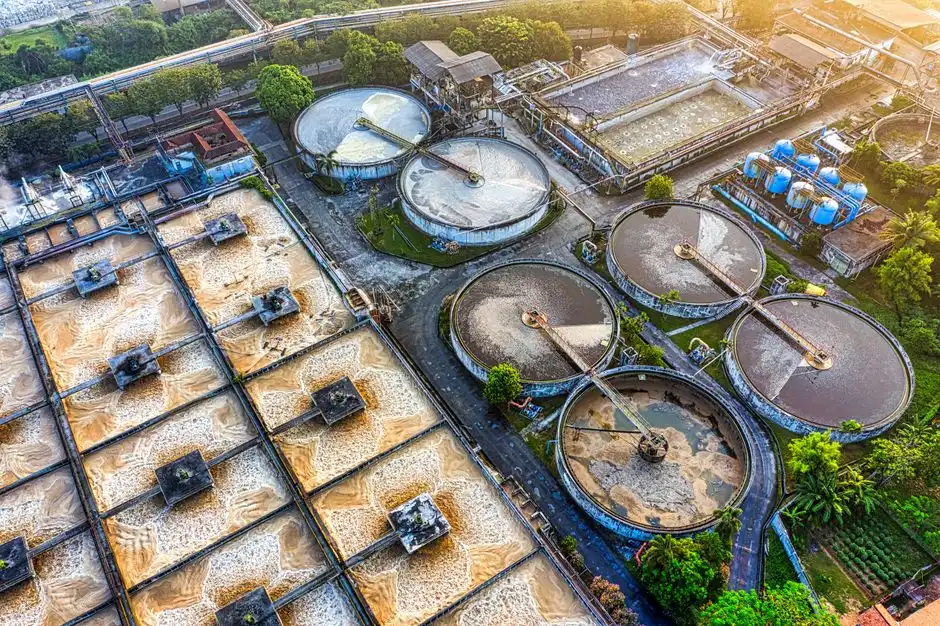
The defensible food-and-beverage treatment sequence is screening, equalization, dissolved air flotation, biological treatment, chemical precipitation, and final polishing. Each stage has a defined duty. Screening protects pumps and downstream equipment from debris and solids; equalization controls flow, organic load, pH, and temperature; DAF removes FOG and floatable solids; biological treatment addresses soluble BOD and COD; chemical precipitation targets phosphorus; final polishing addresses the permit’s most sensitive solids or BOD condition.
HydropureWater’s design table lists common POTW or categorical limits of 250–500 mg/L BOD, typically 100 mg/L TSS with 25–50 mg/L achievable, O&G of 25–50 mg/L, TSS of 50–100 mg/L, and pH of 6.0–9.0. These figures are design context, not Hickman permit terms. The exact applicable values must be confirmed in the current POTW permit and categorical standard.
| Stage | Primary duty | Source-reported design context | Key site-specific check |
|---|---|---|---|
| Screening and equalization | Protect equipment and stabilize the wastewater | HydropureWater identifies undersized equalization as a cause of hydraulic overload during a 4-hour CIP cycle. | Actual peak discharge, duration, pH, temperature, and batch-release sequence |
| DAF | Remove FOG and floatable solids | HydropureWater reports hydraulic loading of 4–25 m/h, recycle of 20–40% of forward flow, and an air-to-solids ratio of 0.005–0.02 for F&B applications. | Measured FOG, TSS, flow variability, and coagulant demand |
| Biological treatment | Remove soluble BOD and COD | HydropureWater reports HRT of 8–24 hours for conventional activated sludge and 4–10 hours for MBR; MLSS of 3,000–5,000 mg/L conventionally and 8,000–12,000 mg/L for MBR. | Raw load, biodegradability, temperature, pH, nutrients, and required HRT |
| MBR polishing option | Provide low-solids effluent with membrane filtration | HydropureWater reports final MBR effluent below 30 mg/L BOD and below 5 mg/L TSS. | Whether the permit requires consistently low solids and whether site constraints justify MBR |
| Chemical precipitation | Remove phosphorus | HydropureWater reports 50–250 mg/L alum or 30–150 mg/L ferric chloride; PLC-controlled dosing reduced chemical use by 10–20% versus manual feed. | Jar tests, phosphorus form, mixed-liquor alkalinity, mixing, flocculation, and solids separation |
| Final solids polishing | Meet the most sensitive permit condition | HydropureWater reports final MBR effluent below 30 mg/L BOD and below 5 mg/L TSS. | Permit limit and whether polishing is essential or optional |
DAF should be evaluated as an industrial DAF system for FOG and suspended-solids removal, with hydraulic and organic loading checked against the measured waste stream. An integrated membrane bioreactor is justified where consistently low solids matter or footprint is constrained; it is not an automatic replacement for conventional biological treatment. MBR performance cited by HydropureWater is an application-level benchmark, not a site guarantee.
Chemical treatment requires the same discipline. A PLC-controlled chemical dosing system can trim feed to actual demand, but the dose must come from jar testing and site chemistry. The design must address coagulant availability, alkalinity, mixing energy, flocculation, and the downstream mechanism for removing precipitated solids.
Diagnose the failures that trigger sewer-limit exceedances
Visible operating symptoms usually identify the weak process stage, but the corrective action must follow the cause. FOG pass-through is a DAF problem until proven otherwise: check coagulant conditioning, recycle, surface loading, and hydraulic overload. HydropureWater identifies under-dosed coagulant and flotation-cell overload as common causes.
| Symptom | Likely process weakness | Required diagnostic | Corrective action |
|---|---|---|---|
| FOG pass-through | DAF conditioning or hydraulic overload | Review coagulant dose, recycle rate, surface loading, float depth, and scum removal. | Correct conditioning and restore hydraulic capacity. |
| pH excursion | Undersized equalization or failed trim control | Trend pH, equalization level, blend flow, and chemical feed during product dumps and CIP. | Increase usable equalization or repair and tune the pH trim loop. |
| Overload during a four-hour CIP cycle | Equalization sized around average flow | Reconstruct the actual discharge hydrograph and compare it with basin capacity and downstream hydraulic limits. | Revise equalization or controlled-release operation. |
| Phosphorus exceedance | Chemical feed, mixing, flocculation, or solids separation | Verify dose, chemical form, alkalinity, mixer operation, floc condition, and residual solids. | Retune precipitation and correct the physical removal step. |
| Solids breakthrough | DAF carryover, biological solids loss, or inadequate clarification | Compare solids profile with hydraulic events, sludge wasting, and effluent turbidity or TSS trend. | Correct the responsible separation stage. |
| Compliance-data gap | Monitoring and recordkeeping failure | Reconcile samples, SCADA alarms, chemical deliveries, calibrations, and corrective actions. | Restore the audit trail and document the response. |
Published performance results provide context, not guaranteed output. Hixson reports optimized DAF results of 74% TSS removal and 99% oil-and-grease removal at poultry slaughterhouses; it also cites more recent poultry operations reporting up to 99% TSS, 85% BOD₅, and 98% phosphate removal. Hixson’s beverage-facility pilot results report effluent COD of 16.9 mg/L, effluent TSS of 3.8 mg/L, and COD removal of 92.6%. These results should be treated as reported pilot or application evidence.
For biological selection, use the comparison of activated sludge, MBR, and other BOD-removal options to verify that each proposed process is matched to the measured organic load. Operationally, require alarms, timestamped event logs, sample records, and documented corrective actions. A passing sample does not establish a complete compliance history.
Select equipment and assemble a permit-ready submittal
Equipment selection should compare each option by the problem it solves, the evidence supporting its performance, operating constraints, and the permit parameters it controls. A skid size or generic food-industry case study is not an engineering basis. The bidder must show how its proposed equipment handles the measured wastewater and final permit conditions.
| Equipment | Problem addressed | Source-reported scope | Buyer’s acceptance check |
|---|---|---|---|
| DAF | FOG, floatable solids, and colloidal matter | HydropureWater reports 4–300 m³/h across 13 standard models, with micro-bubble flotation and automatic skimming. | Calculation based on measured forward flow, peak-to-average ratio, FOG, TSS, recycle, and surface loading. |
| MBR | Biological treatment with low-solids polishing | HydropureWater reports 10–2,000 m³/day, filtration below 1 μm, and a footprint 60% smaller than conventional systems. | Raw load, footprint, membrane cleaning, energy demand, and permit need for low-solids effluent. |
| Automatic chemical dosing | Coagulant, flocculant, pH adjustment, and phosphorus removal | HydropureWater describes PLC-controlled injection for coagulants, flocculants, pH adjusters, and specialty chemicals. | Control interlocks, flow-proportional strategy, event logging, calibration, and chemical storage. |
| Lamella or sedimentation clarification | Compact solids polishing | HydropureWater reports a lamella product for 20–40 m/h surface loading and chemical consumption reduced by up to 30%. | Whether the permit requires this polishing step and whether the hydraulic and solids duty are verified. |
| Plate-and-frame filter press | DAF skummings and biological-waste-sludge dewatering | HydropureWater reports 1–500 m² filtration areas and dewatering to 22–28% dry matter. | Feed-solids characterization, batch cycle, filtrate return, cake handling, and disposal route. |
HydropureWater’s high-efficiency sedimentation product may be relevant where a compact polishing step is justified; the permit should establish that need before it becomes part of the scope. Similarly, a plate-and-frame filter press should be selected from measured sludge properties and disposal requirements, not from nominal filtration area alone.
Each bid should include:
- The current permit interpretation and categorical category;
- A guaranteed design basis and production-weighted wastewater characterization;
- Stage-by-stage process calculations;
- Materials of construction and utility requirements;
- A controls narrative, alarm list, and event-logging scope;
- A monitoring and sampling plan;
- O&M assumptions, chemical consumption, and sludge disposition;
- A compliance-performance guarantee tied to the final permit.
Do not accept a supplier’s generic food-processing case claim as that guarantee. Require measured wastewater data, the current Hickman-area permit conditions, and named operating inputs in the proposal.
Operational monitoring and reporting requirements
Ongoing compliance requires a traceable monitoring system, not isolated sample results. HydropureWater reports that most food-and-beverage categorical permits require 24-hour composite sampling for BOD, TSS, FOG, and total phosphorus at frequencies from monthly to quarterly. Those are source-reported permit patterns; the Hickman-area POTW permit determines the actual parameter list, frequency, sample point, and analytical method.
Confirm whether the POTW requires continuous pH and flow monitoring for the facility. If so, the instruments, calibration schedule, data validation, and alarm response need clear ownership. The PLC-controlled chemical dosing system should feed timestamped flow, setpoint, and alarm data into the plant record rather than leaving dose changes only in an operator log.
Use one reconciled compliance record: the SCADA event history, analytical results, calibration records, chemical deliveries, equipment alarms, sampling records, and corrective actions. This allows an auditor to trace what happened from production event to sample result. Electronic discharge-monitoring reports, POTW reporting portals, and applicable state noncompliance systems should then be treated as outputs of the same operational record.
The control authority must confirm current portal requirements, deadlines, credentials, and acceptable electronic formats. Do not transfer another state’s reporting workflow to the Hickman-area plant without verification. Missing a notification or retaining an unreconciled excursion can become a compliance failure even when a later sample passes.
Frequently Asked Questions
What is the cost of meeting pretreatment limits for a food plant near Hickman?
The supplied research contains no current Hickman-area equipment or installation quotation, so a defensible price cannot be stated from those sources. The budget request should separately price wastewater characterization, civil and mechanical work, screening, equalization, DAF or biological treatment, chemical dosing, polishing, sludge dewatering, controls, monitoring, commissioning, permits, and annual chemical and utility consumption. Each price should identify its design basis and exclusions. A lower equipment price can be misleading if equalization, chemical storage, solids removal, or reporting upgrades are omitted.
Which treatment technology should a Hickman-area food plant select?
Select the technology after identifying the controlling permit and measuring the wastewater. Use DAF when FOG and floatable solids are material, conventional biological treatment when the permit can be met with the required organic-removal performance, MBR when low solids or a constrained footprint justifies the added complexity, and chemical precipitation when phosphorus requires it. The regional food-plant sewer-limit guide provides a useful comparison framework, but the final selection must use the Hickman-area permit and site data.
How should a supplier prove that the proposed equipment will meet the permit?
Require a permit-bound proposal containing the design wastewater, stage-by-stage calculations, equipment sizing, controls narrative, monitoring plan, O&M assumptions, sludge plan, and a compliance-performance guarantee. Ask the supplier to identify every supplied number, its source, and its scope. A generic food-processing case study or supplier-published benchmark should be treated as supporting evidence, not proof that the proposed system will meet the site’s final permit conditions.
What delivery and commissioning scope should be included in the purchase?
No verified delivery or lead-time range appears in the supplied research, so request a written schedule from the manufacturer. Clarify whether the scope includes engineering, fabrication, freight, civil work, installation, electrical and controls integration, permits, operator training, startup, performance testing, and commissioning. Also identify acceptance criteria, what happens when site wastewater differs from the design basis, and who owns corrective action during performance testing.