What Borama’s Water Evidence Means for Data Center Design
Borama’s available evidence establishes water stress but does not determine industrial treatment design for a data center. The local case study, published by Springer Science and Business Media LLC as a Research Square preprint, investigated household drinking-water treatment with BioSand filters. It found up to 95.66% bacterial reduction under laboratory conditions, 87.9–98.5% in field conditions, consistent helminth removal, and 85% turbidity reduction. Those results support the local relevance of decentralized filtration, maintenance, and community adoption. They do not establish data-center effluent compliance or performance for cooling tower blowdown. The treatment design must instead be based on source characterization, a site-specific cooling water balance, local reuse and disposal routes, and an environmental assessment reviewed through Somalia’s National Environmental Management Authority, or NEMA.
The evidence boundary matters. The BioSand preprint had not been peer reviewed by a journal, and its household scope did not test industrial CTBD chemistry, reuse performance, or discharge quality. It also found that BioSand filters were limited in removing dissolved contaminants. That limitation rules out using turbidity reduction as evidence that the water is suitable for RO feed or cooling reuse.
For procurement, convert local concerns into a source-characterization package. Request seasonal turbidity, total dissolved solids, conductivity, hardness, silica, iron, manganese, microbial indicators, abstraction records, and the chemical program used in the cooling tower. These are inputs for design, not acceptance criteria for reuse. The broader data-center wastewater and cooling-blowdown treatment framework explains why household treatment evidence and industrial process design should remain separate documents.
Separate Sanitary Wastewater from Cooling Blowdown
A Borama data center should keep sanitary sewage and cooling tower blowdown hydraulically and chemically separate from collection through final reuse or disposal. Sanitary wastewater requires screening, equalization, biological treatment, solids separation, disinfection, and a destination matched to the selected reuse standard. Cooling blowdown requires equalization, suspended-solids removal, scale control, membrane treatment, reuse-water polishing, and concentrate management. Combining the streams risks oxidizing-biocide shock to biological biomass and precipitation of calcium and silica, which can blind membranes and transfer CTBD chemicals into the sanitary process.
The adapted Mogadishu sanitary reference in the HydropureWater 2026 guidance uses approximately 150 L/person/day, BOD of 200–300 mg/L, TSS of 200–250 mg/L, and NH₃-N of 20–40 mg/L. These values are a screening analogue, not a Borama design basis. The same guidance gives CTBD values of TDS 2,000–6,000 mg/L, hardness of 800–1,500 mg/L as CaCO₃, silica of 40–100 mg/L, and pH of 8.0–9.0, with residual biocides and phosphonates. Actual Borama samples must replace these provisional values.
| Design basis | Sanitary wastewater | Cooling tower blowdown |
|---|---|---|
| Primary objective | Remove organic matter and pathogens before the selected reuse or disposal route | Remove suspended solids and scale-forming species while recovering reusable water |
| Adapted Mogadishu screening values | 150 L/person/day; BOD 200–300 mg/L; TSS 200–250 mg/L; NH₃-N 20–40 mg/L | TDS 2,000–6,000 mg/L; hardness 800–1,500 mg/L as CaCO₃; silica 40–100 mg/L; pH 8.0–9.0 |
| Critical contamination risk | Pathogens, biodegradable organics, ammonia, solids | Residual biocide, phosphonate, calcium, silica, suspended corrosion products |
| Candidate treatment | Package A/O or MBR, clarification, disinfection | DAF or clarification, multimedia filtration, UF guard, scale control, RO |
| Outlet decision | Toilet flush, irrigation, permitted disposal, or licensed removal | Cooling make-up, discharge with verified acceptance, or concentrated residual management |
The sanitary outlet remains a separate compliance decision. An underground package sewage treatment plant may be relevant for screening, but disinfection and treatment must match toilet-flush, irrigation, on-site disposal, or permitted removal. The Mogadishu analogue illustrates a sizing method: 200 occupants at 150 L/person/day produce 30 m³/day, while a WSZ-50 unit at 50 m³/day leaves roughly 65% headroom. That is an analogy, not a Borama recommendation. A decentralized sewage treatment equipment guide provides further context for comparing packaged treatment modules.
Calculate the Cooling Water Balance Before Sizing Equipment
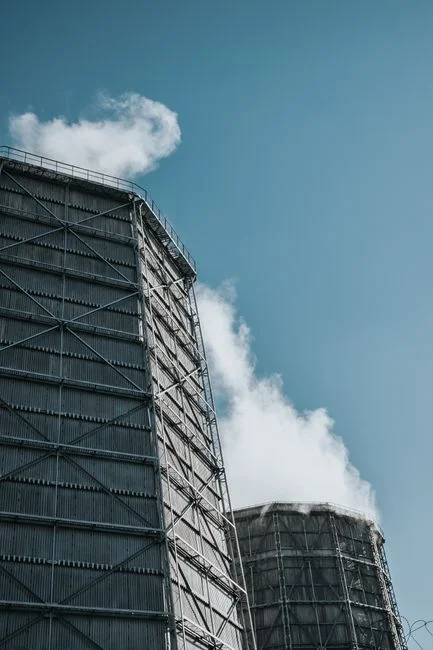
The cooling water balance determines CTBD flow, make-up demand, treatment capacity, and concentrate volume; it must precede equipment sizing. At a cycles of concentration, or CoC, of 4, blowdown equals 25% of make-up; at 6 CoC, it equals 20%. Moving from 4 to 6 CoC therefore reduces blowdown by five percentage points of make-up. It does not represent a 50% reduction, although it can materially lower freshwater withdrawal and discharge.
Build the calculation from the tower design rather than from a generic data-center flow:
- Obtain evaporative loss, drift, blowdown, and make-up estimates for each tower cell at the selected peak ambient conditions.
- Confirm the proposed CoC setpoint and the resulting blowdown percentage from the cooling designer.
- Identify emergency dumps, offline periods, future capacity, and any reuse-water credit accepted by the cooling system.
- Calculate the hourly and daily make-up and CTBD duties, then select treatment duty and installed redundancy with the responsible engineer.
| Calculation input | Evidence or information required | Procurement consequence |
|---|---|---|
| Evaporation and drift | Cooling-system model, local wet-bulb and dry-bulb data, tower configuration, operating hours | Sets make-up demand and the water lost from the recirculating loop |
| Cycles of concentration | Cooling designer’s operating setpoint and chemistry limits | Sets the blowdown-to-make-up relationship |
| Peak and emergency flows | Peak temperature, start-up conditions, dump events, downtime assumptions | Determines equalization, treatment peak, and storage requirements |
| Reuse destination | Permeate-quality requirement and confirmed credit in the cooling-water balance | Determines whether recovered permeate reduces external make-up |
IDE’s 2026 article states that a 100-megawatt data center may require up to 2 million liters of water per day. That is scale context only; the Borama flow must be calculated from the actual cooling configuration and local psychrometrics. The same discipline applies to cooling blowdown treatment in a water-constrained data center: ask for wet-season and peak-temperature data, number of cells, chemical program, future load, and planned outages. No generic Borama capacity or redundancy percentage is defensible before those inputs are available.
Treat Cooling Blowdown for Reuse Without Overloading the Membrane System
The recovery target determines both equipment complexity and the amount of concentrate that Borama must manage. The adapted Mogadishu design basis proposes PLC-controlled chemical dosing, lamella clarification or DAF, multimedia filtration, softener or antiscalant control, 5 µm cartridge filtration, RO, and UV or chlorine-dioxide polishing. These are candidate modules for verification, not a fixed plant configuration. DAF for solids removal, UF pretreatment for data-center water reuse, and an industrial reverse osmosis system address different parts of that train.
Multimedia filtration removes suspended material and can address iron and manganese; the UF guard then protects RO from colloids. The adapted design basis requires SDI below 3 and recommends UF after multimedia filtration. Softening and antiscalant dosing are not interchangeable: ion exchange replaces hardness ions with sodium, while antiscalant preserves the dissolved-salt balance while adding chemicals. The choice must follow the measured ion balance and pilot evidence.
| Recovery route | Recovery band | Principal advantage | Residual-waste and implementation issue |
|---|---|---|---|
| Conventional single-pass brackish-water RO | 75–80% | Simplest membrane route and lower procurement complexity | Leaves a concentrated brine; requires a verified discharge, haul-off, or further treatment route |
| Scale-controlled PFRO or pulse-flow RO | 90–96% | Higher recovery with controlled membrane operation | Requires validated chemistry, cleaning strategy, power resilience, and concentrate handling |
| Precipitation followed by RO | 95–99% | Converts scaling salts into a dense solids stream | Shifts the challenge to solids dewatering, final disposal, energy, and fuel supply |
IDE reported in 2026 that its industrial brine desalter operated at around 95% recovery and reduced permeate silica to about 1 mg/L. That field result demonstrates a possible operating outcome; it is not a transfer guarantee for Borama. A one-week pilot using actual CTBD is required before finalizing antiscalant selection, recovery, pretreatment, flux, cleaning interval, and concentrate chemistry.
At lower recovery, a filter press for RO concentrate solids handling can dewater captured solids and recycle the supernatant. A precipitation-based high-recovery route adds thermal crystallization and produces a salt cake, creating a zero liquid discharge problem unless thermal capacity and disposal arrangements are secured. Chemical dosing should be metered and monitored, while UV or chlorine-dioxide disinfection must match the selected reuse destination. Candidate equipment modules therefore remain separate until the pilot establishes the complete CTBD train.
Turn the Treatment Concept into a Borama Procurement Package
Procurement should proceed in phases, with the pilot and permit pathway completed before the treatment package is frozen. The sequence is baseline source testing and cooling-water balance; sanitary and CTBD flow estimates; NEMA pre-consultation; treatment pilot; conceptual design; EIA and permit submission; equipment procurement; installation; and commissioning. This order prevents a generic equipment quotation from becoming the governing design.
Require the one-week pilot to use actual CTBD and to report membrane flux, normalized recovery, pressure rise, cleaning frequency, pretreatment demand, antiscalant consumption, and concentrate chemistry. Its results should update the RO and UF membrane replacement strategy and the treatment guarantees. Disinfection requirements should also be explicit, whether the vendor proposes UV or a chlorine-dioxide generator.
| Vendor proposal component | Required detail |
|---|---|
| Ex-works equipment | Skids, membranes, vessels, pumps, instruments, PLC/SCADA, and performance exclusions stated separately |
| Imported consumables and spares | Initial membrane sets, filter cartridges, antiscalant, chemicals, dosing-pump parts, and critical-spares quantities |
| Delivery and site works | Containerization, marine freight and insurance, port clearance, inland haul, local installation, commissioning, and training priced as separate items |
| Power and resilience | Generator-backed loads, UPS for controls, VFD soft starts, remote monitoring, and operating assumptions |
| First-year operating cost | Membranes, chemicals, cartridge filters, fuel or electricity, labor, maintenance, and waste removal identified separately |
The Mogadishu logistics analogue estimates RO-skid delivery at 16–20 weeks ex-works plus 6–8 weeks for port clearance through transshipment. The actual Borama route, port, security conditions, customs requirements, and current lead times must be confirmed rather than copied. The design should include N+1 generator capacity, UPS support for PLC and SCADA, VFD soft starts for the RO high-pressure pump, remote monitoring, quarterly vendor support, and stocked critical spares. Modular shipment is useful where it reduces civil work, supports phased commissioning, or permits relocation if the security situation changes.
Confirm Environmental and Residual-Waste Responsibilities
Permitability and residual-waste disposal are design constraints, not post-purchase compliance tasks. Somalia’s Environmental Management Act, enacted in 2019, and NEMA guidance reference WHO/FAO standards, but the public record cited in the HydropureWater 2026 guidance contains no numeric industrial effluent limits specifically for data centers. Therefore, no reuse or discharge specification can be inferred from that record.
The same guidance cites Maputo values of pH 6–9, a discharge-point temperature rise below 3°C, class-based TSS controls, and chloride or TDS controls for marine pathways. These are regional engineering proxies, not Somali legal limits. A Borama environmental assessment should be coordinated through NEMA and include baseline intake and discharge chemistry, groundwater-abstraction information, thermal-discharge implications, and the proposed receiving or disposal route.
The planning analogue in the research assigns 12–18 months for permitting coordination in Mogadishu. No published NEMA permit timeline was identified in the cited public record, so a local environmental consultant should establish the actual schedule and required submissions. Confirm abstraction and discharge pathways early. Where no sewer, surface-water, or groundwater discharge route has been verified, on-site zero liquid discharge or licensed tanker removal must be evaluated as an alternative, not assumed away.
Assign ownership for filter-press cake, crystallized salts, used membranes, dosing chemicals, and transport to the final disposal destination. A filter-press process-flow reference can support clarification of the solids route, but it does not replace a licensed waste destination or local environmental approval. The permit scope, waste classification, transport responsibility, and receiving facility should be named in the purchase documents.
Frequently Asked Questions
What treatment capacity does a data center in Borama, Somalia need?
No defensible equipment capacity can be named from the available research alone. Calculate make-up and blowdown from evaporation, drift, operating hours, peak conditions, and the selected CoC; at 4 CoC, blowdown is 25% of make-up, while at 6 CoC it is 20%. Then size the CTBD train against the engineer-approved peak duty and add redundancy based on outage and dump scenarios. The sanitary train should be calculated separately from verified occupancy and wastewater flow.
Which cooling-blowdown treatment route should Borama select?
Select from pilot results and disposal conditions, not from recovery percentage alone. Conventional brackish-water RO offers the simplest route but leaves more brine; scale-controlled RO requires validated chemistry and more demanding operation; precipitation plus RO shifts the residual stream to dewatered solids and potentially salt cake. Confirm concentrate disposal, power availability, remote O&M capability, and the selected reuse destination before choosing equipment. A comparison of treatment-selection and supplier-evaluation criteria should be applied to actual CTBD chemistry.
How much will the Borama treatment package cost?
A fixed price or per-m³ operating cost cannot be issued from the available research. Request a line-itemized quotation separating ex-works equipment, membranes and consumables, containerization, marine freight and insurance, customs, port clearance, inland haul, local installation, commissioning, generator-related works, first-year consumables, and waste-disposal costs. The supplier should also state exclusions and performance guarantees so that different technical scopes remain comparable.
Which supplier should be selected for CTBD treatment?
Require demonstrated CTBD chemistry experience, one-week pilot support, remote SCADA capability, a critical-spares plan, and transparent treatment and concentrate guarantees. Ask how the supplier will support local technicians, respond to membrane fouling, manage chemicals, and maintain performance during generator operation. Check whether proposed recovery and pretreatment claims are backed by comparable CTBD tests rather than household filtration or a single industrial case. Include the data-center wastewater and cooling-blowdown treatment framework in the technical schedule to hold the scope consistent.