What a Ha'il data center must treat
A data center in Ha'il generally needs three treatment decisions: treatment of sanitary wastewater, treatment of cooling-tower blowdown for reuse or compliant disposal, and pretreatment of any other industrial wastewater before membrane or biological systems. In evaporative cooling, blowdown contains concentrated dissolved salts such as silica, calcium carbonate and calcium sulfate. Conventional brackish RO is commonly limited to 75–80% recovery, so a Ha'il project should assess UF pretreatment, RO recovery, residual-brine control and reuse chemistry together rather than specify RO in isolation. The required capacity and permit conditions must be established from measured flows, water analyses, cooling configuration and Saudi discharge requirements.
Cooling-tower blowdown should remain separate from sanitary wastewater because the two streams require different treatment objectives. Evaporation removes water while concentrating dissolved constituents, so blowdown recovery must address mineralization, scale formation and corrosion compatibility. Sanitary wastewater, by contrast, requires biological treatment. The broader Arusha data-center wastewater and cooling-blowdown treatment framework and the data-center cooling-blowdown treatment methodology provide useful comparisons, but neither establishes Ha'il site flows or permit limits.
| Source category | Principal contaminants and operating concern | Required design basis |
|---|---|---|
| Sanitary wastewater | Organic matter, suspended solids and biological load | Flow profile, wastewater analysis, biological treatment objectives and reuse or discharge destination |
| Cooling-tower blowdown | Concentrated dissolved salts, including silica, calcium carbonate and calcium sulfate | Cooling cycles of concentration, makeup-water chemistry, inhibitor carryover, recovery target and residual route |
| Other wastewater | Power-generation, washdown, firewater-testing or maintenance contaminants | Source-by-source flow, chemistry, chemical inventory and compatibility with any common treatment train |
Power-generation water is a further design question. An ASME International study on evaporative cooling and HRSG blowdown recycling examined how power and desalination combined-cycle plants could integrate blowdown into broader reuse strategies; it does not establish conditions for a Ha'il data center. The buyer should therefore determine whether onsite generation exists and whether its blowdown is separate, blended or excluded. Until site-specific data are supplied, flows, groundwater quality, freshwater quality and applicable discharge limits remain unresolved inputs rather than design assumptions.
Build the Ha'il water and salt balance
The treatment train should be sized from a reconciled cooling-water and wastewater mass balance, not from average wastewater generation. For each evaporative cooling circuit, determine gross blowdown, evaporation, drift, makeup water, expected cycles of concentration and the portion of blowdown that can remain in service, be reused or must leave the site. The critical calculation is the salt balance: freshwater additions carry dissolved solids into the cooling loop, evaporation leaves those solids behind, and control of cycles of concentration determines how much blowdown and residual treatment capacity are required.
Request 12 months of operating data where available, followed by a representative campaign that captures startup, shutdown and peak cooling conditions. The sampling plan should measure pH, conductivity, total dissolved solids, calcium, hardness, alkalinity, silica, chloride, sulfate, iron, manganese, turbidity, suspended solids, total organic carbon and relevant biological indicators. It should also record cooling-water chemistry, inhibitor products, cleaning chemicals and any antiscalant carryover because these affect membrane compatibility, disinfection requirements and reuse quality.
| Balance input | How to establish it | Decision affected |
|---|---|---|
| Cooling-system configuration | Identify circuit arrangement, operating temperature, cooling method and metering points | Treatment flows, recovery objective and reuse quality |
| Water chemistry | Analyze freshwater, circulating water, makeup and blowdown | Scaling risk, membrane selection and chemical compatibility |
| Operating history | Obtain available monthly data and conduct representative peak-condition monitoring | Design flow, storage, redundancy and chemical consumption |
| Site wastewater | Measure each source separately across normal and exceptional operations | Sanitary treatment and pretreatment boundaries |
IDE Tech reports water demand of up to 2 million liters per day for a 100-megawatt facility, but that published figure is a general context value, not a Ha'il design flow. Actual demand must be derived from the facility's IT load, cooling configuration, operating profile and climate-adjusted conditions. Chemical dosing should be selected only after this balance and a compatibility review; an automatic chemical dosing system may support controlled pH adjustment or specialty treatment, but it cannot correct an unresolved salt balance or unsupported recovery claim.
Select the cooling-blowdown treatment process
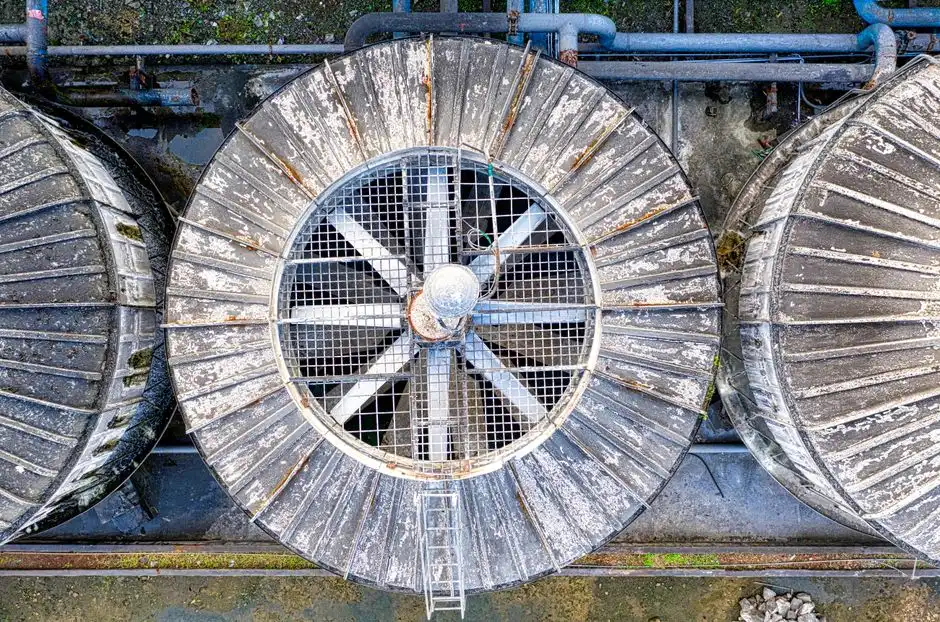
A defensible cooling-blowdown process starts with characterization, removes suspended solids, controls scaling chemistry, applies reverse osmosis where the reuse objective justifies it, conditions the permeate and establishes a verified residual-management route. Pretreatment must protect the membrane system; RO then removes dissolved salts; post-treatment chemistry must make the permeate compatible with the receiving cooling system. The concentrate cannot be omitted from the equipment selection because it remains the destination of the removed salts.
For solids removal and RO pretreatment, evaluate the UF pretreatment for data-center wastewater. HydropureWater specifies UF systems from 2,000–40,000 L/h, 0.03-micron PVDF membranes, feed turbidity up to 300 ppm, automatic backwash and air scour. Those are product parameters, not confirmation that the stream is suitable; actual feed chemistry, temperature, flow and membrane-fouling potential still require review.
| Process option | Primary function | Selection condition | Residual-management issue |
|---|---|---|---|
| UF alone | Remove suspended solids and protect downstream equipment | The treated-water quality directly fits the selected duty without dissolved-salt removal | Concentrated reject from UF still requires a destination |
| UF followed by RO | Produce lower-salinity water for reuse | Makeup or process reuse requires control of dissolved salts, scaling ions and silica | RO concentrate must be recovered, discharged under an approved route or further treated |
| High-recovery architecture | Increase recovery through staged treatment or controlled precipitation | Conventional RO recovery is insufficient and the additional chemistry and solids handling are justified | Precipitated solids and residual brine require verified handling |
For the main demineralization step, evaluate an industrial RO system for cooling-blowdown reuse. HydropureWater specifies recovery rates up to 95%, but this is a maximum equipment claim rather than a guaranteed Ha'il operating result. The site recovery must be calculated from the complete analysis, feed temperature, concentration limits, membrane selection and concentrate-management constraints.
IDE Tech reports that conventional brackish-water RO is often limited to 75–80% recovery before scaling becomes unmanageable, and describes an industrial cooling-blowdown application operating at around 95% recovery with permeate silica reduced to about 1 mg/L. These figures belong to the cited examples, not to the proposed Ha'il site. The same source describes controlled precipitation in a fluidized-bed reactor, where sparingly soluble salts form dense solids, together with dynamic RO operation intended to control membrane-surface crystallization.
Where high recovery is required, compare controlled precipitation, staged treatment and other verified architectures on the complete mass balance. Zero liquid discharge should not be promised unless brine volume, solids handling, energy demand and the final residual-disposal route have been demonstrated. The industrial water softener system may address hardness in a defined pretreatment duty, but softening does not remove all dissolved salts or resolve silica concentration.
Decide where the treated water should go
The reuse destination determines the required water quality and the acceptable residual route. Compare cooling make-up reuse, selected process or washdown reuse, transfer to another authorized user, and compliant discharge after treatment. These options should be evaluated independently because a route that works for low-pressure washdown may be unsuitable for cooling make-up, while direct discharge may be constrained by the concentration and temperature of the final stream.
| Destination | Quality and operating checks | Decision required |
|---|---|---|
| Cooling make-up | Conductivity, hardness, alkalinity, silica, pH, inhibitor residual and biological limits against the actual cooling program | Confirm blending, chemical conditioning and protection against scale, corrosion and biological growth |
| Process or washdown reuse | Required purity, temperature, suspended solids and application-specific chemistry | Match treatment quality to each duty rather than using one generic reuse specification |
| Transfer to another authorized user | Receiving-user quality specification, quantity, pressure and contractual responsibility | Confirm the user's treatment, monitoring and residual obligations |
| Compliant discharge | Applicable Saudi discharge, reuse and environmental requirements | Obtain confirmation from the authority having jurisdiction and a licensed local designer |
Freshwater savings should be calculated from the verified site water balance, including the cooling tower cycles of concentration, reuse fraction and operating profile. Generic data-center water-use claims do not establish the Ha'il case. The selected recovery rate also determines the residual stream: treatment changes the water's destination and concentration; it does not remove the obligation to manage remaining salts and contaminants.
Sanitary wastewater requires a biological route rather than the cooling-blowdown membrane train. HydropureWater specifies its MBR integrated wastewater treatment system for 10–2,000 m³/day, with near-reuse-quality effluent and filtration below 1 micron. That specification makes MBR relevant for evaluation where the measured sanitary flow and reuse objective support it, but it does not determine the Ha'il configuration.
The supplied research does not provide a Ha'il-specific permit limit. Applicable Saudi discharge, reuse and environmental conditions must therefore be confirmed with the relevant authority and a licensed local designer. A broader zero-liquid-discharge capacity assessment can help structure the residual-management question, but it does not substitute for a Ha'il compliance review.
Size equipment with redundancy and operating safeguards
Each major treatment stage should be sized using the verified design peak flow and the operator's confirmed redundancy criterion. Average daily wastewater flow is not an appropriate design basis for a mission-critical cooling-water system. The technical schedule should state average and peak flow, design operating hours, required standby capacity, future cooling expansion and the maximum permitted interruption. It should also define whether storage, standby treatment or an alternate supply provides continuity during maintenance or an upset.
| RFQ item | Minimum information required | Reason for inclusion |
|---|---|---|
| Design basis | Peak flow, operating hours, standby criterion, expansion and allowable interruption | Prevents average-flow undersizing and defines availability |
| Treatment scope | Pretreatment, filtration, high-pressure pumping, RO, energy recovery where justified, permeate storage and clean-in-place provisions | Establishes a complete operating train rather than isolated equipment |
| Controls | Differential pressure, permeate conductivity, recovery, feed pressure, turbidity and critical chemistry monitoring with alarms | Supports early fault detection and controlled responses |
| Fail-safe routing | Defined response for power loss, membrane breach, high conductivity and treatment interruption | Protects cooling continuity and reuse quality |
| Supplier commitments | Design feed analysis, temperature range, recovery calculation, membrane model, cleaning philosophy, consumables, warranty and availability | Makes proposals technically comparable |
The controls specification should define alarm setpoints, automatic actions and the safe operating state. For example, high feed pressure or rising differential pressure should trigger investigation without causing an uncontrolled loss of cooling supply. Fail-safe routing should address loss of power, membrane or filter breach, permeate conductivity excursion, chemical dosing failure and treatment interruption.
Use the RO and UF membrane and filter elements schedule to confirm model compatibility with the specified feed chemistry, temperature and recovery calculation. The water-treatment parts, valves and filter media schedule should identify critical spares and consumables. Chemical dosing remains a controlled part of the process, not a substitute for correct pretreatment, recovery design or residual management.
Avoid the main procurement and operating risks
A quotation without site analyses, flow documentation, a stream-by-stream mass balance or an explicit concentrate-disposal route is incomplete. Reject it before comparing equipment price. The supplier should show which water analysis was used, how each design flow was derived and where every residual stream will go.
Do not accept a manufacturer's maximum recovery as guaranteed site performance. Require the recovery basis, assumptions, temperature correction, membrane-fouling allowance, scaling calculation and treatment of concentrate quality. For example, a 95% equipment claim cannot be used as the site's operating target without the complete water analysis and an approved residual route.
Keep equipment compliance separate from environmental compliance. An RO datasheet does not authorize discharge, and a reuse calculation does not establish permission to return water to a cooling tower. Obtain the applicable Ha'il requirements from the authority having jurisdiction and a licensed local designer. Planning guidance in the effluent-treatment buyer guide and the wastewater-treatment-plant sizing guide can support procurement structure, but neither supplies Ha'il-specific environmental approval.
Complete chemical-cleaning, membrane-replacement, cartridge-replacement, spare-parts, operator-training and remote-monitoring plans before commissioning. Pilot-test the highest-risk chemistry or recycle stream when silica, scaling indices, suspended solids or inhibitor carryover remain uncertain. This is especially important where recycled permeate, chemical treatment and cooling concentration interact in ways that may not appear in a single water analysis.
Frequently Asked Questions
How much should a Ha'il data center budget for wastewater and cooling-blowdown treatment?
The buyer should request a site-specific lifecycle estimate rather than use a generic industry price. The supplied research provides no Ha'il cost figure. The estimate should itemize pretreatment, membranes, pumping, storage, controls, chemicals, cleaning, energy, solids handling, concentrate management, commissioning and operator training, with separate pricing for each reuse or disposal route.
Should a data center choose UF alone or UF followed by RO?
Use UF alone only where its treated-water quality directly satisfies the intended duty and no dissolved-salt reduction is required. Use UF followed by RO when cooling make-up or another reuse application requires control of dissolved salts, silica and scaling constituents. The final selection depends on the complete source analysis and the receiving system's water specification.
What information should be included in an equipment RFQ?
Include source-by-source average and peak flows, complete water analyses, cooling-system data, chemical and inhibitor inventory, reuse requirements, operating hours, expansion plans, standby criteria, recovery calculation basis, membrane details, controls, fail-safe routing and the destination of every liquid and solid residual.
Can a cooling-blowdown treatment system guarantee zero liquid discharge?
No such guarantee follows from the supplied evidence. A zero-liquid-discharge claim requires a complete mass balance and verified routes for all remaining liquid and solid residuals. The bid should quantify the residual volume and composition, identify the receiving route, document solids handling and state the operating assumptions supporting the claim.
Which Saudi authority or standard should approve the discharge and reuse plan?
The supplied research does not identify the applicable Ha'il permit or Saudi standard for this project. The buyer should request written confirmation from the authority having jurisdiction, supported by a licensed local environmental designer, covering discharge, reuse, residual handling and any monitoring or reporting conditions.