Why Indore Is a Special Case for Data-Center Water
Indore sits in the Malwa / West-Central India hot semi-arid belt, where 45°C summer temperatures collide with seasonal surface- and groundwater stress; any 2026 design for a 5–30 MW data center must prioritize reuse. CEEW's 2025 finding, cited by Earth5r, is that 57% of Indian districts are at high to very high risk of extreme heat, including many existing data-centre hubs, so Indore sits inside a national heat-risk pattern rather than an isolated pocket.
India has no national data-centre water-efficiency standard and no mandatory sectoral water-use reporting; of the 15 states with data-centre policies, only five include explicit sustainability provisions (Earth5r, 2025), which makes MPPCB / MPCB consent the binding instrument on the ground in Indore. Rack density has migrated from 1–3 kW per rack in the early 2000s to around 8 kW today (Earth5r, 2025), which lifts cooling intensity per megawatt and pushes the per-MW water figure toward the higher end of the band cited by CEEW/IEA for a 100 MW site. Generic blowdown guidance written for temperate, water-rich grids understates both the cooling load and the disclosure burden. The engineer must plan around a hot-season peak that is a permanent design input, not an edge case.
The Two Wastewater Streams an Indore Data Center Actually Has
An Indore data center in 2026 must treat two separate wastewater streams: cooling tower blowdown (CTBD) and domestic sewage. Stream one is CTBD — the periodic purge from the recirculating cooling loop needed to stop dissolved solids, corrosion byproducts, and biological growth from concentrating past safe limits. At about 4 cycles of concentration, 25–30% of makeup water leaves as blowdown, with TDS of 1,200–6,000 mg/L (4–8× the makeup), 10–50 mg/L suspended solids, and an accumulated load of biocides, corrosion inhibitors, scale inhibitors, and dispersants; legacy chromate and high-phosphate chemistries complicate reuse or discharge (Genesis Water Tech). Stream two is on-site domestic sewage from offices, the cafeteria, and any staff housing — lower in flow but high in BOD, which must meet MPCB effluent conditions under a separate consent line. Routing sewage into the blowdown RO train is a common error that leads to fouling, biocide interaction, and TDS swings that destroy membrane life and breach consent. The two streams require a physico-chemical and membrane train plus a biological train run on parallel consent lines, rather than a single combined unit, with a buried packaged A/O sewage plant sized for the staff flow.
Sizing the Indore Site: From Contracted Load to Blowdown Volume
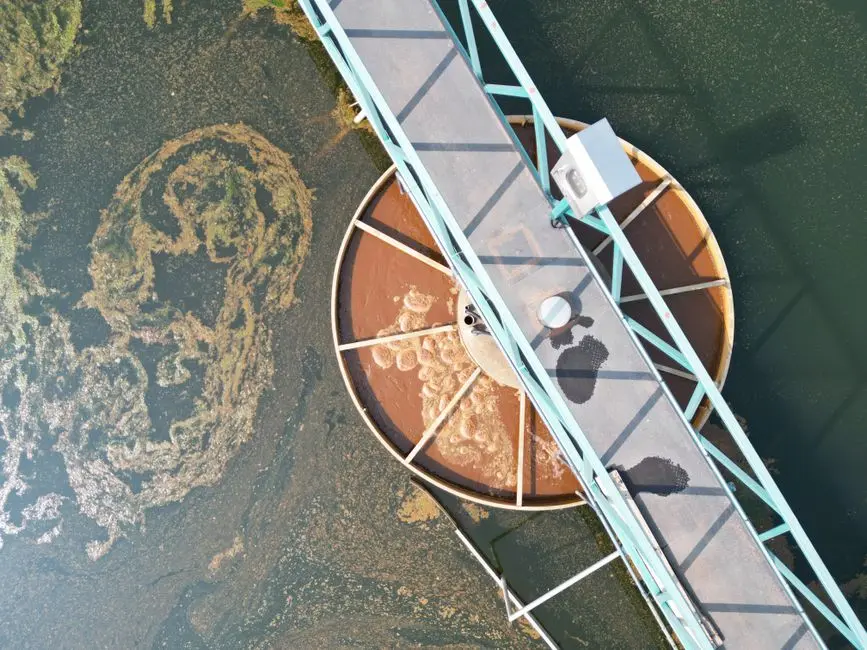
The working benchmark is the IEA figure cited by CEEW: a 100 MW hyperscale facility uses roughly 0.8–2 million litres a day for on-site cooling, with the upper end the realistic Indore assumption given Malwa summer peaks (Earth5r, citing CEEW, 2025). Properly sizing these treatment systems requires evaluating the specific environmental and operational variables of the site. For a 10 MW reference site, the engineer picks a per-MW water use within the 8,000–20,000 L/day range and applies a 20–30% blowdown fraction on makeup water (Genesis Water Tech) to estimate blowdown volume. Final numbers must come from the project PUE, target WUE in L/kWh, cooling-tower cycles of concentration, the makeup source mix (Indore Municipal Corporation vs borewell vs recycled sewage), and Indore-specific wet-bulb and dry-bulb design conditions — the table below is an order-of-magnitude envelope only. Inputs the engineer must collect before sizing: contracted IT load, design PUE, target WUE, cycles of concentration, makeup source and quality, and the Indore wet/dry-bulb envelope. The site is also not a uniform grid: free-cooling hours drop sharply in April–June, so the blowdown generation curve is seasonal, not flat.
| Parameter | Lower-end assumption | Upper-end assumption (Indore peak summer) |
|---|---|---|
| Per-MW on-site cooling water use (L/day) | 8,000 | 20,000 |
| Cycles of concentration in cooling tower | 4 | 5–6 |
| Blowdown fraction of makeup water | 20% | 30% |
| 10 MW site — daily makeup (L/day) | 80,000 | 200,000 |
| 10 MW site — daily CTBD generated (L/day) | 16,000 | 60,000 |
| CTBD TDS (mg/L) | 1,200 | 6,000 |
| CTBD suspended solids (mg/L) | 10 | 50 |
The 2026 Reuse-First Treatment Train for CTBD
Reuse is now a standard industry practice, with AWS cooling 20 data centres on purified wastewater by 2023 and Google using reclaimed or non-potable water at over 25% of its campuses (KETOS, 2026). A typical reuse train runs side-stream filtration → antiscalant dosing → ultrafiltration (0.01–0.1 µm) as RO guard → brackish-water RO at conservative local recovery, with permeate (10–50 mg/L TDS per Genesis Water Tech) returned to the cooling-tower makeup stream through an industrial RO system. Recovery for blowdown RO sits in the 50–85% band because of scaling potential on calcium, magnesium, and silica; pushing higher requires staged brine management. Side-stream filtration is sized at 1–5% of total circulation flow with capital costs of $50,000–200,000 for typical data-center installations (Genesis Water Tech), and the 0.01–0.1 µm UF guard drops suspended solids to a level the RO can take without rapid fouling. India's five sustainability-flagged state policies are the current ceiling: Rajasthan's 2025 policy is the most complete, requiring wastewater recycling, ZLD, rainwater harvesting, and groundwater recharge (Earth5r, 2025) — the direction an Indore design should anticipate even if MPPCB consent today is less prescriptive.
On-Site Domestic Sewage: Picking the Right Packaged Plant
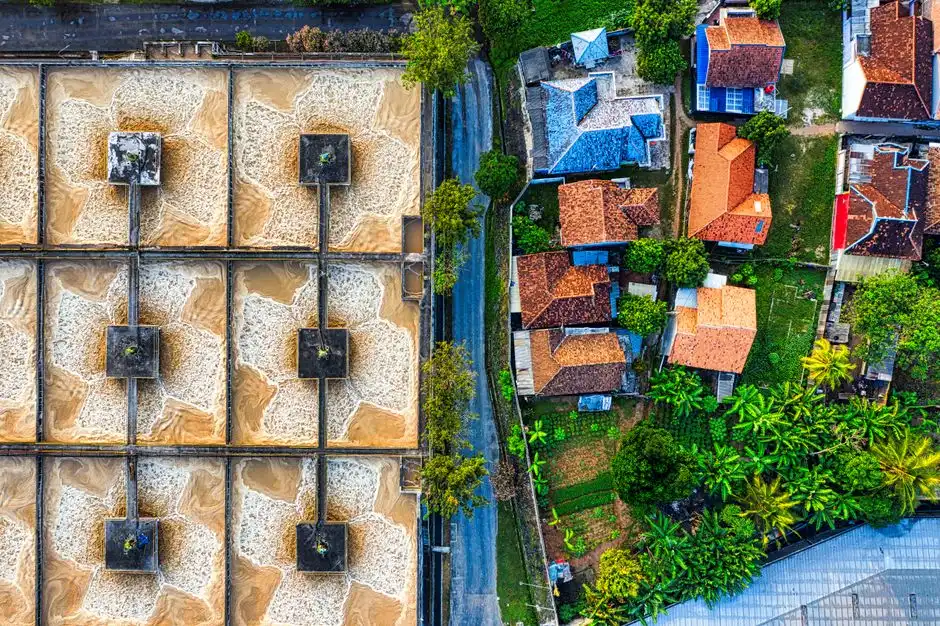
Staff sewage is sized against the CPHEEO urban norm of 135 litres per person per day, cross-checked against the Earth5r estimate that a 100 MW facility's water footprint is equivalent to the daily domestic supply of roughly 6,000–15,000 people. At 5–20 MW the sewage flow is modest and the right plant depends on footprint and reuse intent: a packaged A/O sewage plant of the WSZ type handles 1–80 m³/h and suits campus flows where land is at a premium and the treated stream goes to land irrigation or a soak pit. An MBR system (10–2,000 m³/day, sub-micron filtrate) is the right pick when the operator wants treated sewage for toilet flushing or landscaping, because it produces near-reuse-quality effluent with a smaller footprint than conventional activated sludge. A ClO₂ generator belongs on the CTBD side as a biocide control option for the cooling loop, not on the sewage side where it interacts negatively with RO membranes. Reject any single-train proposal that mixes CTBD and domestic sewage — it is a consent risk and a membrane-life risk.
When Indore Designs Should Future-Proof for ZLD
Some jurisdictions cap blowdown TDS below 1,500 mg/L for discharge, effectively prohibiting direct disposal of concentrated blowdown (Genesis Water Tech) — Indore designers should check MPPCB's current general consent range against this benchmark before locking the train. Where MPCB tightens further, a partial ZLD path (RO at 70–80% recovery → MVC or brine concentrator at ~95% recovery) captures most of the benefit at lower cost than full crystallisation; a full ZLD train with crystalliser pushes capex into the $3–8 million range typical of data-center ZLD (Genesis Water Tech). Mechanical vapour compression is the default evaporation stage for data-center CTBD because it avoids the need for a steam source and produces distillate with TDS below 10 mg/L, usable as high-quality cooling-tower makeup. ZLD remains a future-proofing option in 2026 Indore designs, not the default — reuse is the default, ZLD is the upgrade path if consent tightens or freshwater cost rises sharply. The MVC distillate line is also a useful buffer against Indore Municipal Corporation supply interruptions.
Compliance, Disclosure and What to Ask a Supplier in 2026
Disclosure is voluntary unless the operator falls inside SEBI's top-1,000 listed companies bound by the Business Responsibility and Sustainability Report (Earth5r, 2025). BRSR Principle 6 requires disclosure of water withdrawal by source, consumption, water intensity, discharge by destination, level of treatment, and ZLD status — so the way a facility treats cooling-tower blowdown is a direct disclosure line item. Ask for hyperscale precedents analogous to the AWS (20 sites on purified wastewater by 2023) and Google (reclaimed water at 25%+ of campuses) cases cited by KETOS (2026), and request evidence that the proposed train meets BRSR Principle 6 disclosure and MPPCB / MPCB consent parameters for the Indore site. Reject any single-train proposal that mixes CTBD and domestic sewage — it is a consent risk and a membrane-life risk at the same time. Comparable engineering treatments for similar climates are documented in the Nagpur data center blowdown guide, the Santo Domingo data center guide, the Manaus data center guide, and the Perth data hall process wastewater guide, all of which separate the cooling-tower stream from the sanitary stream.
Frequently Asked Questions
What wastewater and cooling blowdown treatment does a data center in Indore, India need?
Two separate streams: a physico-chemical + UF/RO train for CTBD and a biological (A/O packaged plant or MBR) train for staff sewage, with a reuse-first RO permeate loop returning blowdown to the cooling-tower makeup stream. The two streams must run on separate MPCB consent lines.
How much does a data center blowdown treatment system cost in Indore?
Cost is project-specific. Ask suppliers to band their capex against the Genesis Water Tech range — $250,000–$500,000 for a 50,000 GPD RO train and $3–8 million for a full ZLD train — and to scope a reuse-only train for the 10–30 MW Indore envelope before binding to a single number. Operating cost is $1.50–3.00 per thousand gallons treated for RO; $5–15 per thousand gallons for ZLD (Genesis Water Tech).
Is MPCB consent required for cooling-tower blowdown discharge in Indore?
Yes, blowdown discharge falls under MPPCB / MPCB consent, and the engineer must confirm the consent terms before sizing the train. Some jurisdictions cap blowdown TDS below 1,500 mg/L for discharge (Genesis Water Tech), so the consent TDS limit is the binding number for the train selection.
Can blowdown be reused as cooling-tower makeup water?
Yes, and it is the 2026 default