
Start with the permit and the actual wastewater matrix
For mining and metals wastewater, MBR is usually the stronger choice when the site has a constrained footprint, variable or shock-prone influent, and a clear water-reuse or brine-disposal driver. Conventional activated sludge remains economical for large, dilute flows where a serviceable aeration basin already exists and reuse value is low. Neither biological process removes dissolved metals by itself: upstream precipitation remains necessary, and a site pilot must verify performance with the actual feed. The choice should therefore start with the current NPDES permit and influent characterization, not with a generic comparison of membrane and clarifier equipment.
40 CFR Part 440 establishes federal effluent limits for arsenic, lead, zinc, copper, nickel and cadmium in ore mining and dressing discharges. The current site permit must be checked for the applicable daily-maximum and monthly-average limits, along with state-specific conditions such as selenium and sulfate limits. Federal requirements do not establish the biological process selection by themselves: discharge compliance, reuse quality and pretreatment needs are separate design questions.
Obtain at least 30 days of representative influent and effluent data before selecting a treatment train. Hydroponics-style “mine-water formula” assumptions are not a substitute for a site-specific metals matrix. HydropureWater’s 2026 field observations identify BOD/COD below 0.3, sulfate above 1,000 mg/L, TDS above 5,000 mg/L and hardness in the thousands of mg/L as CaCO3 as screening flags for biological-treatment and membrane-fouling risk. These are field observations, not universal design limits, and they should be confirmed against sampling.
Separate soluble metals from particulate metals. Both MBR and CAS require upstream precipitation under the source-described approach: pH 8.5–9.5 for CAS and pH 6.5–7.5 for MBR to maintain metals in hydroxide form. MBR’s membrane solids separation improves clarification, but it is not a substitute for chemical precipitation. Reuse, zero-liquid-discharge or process-water applications may also require filtration, disinfection or RO; those units should not be assigned automatically to the MBR.
| Design basis | What the buyer must confirm | Implication for MBR versus CAS |
|---|---|---|
| Regulatory envelope | Current NPDES limits, state selenium and sulfate conditions, discharge point | Neither process can be approved against federal limits without the current site permit. |
| Wastewater matrix | At least 30 days of influent and effluent data; soluble and particulate metals | High sulfate, TDS, hardness or low BOD/COD requires site-specific process review and pilot evidence. |
| Metals removal route | Precipitation chemistry, pH control, solids separation | Both trains need upstream precipitation; MBR does not eliminate the requirement. |
| End use | Discharge, reuse, brine disposal or zero-liquid-discharge criteria | Additional polishing should be defined by the reuse specification rather than assumed from MBR selection. |
For a broader explanation of treatment-train configuration and cost, use the 2026 MBR cost per m³ guide as a secondary reference, then reconcile it with the site permit and sampling results.
How the two treatment trains handle mining wastewater differently
Conventional activated sludge separates biomass by gravity; MBR separates it through membranes. That difference changes the operating envelope, the failure mode and the pretreatment required, but it does not change the fundamental need to remove metals upstream.
A CAS train consists of an aeration tank followed by a secondary clarifier. Mixed liquor flows from aeration to clarification, settled solids return as RAS, and excess solids leave as WAS. Clarifier performance therefore links biomass concentration to settleability. The source comparison gives CAS a typical MLSS range of 2,000–4,000 mg/L and identifies 5–15 days SRT for non-nitrifying service and 1–5 days for nitrifying service.
An MBR retains activated-sludge biomass in an aerated biological tank while submerged PVDF modules separate solids from the liquid. The membrane replaces the clarifier and the filtration step normally required to produce low-solids effluent. Membrane solids retention allows biomass concentration to be less dependent on gravity settling: the cited operating range is 8,000–12,000 mg/L MLSS, with operation up to 15,000 mg/L identified in the commercial comparison.
The EPA MBR Fact Sheet performance data cited in the research reports effluent turbidity of 0.01–1.31 NTU and BOD of 0.10–0.72 mg/L. These are published performance ranges, not guarantees for a mine-water matrix. Actual results depend on influent biodegradability, pretreatment, sludge age, temperature, loading and membrane design.
Shock response must also be treated carefully. HydropureWater’s 2026 field data reports a 30–60% loss in removal efficiency for 24–72 hours after a metal pulse in CAS, while MBR retains biomass. Retaining biomass does not eliminate shock effects: metals can still inhibit biology, foul membranes or change mixed-liquor properties. Equalization, pH control and precipitation remain part of the train.
The practical process sequence is:
- Equalization and screening
- pH control and metals precipitation
- Biological treatment
- Membrane solids separation in an MBR, or gravity clarification in CAS
- Reuse-specific polishing where required
That sequence should be reflected in the integrated MBR membrane bioreactor configuration and in the site’s pretreatment design.
Compare the parameters that determine process fit
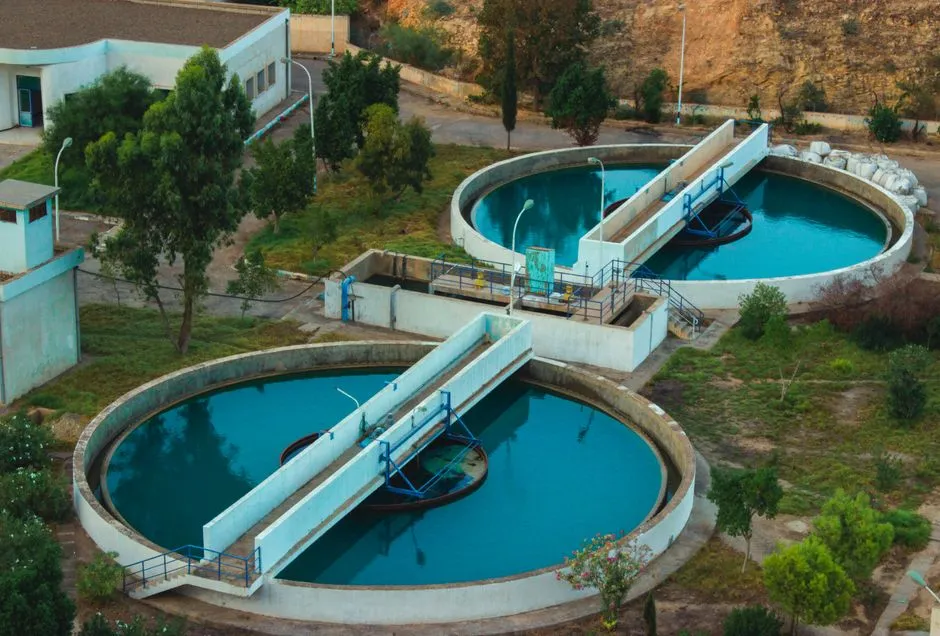
The meaningful technical comparison is between operating envelope, pretreatment burden, solids-handling risk and available infrastructure. A smaller footprint only helps if the feed is sufficiently controlled to keep the membranes serviceable.
| Parameter | Conventional activated sludge | MBR | Engineering implication |
|---|---|---|---|
| MLSS | 2,000–4,000 mg/L | 8,000–12,000 mg/L; up to 15,000 mg/L | MBR offers higher biomass concentration and decouples it from gravity settling. |
| SRT | 5–15 days non-nitrifying; 1–5 days nitrifying | 30–60 days in the cited commercial comparison | SRT must be selected for the actual treatment objective and metal tolerance. |
| Effluent solids separation | Clarifier and downstream filtration if needed | Submerged membrane modules | MBR shifts risk from settling failure to fouling, air scour and membrane maintenance. |
| Footprint | Large aeration and clarification footprint | Commercial estimate: approximately 60% less concrete and civil scope | Confirm the estimate against module configuration, tanks, access and site layout. |
| Pretreatment | Clarifier-compatible solids handling and pH control | Fine screening and automatic pH adjustment | Poor pretreatment can eliminate MBR’s operating advantage. |
| Membrane life | Not applicable to the clarifier | 5–8 years under rigorous pretreatment and disciplined CIP | Sulfate above 1,000 mg/L and high hardness can shorten cleaning intervals. |
Module format affects headworks design. The source specifies 1–2 mm screening for hollow-fiber modules and 2–3 mm for flat-plate modules. A GX-series rotary mechanical bar screen should be checked against the selected module format rather than specified generically.
MBR also shifts the operating burden. It requires air scour, chemical cleaning, permeate pumping, PLC controls, membrane-replacement planning and disciplined CIP. CAS requires dependable solids separation and adequate clarifier capacity. Where a serviceable aeration basin already exists and the flow is large and dilute, CAS may remain the lower-risk choice. The source’s commercial analysis identifies approximately 5,000 m³/day as a screening point above which CAS can be favorable when electricity is below approximately $0.07/kWh and the basin remains usable.
Footprint savings are therefore a project-specific result. They should not be used as a substitute for checking basin volume, module depth, equalization, chemical storage, washdown, access and replacement handling.
Use a decision framework instead of choosing on footprint alone
A preliminary MBR case requires site facts in three areas: constrained land, moderate flow and a reason to recover or constrain discharge water. Two or three positive answers support further MBR evaluation, but they do not justify procurement without influent testing, pretreatment review and pilot validation.
The three screening questions are:
- Is the available footprint under approximately 500 m²?
- Is the flow below roughly 2,000 m³/day?
- Is there a reuse, brine-disposal or zero-liquid-discharge driver?
Zero or one positive answer points toward CAS or a hybrid. A hybrid may retain a serviceable CAS train and add MBR polishing only to the reuse stream, avoiding unnecessary membrane capital for the full flow. Where an existing basin is adequate, the retrofit comparison notes that cassettes may be installed where basin volume supports the required MLSS and depth accommodates the modules, while the clarifier and sand filter are retired. Equalization and headworks upgrades may still be required.
| Screening result | Preliminary position | Required evidence before approval |
|---|---|---|
| Two or three positive answers | MBR merits detailed evaluation | Current permit, representative influent matrix, pretreatment review and 60–90 day site pilot. |
| Zero or one positive answer | CAS or hybrid is usually more defensible | Existing-asset assessment, operating-cost comparison and confirmation that reuse quality does not justify MBR polishing. |
| High electricity price or strong reuse value | MBR economics may improve, but process risk still governs | Total-cost sensitivity, pilot performance and an agreed acceptance protocol. |
| Poor pretreatment or variable feed | Neither train is ready for procurement | Equalization, screening, pH control, precipitation and representative shock testing. |
The decision record should include the electricity tariff, existing-asset condition, footprint, flow, reuse value, brine-disposal cost, permit limits and anticipated shock events. For a mine wastewater retrofit, the choice between DAF and clarification should also be addressed upstream of the biological step; the DAF versus clarifier selection for mining wastewater provides a separate solids-removal check.
Laboratory batch removal is not full-scale proof. The decision gate should be an influent-based pilot demonstrating the required effluent quality under the permit and anticipated reuse or polishing conditions.
Test the business case with capital cost, operating cost and reuse value
MBR normally costs more than an equivalent-flow CAS train, so the business case must identify what the premium buys and whether reuse or disposal savings offset it. The commercial comparison uses a 1,000 m³/day scenario: MBR CAPEX is 20–40% above equivalent-flow CAS, and OPEX is 15–30% higher per m³. These are scenario assumptions, not quotations or universal project percentages.
| Cost or value item | MBR effect | Buyer input required |
|---|---|---|
| Capital cost | 20–40% premium in the cited 1,000 m³/day commercial scenario | Equal-flow CAS baseline, site civil work, membrane cassettes, fine screens, permeate pumps, PLC and equalization or headworks modifications. |
| Operating cost | 15–30% higher per m³ in the same scenario | Air-scour energy, sodium-hypochlorite and citric-acid cleaning, membrane replacement, labor and actual tariff. |
| Reuse value | Approximately $2/m³ make-up-water value is the commercial screening assumption | Actual avoided purchase-water cost, brine-disposal cost and reuse volume. |
| Payback | 4–6 years is cited where a meaningful reuse or brine-disposal driver exists | Confirmation that avoided costs are realizable and that optional effluent quality is not being paid for without value. |
The capital premium is not just the membrane cassette. It includes fine screening, permeate pumping, controls, equalization changes and any additional civil works. The operating premium includes air scour, cleaning chemicals, membrane replacement and operator labor. Those line items should be compared against the avoided cost of the existing CAS assets and the value of recovered water.
The approximately $2/m³ make-up-water threshold is a screening assumption, not a site valuation. A buyer should calculate avoided water purchases, avoided brine disposal and any incremental polishing costs using actual site quantities. The cited 4–6 year payback applies only where a meaningful reuse or brine-disposal driver exists; it is not a guaranteed result.
Run a sensitivity check on electricity tariff, recovered-water value, membrane life, chemical consumption and pretreatment scope. If the result depends on one optimistic assumption, the project should not be approved as a firm MBR case. The 2026 MBR cost per m³ guide can inform the worksheet, but vendor and site inputs remain necessary for an estimate.
Prove the selection with a site-specific pilot
A 60–90 day pilot using actual site wastewater is the appropriate gate before full-scale procurement because the critical risks are the complete metals matrix, shock response, membrane fouling and recovery after upset conditions—not membrane filtration in isolation.
Run the pilot with a rented DF-series 0.1 μm PVDF membrane module and an integrated aeration box. Use representative wastewater rather than synthetic water. Monitor flow, pH, temperature, sulfate, TDS, hardness, soluble metals, particulate metals, turbidity, MLSS, SRT, transmembrane pressure, cleaning frequency and effluent TSS and BOD.
Include representative metal-loading and shock events. Record the magnitude and duration of each event, the corresponding removal response, recovery time and any change in membrane fouling. The pilot should exercise the selected pretreatment train, including fine screening and automatic chemical dosing; an automatic chemical dosing system should be checked as part of that demonstration.
Size the pilot around a defensible fraction of the proposed full-scale flow and state that basis in the test plan. Acceptance criteria should be site-specific. They should include the required effluent quality under the current permit and the anticipated reuse or polishing requirement, with recovery after the agreed shock events.
Do not convert the commercial field-performance statements into full-scale guarantees. Require agreement in the equipment proposal on pilot acceptance criteria, data ownership, deviation handling, remediation responsibilities and the consequences of a failed test. If the pilot cannot meet the required result after appropriate remediation, the process selection or pretreatment scope must be revisited.
Frequently Asked Questions
What is the total-cost premium for MBR versus conventional activated sludge?
The cited commercial 1,000 m³/day scenario places MBR CAPEX 20–40% above equivalent-flow CAS and OPEX 15–30% higher per m³. These are not quotations. Request site-specific pricing for equal flow and duty, including membranes, fine screens, permeate pumps, PLC work, civil changes, equalization, air scour, cleaning chemicals, replacement and labor.
How should MBR capacity and pilot performance be validated before purchase?
Use a 60–90 day pilot with actual wastewater and a defensible fraction of proposed full-scale flow. Agree in advance that it must demonstrate permit and reuse quality, including recovery from representative metal shocks, while recording transmembrane pressure and cleaning frequency. Require the supplier to specify acceptance criteria and remediation responsibilities in the proposal.
Does MBR eliminate the need for metals precipitation in mining wastewater?
No. The source-described approach still requires upstream precipitation: pH 8.5–9.5 for CAS and pH 6.5–7.5 for MBR to maintain metals in hydroxide form. MBR improves membrane solids separation, but it does not remove the dissolved-metal precipitation requirement under the cited 40 CFR Part 440 framework.
When does conventional activated sludge remain the better option?
CAS is often the better fit for large, dilute flows with a serviceable aeration basin, low reuse value and no brine-disposal driver. The commercial screening analysis identifies flows above approximately 5,000 m³/day and electricity below approximately $0.07/kWh as favorable conditions. Verify those assumptions against the site permit, existing assets and actual operating cost.
Related Equipment
- GX-series rotary mechanical bar screen — specifications, capacity range, and technical data