What Makes Textile Wastewater Treatment in Kazakhstan Different?
Textile wastewater treatment in Kazakhstan normally requires a site-specific treatment train: characterize the wastewater, equalize flow and loads, remove suspended and colloidal material, treat biodegradable organics biologically, then polish or reuse the effluent according to the discharge destination. DAF is a strong pretreatment option for solids, oil and grease and colloidal matter, while MBR can provide compact biological treatment and membrane separation for reuse projects. Kazakhstan's March 2025 Water Code is increasing attention to monitoring and infrastructure renewal, but final equipment selection must depend on sampling, permit conditions and reuse objectives—not generic removal claims.
Textile effluent treatment cannot be specified from the sector name alone. The zeolite study on textile wastewater states that filtration performance depends on both column depth and wastewater characteristics, which is a direct warning against copying a packaged configuration without site data (Elsevier, Molecules, 2021). A dyeing line, finishing operation and washing line can produce materially different pollutant mixtures, and production changes alter the composition and concentration entering the treatment plant.
Kazakhstan adopted a new Water Code in March 2025 that promotes conservation, digital monitoring and infrastructure upgrades (Trade.gov, Kazakhstan – Environmental Technologies, 2025). The same market report records 317 billion tenge ($589 million) allocated to industrial waste recycling in 2025, alongside 25 projects worth 330 billion tenge ($614 million) already underway, with textile waste among the targeted materials (Trade.gov, 2025).
That investment signal establishes policy and market direction, not a site's discharge route. Wastewater treatment, water reuse and solid-waste recovery remain separate engineering and compliance decisions. Each proposal therefore needs the current discharge or reuse permit, receiving sewer or water body, production schedule, seasonal operating profile and current treatment performance before equipment is selected.
Characterize the Wastewater Before Choosing Equipment
A defensible design basis requires representative samples across production conditions; one spot sample cannot establish the loads that equalization, pretreatment and biological treatment must handle.
Request samples spanning routine production, peak output, batch discharges, cleaning operations and the relevant seasons. A single sample may miss a dye change, sizing-agent addition, salt variation or cleaning chemical. Treat the following as design inputs, not a substitute for site-specific testing:
- Hourly and daily flow variation, average load, peak flow and batch-discharge frequency;
- pH, temperature, suspended solids, settleable solids, COD and BOD;
- Oil and grease, color and conductivity;
- Selected constituents identified by the plant process and characterization program, including relevant salts, dyes or sizing chemicals where present.
No Kazakhstan-specific textile discharge limits were supplied in the research. The buyer must obtain the site's current permit conditions and confirm the applicable reviewing authority rather than substitute an assumed generic limit. The design basis should then separate hydraulic capacity from pollutant loading and recovery targets; those are different sizing questions.
Seasonality also applies to the biological stage. A MicrobiologyOpen study compared activated-sludge microbial communities at well-operating textile wastewater treatment plants during winter and summer (MicrobiologyOpen, Assessing the composition of microbial communities in textile wastewater treatment plants in comparison with municipal wastewater treatment plants, 2025). That seasonal comparison supports repeated biological assessment, including acclimation and process control, rather than reliance on municipal operating assumptions.
| Design input | Information to obtain | Why it changes selection |
|---|---|---|
| Hydraulic profile | Average flow, peak flow, batch discharges and equalization requirements | Sets basin volume and instantaneous equipment capacity |
| Pollutant loads | COD, BOD, suspended solids, color, conductivity, oil and grease and selected constituents | Determines pretreatment, biological loading and polishing duties |
| Operating variation | Production schedule, seasonal changes and chemical-use changes | Establishes whether DAF and biological systems need additional capacity or control range |
| Compliance route | Current permit, receiving sewer or water body, and intended reuse application | Defines the required effluent quality and validation evidence |
Build the Treatment Train from Load to Reuse
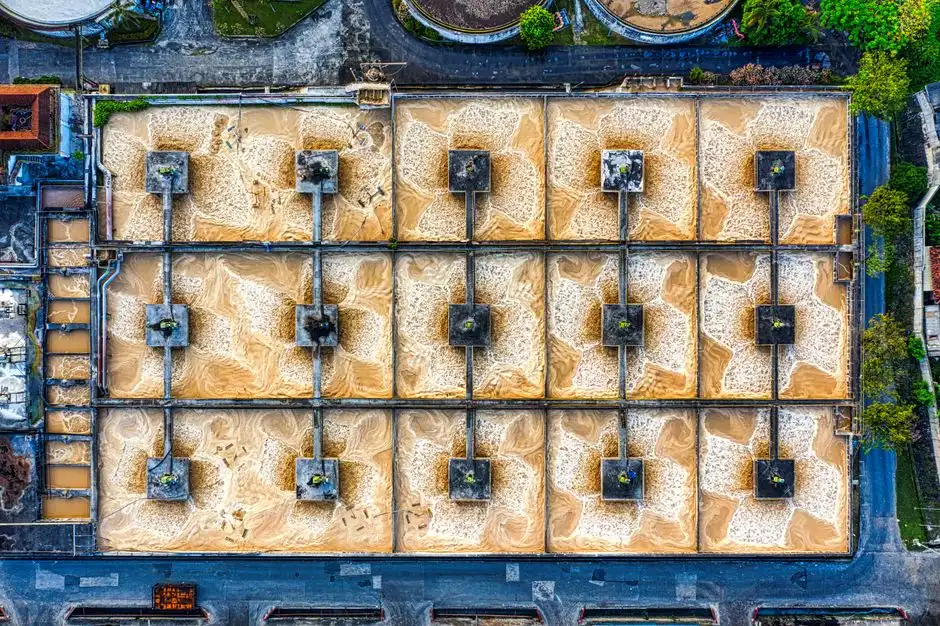
The treatment train should assign each stage a defined duty, beginning with equalization and ending with a confirmed route for separated solids.
- Equalization and screening: blend flow and load variation, remove coarse material and provide the residence time needed for controlled feeding.
- pH or chemical control where required: adjust conditions identified by characterization rather than applying a fixed chemical dose.
- DAF pretreatment: remove suspended solids, oil and grease and colloidal material before biological treatment where these fractions could interfere with biological operation or increase downstream loading.
- Biological treatment: reduce biodegradable organics under site-specific acclimation and seasonal monitoring.
- Clarification or membrane separation: provide the solids separation required after the biological stage.
- Polishing or disinfection where required: meet the validated reuse or discharge objective.
- Sludge dewatering: prepare DAF float, biological excess sludge and other process solids for their confirmed handling route.
For sites where DAF pretreatment is indicated, the specified textile wastewater DAF pretreatment system provides a documented starting point for comparison. Biological loading still must be checked against the characterized COD and BOD, and downstream solids separation must remain part of the selected train.
The supplied MBR membrane bioreactor for industrial process water and reuse combines biological treatment with submerged PVDF membrane filtration in a stated flow range of 10–2,000 m³/day (manufacturer specification, 2026). It is therefore relevant where compact biological treatment and membrane separation are both required, but the flow range does not establish a model for a Kazakhstan plant without site data.
Natural zeolite depth filtration is a technology to evaluate when its media and column depth are matched to the wastewater (Elsevier, Molecules, 2021). It is not a substitute for upstream solids removal. For the same reason, biological treatment should not be assumed from municipal practice: the MicrobiologyOpen study examined textile activated sludge in two seasons at well-operating plants (MicrobiologyOpen, 2025).
DAF float and biological solids change the mass balance. Their expected quantity and characteristics must be included in the design before selecting a dewatering route; otherwise the main treatment equipment may operate while its concentrated by-product has no practical destination.
| Stage | Primary duty | Key output to verify |
|---|---|---|
| Equalization and screening | Stabilize hydraulic and load conditions | Blended wastewater suitable for controlled treatment |
| DAF pretreatment | Remove suspended solids, oil and grease and colloidal material | Reduced solids and separate float for handling |
| Biological treatment | Remove biodegradable organics | Biologically treated wastewater and excess sludge |
| Clarification or MBR separation | Separate solids or retain biomass by membrane | Water meeting the next treatment or reuse stage |
| Depth filtration, polishing or disinfection | Address validated residual contaminants | Effluent suitable for the specified route |
| Sludge dewatering | Reduce solids volume | Dehydrated solids with a confirmed disposal or recovery route |
Compare DAF, MBR and Clarification for the Main Treatment Stages
DAF, MBR and lamella clarification have different principal duties and should be compared by process position rather than treated as interchangeable products.
The specified DAF system has a stated capacity range of 4–300 m³/h, 13 standard models, micro-bubble technology and automatic skimming (manufacturer specification, 2026). Its strongest textile role is upstream pretreatment of suspended solids, oil and grease and colloidal matter. It does not establish complete biological treatment or reuse compliance.
The specified MBR system combines biological treatment with submerged PVDF membrane filtration in a stated range of 10–2,000 m³/day. Its specification states near-reuse-quality effluent below 1 μm filtration (manufacturer specification, 2026). That filtration claim is not the same as demonstrating suitability for a particular reuse application; the receiving process, water chemistry and required analytical parameters still need verification.
The specified lamella clarification product uses flocculation and sludge recirculation. Its manufacturer states a surface-loading rate of 20–40 m/h and a reduction in chemical consumption of up to 30% (manufacturer specification, 2026). These are product specifications, not independently verified textile-plant performance data, so a buyer should request the basis of the chemical-consumption claim.
| Technology | Principal duty | Textile relevance | Stated product scale | Selection data required |
|---|---|---|---|---|
| DAF | Suspended-solids, oil-and-grease and colloid removal | Pretreatment before biological treatment | 4–300 m³/h; 13 models | Peak flow, solids and FOG loads, chemical demand, float route |
| MBR | Combined biological treatment and membrane separation | Compact process water or reuse projects | 10–2,000 m³/day | Influent load, membrane pretreatment, reuse target, solids removal route |
| Lamella clarification | Solids separation after flocculation | Potential post-biological separation stage | 20–40 m/h stated surface-loading rate | Flow, settleable solids, flocculant demand, sludge properties |
Use DAF when the primary need is solids and colloid control; consider MBR when biological treatment and membrane separation must be combined; and place clarification where the process requires a separate flocculation and solids-separation stage. A more detailed comparison of DAF and clarification technologies can support that stage assignment, but the final choice must remain tied to textile characterization data.
Plan Chemical Control, Sludge Handling and Reuse
Reliable treatment requires controlled chemical addition and a confirmed solids route; neither should remain an unpriced or undefined accessory in a bid.
The specified automatic chemical dosing system can support controlled injection of coagulant, flocculant, pH-adjuster or specialty chemicals where characterization supports those functions. The supplied research provides no defensible textile dosing rate. Jar or pilot testing must therefore establish dose, mixing conditions, pH response and chemical consumption before final control values are specified.
The specified plate and frame filter press has a stated filtration-area range of 1–500 m² and manual, hydraulic or fully automatic PLC-controlled options (manufacturer specification, 2026). Selection should use measured sludge feed rate, solids concentration, cake target, operating cycle and the available solids destination—not filtration area alone.
The specified ultrafiltration water treatment system has a stated range of 2,000–40,000 L/h, 0.03 μm PVDF membranes, automatic backwash and air scour (manufacturer specification, 2026). Treat it as membrane polishing or pretreatment where the wastewater and target application justify it, rather than adding it automatically to every train.
Process-water reuse, washing or cooling reuse, and environmental discharge have different quality targets and validation requirements. The design brief should identify the intended application, relevant water-quality parameters, monitoring frequency and who accepts the reuse risk.
| Auxiliary function | Equipment basis | Required evidence |
|---|---|---|
| Chemical control | Coagulant, flocculant, pH adjustment or specialty dosing | Jar or pilot dose response and operating range |
| Sludge dewatering | Plate and frame filtration | Feed solids, cake target, cycle and disposal route |
| Membrane polishing | Ultrafiltration where technically required | Target contaminants, membrane pretreatment and cleaning demand |
| Monitoring and records | Online instruments plus laboratory control | Parameters linked to permit or reuse conditions |
Kazakhstan's March 2025 Water Code promotes digital monitoring (Trade.gov, 2025). A plant should therefore define instruments, data ownership, calibration, alarm handling and operating records, while confirming the legally applicable Kazakhstan requirements through qualified local review.
Make the Supplier Brief Work for a Kazakhstan Project
A comparable bid should expose the assumptions behind every guaranteed result, including who owns compliance when process performance depends on site wastewater and operation.
Require each bidder to submit its design basis, characterized wastewater data, flow and load assumptions, treatment objective, proposed equipment scale and process-flow diagram. The bid should also state guaranteed performance parameters, test methods, guarantee conditions, utility and chemical requirements, sludge yield and the complete instrumentation scope.
Ask how the proposed biological stage addresses seasonal production changes and whether seasonal monitoring and acclimation are included. A microbial-population comparison across winter and summer at well-operating textile plants (MicrobiologyOpen, 2025) supports this question because textile biological operation cannot be inferred solely from municipal experience.
Request a clear commissioning and support plan covering operator training, troubleshooting, spare parts and remote or on-site technical assistance. Do not assume delivery or service performance: the supplied research contains no defensible project-specific lead time or service-level range. The bidder must confirm how the proposal addresses the site's current Kazakhstan permit, discharge route and any reuse standard.
Trade.gov reported that 98 water-management projects commenced in Kazakhstan in 2025 (Trade.gov, 2025). This demonstrates active infrastructure modernization, but it does not guarantee any supplier's delivery schedule, permit result or equipment performance.
| Bid item | Required response | Reason to include it |
|---|---|---|
| Design basis | Verified flow, loads, operating profile and reuse or discharge target | Prevents an equipment package based on unstated assumptions |
| Performance guarantee | Parameters, test methods, boundary conditions and remedy | Makes the guarantee technically verifiable |
| Sludge obligation | Expected solids, dewatering duty and destination | Prevents an undefined by-product |
| Seasonal operation | Monitoring and acclimation plan | Addresses textile production variability |
| Compliance responsibility | Permit assumptions, local review and responsibility matrix | Separates equipment supply from regulatory responsibility |
| Support | Commissioning, training, spares and technical support | Defines operational readiness and after-sales scope |
Turn the Design into an Implementation Checklist
A staged implementation sequence keeps catalog assumptions from overriding the verified wastewater and permit basis.
- Establish the basis: obtain the wastewater characterization, production profile and current permit.
- Define the objective: establish required effluent quality, discharge route and reuse application.
- Test the process: pilot DAF, biological operation and any filtration or adsorption step with representative wastewater.
- Size the train: size equalization, DAF, biological treatment, solids separation, reuse equipment and sludge handling around the verified design basis.
- Control operation: define online monitoring, laboratory controls, bypass prevention and contingency operation.
- Validate commissioning: confirm performance with site wastewater and establish a seasonal operating record.
Pilot and commissioning results must override generic catalog assumptions. This is especially important where seasonal variation changes biological loading, chemical demand or solids production.
Frequently Asked Questions
What is the best treatment system for a textile plant in Kazakhstan?
There is no defensible single-machine answer. Use characterization to determine whether DAF pretreatment, biological treatment, clarification or membrane polishing is required, then size each stage against verified flow and loads, the permit and the intended reuse application.
How much should a textile wastewater treatment project cost?
The supplied research contains no defensible project-price range. Request a vendor budget quotation against the verified flow, pollutant loads, permit conditions, reuse target, utilities, chemical demand and sludge route so that equipment and omitted scope can be compared consistently.
Is DAF sufficient for textile wastewater?
No standalone conclusion is valid without the permit and reuse target. DAF is documented for textile pretreatment of suspended solids, oil and grease and colloidal matter, but it does not establish complete treatment, reuse suitability or discharge compliance.
What size DAF or MBR system does a Kazakhstan textile plant need?
Use characterized peak flow and loads rather than production volume alone. For initial comparison, the specified DAF range is 4–300 m³/h and the specified MBR range is 10–2,000 m³/day (manufacturer specifications, 2026); neither range justifies selecting a model before site data, pretreatment duty and biological loading are verified.
What compliance documents should be included in the supplier brief?
Attach the current discharge or reuse permit, applicable permit conditions and a responsibility matrix covering equipment operation, monitoring, reporting, sludge handling and corrective action. Obtain Kazakhstan-specific advice on the implications of the March 2025 Water Code from a qualified local adviser; Trade.gov's 2025 summary identifies the regulatory direction but is not a permit or legal opinion.