What Counts as High TDS and Why Conventional Treatment Fails
Total dissolved solids (TDS) above 1,000 mg/L push a wastewater stream out of the conventional biological envelope; above 3,000 mg/L the stream is generally classified as high-TDS industrial wastewater, and above 10,000 mg/L the ionic load starts behaving like a brine. The standard engineering bands run fresh (<1,000 mg/L), brackish (1,000–10,000 mg/L), saline (10,000–35,000 mg/L), and brine (>35,000 mg/L), with seawater RO feeds sitting at 35,000–45,000 mg/L and produced water from oil & gas often exceeding 80,000 mg/L. The dominant ionic species driving these numbers are Na⁺, Cl⁻, SO₄²⁻, Ca²⁺, and Mg²⁺ — species that pass straight through activated-sludge flocs, MBR biomass, and most coagulant-precipitant chemistries. A well-tuned ASP or MBR reliably removes 90–95% of BOD/COD/TSS, but TDS removal on the same stream typically measures under 5%.
That is why the discharge and reuse benchmarks from international standards treat TDS as a separate compliance axis from organics. WHO Guidelines for Drinking-water Quality 4th ed. (2022) set an aesthetic TDS threshold of 1,000 mg/L, which has become the de-facto closed-loop reuse target for industrial plants from pharma to power. On the surface-discharge side, NOM-001-SEMARNAT-2021 (Mexico) holds TSS to <30 mg/L and oils/greases to <15 mg/L, while Kuwait EPA Decision 210/2001 sets BOD ≤20 mg/L and TDS ≤2,000 mg/L for municipal recipients — both implying that any high-TDS upstream stream must be polished by membrane or thermal means before biological discharge is even attempted. The relevant regional deep-dives are in the Mexico City NOM-001 compliance and cost benchmarks and the Kuwait EPA discharge compliance engineering guide.
Process Train Architecture: Pre-Treatment to Final Polishing
A defensible high-TDS train is a six-step P&ID, not a single unit operation, and the sequence below maps directly to the unit operations most plants will see in a vendor drawing.
- Equalisation and pH correction. A surge basin with automatic chemical dosing holds pH at 6.5–7.5 and dampens influent spikes; automatic chemical dosing skids sized on a 15-minute retention basis are typical.
- Suspended-solids and oil removal. DAF units in the 4–300 m³/h range drop FOG below 10 mg/L outlet and pull TSS under 30 mg/L — enough to protect downstream filters.
- Multimedia filtration. Multi-media pre-filters (anthracite/sand/garnet) drive the Silt Density Index (SDI) below 5, and ideally below 3, so RO membranes survive their warranty window.
- Primary separation. Reverse osmosis, electrodialysis reversal, forward osmosis, or thermal evaporation, selected on influent TDS band and recovery target.
- Concentrate management. RO reject (typically 15–35% of feed volume) is sent to a brine concentrator or crystalliser; thermal distillate is polished through mixed-bed ion exchange and recycled.
- Disinfection and monitoring. Chlorine dioxide generation at 0.2–1.0 mg/L residual, followed by inline conductivity/TDS and TOC analysers tied to the plant SCADA.
Step 4 is where 80% of the design risk lives, and it is the only step where TDS is actually removed from the water phase. Everything upstream of it is protection; everything downstream of it is either brine handling or polishing.
Reverse Osmosis: The Workhorse for 3,000–35,000 mg/L TDS
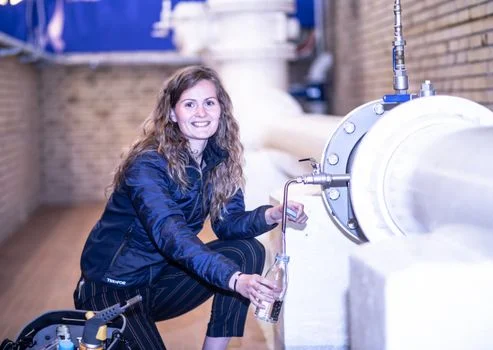
Reverse osmosis is the default primary separation for any stream in the 3,000–35,000 mg/L band because it is the lowest-energy way to move dissolved ions out of the water phase. Modern brackish RO (BWRO) units deliver 70–85% recovery in a single pass and 85–95% in a two-pass array, with salt rejection of 95–99.5%. Seawater RO (SWRO) membranes push rejection to 99.5–99.8% at recoveries of 35–50%, because osmotic pressure caps single-stage recovery around the 70,000 mg/L feed ceiling. Energy consumption sits at 0.5–1.5 kWh/m³ for BWRO and 2.5–4.0 kWh/m³ for SWRO, both of which are an order of magnitude below any thermal route.
The cap on RO performance is not the membrane chemistry — it is the feed. SDI must be held below 3 (BWRO) or below 5 (SWRO) to keep fouling off the membrane surface, which is why the multimedia filter and DAF upstream of the RO are not optional. Hardness also matters: above 4,000 mg/L Ca²⁺ equivalent in the concentrate, antiscalant chemistry has to be modelled in Hydra or equivalent, and for feeds with a high CaSO₄ scaling potential, EDR frequently wins the trade study. Our industrial RO systems spec recovery up to 95% with full PLC automation and minimal chemical draw, which makes them a fit for pharma, F&B, and power make-up duties.
The obligation that gets buried in vendor quotes is the concentrate stream. A 75% recovery system still discharges 25% of the feed as brine, at 4× the feed concentration. If the discharge limit is 2,000 mg/L TDS, that 25% stream has to be crystallised, deep-well injected, or hauled — which is where the project budget needs a second column.
Electrodialysis Reversal, Forward Osmosis, and Capacitive Deionisation
EDR, FO, and CDI are specialist tools that win specific trade studies, not general-purpose replacements for RO. Electrodialysis reversal typically runs at 80–90% recovery with 1–3 kWh/m³ energy draw, tolerates higher SDI than RO (up to 6–8 with periodic reversal), and handles CaSO₄-scaling feeds that would foul an RO membrane. Capital cost runs 20–60% above RO at similar capacity, which keeps EDR out of generic scope but in scope for high-recovery (>90%) projects on scaling-prone feed such as mining raffinate or cooling-tower blowdown.
Forward osmosis uses a high-osmotic-pressure draw solution to pull water through a fouling-resistant membrane, achieving 50–80% concentration of the feed with very low fouling. The constraint is draw regeneration: the draw solute has to be recovered thermally or with a second RO step, which adds a layer of process complexity that limits FO to niche applications (landfill leachate concentration, food-stream dewatering, oily-wastewater volume reduction). Capacitive deionisation is the emerging option: it cycles electrical adsorption/desorption on porous carbon electrodes to pull salt out of 500–5,000 mg/L feeds at under 1 kWh/m³. Commercial-scale CDI units are still small in 2026, and the technology is best treated as a polishing or brackish-pre-treatment step rather than a primary separator.
Thermal and Crystallisation Routes for Zero Liquid Discharge
ZLD is a compliance decision, not an efficiency decision, and the engineering memo should be honest about that up front. The drivers are water scarcity (Middle East, US Southwest, inland China), regulatory bans on brine discharge (parts of India, inland China, US west), and high-value salt recovery (Na₂SO₄, NaCl, CaCl₂ from mining or pharma). The thermal core sits on multi-effect distillation (MED) or mechanical vapour compression (MVC) at 35,000–100,000+ mg/L feeds, with 90–98% water recovery and 15–25 kWh/m³ energy for MVC. The final step is a brine crystalliser producing solid salt cake for landfill or sale, followed by a plate and frame filter press for the crystalliser blowdown.
The energy penalty is real. A thermal ZLD train consumes 10–20× the energy of an RO-only train — typically 25–60 kWh/m³ once the crystalliser load is included — and CAPEX for a 1,000 m³/day ZLD skid runs USD 8–25 million installed depending on feed chemistry and salt valorisation. That is why the cost crossover with RO sits in the 35,000–50,000 mg/L band: below it, RO plus brine hauling or deep-well injection is cheaper; above it, thermal becomes unavoidable if water recovery >95% is mandated.
| Thermal unit operation | Feed TDS band (mg/L) | Water recovery | Energy (kWh/m³) | Typical application |
|---|---|---|---|---|
| MED (multi-effect distillation) | 35,000–70,000 | 90–95% | 10–18 | Cogeneration-adjacent, low-grade heat available |
| MVC (mech. vapour compression) | 50,000–100,000+ | 92–98% | 15–25 | Standalone, electricity-favoured sites |
| Brine crystalliser | >150,000 (concentrate) | >99% water; solid salt | 25–60 (whole train) | Final ZLD step, salt sale or landfill |
Process Selection Matrix: Matching TDS Range to Technology
The matrix below is the single artefact a process engineer should paste into a project memo. It maps influent TDS to a primary technology, expected recovery, energy intensity, the dominant risk, and the minimum pre-treatment envelope. TDS alone is not enough — discharge limit, energy price, brine disposal route, and capex envelope each shift the recommendation by a row.
| Influent TDS (mg/L) | Primary technology | Expected recovery | Energy (kWh/m³) | Key risk | Minimum pre-treatment |
|---|---|---|---|---|---|
| 1,000–5,000 | BWRO or CDI polishing | 80–95% | 0.4–1.0 | Fouling, biofouling | MMF + cartridge |
| 5,000–15,000 | BWRO (single or two-pass) | 75–90% | 0.6–1.5 | CaSO₄ scaling on concentrate | DAF + MMF + antiscalant |
| 15,000–35,000 | BWRO with concentrate recycle, or EDR | 70–90% | 1.0–3.0 | Brine disposal obligation | DAF + MMF + softening or EDR |
| 35,000–70,000 | SWRO + thermal, or MVC | 85–95% | 3.0–15 | Energy cost; concentrate volume | Full DAF + MMF + RO pre-treatment |
| >70,000 | Thermal crystalliser train (MED/MVC + BC) | 95–99% | 20–60 | Capex, salt handling | RO concentrate or pre-evaporator |
Combined trains are the norm above 35,000 mg/L when water recovery >90% is required — SWRO first to lift recovery cheaply, thermal finishing on the concentrate to reach the ZLD ceiling.
Cost, Energy, and Recovery Comparison
The economic envelope for a primary separation train in 2026 is summarised below. OPEX for an RO-only train typically runs USD 0.3–0.8/m³, dominated by energy and membrane replacement (membranes last 3–5 years at SDI <3). Thermal ZLD OPEX is 5–10× higher at USD 1.5–4.0/m³ for MED/MVC, and USD 2.5–6.0/m³ once a crystalliser and salt disposal are included. CAPEX is the second-order story: USD 800–2,500 per m³-day installed for RO and 8–25× higher for full ZLD.
| Technology | CAPEX (USD per m³-day) | OPEX (USD/m³) | Energy (kWh/m³) | Recovery | Best-fit TDS band (mg/L) |
|---|---|---|---|---|---|
| BWRO | 800–2,500 | 0.3–0.8 | 0.5–1.5 | 70–95% | 3,000–15,000 |
| EDR | 1,500–3,500 | 0.5–1.2 | 1.0–3.0 | 80–90% | 5,000–35,000 (scaling) |
| FO (with draw regen) | 2,000–4,000 | 0.8–2.0 | 0.3–0.8 (excl. draw regen) | 50–80% | Niche / leachate |
| MED | 5,000–10,000 | 1.5–3.0 | 10–18 | 90–95% | 35,000–70,000 |
| MVC | 6,000–12,000 | 2.0–4.0 | 15–25 | 92–98% | 50,000–100,000+ |
| ZLD train (RO + MVC + BC) | 10,000–25,000 | 2.5–6.0 | 25–60 | >98% | >35,000 (mandated) |
The cost crossover sits at 35,000–50,000 mg/L TDS. Below that line, RO dominates on both CAPEX and OPEX; above it, thermal becomes unavoidable if water recovery is mandated, and the only question is whether MED or MVC is the better fit based on heat-versus-power balance at the site. Energy price per kWh is the single most sensitive input — a swing from USD 0.05 to USD 0.12/kWh adds 30–60% to thermal OPEX and roughly 5–10% to RO OPEX, which can flip a project from RO+hauling to RO+thermal. The longer-term market context for these decisions is mapped in the 2030 water reuse market forecast.
Frequently Asked Questions
What TDS level is considered high for industrial wastewater? Above 3,000 mg/L is typically classed as high-TDS for industrial discharge. Above 10,000 mg/L the stream is saline and must be treated by membrane or thermal means; above 35,000 mg/L it behaves like a brine and pushes the design toward thermal or ZLD.
Can high TDS be removed by biological treatment alone? No. Activated sludge and MBR reliably remove 90–95% of BOD, COD, and TSS, but TDS removal on the same stream is typically under 5% because dissolved ionic species pass through the biomass. Biological treatment must be paired with RO, EDR, or thermal separation to actually remove salts.
What is the best technology for TDS above 50,000 mg/L? A thermal train — typically MVC on the main brine duty with a brine crystalliser as the finishing step — is the standard answer. Expect 25–60 kWh/m³ for the full train and CAPEX of USD 10,000–25,000 per m³-day installed.
How much does industrial RO cost per cubic metre in 2026? OPEX of USD 0.3–0.8/m³ at 75% recovery, energy 0.5–1.5 kWh/m³, and CAPEX of USD 800–2,500 per m³-day installed for a packaged unit. Membrane replacement is the dominant OPEX line at 15–25% of total, which is why SDI control upstream is non-negotiable.
Is zero liquid discharge economically justified? Only when water price, brine disposal cost, or local regulation make water recovery >95% financially compelling. Typical paybacks run 4–9 years on water-scarce sites in the US Southwest or Middle East, and longer where water is cheap and brine hauling is permitted.