Why Semarang Is a Different Cooling-Tower Chemistry Problem
Semarang sits in a tropical humid regime that does not behave like the dry-climate cooling-tower references most engineering teams carry into a greenfield design. The 78–85% relative humidity band reported by PAGASA for Metro Manila applies almost identically to Semarang's coastal plain, and that sustained humidity suppresses evaporative cooling efficiency, forcing operators to push cycles of concentration (CoC) higher to reject the same heat load. At 4 CoC, a typical cooling tower already loses 25–30% of makeup water to blowdown; pushing to 6 CoC concentrates dissolved solids faster than the same tower would in a dry climate (HydropureWater, 2026; Genesis Water Technologies, 2025-12).
PDAM Semarang surface-water intakes along the Kaligarang and Kreo river systems are the most accessible supply for a greenfield build, but no publicly available Semarang-specific TDS, chloride, or silica dataset was found in the research. Confirm those three parameters against a current intake water analysis before sizing the RO recovery rate or selecting antiscalant chemistry. The intake test is the document that drives every downstream decision.
Discharge routing is the second site variable. Greenfield sites around the Kendal, Bawen, and Tanjungsari industrial corridors that cannot return blowdown to a closed industrial canal will route treated effluent to the Kali Garang or Kali Semarang drainage basin, and that triggers the Ministry of Environment and Forestry (KLHK) effluent regime under PP 22/2021. Verify current numeric limits against the site AMDAL/environmental permit and the latest KLHK technical guidelines, because no Indonesia-specific discharge numbers are documented in the scraped research.
Monsoon-season stormwater (November–March) contacting outdoor equipment pads produces high-volume, high-suspended-solids pulses that must be segregated from the membrane feed. Stormwater segregation is what keeps a tropical pretreatment train inside its design envelope when a single 100 mm rainfall event lands on the site.
The Four Wastewater Streams a Semarang Site Must Treat
A tropical data center produces four distinct wastewater streams with different chemistry, peak flow, and compliance exposure. Treating blowdown in isolation is the most common scoping error on Indonesian sites, and the KLHK PP 22/2021 chain treats each stream under the same industrial-effluent envelope once it enters the discharge basin.
Cooling-tower blowdown is the largest stream by volume: 25–30% of makeup water at 4 CoC, with TDS 1,200–6,000 mg/L, suspended solids 10–50 mg/L, residual biocides, scale inhibitors, and corrosion products (HydropureWater, 2026; Genesis Water Technologies, 2025-12). Reverse-osmosis reject from humidification and process-water polishing arrives at 20–30% of feed flow as a high-TDS concentrate that re-enters the waste train and must be balanced into the same reuse/discharge decision. Diesel generator cooling water, floor wash, and humidifier bleed are lower-volume but intermittent, often oily, and cannot be routed to the same membrane system as blowdown without oil-removal pretreatment on a dissolved-air flotation unit ahead of the membrane skid. Stormwater and monsoon runoff contacting outdoor equipment pads is seasonal and high-volume, with suspended-solids spikes during monsoon events; it needs segregation rather than direct membrane feed.
| Stream | Typical volume | TDS range | Suspended solids | Binding compliance parameter |
|---|---|---|---|---|
| Cooling-tower blowdown | 25–30% of makeup at 4 CoC | 1,200–6,000 mg/L | 10–50 mg/L | TDS, chloride, biocide residuals (KLHK PP 22/2021) |
| RO reject / process concentrate | 20–30% of RO feed | Higher than feed, scales with CoC | Low (post-membrane) | TDS, sulfate |
| Oily floor drain / generator cooling | Intermittent, low volume | Variable | High when oily | Oil & grease, COD |
| Monsoon stormwater | Seasonal high-volume pulse | Low to moderate | Spike event-driven | Suspended solids, pH |
Each of the four streams has a different binding compliance parameter, so map every stream to KLHK PP 22/2021 effluent requirements and to the local site permit before finalising the train.
Reuse Targets Versus Discharge Limits: What the Permit Actually Demands
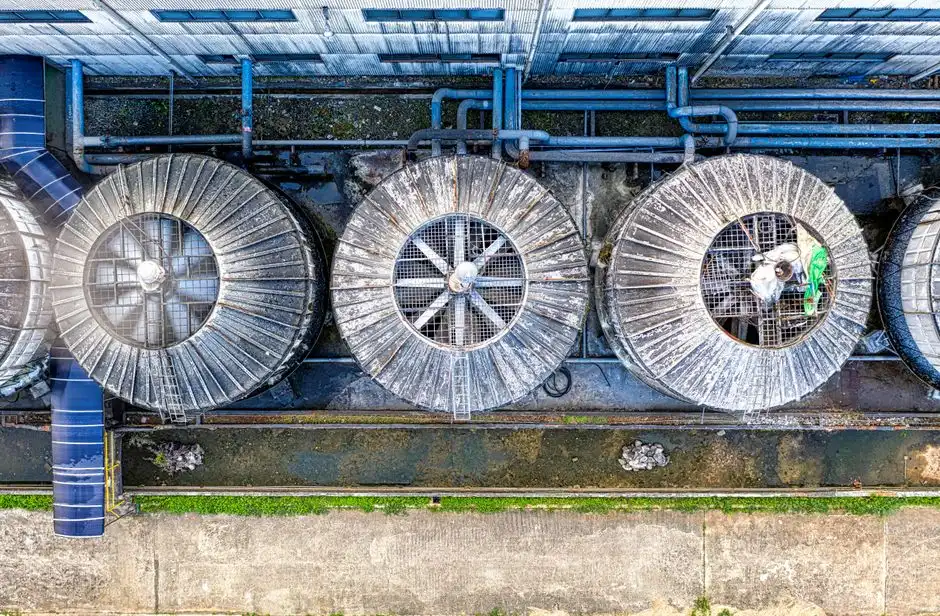
Reuse targets are tighter than discharge targets, and the gap between them is what determines whether the Semarang site sells permeate back to the cooling tower or pays to dispose of concentrate. Cooling-tower makeup should land at TDS 500–1,500 mg/L with permeate goals of 10–50 mg/L TDS from RO, suspended solids 10–25 mg/L, pH 6.5–8.5, and silica below 150 mg/L to keep scaling risk manageable at 4–6 CoC (HydropureWater, 2026; Genesis Water Technologies, 2025-12).
Discharge compliance focuses on TDS, chloride, sulfate, and any residual biocide or phosphate ceilings. Some jurisdictions now cap TDS below 1,500 mg/L in industrial discharge, effectively prohibiting discharge of untreated concentrated blowdown; confirm the current KLHK PP 22/2021 numeric ceilings and any provincial tightening with the local LHKA/environmental team, because the scraped research does not contain Indonesia-specific numbers.
Pushing from 4 to 6+ CoC cuts blowdown volume but raises scaling risk and pushes blowdown TDS toward the 6,000 mg/L upper bound, so the reuse target and the discharge target cannot be selected independently. Biocide and corrosion-inhibitor residuals accumulate proportionally with CoC, which is why the chemical program and the membrane pretreatment program must be designed as one system, not in sequence.
| Parameter | Cooling-tower makeup target | KLHK PP 22/2021 effluent (verify with permit) |
|---|---|---|
| TDS (RO permeate) | 10–50 mg/L | Confirm with site permit |
| Suspended solids | 10–25 mg/L | Confirm with site permit |
| pH | 6.5–8.5 | Confirm with site permit |
| Silica (as SiO₂) | < 150 mg/L | Confirm with site permit |
| Oil & grease (floor drain stream) | Below RO membrane tolerance | Confirm with site permit |
Four Treatment Trains From Minimum Compliance to Zero Liquid Discharge
Four realistic trains cover the range from minimum compliance to full ZLD based on site water stress, permit stringency, and CapEx appetite. The right tier is a function of PDAM Semarang industrial tariffs, the KLHK effluent ceiling, and whether the hyperscale tenant contractually requires zero liquid discharge.
- Side-stream filtration only — 10–25 micron self-cleaning filter on 1–5% of circulation flow; CapEx $50,000–200,000 for typical data-center flow (Genesis Water Technologies, 2025-12). Minimum train for any tropical site drawing from PDAM, but does not by itself solve a discharge TDS exceedance.
- UF + BWRO — an ultrafiltration pretreatment skid ahead of an industrial reverse osmosis system for cooling-blowdown reuse, achieving 50–85% recovery with 10–50 mg/L TDS permeate; OpEx $1.50–3.00 per 1,000 gallons (Genesis Water Technologies, 2025-12). The default train that brings a tropical site inside effluent limits in most cases.
- UF + RO + NF polish — nanofiltration at 75–150 psi and 70–85% recovery partially softens and blends back to raise overall reuse volume; appropriate where hardness rather than total TDS is the binding constraint (HydropureWater, 2026; Genesis Water Technologies, 2025-12).
- UF + RO + MVC brine concentrator — mechanical vapor compression at 95–98% recovery with distillate below 10 mg/L TDS, concentrate 20–30% dissolved solids, energy 15–25 kWh per 1,000 gallons; ZLD path justified when zero discharge is contractually required or regulatorily blocked (HydropureWater, 2026; Genesis Water Technologies, 2025-12).
RO CapEx of $250,000–500,000 for a 50,000 GPD train and ZLD overlay CapEx of $3–8 million with $5–15 per 1,000 gallons OpEx bracket the buyer decision. MVC capital of $1–3 million for 10,000–30,000 GPD concentrate processing is the typical sub-line within a ZLD overlay (Genesis Water Technologies, 2025-12).
| Train | CapEx envelope | OpEx envelope | Recovery | When to choose it |
|---|---|---|---|---|
| Side-stream only | $50,000–200,000 | Minimal (solids disposal) | No volume reduction; enables higher CoC | Low permit stringency, PDAM only |
| UF + BWRO | $250,000–500,000 (50,000 GPD) | $1.50–3.00 / 1,000 gal | 50–85% | Default tropical train |
| UF + RO + NF polish | RO CapEx + NF skid adder | RO OpEx + NF blend pumping | 70–85% (NF) | Hardness-driven limits |
| UF + RO + MVC | $3–8 million (ZLD overlay) | $5–15 / 1,000 gal | 95–98% | Tenant or regulator mandates ZLD |
Tropical Pretreatment Checklist That Holds Membrane Life at 3-5 Years
Membrane fouling is the dominant failure mode on Indonesian sites because Semarang loop water runs at 28–32°C and is biologically active year-round. Four pretreatment levers hold membrane life at 3–5 years, and skipping any one of them is what drives replacement intervals down to 12–18 months in tropical service (HydropureWater, 2026).
- Self-cleaning side-stream filtration at 10–25 micron keeps blowdown suspended solids below 15 mg/L before the UF pretreatment skid.
- Bio-organic flocculant dosing aggregates colloidal solids and biofilm fragments that bypass conventional filtration in warm loop water.
- Antiscalant chemistry must be tuned for silica and calcium sulfate; conventional BWRO caps at 75–80% recovery before scaling becomes unmanageable, so an automatic antiscalant and biocide dosing skid sized for the local source water pushes recovery toward 85%.
- A chemical-free UV sterilizer or chlorine dioxide system controls planktonic bacteria and biofilm precursors without adding residuals that accumulate at high CoC. Pair this with proper RO and UF membrane elements rated for tropical service.
The four levers must be specified together. Designing the chemical program and the membrane pretreatment program in isolation is the engineering failure mode that produces short membrane life on tropical sites.
Semarang CapEx, OpEx, and Payback Logic for a Hyperscale Build
A 50,000 GPD RO train runs $250,000–500,000 CapEx and $1.50–3.00 per 1,000 gallons OpEx; a ZLD overlay adds $3–8 million and $5–15 per 1,000 gallons (Genesis Water Technologies, 2025-12). Direct discharge fees in water-stressed regions now exceed $5–15 per thousand gallons, so avoided discharge plus avoided PDAM Semarang industrial purchases are the two savings lines a procurement team can defend to KLHK and to the ESG reviewer (Genesis Water Technologies, 2025-12).
At a 60–85% blowdown recovery rate, the Scope 3 water withdrawal reduction is auditable under CDP and IFRS S2. A multi-media pre-filter ahead of the UF stage is the lowest-cost insurance for that ESG number holding up to audit. A 100 MW hyperscale facility can draw up to 2 million litres per day (IDE Water Technologies, 2026), so even modest reuse rates compound quickly; size the train against the actual site load rather than a generic figure. Typical RO-only payback sits at 3–5 years for a hyperscale-scale Semarang build once both water-purchase and discharge-fee avoidance are counted (HydropureWater, 2026; Genesis Water Technologies, 2025-12).
| Line item | Envelope | Source |
|---|---|---|
| RO train CapEx (50,000 GPD) | $250,000–500,000 | Genesis Water Technologies, 2025-12 |
| RO train OpEx | $1.50–3.00 / 1,000 gal | Genesis Water Technologies, 2025-12 |
| ZLD overlay CapEx | $3–8 million | Genesis Water Technologies, 2025-12 |
| ZLD overlay OpEx | $5–15 / 1,000 gal | Genesis Water Technologies, 2025-12 |
| Avoided discharge fee | $5–15 / 1,000 gal | Genesis Water Technologies, 2025-12 |
| Hyperscale site load (100 MW) | Up to 2 million L/day | IDE Water Technologies, 2026 |
| RO-only payback (hyperscale scale) | 3–5 years | HydropureWater, 2026; Genesis Water Technologies, 2025-12 |
Frequently Asked Questions
What CapEx and OpEx should we put on the RFQ for a Semarang hyperscale site?
For a 50,000 GPD RO train, budget $250,000–500,000 CapEx and $1.50–3.00 per 1,000 gallons OpEx; a ZLD overlay adds $3–8 million and $5–15 per 1,000 gallons (Genesis Water Technologies, 2025-12). Request a per-1,000-gallens all-in OpEx line that bundles energy, chemicals, membrane replacement, and maintenance so the RFQ responses are comparable.
How do we choose the right treatment train tier before issuing the RFQ?
Match the train to permit stringency, not to marketing material. Side-stream filtration only fits low-stringency PDAM-only sites; UF plus BWRO is the default train that brings a tropical site inside effluent limits; NF polish applies when hardness is the binding parameter; UF plus RO plus MVC is justified only when a hyperscale tenant contractually mandates zero liquid discharge or KLHK blocks surface discharge (HydropureWater, 2026; Genesis Water Technologies, 2025-12). Ask each bidder to identify the binding permit parameter their train is sized against.
What site-specific data do we need before finalising the train?
Three documents drive the design: a current PDAM Semarang intake water analysis covering TDS, chloride, and silica; the site AMDAL/environmental permit with the KLHK PP 22/2021 numeric limits applied to the receiving Kali Garang or Kali Semarang drainage basin; and a 12-month monsoon stormwater profile for the equipment-pad catchment. None of those three inputs were available in scraped research, so request them from PDAM, the local LHKA office, and the site civil team before locking in antiscalant selection or RO recovery rate.
How long should membranes last on a Semarang site, and what is the failure mode if they fail early?
A correctly pretreated tropical site runs 3–5 years on UF and RO membrane elements. Skipping the four pretreatment levers — self-cleaning side-stream filtration, bio-organic flocculant, silica-tuned antiscalant, and chemical-free UV or chlorine dioxide disinfection — is what drives replacement intervals down to 12–18 months (HydropureWater, 2026). The failure signature is rising differential pressure at constant recovery, and the fix is a pretreatment retrofit, not a membrane replacement alone.
Related Equipment
- industrial reverse osmosis system for cooling-blowdown reuse — specifications, capacity range, and technical data