
What "Transportation Equipment Wastewater" Actually Means in Amory
Transportation equipment manufacturing in Mississippi covers truck body fabrication, rail car assembly, aerospace subassemblies and heavy mobile equipment, and each operation produces a distinct mix of process wastewater. The streams a basin in an Amory facility handles include paint overspray washwater from booth walls and floor grates, phosphate or nickel pretreatment rinse from metal-finishing lines, machining coolant bleed from CNC operations, parts-washer effluent, and cooling-tower or boiler blowdown. These streams carry suspended solids, free and emulsified oil and grease, metals (notably zinc, nickel, chromium and iron), COD and BOD from paint, lubricants and cleaners, and sometimes trace organics from cleaning chemistries — a profile that is decidedly not the dissolved-organic mix of domestic sewage.
Most Amory-area plants already run a coarse screening and oil-separation headworks before biological treatment, which sets the inlet envelope any downstream system must accept. Skid-mounted dissolved air flotation ahead of the basin strips free oil and floats suspended solids before they hit the biology; the DAF unit commonly paired with industrial pretreatment and a coarse rotary mechanical bar screen are typical first-stage equipment on these sites. The biological stage is then sized to the post-DAF flow, which is where the CAS-versus-MBR choice is made. For the broader envelope, the integrated MBR system product page lists 10–2,000 m³/day as the standard size band, which covers most Amory plants inside a single skid.
Conventional Activated Sludge: What It Does Well in This Sector
CAS remains the established baseline at most Amory-area plants due to a long parts base, operators who understand the biology, predictable O&M, and a lower CAPEX at flows under 500 m³/day. The technology has been used on paint-shop and metal-finishing wastewater for decades, and the unit operations — aeration basin, clarifier, return and waste activated sludge — are well understood.
For transportation equipment wastewater specifically, CAS handles variable influent loads well, integrates cleanly with upstream DAF and equalization, and tolerates the oily and metal-bearing character of paint-booth and pretreatment streams when those streams have been pre-conditioned. Established jar-testing and coagulant-dosing protocols let a competent operator manage shift-to-shift swings in paint loading or coolant bleed. CAS shows its limits downstream: the secondary clarifier overflow typically requires a tertiary polish — sand filtration, microfiltration or UF, and sometimes RO — to reach the sub-50 μm quality that a closed-loop rinse line or cooling-tower makeup demand. For a sewer-discharge-only plant operating under MDEQ industrial pretreatment limits, the CAS-plus-DAF combination remains a fully defensible baseline.
Membrane Bioreactor: What Changes for an Amory Plant
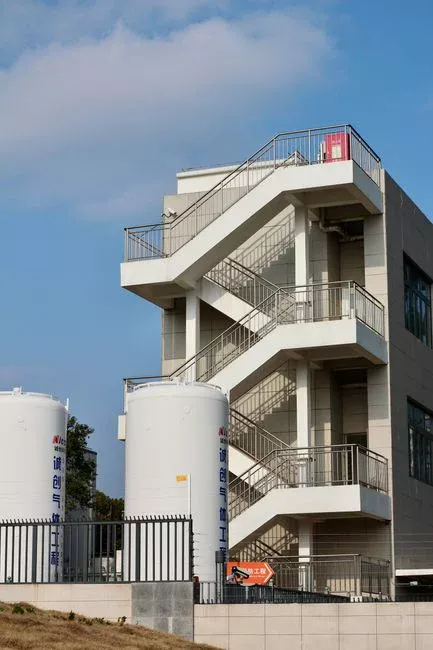
An integrated MBR combines a CAS-style aeration basin with submerged PVDF membranes (typically 0.1 μm pore size) that physically retain biomass and most particulates, replacing the secondary clarifier with membrane cassettes. The mixed liquor stays in the basin, the membranes reject the solids, and the permeate leaves as a sub-1 μm effluent clear enough to feed a polishing RO skid for reuse applications.
These systems represent a departure from traditional clarification, offering a more compact and precise separation method. The HydropureWater integrated MBR product family targets 10–2,000 m³/day, with documented <1 μm effluent and roughly 60% smaller footprint than a comparable conventional train (HydropureWater product catalog, 2026). Higher mixed-liquor suspended solids (MLSS) tolerance and tighter effluent mean MBR handles oily and metal-laden industrial streams more robustly than a clarifier-based CAS train. The DF-series flat-sheet PVDF cassettes are individually replaceable modules at 80–225 m² each, producing 32–135 m³/day per cassette, with 10–20× lower energy consumption than external cross-flow designs (HydropureWater catalog, DF series). The practical consequence for an Amory plant is that a single cassette stack can replace the secondary clarifier, a sand filter, and the upstream polymer dosing skid, all under one PLC.
Head-to-Head Comparison for an Amory Transportation Plant
The decision for most Amory plants involves six parameters: effluent quality, footprint, hydraulic envelope, operating complexity, reuse fit, and energy. The table below pulls the documented MBR specifications together with a qualitative read on CAS so an engineer can screen the choice.
| Parameter | CAS (with DAF headworks) | Integrated MBR (HydropureWater) |
|---|---|---|
| Effluent quality | Typically meets MDEQ industrial pretreatment for sewer discharge | <1 μm effluent suitable for direct rinse reuse or RO feed (catalog, 2026) |
| Footprint at same daily flow | Baseline | ~60% of CAS footprint (HydropureWater MBR catalog, 2026) |
| Documented hydraulic envelope | Covers 10–500 m³/day typically with one train; parallel basins at higher flow | 10–2,000 m³/day single skid (HydropureWater catalog, 2026) |
| Operating complexity | Routine sludge wasting, clarifier attention, polymer dosing | Membrane integrity, aeration control, periodic CIP |
| Reuse fit | Needs separate UF/RO polish to feed rinse or cooling-tower makeup | Effluent can feed RO directly, reducing polishing load |
| Energy profile | Lower aeration demand; clarifier-driven | 10–20× lower than external cross-flow MBRs (DF series); higher than simple CAS basin |
| Module/cassette basis | n/a | 32–135 m³/day per DF-series cassette at 80–225 m² (catalog, 2026) |
The headline trade-off is that MBR trades energy and membrane upkeep for a tighter effluent, a smaller basin room, and the option to feed reuse. If the plant's discharge is going down a sewer and nothing else, the trade is difficult to justify; if the plant needs reuse water or a sub-1 μm polish to feed a reverse-osmosis skid, MBR pays for itself in avoided purchased water and civil cost.
When CAS Is the Right Answer in 2026
For an Amory plant where the only goal is sewer discharge under MDEQ industrial pretreatment limits, with no reuse mandate, no cooling-tower makeup demand, and no zero-liquid-discharge pressure, CAS remains the right call. The plant's flow is steady, the basin room has room to expand, and the operator base already knows how to run a clarifier train. Under these conditions, CAS's lower CAPEX and familiar O&M outweigh MBR's footprint and effluent advantages. The decision tilts back to CAS for any plant that lacks trained operators for membrane maintenance, clean-in-place chemistry, and integrity testing, or where the capital budget is constrained. A simple packaged CAS train, like the type described in the WSZ underground integrated sewage treatment product family, is the more defensible scope in that scenario.
When MBR Is the Right Answer in 2026
The case for MBR at an Amory transportation equipment plant is the mirror image of the case for CAS. If the plant is targeting rinse water reuse, cooling-tower makeup, or zero-liquid-discharge and needs a sub-1 μm effluent to feed an RO train, MBR is the right answer. If floor space is constrained — the basin room cannot be expanded, the site is landlocked, or the civil footprint would trigger a new permitting cycle — MBR's roughly 60% footprint reduction (HydropureWater MBR catalog, 2026) allows the retrofit to fit inside the existing room.
MBR is also the right call where the discharge envelope is tight and a CAS train would still need a tertiary polish. The operational-simplification argument matters too: an MBR plant replaces clarifiers, sand filters, and a tertiary stage with one membrane cassette train under PLC control. For a plant trying to remove headcount from the basin room or eliminate a polymer-dosing skid, that is a real economic input. The specific product family that fits this case is the integrated MBR skid with DF-series flat-sheet PVDF cassettes sized from the cassette-level flux data.
Sizing and Budgeting for an Amory Retrofit
Before requesting a quote, an engineer should pull four pieces of information into a one-page datasheet. First, confirm the design flow in m³/day and the peak shift factor — the documented MBR envelope is 10–2,000 m³/day (HydropureWater catalog, 2026), so most Amory plants sit inside a single skid envelope. Second, characterize the influent for COD/BOD, TSS, oil and grease, and metals (zinc, nickel, iron) so the supplier can right-size the equalization basin and the membrane area. Third, request cassette-level flux and air-scour rates per cassette — 32–135 m³/day per DF-series cassette is the published band — so the cassette count, blower sizing, and tank dimensions are defensible on paper.
Fourth, ask for a side-by-side CAPEX/OPEX worksheet that prices the membrane replacement interval, CIP chemical usage, and the avoided cost of purchased rinse or cooling-tower makeup water. The unit value of the avoided water is the variable that flips the answer; without it, the comparison is biology and footprint, which rarely justify an MBR retrofit alone. The 2026 MBR cost-per-m³ guide and the USA MBR cost and ROI guide lay out the worksheets to request, but the actual price must come from the supplier against the engineer's datasheet. For product-level scope and a formal quotation, the integrated MBR system product page is the right starting point.
Frequently Asked Questions
What budget should an Amory plant plan for a 100 m³/day MBR retrofit in 2026?
There is no published price for the integrated MBR skid in the research, and any figure given without a supplier quotation against the plant's specific influent, equalization and cassette count is not defensible. The cost workbook to request is laid out in the USA MBR cost and ROI guide, and the supplier will need the design flow, peak shift factor, influent characterization, and the avoided-cost value of reuse water before a number can be issued. Treat any rule-of-thumb price as illustrative only.
How do I select an MBR supplier for a transportation equipment wastewater retrofit?
Request documented evidence that the supplier's product envelope covers 10–2,000 m³/day with <1 μm effluent and the published ~60% footprint reduction (HydropureWater catalog, 2026), and that the cassettes are individually replaceable flat-sheet PVDF modules in the 32–135 m³/day per cassette band (DF series). Ask for a reference list of industrial sites treating paint, phosphate or nickel pretreatment, or machining coolant streams, and for a CAPEX/OPEX worksheet that prices membrane replacement, CIP chemistry, and the avoided cost of reuse water. The MBR cost-per-m³ guide and the integrated MBR system product page are
Frequently Asked Questions
What is the typical CAPEX premium for an MBR over a conventional activated sludge system for a 50–200 m³/day transportation equipment plant in Amory?
For a plant in the 50–200 m³/day range, you should expect a CAPEX premium of 25% to 40% for an MBR system compared to a conventional activated sludge (CAS) configuration. While CAS requires larger secondary clarifiers and tertiary filtration steps to meet stringent discharge limits, the MBR premium is driven by high-flux membrane modules, automated backpulse systems, and stainless steel aeration skids.
However, when factoring in the total cost of ownership, the capital intensity is often offset by a 30% reduction in civil works, as MBRs operate at higher Mixed Liquor Suspended Solids (MLSS) concentrations—typically 8,000–12,000 mg/L—allowing for a significantly smaller tank footprint.
How do I evaluate MBR suppliers for a 2026 retrofit in northeast Mississippi — what documentation and performance data should I require?
When vetting suppliers, prioritize documentation that demonstrates successful treatment of high-emulsified oil and grease (O&G) common in transportation facilities. Require three years of normalized permeability data from similar industrial sites to ensure the membranes resist fouling from paint resins and phosphate-heavy surfactants.
Specifically, request a pilot-scale report or site-specific mass balance calculation that validates flux rates (LMH) under winter ambient temperatures typical of northeast Mississippi. Ensure the supplier provides a formal guarantee for membrane life—typically 5 to 7 years—and a detailed energy consumption profile expressed in kWh/m³ of treated permeate, inclusive of all permeate pumps and scouring blowers.
How do I size an MBR skid for a transportation equipment plant with paint overspray washwater and phosphate rinse?
Sizing must be based on a peak hydraulic load that accounts for batch discharges of phosphate rinses and the high Chemical Oxygen Demand (COD) spikes characteristic of paint overspray. Design the system using a conservative Net Flux rate of 12–18 LMH (liters per square meter per hour) to account for the potential organic loading and the viscosity of the mixed liquor.
Include an equalization tank volume capable of buffering at least 1.5 times the maximum daily flow to dampen the impact of shock loads on the biological process. Furthermore, ensure the membrane surface area is calculated with a 20% redundancy factor to allow for Clean-in-Place (CIP) cycles without interrupting the plant's continuous throughput requirements.
What lead time and installation footprint should an Amory plant expect when retrofitting an existing CAS basin with a submerged MBR?
Retrofitting an existing CAS basin with submerged MBR modules typically requires a lead time of 16 to 24 weeks for custom-fabricated stainless steel skids and integrated PLC controls. On-site installation, including basin modifications and membrane integration, generally spans 4 to 6 weeks, assuming the existing tank volume can be repurposed for high-density biomass aeration.
By eliminating the secondary clarifiers, you can expect to reduce the total process footprint by up to 50%. This creates available space within the existing facility envelope for the necessary chemical dosing skids required to pre-treat phosphate rinses and adjust pH before the MBR stage.
Is conventional activated sludge still compliant with 2026 MDEQ industrial pretreatment limits for transportation equipment manufacturers, or is MBR becoming the de facto choice?
While CAS remains technically compliant if paired with robust tertiary treatment—such as sand filtration or chemical precipitation—it is increasingly difficult to meet the tightening 2026 MDEQ (Mississippi Department of Environmental Quality) industrial pretreatment standards for phosphorus and suspended solids using CAS alone. The variability of transportation wastewater often leads to clarifier bulking or solids carryover, putting discharge permits at risk.
MBR is rapidly becoming the de facto choice because it provides a physical barrier (typically 0.04 µm pore size) that consistently yields effluent with <5 mg/L of Total Suspended Solids (TSS) and superior phosphorus removal. For facilities looking to minimize regulatory risk and potential fines, the reliability of MBR’s absolute barrier technology outweighs the lower initial complexity of legacy CAS systems.