Why Camayenne's Water Profile Forces a Different Spec than US Benchmarks
Camayenne sits on a narrow Atlantic peninsula that pushes humid, salt-laden marine air directly across any open cooling equipment, and that single fact reorders every assumption carried over from US inland benchmarks. The Saha University of Georgia Extension publication (TP-121, June 2026) notes that the most common data center discharge stream is cooling-tower blowdown — the controlled purge of recirculating water in which salts, minerals, biocides, corrosion inhibitors and heavy metals are progressively concentrated, and that above 5–6 cycles of concentration the biological and scaling risk curve turns exponential (S3). A Conakry site lives on the steep part of that curve from day one, because the same marine air that loads chloride onto tower fill also raises the baseline dissolved-solids content of the makeup water drawn from a municipal system that is, by S3's framing, often inconsistent in disinfection and quality.
The consequence is that a Camayenne spec cannot be copied from a Loudoun County, a Cheyenne or a Loudoun Water intake. Conakry does not have a functioning US-style industrial pretreatment program to lean on; S2 and S5 both document how US utilities' enforcement gaps still surface in places with decades of industrial discharge oversight, and Loudoun Water — which manages wastewater from more than 200 data centers in northern Virginia — still had to build its own control mechanism for fill-and-flush chemistry over time (S2). A Camayenne developer must therefore internalize more of the treatment train than any US peer. The defensible design starts from worst-case makeup quality, not best-case, and is sized to discharge to the marine environment under Guinean coastal rules, not to a willing publicly owned treatment works.
Three Wastewater Streams, Three Different Treatment Objectives
A 1–10 MW data center on the Camayenne peninsula needs three distinct workstreams, not one combined drain, because each stream has a different regulatory exposure, a different chemistry and a different downstream option. Mixing them is the single most common specification error carried over from US designs that assume a willing POTW at the back end.
Stream 1 is construction-phase fill-and-flush water, the one-time circulation of water (sometimes with corrosion-inhibitor additives) through closed-loop coolant piping to remove bacteria, debris and mill scale before the loop is commissioned. The 2026 Cheyenne, Wyoming case showed what can go wrong: the local Board of Public Utilities traced the rare copper-associated bacterium Cupriavidus gilardii to a data center fill-and-flush discharge, revoked the project's wastewater permit and issued a $10,000 fine after the organism survived treatment and reached a reuse system (S2). Stream 2 is steady-state cooling-tower blowdown, the controlled purge of recirculating water used to prevent over-concentration; according to S5, this stream typically contains salts, minerals, residual biocides, corrosion inhibitors and metals, and S3 puts its volume at 20–40% of intake. Stream 3 is ancillary wastewater — RO/UF reject from any blowdown-reuse train, softener brine and equipment drain water — which is small in volume but high in TDS and must be segregated. The June 2026 UGA Extension TP-121 reference also flags a fourth emerging stream: direct-liquid and immersion-cooling fluids that may contain refrigerants or PFAS compounds, which S5 says require specialized handling and should be characterized for any future-proofed Guinea campus.
| Stream | Source | Key Contaminants | Default Disposition |
|---|---|---|---|
| Fill-and-flush (construction) | Closed-loop pipe commissioning | Biocides, corrosion inhibitors, metals, possible microbiological carry-over | On-site equalization, characterize, haul-off or controlled discharge |
| Cooling-tower blowdown (steady-state) | Evaporative tower purge | Concentrated salts, hardness, silica, metals, residual biocides | Two-stage physical + targeted treatment; reuse or controlled discharge |
| Ancillary wastewater | RO/UF reject, softener brine, floor drains | High TDS, occasional oils | Segregated, often blended with blowdown for treatment |
| Direct-liquid / immersion fluids (future) | High-density GPU loops | Refrigerants, possible PFAS | Specialized handling, segregated from blowdown |
Cycles of Concentration: The Single Lever That Drives Blowdown Volume
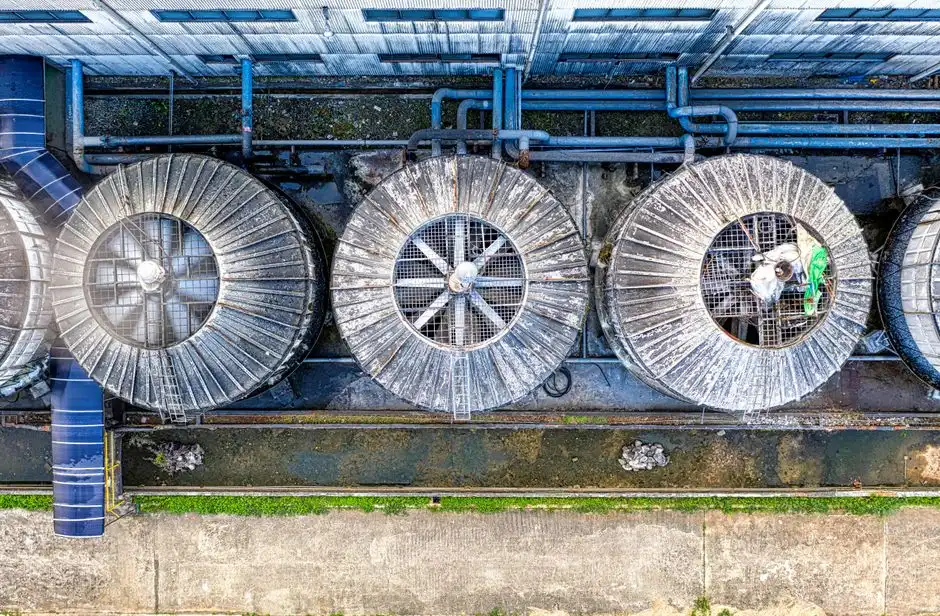
Cycles of concentration (CoC) is the single ratio that governs how much water leaves a cooling tower as blowdown, and the math is the same in Conakry as in Loudoun County. S3 gives the relationship directly: blowdown fraction equals 1/(CoC−1) of makeup water. At 4 CoC the blowdown is 25% of makeup; at 6 CoC it is 20%. That is a 5 percentage-point reduction — a 20% improvement in blowdown volume, not the 50% that operations teams routinely assume when they are told to push CoC higher (S3).
The same source warns that the biological and scaling risks rise exponentially above 5–6 CoC without advanced physical or biological control, and that equipment fouling, microbiologically influenced corrosion and scaling damage often force CoC back down to a manageable level, eroding the very savings the chemistry programme was meant to deliver. For a coastal Camayenne site the practical ceiling is lower than at a dry inland site because chloride stress accelerates under-deposit corrosion on tower fill and condenser tubes. The design CoC should therefore be set defensively — at or below the level the supplier can guarantee with the chosen treatment train — and the blowdown-handling equipment should be sized to the worst credible ratio, not the optimistic one.
Treatment Train for Cooling-Tower Blowdown at a Camayenne Campus
For a 1–10 MW facility the defensible default is a modular two-stage train with a reverse-osmosis upgrade path held in reserve. S3 and S5 both describe the canonical unit operations in the same order: physical separation first, then targeted contaminant removal, then disinfection. The order matters because each stage is sized to a specific load and a single combined reactor is harder to operate and harder to permit.
Stage 1 is physical separation. Settle out suspended solids, then pass the stream through a dissolved air flotation system for blowdown pre-treatment or a multi-media filter for blowdown polishing to handle the suspended-solids and any residual oil. S3 explicitly recommends media filtration or DAF for the suspended-solids removal step, and S5 lists suspended solids among the constituents EPA guidance expects to be controlled in cooling-tower blowdown. Stage 2 is targeted contaminant removal — side-stream filtration or ion exchange to strip hardness, silica and the metals that concentrate at higher CoC. S3's point that "chemical complexity increases the dissolved solids load in blowdown, making downstream treatment more difficult" is the engineering reason this stage exists: a chemical-only program fails at high CoC because it raises the load on whatever comes after it. Stage 3 is disinfection, sized for the recycled stream, with an on-site chlorine dioxide generator for cooling-loop disinfection or a UV sterilizer as a chemical-free polishing step chosen for Legionella, biofilm and any microbiological carry-through. S2 notes that biocides are routinely added to closed loops, so the disinfection stage must be sized for residuals as well as live organisms.
S1's 2026 life-cycle assessment shows that pushing for full UF+RO blowdown-to-makeup reuse can multiply treatment energy more than fivefold versus freshwater, balanced only by improvements in CoC that would reduce blowdown and chemical consumption. In Conakry, where municipal water is intermittent, expensive or saline, that tradeoff can flip in favour of an industrial RO system for blowdown-to-makeup reuse as a later upgrade — but it should be specified as a Stage 5 add-on, not built into the base CAPEX. S3 reports that 15–25% makeup reduction is realistic at a 10 MW facility running the two-stage train, with reuse options including irrigation, toilet flushing, equipment wash and (after the most advanced polish) cooling-tower makeup.
Construction-Phase Fill-and-Flush: The Permit Risk Most Specs Underestimate
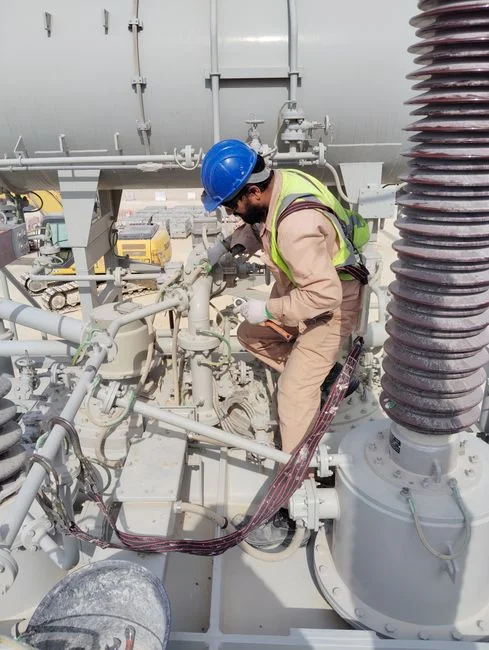
The 2026 Cheyenne case is the clearest evidence that fill-and-flush is a first-class compliance stream, not a commissioning afterthought. The Cheyenne Board of Public Utilities revoked the project's wastewater permit and issued a $10,000 fine after identifying Cupriavidus gilardii in the sewer system — an organism that, as S2 reports, "remained in wastewater after it was treated and reused to irrigate a golf course as part of a water conservation program" — and announced it would not accept certain types of wastewater from data centers citywide until the cause was understood. S2 quotes Bryce Dorr of the Board saying the utility had "set up a rule that says, 'You will not discharge to the public wastewater system, period, until we learn more.'"
Loudoun Water, which manages wastewater from more than 200 data centers in northern Virginia, has responded to the same class of risk by requiring pre-discharge testing of fill-and-flush water and independent verification of the results, with non-compliant loads redirected to "an appropriate facility" for disposal (S2). For a Camayenne project with no equivalent municipal pretreatment program, the conservative move is on-site equalization and characterization, with haul-off or controlled discharge only after metals, biocide residuals and microbiology are documented. The equalization tank should be specified with mechanical mixing and dedicated sampling ports — not a passive holding pond — so the operator can actually demonstrate compliance to any future Guinean regulator. The principle is identical to S2 and S5's recommended control mechanism, even though the regulator itself does not yet exist in West Africa.
Decision Framework: Which Cooling Architecture Fits Camayenne?
Upstream of the treatment train sits a more consequential choice: which cooling architecture the campus will run. S5 and S3 frame the options in terms that translate directly to a coastal Guinean site, with the qualification that Guinean coastal discharge rules are not the US Clean Water Act and must be checked against current Direction Nationale de l'Environnement guidance before any architecture is frozen.
Architecture A is once-through seawater cooling. It carries the lowest CAPEX and the lowest treatment energy, but it requires a deep-water intake, a discharge outfall, and permits to release warm brine back to the Atlantic. S5 notes that thermal discharge to receiving water is regulated in the US under the Clean Water Act "subject to site-specific permit conditions that vary considerably between facilities and jurisdictions" — and Camayenne's shoreline, near a population centre, will impose its own constraints. Architecture B is a closed-loop with an evaporative cooling tower and a blowdown treatment train — the most common 2026 architecture for hyperscale per S5, and the practical default for most Camayenne builds. S3 estimates that a 10 MW facility at 4 CoC may intake 15 million gallons monthly and produce 3.75 million gallons of recoverable blowdown, so the treatment train is non-optional. Architecture C is a closed loop with reclaimed municipal water for makeup, where S1's 2026 LCA shows a wastewater scenario has roughly twice the GWP of freshwater once treatment energy is included, with treatment energy about 80% of the difference — but the water-scarcity value in Guinea can flip that math.
| Architecture | Water Source | Treatment Energy | Permit Complexity | Defensible for Camayenne? |
|---|---|---|---|---|
| A — Once-through seawater | Deep Atlantic intake | Lowest | High (intake + brine outfall) | Only if shoreline and brine rules allow |
| B — Evaporative tower + blowdown train | Municipal (intermittent) | Moderate | Moderate | Defensible default for 1–10 MW |
| C — Closed loop + reclaimed municipal makeup | Treated municipal wastewater | High (UF+RO) | High (dual distribution) | Future upgrade if water scarcity worsens |
For most Camayenne builds the defensible default is Architecture B, with a modular two-stage blowdown train and an Architecture A seawater outfall held in reserve for peak-load events or for emergency thermal rejection.
Cost and Payback for a Modular Blowdown Treatment Package
The financial case for a modular blowdown package is built on avoided water acquisition, avoided sewer and avoided chemical costs, not on water savings alone. S3 gives the canonical reference case: a 15 MW facility recovering 60% of blowdown (3 million gal/yr) at $200,000 CAPEX yields a 6.7-year simple payback on water savings alone, falling to 3–5 years once avoided water acquisition, sewer and chemical costs are included.
That same source warns that hyperscale-grade RO and ion-exchange trains carry 3–4× higher per-gallon CAPEX at small facilities (around 5 MW) and usually fail to deliver ROI without dedicated operators — favouring modular media/DAF plus targeted polishing instead. A modular 100–300 GPM blowdown system typically matches a 1–10 MW Camayenne campus and avoids the operational complexity that sinks many under-used reuse installations, according to S3's right-sizing principle.
| Cost Lever | Order-of-Magnitude Range (research evidence) | Decision Implication |
|---|---|---|
| Modular 100–300 GPM train, two-stage | ~$200,000 CAPEX at 15 MW reference (S3) | Fits 1–10 MW scale without dedicated operators |
| Hyperscale RO/IX at 5 MW | 3–4× per-gallon CAPEX vs hyperscale (S3) | Avoid unless dedicated operators and water scarcity justify |
| Payback, water only | 6.7 years at 15 MW reference (S3) | Marginal for most finance committees |
| Payback, total cost of water | 3–5 years at 15 MW reference (S3) | Acceptable threshold for sustainability infrastructure |
The largest payback risk is not the equipment cost but the absence of metered sub-stream data. S5 notes that many operators are bound by nondisclosure agreements that hide facility-level water use, and the Saha UGA TP-121 publication observes that public records regarding data center water usage are currently limited. A Camayenne developer should price that transparency risk in from the start: the 2026 ROI framing for modular grit removal versus in-house tank build-out shows the same principle — without metered data, the spend cannot be defended. S3's prescription is to "start with an honest assessment" of where water enters, where it leaves, what is consumed versus discharged, and what the water quality of each stream is.
Frequently Asked Questions
What is a defensible CAPEX range for a 1–10 MW data center blowdown treatment package in Camayenne?
S3 cites a reference case of $200,000 CAPEX for a modular two-stage train at a 15 MW facility, with 3–5-year payback once avoided water, sewer and chemical costs are included; the right input a buyer must obtain from a vendor is a sized quotation against the actual worst-case blowdown volume at the design CoC, not against a generic GPM figure. Quote requests should specify target CoC, intake TDS and the reuse end-use (irrigation, toilet flush, makeup) so the vendor prices the correct polishing stage.
How should a Camayenne developer screen suppliers for a modular blowdown and disinfection train?
The actionable check is to require evidence that the supplier has shipped at least one comparable two-stage train (media filtration or DAF plus chemical oxidation or UV) into a coastal or high-TDS environment, and to require a written statement of the maximum CoC the train is warranted to support. S5's point that the Saha UGA TP-121 publication documents variable coverage of modern cooling-tower chemistry under existing pretreatment programmes means the supplier must demonstrate chemistry-specific experience, not just filtration experience.
How is construction-phase fill-and-flush wastewater treated differently from steady-state blowdown?
Fill-and-flush is segregated into a dedicated equalization tank with mixing and sampling ports, characterized for biocides, metals and microbiological carry-over, and only released or hauled off after results are documented — mirroring the control mechanism Loudoun Water applies to more than 200 data centers in northern Virginia (S2). Steady-state blowdown goes through the modular two-stage train described above; the two streams should never be combined, because the regulatory and microbial risk profiles are different.
When does a reverse-osmosis upgrade to blowdown-to-makeup reuse pay back in Guinea?
Per S1's 2026 LCA, full UF+RO blowdown-to-makeup reuse multiplies treatment energy more than fivefold versus freshwater, so the upgrade only pays back when makeup water is genuinely scarce, intermittent or saline enough that the water value exceeds the energy penalty. The input a buyer must obtain is the marginal cost of Conakry municipal makeup water at the project's commissioning date, plus the cost of any planned redundancy in supply; if those exceed the energy cost of RO at the local grid carbon intensity, the upgrade is justified.
Related Equipment
- industrial RO system for blowdown-to-makeup reuse — specifications, capacity range, and technical data