
Why this choice matters for a Cleburne chemical plant
The secondary biological system at a chemical plant in Cleburne, TX, determines whether a permit remains valid, a reuse loop closes, or a retrofit fits on the pad. Cleburne sits inside the Trinity River basin between Dallas–Fort Worth and the Brazos River watershed, and most specialty chemical facilities in the corridor either send treated effluent to a publicly owned treatment works (POTW) under an indirect discharge permit or pursue on-site reuse for cooling-tower makeup and process rinsing. The discharge route, the lot size, and the chemistry of the waste dictate which technology earns its place.
Chemical process wastewater is fundamentally different from municipal sewage. Influent COD and BOD swing with batch campaigns, pH drifts between acidic and alkaline campaigns, and intermittent releases of solvents, surfactants, and salts routinely upset biology designed for a steady domestic load. Both membrane bioreactors (MBR) and conventional activated sludge (CAS) use the same aerobic biology to do the actual organic destruction (Seven Seas Water Group, 2026). The difference is the solids-separation step downstream of biology: a clarifier in CAS, or an ultrafiltration or microfiltration membrane in MBR (Seven Seas Water Group, 2026). This makes the decision a separation-and-footprint problem rather than a treatment-chemistry problem. For a deeper look at the technology and the operating-cost inputs needed from a vendor, the 2026 MBR cost and selection guide is a useful companion read.
How conventional activated sludge treats chemical wastewater
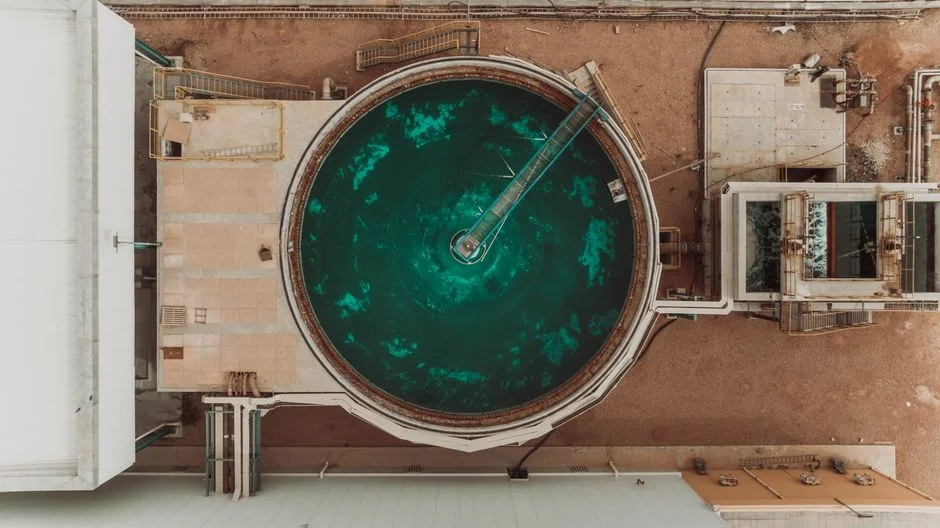
CAS is the older of the two systems and remains the default on many Texas industrial sites. Wastewater enters an aeration tank where aerobic bacteria metabolise organic compounds in an oxygen-rich environment (Seven Seas Water Group, 2026). The mixed liquor — biomass plus water — then flows into a settling tank, or clarifier, where the activated sludge separates from the treated water under gravity, and clarified water overflows toward disinfection or further polishing (Seven Seas Water Group, 2026). A controlled fraction of the settled sludge is returned to the aeration tank to keep the microbial population healthy; without that recycle, biomass would wash out of the system (Seven Seas Water Group, 2026).
The clarifier is the load-bearing assumption in any CAS design, and it is also where a chemical site often breaks the system. Clarifier performance depends on sludge settleability — the floc's ability to form, hold together, and drop out of the water column. That floc structure is destroyed by inhibitory organics, surfactants, and oil and grease that arrive with batch dumps, and it is destroyed even faster by salt spikes that change floc density. Once the floc fails, the clarifier carries solids over the weir, effluent turbidity rises, and the downstream disinfection step is suddenly asked to handle a solids load it was never sized for. This is why CAS works on steady, low-inhibitor loads and behaves poorly on the variable, salt-bearing streams that arrive from a specialty chemical plant.
How an MBR treats chemical wastewater
MBR is activated sludge with a physical membrane standing in for the clarifier. The same aeration biology performs the organic destruction; the difference is that mixed liquor is filtered through submerged membranes with fine pores that physically retain biomass and allow only treated water through. The HydropureWater MBR membrane bioreactor system uses submerged PVDF membranes delivering less than 1 μm filtration and is rated for flows from 10 to 2,000 m³/day (HydropureWater product catalog, 2026). The flat-sheet implementation, the DF series PVDF flat sheet MBR module, is built around a 0.1 μm pore size and an integrated aeration box that scours the membrane surface continuously; modules are individually replaceable and the manufacturer states this design uses 10–20× less energy than external cross-flow configurations (HydropureWater product catalog, 2026).
Because the membrane physically retains biomass, the system can be operated at a far higher mixed liquor suspended solids concentration than CAS without losing solids over a weir. A higher MLSS inventory means more biological capacity in the same tank volume, which gives MBR its tolerance for shock loads and intermittent inhibitory compound releases. A 50,000 GPD (189 m³/day) modular MBR plant is documented as a real industrial-scale reference installation (Seven Seas Water Group, 2026), demonstrating that the technology has been delivered in a size envelope that fits a mid-sized chemical facility.
MBR vs CAS at a glance: parameter comparison
The table below captures the decision-shaping parameters a Cleburne engineer will be asked about in a memo. Values are taken from the supplied sources; where a numeric figure is not in the research, the cell states the qualitative direction rather than inventing a number.
| Attribute | Conventional activated sludge (CAS) | Membrane bioreactor (MBR) | Source |
|---|---|---|---|
| Solids separation mechanism | Gravity clarifier with sludge recycle to aeration tank | Submerged UF/MF membrane as the physical barrier | Seven Seas Water Group, 2026 |
| Effluent quality | Clarifier overflow; suspended solids can carry over | UF/MF barrier blocks suspended solids; higher-quality effluent | Seven Seas Water Group, 2026 |
| Footprint | Larger; needs separate secondary clarifier | Compact; no separate clarifier | Seven Seas Water Group, 2026; HydropureWater product catalog, 2026 |
| Sludge handling | Additional settling and dewatering steps beyond the clarifier | Sludge concentrated inside the membrane module for easier handling | Seven Seas Water Group, 2026 |
| Footprint reduction vs. conventional | Baseline | Approximately 60% smaller footprint than conventional systems (manufacturer claim) | HydropureWater product catalog, 2026 |
| Capacity envelope (integrated system) | Site-specific civil design | 10 to 2,000 m³/day per integrated system | HydropureWater product catalog, 2026 |
| Per-cassette capacity (flat-sheet module) | Not applicable | 32 to 135 m³/day per cassette, depending on module size | HydropureWater product catalog, 2026 |
| Operator model | Sludge recycle loop maintains microbial population | Fresh microorganisms must be added with each new treatment batch | Seven Seas Water Group, 2026 |
| Reuse suitability | Limited; typically needs further polishing | Near-reuse-quality effluent suitable for further polishing | Seven Seas Water Group, 2026; HydropureWater product catalog, 2026 |
The 60% footprint figure is a manufacturer claim from HydropureWater's product catalog (2026); treat it as the vendor's published envelope rather than an independently verified benchmark, and ask the vendor to substantiate it for the specific influent you plan to treat.
Where each system wins on a chemical wastewater stream
For a Cleburne chemical producer, the choice depends on which system survives the actual feed conditions and meets the discharge or reuse target.
MBR wins on a constrained site. The compact footprint removes the secondary clarifier and the gravity-settling dependency that breaks down under chemical stress, and the membrane barrier keeps the biological reactor stable across shock loads that would lift a clarifier weir (Seven Seas Water Group, 2026; HydropureWater product catalog, 2026). MBR also wins when the plant is targeting water reuse, because the less-than-1 μm PVDF membrane produces near-reuse-quality effluent suitable for further polishing toward cooling-tower makeup or process rinsing (HydropureWater product catalog, 2026). For batch and batch-plus-continuous operations common in Cleburne's specialty chemical sector, the membrane barrier is more forgiving of empty-and-fill cycles than a clarifier that requires a steady hydraulic profile to settle sludge.
CAS wins in specific cases. A plant that discharges to a POTW under an indirect discharge permit that does not require sub-NTU effluent, that has land available for a clarifier and aeration basin, and where capital cost dominates the decision is a CAS application (Seven Seas Water Group, 2026). On those sites, CAS is a proven, lower-capex workhorse. MBR's higher MLSS operation provides a buffer against the inhibitory organics and salt spikes that arrive with specialty chemical manufacturing, but the supplied research does not provide a numeric MLSS or salt-tolerance threshold, so the case for MBR under inhibition should be made qualitatively and confirmed with jar testing or pilot data on the actual plant stream.
Cost, retrofit and decision framework for Cleburne sites
The supplied research does not contain numeric capital or operating cost figures, and any vendor that quotes a number without first asking for your flow, load, and discharge route is selling, not engineering. What the research does support is the direction of the cost trade: MBR carries higher membrane and module cost, CAS carries higher civil and earthwork cost, and the operating-cost split is membrane-aeration energy and periodic membrane replacement for MBR versus clarifier maintenance and sludge handling for CAS. For an itemised comparison, request membrane area, aeration blower duty, civil work scope, and membrane replacement interval from any vendor on your bid list.
The retrofit question arises frequently on Cleburne sites that already have a CAS basin in the ground. In some cases, the existing basin can be retained and a post-clarifier membrane stage added to upgrade the separation step. The MBR concept still applies, but the hydraulics, recirculation, and MLSS control all change when a membrane stage is grafted onto a CAS tank, so this is a configuration decision for a qualified process engineer rather than a catalogue choice. Greenfield sites with no existing civil work usually compare MBR and CAS on footprint, reuse target, and feed variability; retrofit sites usually compare MBR-augmented-CAS against full MBR conversion.
The decision framework relies on four inputs a buyer must have before talking to a vendor. (1) Footprint available on the pad — if the existing basin is staying, this is fixed. (2) Discharge route — POTW, surface water under a Texas Pollutant Discharge Elimination System (TPDES) permit, or on-site reuse. (3) Influent variability — batch duty, salt and solvent spikes, and pH swing. (4) Target effluent quality — BOD, TSS, and any reuse-specific conductivity or hardness ceiling. Pick the system that fails the fewest of these. Adjacent equipment the buyer should plan for includes a rotary mechanical bar screen for headworks protection ahead of either system, a PLC-controlled chemical dosing for pH equalisation upstream of biology, and a plate and frame filter press for sludge dewatering to handle the waste biomass from either configuration.
Frequently Asked Questions
Is MBR worth the capex premium over CAS for a chemical plant in Cleburne?
The value of the premium depends on site requirements. The supplied research does not include a numeric capex delta, so request itemised quotes that separate membrane area, aeration blower duty, civil work, and instrumentation from any vendor on your bid list. MBR is typically worth the premium when the site footprint is constrained, when the plant targets water reuse, or when influent variability (batch dumps, salt and solvent spikes) would defeat a clarifier (Seven Seas Water Group, 2026; HydropureWater product catalog, 2026). For a POTW discharge with no reuse target and available land, CAS is usually the lower-capex answer.
What should a Cleburne engineer ask a vendor to confirm sizing and compliance risk before buying an MBR?
Ask for a guaranteed membrane flux under your peak COD and your peak MLSS, a membrane-aeration specific energy figure in kWh per m³ of permeate, and a written membrane replacement interval and cost. For compliance risk, ask the vendor to map the proposed effluent against the actual TPDES or POTW discharge limits you are subject to and to identify which piece of equipment is the bottleneck if a future limit tightens. The supplied research confirms the technology envelope (10 to 2,000 m³/day for the integrated system; 32 to 135 m³/day per flat-sheet cassette) but does not supply a numeric compliance threshold, so the vendor must supply site-specific guarantees against your permit (HydropureWater product catalog, 2026).
How does MBR handle the inhibitory organics and salt spikes common in specialty chemical wastewater?
MBR retains biomass inside the membrane module, which allows the aeration tank to be operated at a higher MLSS than CAS and gives the biology more buffering capacity against shock loads.