
Why a Containerized MBR Fits Brasília Residential and Camp Projects
A containerized MBR combines biological treatment with submerged ultrafiltration inside a 20 ft or 40 ft high-cube shipping container, with the full process train (1.5 mm drum screen, anoxic/aerobic biological stage, submerged PVDF UF membrane cassette, permeate handling) delivered as one factory-tested module (Pure Aqua envelope cited in S3, 2026). Effluent from a properly sized unit runs near-reuse quality, with BOD below 5 mg/L and TSS below 1 mg/L on the stock envelope (Pure Aqua, S3), which is the engineering basis for demonstrating CONAMA Resolução 430/2011 compliance in the Federal District.
Plug-and-play format requires only power and piped influent on a concrete pad — no reinforced basins — which suits Brasília infill sites, construction camps, and seasonal housing where permanent civil works are not wanted. The format is parallelable: multiple containers can be added as a residential estate builds out or as a camp's peak occupancy grows, and the skid can be lifted out and redeployed when a 2–5 year camp horizon ends (S3). For Brasília projects, the deeper operational questions sit inside this envelope — peak flow handling, voltage matching, and the CONAMA 430/ADASA/CAESB compliance chain — and the rest of this article works through them in order. The Brazil package wastewater treatment plants guide covers the broader procurement and compliance context for containerized plants in Brazil.
Step 1 — Establish the Population Equivalent for the Brasília Project
The design headcount is the primary sizing input and the one most often under-counted. For a residential estate, sum the design occupancy from the developer's housing schedule; for a camp, take peak occupancy and apply a loading factor for shared showers, catering, and laundry that are not present in a typical household (S3). The supplied research does not give a Brasília-specific population equivalent — the design headcount must be confirmed from the developer's housing schedule or the camp operator's site plan.
Common under-counting mistakes are forgetting visitors and guests (add 5–10% to headcount), missing the morning shift-changeover surge at labour camps, and copying a hotel's per-capita value onto a camp that has very different fixture counts (S3). For Brasília specifically, account for the dry/wet seasonality of the Cerrado: construction camps often peak during the May–September dry season, while residential developments tend to be steadier year-round. A 300-person construction camp in Brasília — the worked example used later in this guide — should be sized against peak occupancy rather than the rolling average, because the camp's hydraulic peak drives the membrane selection more than its annual loading does.
Step 2 — Convert Population Equivalent to Average Daily Flow
Multiply the design headcount by a per-capita wastewater contribution in litres per capita per day to get the average daily flow (Qavg). Pure Aqua's stock baseline is 50 gpd (≈190 L) per capita per day (Pure Aqua, S3); that figure is a baseline rather than a universal rule. Residential developments in tropical-climate contexts typically sit at 130–180 L/c/d when occupants are full-time and water fixtures are limited; adjust upward if Brasília households have dual-flush toilets, low-flow showers, or shared laundry (S3).
Labour camps with shared showers, kitchen messes, and laundry typically sit at 200–250 L/c/d (S3). Brasília's warmer Cerrado climate increases showering frequency and should push camp per-capita values toward the upper end of that range. Hotels with transient guests can exceed 250 L/c/d, but residential and camp projects in Brasília should not borrow a hotel value without justification (S3). Always validate the per-capita figure against an on-site water-use survey or the developer's billing data before locking it into the design basis (Pure Aqua, S3).
Step 3 — Apply a Peak Hourly Factor and Check Buffer Storage
A membrane bioreactor's flux is rate-limited, so the unit must be sized for peak hourly flow (Qpeak) rather than the 24-hour daily average (Pure Aqua, S3). Apply a peak factor (PF) of 2.0–2.5 for camp occupancies and 1.5–1.8 for steady residential developments; Qpeak = Qavg × PF (S3).
For a 300-person Brasília camp with Qavg of 57 m³/day (190 L/c/d) and a PF of 2.2: Qpeak = 57 × 2.2 / 24 = 5.2 m³/h (S3). The factor matters because the membrane tank's equalization volume is finite — if the buffer is too small, influent surges push transmembrane pressure (TMP) up, shorten cleaning intervals, and risk compliance excursions during peak windows. Most containerized MBR skids include a small internal equalization/buffer tank sized for typical diurnal patterns; if the camp's peak profile is extreme — for example, a single morning wash block serving 300 workers in 90 minutes — specify external buffer storage of at least 4–6 hours of Qpeak (S3). A conservative engineer sizes for the worst observed 4-hour window, not the 24-hour average (Pure Aqua, S3).
Step 4 — Match Qpeak to a 20 ft or 40 ft Containerized MBR
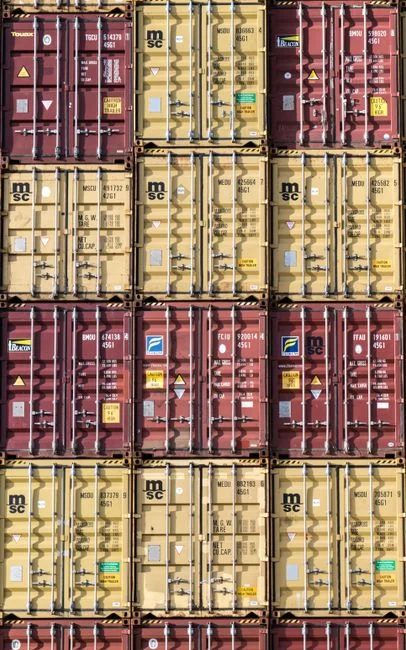
Standard envelope: a single 20 ft HC unit typically handles up to ~50 m³/day, while a 40 ft HC unit covers ~50–200 m³/day, with multiple containers parallelable for larger flows (Pure Aqua, S3; WaterAcademia framing, S3). Translating the calculated Qpeak into a specific container size requires adding 20–30% spare capacity above Qpeak for population growth, seasonal load spikes, and future reuse upgrades (S3). The submerged membrane cassette inside either format is typically the submerged PVDF flat sheet membrane module, which can be swapped or expanded without replacing the container.
Worked example for a 300-person Brasília construction camp: Qavg 57 m³/day (190 L/c/d) → Qpeak 5.2 m³/h → with 25% spare the unit must cover ~6.5 m³/h peak, which sits inside a 40 ft HC envelope of up to ~200 m³/day; spec a 40 ft HC, or parallel two 20 ft units with one held as standby (S3). For a 150-person camp at ~28 m³/day average, a single 20 ft HC unit with 20–30% spare capacity is the right call (S3). For phased Brasília residential projects, install a 20 ft unit now, plumb the second pad, and add the second 20 ft when occupancy hits 70% of design. Where a single 40 ft unit is still undersized, parallel additional 40 ft containers rather than over-specifying one — the modular format is designed for paralleling (S3).
Logistics differ mainly in delivery. A 20 ft unit is easier to lift into a tight Brasília courtyard but requires more parallel units to reach the same flow, multiplying connection and maintenance points. A 40 ft unit is heavier and longer, which can be a constraint on narrow Federal District streets or on camps with soft ground (S3). The containerized MBR membrane bioreactor system and the MBR flat sheet membrane module cover the hydraulic and membrane side of this choice in more detail. The comparison table below summarises the 20 ft vs 40 ft decision for Brasília projects.
| Parameter | 20 ft HC Container | 40 ft HC Container |
|---|---|---|
| Indicative flow envelope | Up to ~50 m³/day (Pure Aqua, S3) | ~50–200 m³/day (Pure Aqua, S3; S3) |
| Indicative population at 190 L/c/d | Up to ~260 people | ~260–1,050 people |
| Footprint and access | Easier Hiab/crane lift on tight Brasília courtyards | Needs more truck and crane room; heavier and longer |
| Phased expansion | Reserve space for a parallel second 20 ft unit | Multiple 40 ft units can be paralleled (S3) |
| Site preparation | Flat concrete pad, 150 mm RC typical (S3) | Flat concrete pad, 150 mm RC typical (S3) |
| Connections | Plug-and-play, water + power only (S3) | Plug-and-play, water + power only (S3) |
Step 5 — Verify the Design Against CONAMA 430 and Brasília Sewer Conditions
A properly sized containerized MBR produces permeate with BOD, TSS, TKN and ammonia well below typical discharge limits — the engineering basis for designing to CONAMA Resolução 430/2011 compliance for small communities (Pure Aqua, S3). Document the expected permeate quality — BOD, TSS, TKN, ammonia — in the permit application, supported by the supplier's reference plant data. For the Brasília permit file, this is the section that an ADASA reviewer will read first.
Engage ADASA (Agência Reguladora de Águas, Energia e Saneamento Básico do DF) early to confirm whether the effluent can be discharged to the public sewer, must be reused on-site, or faces additional restrictions for sensitive receptors such as the Lago Paranoá watershed. Where a public sewer is the receptor, contact CAESB (Companhia de Saneamento Ambiental do Distrito Federal) to confirm connection conditions, sampling access, and any pretreatment requirements they will impose on top of CONAMA 430. If a phosphorus limit applies to the discharge point — common for Brasília receptors near the Paranoá watershed — factor metal-salt chemical dosing into the membrane skid selection from the start, not as a retrofit after delivery (Pure Aqua, S3).
The supplied research contains no price data, so do not infer a euro-per-PE or BRL-per-m³ figure — request a per-container quotation from each shortlisted supplier inclusive of the upstream bar screen, chemical dosing, sludge dewatering, and any UV or chlorine dioxide disinfection. The Brazil package wastewater treatment plants guide covers the broader cost and compliance framing for Brazilian packaged plants.
Site-Specific Checks for Brasília — Voltage, Climate, and Reuse
Confirm voltage compatibility: the Brasília grid is 220V/60Hz while most containerized MBR stock is built for 460V/3Ph/60Hz (Pure Aqua, S3) — specify a step-up transformer or a voltage-matched build at quotation. Brasília ambient temperature sits inside the 20–30°C operating band (Pure Aqua, S3), so no heating or cooling is required; on sites with high groundwater, the container's sealed floor and zero-leakage wall design matter for flood resilience (S3).
Size a genset or solar buffer for the camp's expected outage rate; a membrane plant without backup power will trip on the first sustained outage. For reuse within the camp or for residential irrigation, specify a UV sterilizer on the permeate line to address any residual bacterial loading before the reuse loop. A fully automatic PLC control system (Skyview, S2) is appropriate for camps with no full-time operator; add remote monitoring if the camp is intermittently staffed.
Upstream of the container, install a rotary mechanical bar screen to protect the container's internals from rags, plastics and debris. If the project must meet low phosphorus limits, include an automatic chemical dosing system ahead of the membranes. Downstream, plan a plate and frame filter press for sludge handling, and a UV sterilizer on the permeate line if the effluent is destined for reuse.
Frequently Asked Questions
How long does delivery and on-site erection take for a containerized MBR in Brasília?
A specific lead time in weeks or months is not given in the supplied research. Request the factory build slot, the shipping time to a Brazilian port, and the on-site erection duration in writing from each shortlisted supplier before committing to a project programme, and ask what is included in the factory test, what is shipped loose, and what the site erection scope actually is.
What does a containerized MBR cost in Brasília?
The supplied research contains no price data for a containerized MBR, and no indicative BRL-per-PE or BRL-per-m³ figure should be inferred from the sources. Request a per-container quotation from each supplier that is inclusive of the upstream bar screen, the chemical dosing system if phosphorus control is in scope, the sludge dewatering press, and any UV or chlorine dioxide disinfection on the permeate line, so the totals are directly comparable across bids.
Does a containerized MBR meet CONAMA 430/2011 for discharge to a CAESB sewer?
A properly sized unit produces permeate with BOD, TSS, TKN and ammonia well below typical discharge limits (Pure Aqua, S3), which is the engineering basis for designing to CONAMA Resolução 430/2011 compliance. For Brasília specifically, the permit file must reference CONAMA 430/2011 for the effluent envelope, ADASA for the Federal District discharge or reuse conditions, and CAESB for any additional sewer-connection pretreatment requirements.
Can a 20 ft unit be expanded later as the camp or estate grows?
Yes. The format is parallelable: install a 20 ft unit now, plumb the second pad, and add the second 20 ft when occupancy hits 70% of design (S3). Where a single 40 ft unit is still undersized, parallel additional 40 ft containers rather than over-specifying one — the modular format is designed for paralleling.
Related Equipment
- containerized MBR membrane bioreactor system — specifications, capacity range, and technical data
- PVDF flat sheet membrane module — specifications, capacity range, and technical data
- rotary mechanical bar screen — specifications, capacity range, and technical data
- plate and frame filter press — specifications, capacity range, and technical data
- automatic chemical dosing system — specifications, capacity range, and technical data
- UV sterilizer on the permeate line — specifications, capacity range, and technical data