
What a Containerized MBR STP Is and Why It Fits Thiès
A containerized MBR STP is a pre-engineered membrane bioreactor assembled inside a standard 20 ft or 40 ft high-cube (HC) shipping container, integrating biological treatment with submerged ultrafiltration (UF) at a nominal pore size of 0.04 µm (Pure Aqua, S4; WaterAcademia, S5). The process train is fixed: feed passes a 1.5 mm drum screen, flows into an anoxic/aerobic biological stage, then through a submerged PVDF UF membrane tank before disinfection. A single 20 ft HC unit typically handles up to ~50 m³/day, while a 40 ft HC unit covers ~50–200 m³/day, with multiple containers parallelable for larger flows (Pure Aqua, S4; WaterAcademia, S5).
Thiès projects — labour camps, NGO bases, housing developments — fit this format because the unit arrives on a flatbed, drops onto a concrete pad, and needs only power and piped influent to start up. No reinforced basins, no long civil schedule. For camps with 2–5 year horizons or phased housing, the container can be lifted out and redeployed. Effluent typically meets near-reuse quality (BOD < 5 mg/L, TSS < 1 mg/L per Pure Aqua's envelope, S4), which matters in Thiès where municipal sewer coverage is patchy and on-site irrigation or toilet-flushing reuse reduces freshwater demand. The full process train for a project like this is delivered in a containerized MBR membrane bioreactor system with built-in PLC control (Skyview, S2).
Step 1 — Define the Design Population and Per-Capita Flow
The design population is the primary sizing input and is often under-counted. Multiply the design population by a per-capita flow to get average daily flow (Qavg). Pure Aqua's stock baseline is 50 gpd (≈190 L) per capita per day (Pure Aqua, S4), but that figure is a baseline rather than a universal rule. Residential developments in West Africa typically sit at 130–180 L/c/d when occupants are full-time and water fixtures are limited. Labour camps with shared showers, kitchen messes, and laundry typically sit at 200–250 L/c/d. Hotels with transient guests can exceed 250 L/c/d.
Worked example for a 300-person construction camp in Thiès: 300 × 190 L = 57,000 L/day = 57 m³/day average. If the camp has full showers and a canteen, lift the per-capita value to 220 L and the average rises to 66 m³/day. Get the occupancy profile right before you commit: full-time residential is steady, seasonal construction is peak for 3–6 months, and a shift-worker camp produces a sharp daytime peak that affects the next step. Common mistakes are forgetting visitors and guests (add 5–10% to headcount), under-counting the morning shift-changeover surge, or copying a hotel's per-capita value onto a camp that has very different fixture counts.
Step 2 — Convert Average Flow to Peak Hydraulic Load
A membrane bioreactor's flux is rate-limited, requiring the unit to be sized for peak hourly flow (Qpeak) rather than just Qavg. Apply a peak factor (PF) of 2.0–2.5 for camp occupancies and 1.5–1.8 for steady residential developments. Qpeak = Qavg × PF. For the 300-person camp example with Qavg of 57 m³/day and a PF of 2.2: Qpeak = 57 × 2.2 / 24 = 5.2 m³/h.
The factor matters because the membrane tank's equalization volume is finite. If the buffer is too small, influent surges push transmembrane pressure (TMP) up, shorten cleaning intervals, and risk compliance excursions during peak windows. Most containerized MBR skids include a small internal equalization/buffer tank sized for typical diurnal patterns; if your camp's peak profile is extreme — for example, a single morning wash block serving 300 workers in 90 minutes — specify external buffer storage of at least 4–6 hours of Qpeak. A conservative engineer sizes for the worst observed 4-hour window, not the 24-hour average.
Step 3 — Check the Load Parameters the Unit Was Designed For
Verifying the unit's design envelope against site-specific influent and ambient conditions ensures operational stability. The parameter table below maps Pure Aqua's stock MBR-C envelope (S4) against typical residential and camp sewage in Senegal.
| Parameter | Containerized MBR Design Envelope | Typical Thiès Residential / Camp Sewage |
|---|---|---|
| Operating temperature | 20–30°C | 22–30°C (Thiès ambient) |
| Design temperature | 20°C | Within range |
| Influent BOD | 200–400 mg/L | 200–350 mg/L |
| Influent COD | 400–800 mg/L | 400–700 mg/L |
| Influent TSS | 200–350 mg/L | 200–300 mg/L |
| FOG | Low–moderate | Low–moderate; canteen effluent may push higher |
| Pre-treatment | 1.5 mm drum screen (Pure Aqua, S4) | Required for rags, sand, plastics from greywater |
| Electrical supply | 460V / 3Ph / 60Hz (Pure Aqua, S4) | 220–240V / 50Hz Senegalese grid — specify transformer or voltage-matched variant |
Three factors are critical for a Thiès project. First, ambient temperature sits inside the 20–30°C operating band, so no heating or cooling is needed. Second, the Senegalese grid is 220–240V / 50Hz, while Pure Aqua's stock spec is 460V / 3Ph / 60Hz — a transformer or a voltage-matched build must be specified at quotation. Third, run on-site influent sampling for at least 2 weekdays and 1 weekend day before finalizing the design; camp greywater can carry sand, hair, and plastics that overwhelm a 1.5 mm screen if upstream grit removal is skipped. For background on how the membrane stage works inside the envelope, see the MBR process and efficiency explainer.
Step 4 — Pick a 20 ft or 40 ft Container and Plan for Spare Capacity
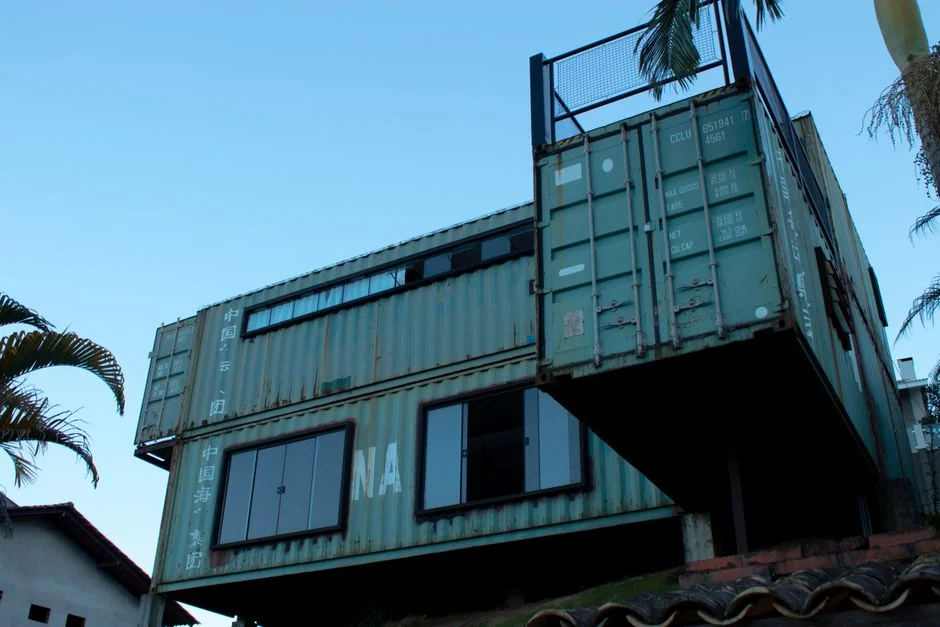
Translating the calculated Qpeak into a specific container size requires adding 20–30% spare capacity above Qpeak for population growth, seasonal load spikes, and future reuse upgrades.
| Selection Criterion | 20 ft HC Container | 40 ft HC Container |
|---|---|---|
| Typical flow envelope | Up to ~50 m³/day | 50–200 m³/day |
| Indicative population (at 190 L/c/d) | Up to ~260 people | 260–1,050 people |
| Footprint (container only) | ~6 m × 2.4 m | ~12 m × 2.4 m |
| Site access | Standard flatbed truck; tight sites | Standard flatbed; needs longer clear approach |
| Scalability | Reserve space for a parallel second 20 ft unit | Multiple 40 ft units can be paralleled (WaterAcademia, S5) |
| Foundation | Flat concrete pad, 150 mm RC typical | Flat concrete pad, 150 mm RC typical |
For the 300-person camp example (Qavg 57 m³/day, Qpeak 5.2 m³/h), a single 20 ft HC unit is at the upper edge of its envelope and leaves little spare capacity — spec a 40 ft HC unit, or parallel two 20 ft units with one held as standby. For a 150-person camp at ~28 m³/day average, a single 20 ft HC unit with 20–30% spare capacity is the right call. For phased construction projects, install a 20 ft unit now, plumb the second pad, and add the second 20 ft when occupancy hits 70% of design. The submerged membrane cassette inside either format is typically the submerged PVDF flat sheet membrane module, which can be swapped or expanded without replacing the container.
Step 5 — Confirm Power, Climate, and Local Compliance
Site-specific checks prevent common integration issues. Power: confirm voltage compatibility, as Senegal's grid is 220–240V / 50Hz while most containerized MBR stock is built for 460V / 3Ph / 60Hz (Pure Aqua, S4). Specify a step-up transformer or order a voltage-matched build. Size a genset or solar buffer for the camp's expected outage rate; a typical Thiès camp sees 4–8 hours of grid interruption per week, and a membrane plant without backup power will trip on the first sustained outage. Climate: Thiès ambient sits inside the 20–30°C operating band (Pure Aqua, S4), so no special HVAC is needed, but on sites with high groundwater, the container's sealed floor and zero-leakage wall design (Pure Aqua, S4) matter for both flood resilience and operator safety. Compliance: confirm the receiving environment — ground irrigation, surface watercourse, or municipal sewer — and the relevant Senegalese discharge standard before specifying effluent polishing, since reuse for irrigation typically needs additional disinfection and possibly nutrient polishing. Operation: a fully automatic PLC control system (Skyview, S2) is appropriate for camps with no full-time operator; add remote monitoring if the camp is intermittently staffed. For a comparative read on hotel-scale packaged MBR selection in a neighbouring West African context, see the West Africa packaged MBR STP buyer's guide.
Frequently Asked Questions
What per-capita flow should I use to size a containerized MBR for a camp in Thiès?
Start at 190 L/c/d (the 50 gpd baseline from Pure Aqua, S4) and adjust up to 200–250 L/c/d for camps with shared showers, kitchens, and laundry. For steady residential developments, 130–180 L/c/d is more typical. Always validate against an on-site water-use survey before locking in the number.
How do I choose between a 20 ft and a 40 ft containerized MBR?
Use the flow envelope: 20 ft HC for up to ~50 m³/day, 40 ft HC for 50–200 m³/day (Pure Aqua, S4; WaterAcademia, S5). Add 20–30% spare capacity above Qpeak and parallel containers if the camp population or build-out is phased. For a quotation-ready spec, request the containerized MBR membrane bioreactor system datasheet.
What influent and climate conditions does a containerized MBR handle in Senegal?
The stock design envelope is 20–30°C operating temperature with a 20°C design point, BOD 200–400 mg/L, COD 400–800 mg/L, and TSS 200–350 mg/L (Pure Aqua, S4) — all of which match typical Thiès residential and camp sewage. Thiès ambient sits inside the operating band, so no heating or cooling is required. Specify a 220–240V / 50Hz variant or step-up transformer to match Senegal's grid.