Why Campbellsville Fabricated Metals Plants Need a Site-Specific Pretreatment Plan
A Campbellsville-area fabricated metals floor that discharges to a small municipal POTW cannot rely on a generic federal-only design, because the receiving plant has limited hydraulic dilution and a Friday afternoon rinse dump will swing the floor-drain chemistry faster than a generic equalization basin can absorb (HydropureWater, 2026, Pine Grove precedent applicable to small-Kentucky POTWs). Because local limits developed under 40 CFR 403.5 govern day-to-day compliance regardless of whether 40 CFR Part 433 categorically applies, a plant without a written pretreatment plan risks a violation notice (HydropureWater, 2026).
The EPA also has a live PFAS rulemaking scoped to chrome finishing facilities in 2026, so any new design should plan for a future anion-exchange or GAC polish as a bolt-on rather than a paid retrofit (HydropureWater, citing epa.gov/eg/metal-finishing-effluent-guidelines, 2026). The first step for any Campbellsville plant is to request the current local-limits letter from the receiving POTW and use that table as the design envelope, treating Part 433 PSNS as a backstop (HydropureWater, 2026).
Does 40 CFR Part 433 Apply to Your Floor? Categorical Coverage Test
Part 433 covers the Metal Finishing point source category, which includes forming, finishing, forging, foundry, metal spraying, and machining wash operations co-located with plating or anodizing lines (HydropureWater, 2026). A stamping shop that ships only dry parts to a separate finisher is generally outside the category; a facility running its own zinc, nickel, or chromic acid tank is inside it (HydropureWater, 2026). The regulation splits limits into PSES (Pretreatment Standards for Existing Sources) and PSNS (Pretreatment Standards for New Sources), with PSNS tighter because it applies to sources constructed after the rule's promulgation date (HydropureWater, 2026). Most POTW pretreatment programs enforce PSNS-equivalent local limits on all industrial users as a conservative baseline, so an existing plant should still design to PSNS metrics (HydropureWater, 2026).
| Operation profile | Inside Part 433? | Standard that applies |
|---|---|---|
| Stamping/drawing only, dry parts shipped out | No | Local POTW limits only |
| Zinc, nickel, or chromic acid tank on site | Yes | Part 433 PSES or PSNS + local limits |
| Machining wash co-located with plating or anodizing | Yes | Part 433 PSES or PSNS + local limits |
| Existing source built before rule promulgation | Yes | PSES (or PSNS-equivalent local limits if POTW enforces tighter) |
| New or expanded line after rule promulgation | Yes | PSNS + local limits |
PSNS vs Local POTW Limits: Build the Design Envelope From the Stricter Column
Local limits are developed under 40 CFR 403.5 and are always at least as stringent as categorical standards, so the plant must meet whichever limit is stricter on each parameter (HydropureWater, 2026). Local POTW tables commonly add copper, nickel, zinc, lead, and silver caps plus oil and grease, TSS, and pH caps that the federal categorical rule may understate (HydropureWater, 2026). Part 433 parameters include cadmium, chromium, copper, lead, nickel, silver, zinc, and total toxic organics (HydropureWater, 2026). Many plants err by specifying equalization and precipitation based solely on the federal PSNS column, then fail on parameters the local POTW has tightened (HydropureWater, 2026).
| Parameter | 40 CFR Part 433 PSNS daily maximum (illustrative) | Typical local POTW column | Design driver |
|---|---|---|---|
| Total chromium | 2.77 mg/L | Often lower | Whichever is stricter |
| Copper | 3.38 mg/L | Often lower | Whichever is stricter |
| Nickel | 3.98 mg/L | Often lower | Whichever is stricter |
| Zinc | 2.61 mg/L | Often lower | Whichever is stricter |
| Total toxic organics (TTO) | 2.13 mg/L | Often matched or lower | Whichever is stricter |
| Oil & grease | Not in federal table | Typically capped (~100 mg/L) | Local limit |
| TSS | Not in federal table | Capped by POTW | Local limit |
| pH | Not in federal table | Typically 5.0–11.0 (verify with local letter) | Local limit |
Federal numbers above are the 2026 PSNS daily maximums published for the Metal Finishing category (HydropureWater, 2026). Local values must be confirmed against the current POTW local-limits letter before equipment is specified.
The Four Contaminant Families on a Fabricated Metals Floor
Most fabricated-metals floors generate the same four contaminant families regardless of the specific process mix (HydropureWater, 2026). Free and emulsified oils originate from stamping, machining, and drawing compounds; dissolved heavy metals (Zn, Ni, Cu, Cr, Pb, Cd) come from plating rinsewater and acid pickling (HydropureWater, 2026). Hexavalent chromium comes from chromic acid anodizing, hard chrome, and conversion coating, while cyanide appears wherever alkaline cyanide plating (Zn, Cu, Cd, Ag) is still in use (HydropureWater, 2026). Total suspended solids come from grinding swarf, casting sand, and hydroxide floc carryover (HydropureWater, 2026). The four families do not all respond to the same chemistry: oils need physical separation or chemical break, hex chrome needs reduction, cyanide needs oxidation, and dissolved metals need pH-driven precipitation; collapsing them into one stage typically fails at least one parameter and usually three (HydropureWater, 2026).
Campbellsville Floor Drain: Typical 2026 Influent Ranges
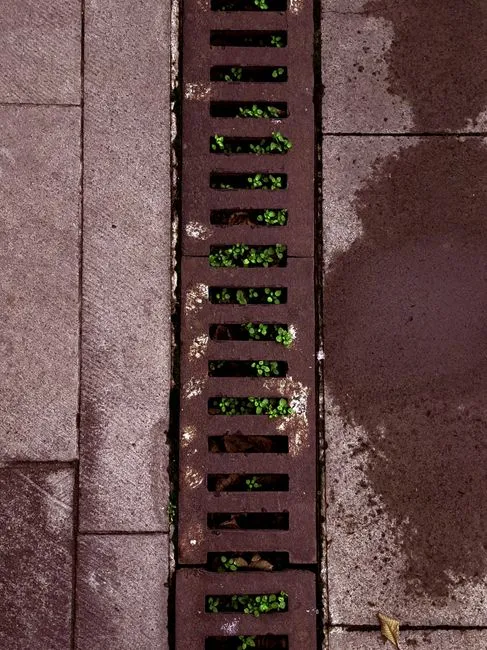
HydropureWater 2026 field data for mixed fabricated-metals floors show oils at 50–500 mg/L, total dissolved metals at 5–200 mg/L, TSS at 100–1,000 mg/L, and pH swinging between 2 and 12 across batch dumps (HydropureWater, 2026). A stamping cell may hold pH near 7 with low metals, while a hard-chrome line will spike Cr(VI) to 50+ mg/L and drop pH below 2 on a rinse dump (HydropureWater, 2026). Plating shops run batch dumps, not steady flow, so equalization is the unit operation that makes downstream chemistry work at all (HydropureWater, 2026). Local POTW and influent numbers should be confirmed by a 14-day flow-proportional composite before equipment is specified (HydropureWater, 2026).
Standard Pretreatment Train: Equalization Through Polishing
The standard sequence a fabricated metals plant uses to hit PSNS-equivalent POTW limits is rotary bar screen, equalization basin, oil/grease removal, hex chrome reduction, cyanide oxidation, hydroxide precipitation, DAF or lamella clarification, pH trim, and optional polishing, with each step having a defined purpose, outlet spec, and failure mode (HydropureWater, 2026). Hexavalent chrome is reduced to trivalent with sodium metabisulfite (or ferrous sulfate) at pH 2–3 and ORP roughly 250–300 mV, and the trivalent form then precipitates as Cr(OH)₃ at pH 8.5–9.5, where Cr(VI) hydroxide would otherwise stay soluble (HydropureWater, 2026). A DAF system is governed by hydraulic surface loading (4–20 m/h), air-to-solids ratio (0.005–0.060, design 0.02), and recycle rate (10–30% of forward flow); pushing A/S higher dries the float but costs blower power and can shatter fragile floc (HydropureWater, 2026). Chemical dosing should be feedforward (flow-paced) plus feedback (pH/ORP) on a PLC-controlled chemical dosing skid with calibration columns and stroke-count totalizers, and alarm and shutdown interlocks on pH excursion, ORP out of range, and high TSS should divert flow back to the equalization basin header (HydropureWater, 2026).
| Step | Outlet spec | Failure mode if skipped |
|---|---|---|
| Rotary bar screen | No rags, wipes, or tramp metal >6 mm | Premature press-cloth blinding, rag carryover to DAF |
| Equalization basin | pH 6–9 smoothed, flow CV < 0.5 | Chemistry downstream chases a moving target |
| Oil/grease removal | Oils reduced for downstream chemistry | DAF float overloaded, polymer demand spikes |
| Hex chrome reduction | ORP ~250–300 mV at pH 2–3 | Cr(VI) passes through precipitation as soluble species |
| Cyanide oxidation | CN below detection before precipitation | CN resolubilizes precipitated metals downstream |
| Hydroxide precipitation | pH 8.5–9.5, metals at PSNS/local limits | Dissolved metals fail PSNS/local limits |
| DAF or lamella | TSS < local limit, A/S 0.02 design | Floc carryover, high effluent TSS |
| pH trim | pH within local window (often 5.0–11.0) | Discharge violation on pH excursion |
Sludge Dewatering: Plate and Frame vs Belt Press Trade-Off
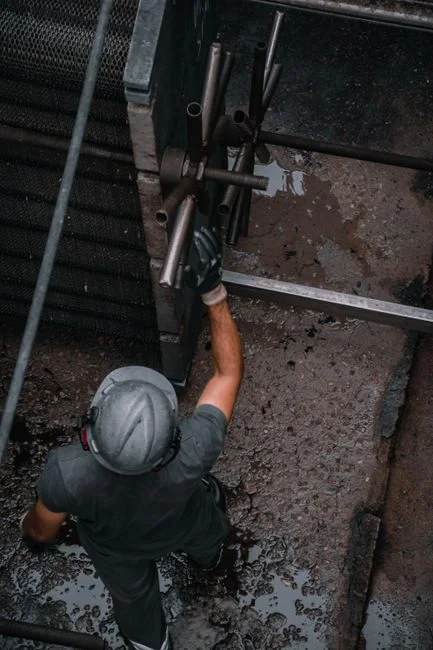
Floated metal-hydroxide sludge typically runs 2–5% dry solids out of the DAF (HydropureWater, 2026). A plate and frame filter press dewaters to 25–35% dry solids, while a belt press is cheaper and continuous but caps out around 22% dry solids on metal hydroxide (HydropureWater, 2026). If the hauler charges by the wet ton, plate and frame pays back through lower tonnage; a rotary mechanical bar screen upstream keeps rags, wipes, and tramp metal out of the sludge train, which is the single most common cause of premature press-cloth failure (HydropureWater, 2026).
14-Day Sampling Protocol to Size the Equalization Basin
A 4-hour composite that misses the Friday afternoon dump will undersize the equalization basin, so a full week of composite flow is the minimum, with 14 consecutive operating days the HydropureWater 2026 design default (HydropureWater, 2026). Data should be logged at 15-minute intervals to calculate the hydraulic peak factor needed to size the basin and prevent short-circuiting, and the 95th percentile flow rate is the design anchor with residence time adequate for chemical precipitation reactions to complete (HydropureWater, 2026). For a Campbellsville buyer following the procedure in the composite sampler buying guide, where the research does not supply a specific Kentucky-Campbellsville influent number, the action is to request the current local-limits letter from the receiving POTW and run a flow-proportional composite before any equipment purchase order is signed (HydropureWater, 2026).
When Polishing or Reuse Is Worth the Capital
Most fabricated metals plants hit sewer limits with the standard train and never need a polishing step (HydropureWater, 2026). Polishing is justified when the POTW tightens local limits below PSNS, when the plant reuses rinsewater and needs RO-quality feed, or when a new rule forces it (HydropureWater, 2026). A submerged PVDF MBR system delivers sub-micron filtration for BOD/COD tightening or cooling-tower makeup; an RO system handles sub-ppm TDS or specific metal caps such as nickel <0.1 mg/L, with an upstream multi-media filter required to hold SDI15 below 3 (HydropureWater, 2026). For the 2026 PFAS rulemaking, anion exchange or GAC is the proven polish for long-chain PFAS tied to chrome plating; the 2026 design move is to lay out the train so a polish skid can be bolted on later, not to install it now ahead of any actual limit (HydropureWater, citing epa.gov/eg/metal-finishing-effluent-guidelines, 2026). The same feedforward logic is described in the auto dosing engineering guide.
Frequently Asked Questions
What capital range should a Campbellsville buyer expect for a PSNS-compliant fabricated-metals pretreatment skid in 2026?
The research does not supply a published price band, so a buyer should request a written proposal that itemizes the equalization basin volume, the DAF system model with air-to-solids and recycle-rate sizing, the PLC-controlled automatic chemical dosing skid, and the plate and frame filter press, then compare three vendor quotes against the 14-day composite influent data (HydropureWater, 2026).
How should a Campbellsville engineer pressure-test a vendor proposal before releasing final payment?
Require a Process Guarantee with specific effluent quality targets and chemical consumption rates based on the plant's own influent characterization, demand stamped mechanical, electrical, and plumbing (MEP) drawings plus PLC logic flowcharts, and make the contract conditional on an on-site commissioning period that demonstrates compliance with 40 CFR Part 433 over a 72-hour continuous performance test before final payment is released (HydropureWater, 2026).
When does the 2026 PFAS rulemaking actually force a Campbellsville chrome finisher to install an IX or GAC polish?
The 2026 EPA PFAS rulemaking is scoped to chrome finishing facilities, but no federal numerical PFAS limit has been published, so the trigger to install ion exchange or GAC is a state or POTW limit, a consent decree, or a finished-product specification that requires PFAS monitoring, not the federal rulemaking alone; the design move today is to allow floor space and hydraulic capacity for a bolt-on polish skid rather than install it now (HydropureWater, citing epa.gov/eg/metal-finishing-effluent-guidelines, 2026).
Plate and frame or belt press for metal-hydroxide sludge from a small Campbellsville plant?
Plate and frame is the better TCO choice when the hauler charges by the wet ton, because it reaches 25–35% dry solids versus roughly 22% for a belt press on metal hydroxide, and the higher capex is offset by lower disposal tonnage (HydropureWater, 2026). A belt press is the better choice only when continuous operation and lower labor outweigh the higher hauling volume on the specific site's waste profile (HydropureWater, 2026).