Why Attalla Fabricated Metals Plants Are Re-evaluating Clarification in 2026
Etowah County's metal-fabrication base — stamping, welding, powder-coating, CNC machining, and structural steel shops clustered along the Attalla/Gadsden industrial corridor — generates a wastewater mix that does not behave like a single pollutant stream. Cutting fluids, tramp oils, grinding swarf, phosphating rinse water, and occasional acid-cleaning dumps combine into batches where free oil, emulsified oil, and settleable metallic fines can swing 10× within a single shift. Most of these shops discharge to a POTW regulated under 40 CFR 433 (Metal Finishing categorical pretreatment standards), with daily-maximum limits measured at the POTW sampling point: oil and grease 52 mg/L, TSS 86 mg/L, plus categorical metals such as total chromium 2.77 mg/L, total lead 0.69 mg/L, and total cadmium 0.69 mg/L for the Fabricated Metals subcategory (per 40 CFR 433, eCFR 2026). A fabricator who misses the O&G daily max faces surcharges, compliance orders, and the enforcement letters the Gadsden-Etowah Industrial Sewer Service has been issuing more frequently through 2025–2026. Rising Alabama sludge-disposal tipping fees and tighter POTW sampling frequency make clarification re-evaluation a 2026 budgeting item.
How a DAF and a Clarifier Actually Treat Oily Metalworking Wastewater
Dissolved air flotation (DAF) units saturate a sidestream of clarified effluent with air at 60–80 psig in a pressure vessel; on release through a needle valve at the DAF inlet, the dissolved air comes out of solution as 30–50 micron microbubbles (per Clearwater/SigmaDAF process descriptions). Coagulant and polymer-conditioned floc — oil droplets, metal hydroxides, suspended fines — collide with the rising bubble swarm and are lifted to the surface, where a paddle or chain-and-flight skimmer removes the float. Heavier settleable solids (swarf, grinding fines, metallic sludges) report to a bottom collection zone and are augered out, so a DAF is a combined float-and-settles device in one tank.
Gravity or lamella clarifiers rely on density differences to separate solids. Solids settle against gravity in a circular or rectangular basin, and inclined-plate (lamella) packs raise the effective surface loading rate to roughly 20–40 m/h (HydropureWater HST design data, 2026). A plain clarifier struggles with free and emulsified oils because oil density sits within ~3–5% of water and emulsified droplets in the 5–20 micron range settle too slowly without coagulation. DAF's microbubbles bypass this physics problem by giving the oil droplet a much lower bulk density than water, which is why DAF dominates oily metalworking streams and clarifiers dominate settleable-solids streams.
DAF vs Clarifier: Head-to-Head for Fabricated Metals Streams
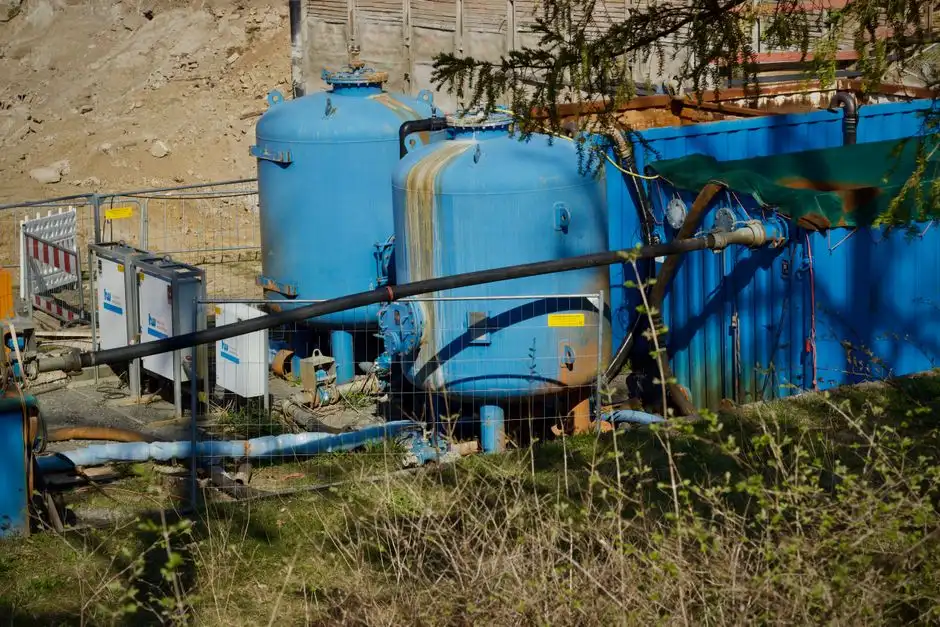
The following matrix ties every row to either a 40 CFR 433 daily-max limit or a process parameter an Attalla plant engineer can defend in a CAPEX review. Footprint and CAPEX figures are stated as bands rather than point estimates, since site-specific hydraulic and structural conditions shift them.
| Parameter | DAF system (with coagulation) | Gravity / lamella clarifier |
|---|---|---|
| TSS removal | 70–90% (per Clearwater/SigmaDAF, 2026) | 50–70% (lamella with polymer) |
| O&G / FOG removal | 80–95% (per Clearwater, Komline-Sanderson process descriptions) | 40–60% alone; rarely meets 40 CFR 433 O&G 52 mg/L without pre-DAF |
| Typical HRT | 20–40 minutes | 2–4 hours |
| Footprint per m³/h | ~0.3–0.6 m² (compact skid ≤66 GPM single-unit deployment) | ~1.5–3.0 m² (basin volume driven) |
| CAPEX band (small/mid fab) | Moderate; scales with flowrate and material (304SS standard, 316SS or PP for high-chloride streams) | Lower headline price; higher civil/basin cost |
| OPEX drivers | Recycle-pump energy, compressed air, coagulant/polymer, skimmer maintenance | Sludge pumping, polymer for TSS polishing, periodic basin cleaning |
| Sludge consistency | Typically 2–5% DS — thicker float reduces downstream dewatering cost | Typically 0.5–2% DS — more dilute underflow |
| Material options | 304SS standard, 316SS or polypropylene for chloride/acid rinse streams | Carbon steel with epoxy or FRP common |
| Best-fit stream | Free/emulsified oil >50 mg/L, FOG-dominated flows, fluctuating hydraulic loads | Settleable metallic sludges, low oil, large yard available, low-CAPEX priority |
DAF is the right answer when the regulatory driver is the 40 CFR 433 O&G daily max of 52 mg/L and the stream is laden with tramp oil, cutting fluid, or drawing compound. A standalone clarifier is the right answer when the stream is a high-TSS, low-oil rinse water with settleable metallic hydroxides and floor space is not a constraint. For mixed fab shops, the literature supports a hybrid train; academic work (e.g., SSRN 2023 on DAF + MMBBR for synthetic oily wastewater) shows DAF as the oil-removal front end followed by a polish stage. Pairing a HydropureWater DAF system for oil and floatables with a HydropureWater high-efficiency lamella clarifier downstream for TSS is a common configuration in metalworking retrofit projects.
Matching Equipment to the Stream: Three Realistic Attalla Scenarios
Scenario A — CNC machining + parts washing. Influent O&G routinely runs 200–2,000 mg/L with emulsified coolant and tramp oil from sumps. A standalone clarifier cannot meet the 40 CFR 433 O&G daily max of 52 mg/L; DAF with chemical coagulation (typically a coagulant such as PAC or alum plus an anionic flocculant polymer) is the only realistic single-stage option. Specify a skid-mounted DAF rated for the peak hourly flow, with redundant polymer feed. Verify your specific subcategory on eCFR — Fabricated Metals (40 CFR 433.15) and Metal Finishing (40 CFR 433.10) carry different daily-max metals ceilings, and the wrong line item on your permit application is a common audit finding.
Scenario B — Sheet-metal stamping + welding, minimal oil. Low-FOG, high-TSS stream from grinding swarf, weld spatter capture, and rinse water. A lamella clarifier as the primary TSS stage handles the bulk load economically. Specify a DAF only if the shop later adds a machining center and the O&G swings up — DAF can then be added as a polish stage in front of the clarifier.
Scenario C — Mixed fab shop with both machining and finishing. Combined oily + TSS stream, fluctuating flow, occasional acid-rinse dumps. Specify DAF as the first stage for oil and floatables, with a lamella clarifier or MBR polish for residual TSS. Pair the DAF with an automatic coagulant and polymer dosing system sized for the peak O&G load, and verify the 40 CFR 433 subcategory against the actual mix of operations on the shop floor. For higher-strength or restricted-discharge cases, an integrated MBR polish stage downstream of the DAF can tighten TSS below 30 mg/L and provide a safety margin against sampling-day spikes.
2026 CAPEX, OPEX, and Footprint Considerations for Attalla Plants
Small skid-mounted DAFs at ≤66 GPM sit at the lower end of the CAPEX band and ship turnkey with chemical conditioning, PLC controls, and a single-skid footprint suitable for a 40×60 ft equipment pad (per Clearwater Compact DAF product data, 2026). Lamella clarifiers for the same flow have a lower headline equipment price but require cast-in-place or shop-fabricated basins, which on many older Etowah County sites means retrofitting around existing floor drains and oil-water separators — civil work often erases the equipment-cost advantage. DAF OPEX is dominated by the recycle pump (typically 5–10% of throughput), compressed-air supply, and polymer/coagulant dosing; clarifier OPEX is dominated by sludge pumping and polymer for TSS polishing, plus periodic basin cleaning. DAF float sludge at 2–5% DS is markedly thicker than clarifier underflow, so downstream dewatering — typically a lamella clarifier maintenance protocol review plus a belt press or screw press — runs cheaper per dry ton. Footprint is the decisive factor on tight Attalla parcels: a DAF at 20–40 minute HRT needs roughly 3–5× less area per m³/h than a clarifier at 2–4 hour HRT. For scaling, the HydropureWater DAF range covers 4–300 m³/h across 13 models, allowing a fabricator to pilot small and ramp without changing equipment families.
A 3-Question Decision Framework You Can Use This Week
Question 1 — Is your influent O&G consistently above ~50 mg/L or does the stream show visible free oil? If yes, a DAF is effectively mandatory to meet the 40 CFR 433 O&G daily max of 52 mg/L; a clarifier alone is not defensible.
Question 2 — Is your stream dominated by settleable metallic fines with little oil? If yes, a lamella clarifier is the more economical primary stage, and a DAF is an optional polish if cutting fluids are added later.
Question 3 — Is your site constrained (≤0.5–1.0 m² available per m³/h of design flow)? If yes, choose DAF or a DAF-plus-clarifier train over a standalone clarifier to keep HRT-driven footprint down.
Before final CAPEX commitment, run a jar test or rent a pilot unit. Komline-Sanderson explicitly offers DAF pilot rentals (per Komline product literature, 2026), and skid-mounted Compact DAF pilots in the 10–30 GPM range can be on-site within weeks. For a deeper cross-industry view of DAF versus gravity clarification on metals-bearing streams, see this DAF vs clarifier comparison for metals-bearing wastewater and the broader metals-plant POTW pretreatment compliance guide for permit-defense framing.
Frequently Asked Questions
Which is better for oily metalworking wastewater — DAF or a clarifier?
DAF is the stronger single-stage answer for oily metalworking streams. With chemical coagulation, DAF delivers 80–95% O&G removal and reliably meets the 40 CFR 433 O&G daily max of 52 mg/L; a clarifier alone typically achieves only 40–60% O&G removal and rarely meets that limit without a DAF pre-stage (per Clearwater/SigmaDAF and Komline-Sanderson process descriptions, 2026).
Can a clarifier alone meet 40 CFR 433 for a fabricated metals shop?
Usually no on the O&G side. A lamella clarifier with polymer dosing can hit the 40 CFR 433 TSS daily max of 86 mg/L on
Frequently Asked Questions
Should a fabricated metals plant in Attalla use a DAF or a clarifier for oily wastewater?
For fabricated metals facilities in Attalla managing high concentrations of emulsified oils, a Dissolved Air Flotation (DAF) unit is generally superior to a gravity clarifier. While clarifiers excel at removing heavy, settleable solids, they struggle with the low-density, non-settleable oil droplets common in metalworking fluids. DAF systems utilize micro-bubbles to float these contaminants to the surface, making them the preferred technology for achieving effective oil/water separation in industrial wastewater streams.
Can a gravity clarifier alone meet 40 CFR 433 oil and grease limits for metal finishing?
A gravity clarifier alone is rarely sufficient to consistently meet the 40 CFR 433 Metal Finishing Point Source Category standards, which typically require oil and grease concentrations below 26 mg/L (daily maximum) or 52 mg/L depending on specific subcategory mandates. Gravity settling is ineffective against emulsified oils and smaller suspended particles that remain buoyant. Consequently, most facilities require supplemental chemical coagulation, flocculation, or DAF pretreatment to achieve compliance with federal discharge limits.
What removal efficiency does a DAF achieve on cutting fluid and tramp oil wastewater?
When properly operated with appropriate chemical conditioning, a DAF system typically achieves 85% to 95% removal efficiency for oil and grease from cutting fluids and tramp oils. The efficiency is highly dependent on the stability of the emulsion and the dosage of coagulants and flocculants. For complex, high-strength waste streams typical of metal fabrication, maintaining an optimal pH range and air-to-solids ratio is critical to sustaining these performance levels.
How much footprint does a DAF system save versus a clarifier for the same flow rate?
A DAF system typically occupies 50% to 75% less floor space than a conventional gravity clarifier for an equivalent flow rate. Because DAF units rely on high-rate particle separation through flotation rather than slow gravitational settling, they utilize more compact tank geometries and higher hydraulic loading rates. This space efficiency is particularly advantageous for existing Attalla manufacturing facilities with limited indoor floor space or congested utility layouts.
Is a hybrid DAF plus lamella clarifier system worth it for a mixed fab shop?
For a mixed fabrication shop processing both heavy metal particulate and high-volume oily waste, a hybrid system is highly recommended. The lamella clarifier efficiently removes dense metallic fines and heavy suspended solids that would otherwise overwhelm a DAF, while the downstream DAF captures the remaining emulsified oils and light fats. This tandem approach protects downstream equipment, reduces chemical sludge volumes, and provides the highest level of protection against permit exceedances.