
Why Pine Grove Fabricated Metals Plants Need a Pretreatment Plan
A Friday afternoon rinse dump can swing the chemistry of a fabricated-metals floor drain in minutes, and Pine Grove-area plants discharge that slug to a small municipal POTW (the Pine Grove Area Municipal Authority service area) with limited hydraulic dilution. 2026 field data from mixed fabricated-metals floors show pH moving between 2 and 12 across batch events, oils at 50–500 mg/L, total dissolved metals at 5–200 mg/L, and TSS at 100–1,000 mg/L; a hard-chrome line on rinse dump can spike Cr(VI) to 50+ mg/L and drop pH below 2 (Source: HydropureWater field data, 2026).
Equalization is a required unit operation for batch-dump shops to ensure downstream chemistry remains effective (Source: HydropureWater, 2026). Because local limits under 40 CFR 403.5 govern day-to-day compliance regardless of whether 40 CFR Part 433 categorically applies, a plant without a written pretreatment plan risks a violation notice (Source: HydropureWater, 2026). The EPA has a live PFAS rulemaking scoped to chrome finishing facilities in 2026; plants should plan for a future anion-exchange or GAC polish stage as a bolt-on rather than installing one today (Source: HydropureWater, citing epa.gov/eg/metal-finishing-effluent-guidelines, 2026).
Does 40 CFR Part 433 Even Apply to Your Floor?
40 CFR Part 433 covers the Metal Finishing point source category, including forming, finishing, forging, foundry, metal spraying, and machining wash operations co-located with plating or anodizing lines (Source: HydropureWater, 2026). A stamping shop that ships only dry parts to a separate finisher is generally outside the category, whereas a facility running its own zinc, nickel, or chromic acid tank is inside it (Source: HydropureWater, 2026). The regulation splits limits into PSES (Pretreatment Standards for Existing Sources) and PSNS (Pretreatment Standards for New Sources), with PSNS standards being tighter for sources constructed after the rule's promulgation date (Source: HydropureWater, 2026). Most POTW pretreatment programs enforce PSNS-equivalent local limits on all industrial users as a baseline, so existing plants should design to PSNS metrics (Source: HydropureWater, 2026). Part 433 parameters include cadmium, chromium, copper, lead, nickel, silver, zinc, and total toxic organics, while local POTW tables often add oil & grease, TSS, and pH caps (Source: HydropureWater, 2026).
| Your floor looks like… | In Part 433? | What to design to |
|---|---|---|
| Stamping/drawing only, dry parts shipped out | No | Local POTW limits only |
| Zinc, nickel, or chromic acid tank on site | Yes | Part 433 PSES or PSNS + local limits |
| Machining wash co-located with plating or anodizing | Yes | Part 433 PSES or PSNS + local limits |
| Existing source built before rule promulgation | Yes | PSES (or PSNS-equivalent local limits if POTW enforces tighter) |
| New or expanded line after rule promulgation | Yes | PSNS + local limits |
The Local-Limits Overlay: Why 40 CFR 403.5 Sets Your Real Numbers

Local limits are developed under 40 CFR 403.5 and are always at least as stringent as categorical standards, requiring plants to meet whichever limit is stricter for each parameter (Source: HydropureWater, 2026). Local POTW tables often tighten copper, nickel, zinc, lead, and silver caps while adding oil & grease, total suspended solids, and pH caps that federal categorical rules may understate (Source: HydropureWater, 2026). Many plants err by specifying equalization and precipitation based solely on the federal PSNS column, leading to discharge failures on parameters tightened by the local POTW. For Pine Grove-area discharges, operators should request the current local limits letter from the POTW and treat that table as the design envelope, using the Part 433 PSNS column as a backstop (Source: HydropureWater, 2026). Compliance is verified against daily-maximum and monthly-average limits before POTW discharge (Source: HydropureWater, 2026).
The Four Contaminant Families You Have to Remove
Most fabricated-metals floors generate four primary contaminant families regardless of the specific process mix (Source: HydropureWater, 2026). Free and emulsified oils originate from stamping, machining, and drawing compounds. Dissolved heavy metals (Zn, Ni, Cu, Cr, Pb, Cd) come from plating rinsewater and acid pickling. Hexavalent chromium results from chromic acid anodizing, hard chrome, and conversion coating, while cyanide appears where alkaline cyanide plating (Zn, Cu, Cd, Ag) is in use. Total suspended solids result from grinding swarf, casting sand, and hydroxide floc carryover. These families require distinct treatment methods: oils need physical separation or chemical break, hex chrome needs reduction, cyanide needs oxidation, and dissolved metals require pH-driven precipitation (Source: HydropureWater, 2026). Attempting to treat all contaminants in one reaction stage typically results in effluent failure on at least one parameter.
The Engineered Treatment Train, Step by Step
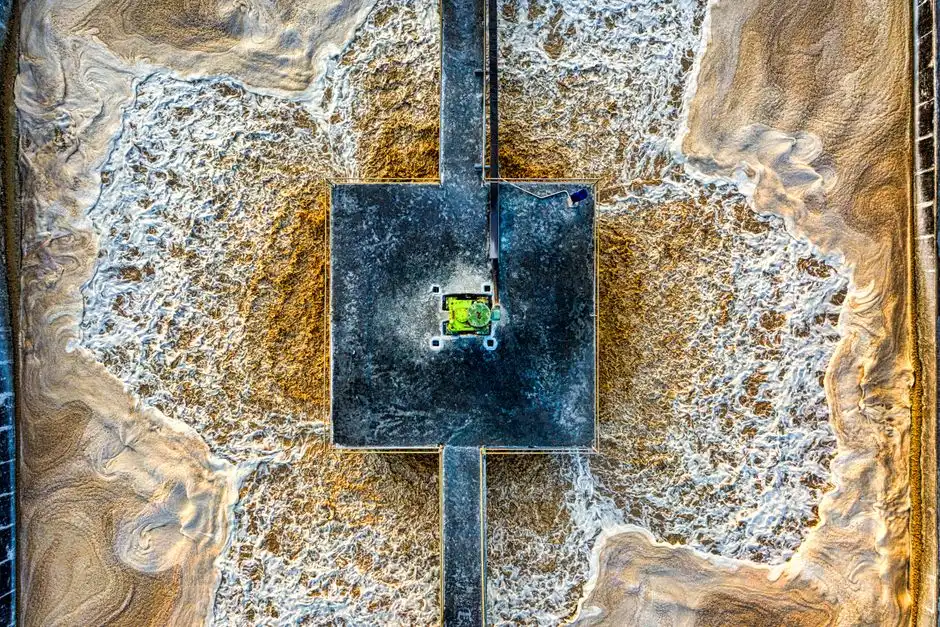
The following treatment sequence allows a fabricated-metals plant to hit PSNS-equivalent POTW limits. Each step serves a defined purpose, requires specific outlet specs, and carries risks if bypassed (Source: HydropureWater, 2026).
- Rotary bar screening. Keeps rags, wipes, and tramp metal out of the sludge train; omission is the most common cause of premature press-cloth failure (Source: HydropureWater, 2026). Outlet spec: visibly clear of debris >2 mm.
- Flow equalization. Smooths pH to 6–9 and flow CV below 0.5; the basin must be sized from a full week of composite sampling, not a 4-hour snapshot, because batch dumps drive the volume (Source: HydropureWater, 2026).
- Oil/grease removal. An API or CPI separator ahead of DAF handles the 50–500 mg/L free and emulsified oil loading typical of fabricated-metals floors (Source: HydropureWater, 2026).
- Hexavalent chrome reduction. Sodium metabisulfite (or ferrous sulfate) at pH 2–3 with ORP controlled at ~250–300 mV converts Cr(VI) to Cr(III) for downstream precipitation (Source: HydropureWater, 2026).
- Cyanide oxidation with NaOCl. Must run before metals precipitation to prevent the resolubilization of precipitates downstream (Source: HydropureWater, 2026).
- Hydroxide precipitation. pH 8.5–9.5 drops dissolved metals (Zn, Ni, Cu, Pb, Cd, Cr(III), Ag) as metal hydroxides; because Cr(VI) hydroxide is soluble at this pH, reduction must occur first (Source: HydropureWater, 2026).
- DAF or lamella clarification. Separates the floc. A dissolved air flotation system is governed by hydraulic surface loading 4–20 m/h, air-to-solids 0.005–0.060 (0.02 typical), and 10–30% recycle (Source: HydropureWater, 2026).
- pH trim, polish, and verify. Trim to the POTW's local-limits pH window, with alarms on pH excursion, ORP out of range, and high TSS automatically diverting flow back to the equalization basin header (Source: HydropureWater, 2026). Dosing is managed by a PLC-controlled automatic chemical dosing skid with calibration columns and stroke-count totalizers to prevent blind dosing (Source: HydropureWater, 2026).
| Step | Outlet spec | Failure mode if skipped |
|---|---|---|
| 1. Rotary bar screen | No debris >2 mm | Premature press-cloth blinding, rag carryover to DAF |
| 2. Equalization | pH 6–9, flow CV < 0.5 | Chemistry downstream chases a moving target |
| 3. Oil/grease removal | Oils <50 mg/L to DAF | DAF float overloaded, polymer demand spikes |
| 4. Cr(VI) reduction | ORP 250–300 mV at pH 2–3 | Cr(VI) passes through precipitation as soluble species |
| 5. Cyanide oxidation | Total cyanide < detection | CN resolubilizes precipitated metals downstream |
| 6. Hydroxide precipitation | pH 8.5–9.5 | Dissolved metals fail PSNS/local limits |
| 7. DAF / lamella | TSS < local limit, A/S 0.02 design | Floc carryover, high effluent TSS |
| 8. pH trim + polish + verify | pH inside POTW window | Discharge violation on pH excursion |
Sludge Handling and the Case for a Plate and Frame Press
Floated metal-hydroxide sludge typically reaches 2–5% dry solids out of the DAF (Source: HydropureWater, 2026). A plate and frame filter press dewaters this to 25–35% dry solids, reducing disposal costs when haulers charge by the wet ton (Source: HydropureWater, 2026). While a belt press is cheaper and continuous, it typically caps out near 22% dry solids on metal hydroxide (Source: HydropureWater, 2026). Because a rotary mechanical bar screen upstream of the equalization basin prevents premature press-cloth failure, it should be integrated into the sludge train rather than relegated solely to headworks (Source: HydropureWater, 2026).
When Polishing or Reuse Is Worth the Capital
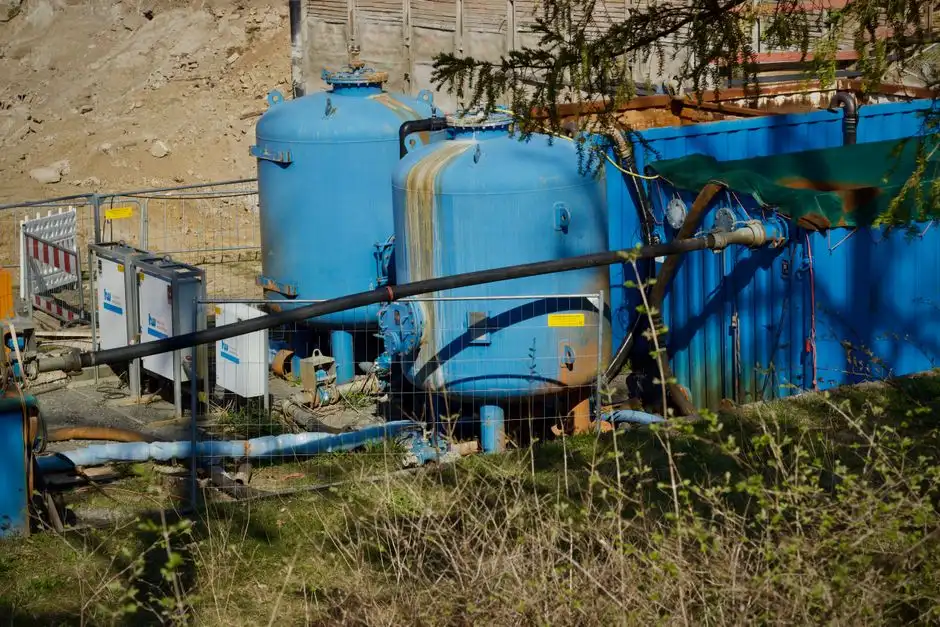
Most fabricated metals plants hit sewer limits with the treatment train above and do not require a polishing step (Source: HydropureWater, 2026). Polishing is necessary only when the POTW tightens local limits below PSNS, the plant requires RO-quality feed for rinsewater reuse, or new regulations mandate it (Source: HydropureWater, 2026). For BOD/COD tightening or water reuse, an MBR system provides <1 μm filtration and stable effluent for cooling tower makeup or rinsewater reclaim (Source: HydropureWater, 2026). Sub-ppm TDS or specific metal caps (e.g., nickel <0.1 mg/L) require an RO system, necessitating an upstream multi-media filter to hold SDI15 below 3 and protect RO membranes (Source: HydropureWater, 2026). For the 2026 PFAS rulemaking, anion exchange or GAC is the proven polish step for long-chain PFAS tied to chrome plating; the recommended strategy is to design the pretreatment train to allow for a bolt-on polish skid (Source: HydropureWater, citing epa.gov/eg/metal-finishing-effluent-guidelines, 2026). Closed-loop zero liquid discharge is rarely economic unless water scarcity or specific reuse economics justify the capital expense (Source: HydropureWater, 2026).
Frequently Asked Questions
Which limit applies when the federal and local numbers disagree?
The stricter of the two. Under 40 CFR 403.5, local POTW limits are always at least as stringent as the Part 433 categorical standard, and the plant must meet whichever limit is stricter on each parameter (Source: HydropureWater, 2026). Request the current local-limits letter from the Pine Grove
Frequently Asked Questions
What sewer pretreatment limits apply to a fabricated metals plant near Pine Grove, PA in 2026?
Fabricated metals plants in Pine Grove must adhere to the categorical pretreatment standards defined under 40 CFR Part 433 (Metal Finishing). As of 2026, effluent limits for total toxic organics (TTO) are capped at 2.13 mg/L, while heavy metal concentrations are strictly regulated: Total Chromium must remain below 2.77 mg/L, Copper below 3.38 mg/L, Nickel below 3.98 mg/L, and Zinc below 2.61 mg/L for daily maximums. Local limits imposed by the Pine Grove municipal POTW may be more stringent, particularly regarding pH (typically 5.0–11.0) and oil and grease concentrations, which are often capped at 100 mg/L.
How long should I composite sample my floor drain before sizing an equalization basin?
To accurately size an equalization basin for a fabricated metals facility, you must conduct a flow-proportional composite sampling program spanning a minimum of 14 consecutive operating days. This duration captures the full variation of batch discharges, such as tank dumps and rinse cycles, ensuring the 95th percentile flow rate is identified. Data should be logged at 15-minute intervals to calculate the hydraulic peak factor, which is essential for sizing the basin to prevent short-circuiting and ensuring adequate residence time for chemical precipitation reactions.
Do I need to install PFAS treatment now under the 2026 EPA chrome finishing rulemaking?
Under the 2026 EPA updates to the Chromium Electroplating Point Source Category, facilities utilizing PFAS-based fume suppressants are required to transition to non-PFAS alternatives or implement point-of-source treatment. If your facility currently utilizes PFOS-free but PFAS-containing chemistry, you must account for the EPA’s effluent guidelines that mandate PFAS monitoring. While specific federal discharge limits for PFAS are currently evolving, installing ion exchange (IX) or granular activated carbon (GAC) polishing stages is now considered best available technology (BAT) to mitigate future liability and ensure compliance with emerging state-level groundwater protection standards in Pennsylvania.
Belt press or plate and frame filter press for metal hydroxide sludge — which pays back?
For metal hydroxide sludge, the plate and frame filter press typically offers a superior return on investment due to higher cake solids content, typically ranging from 30% to 45% by weight. By reducing the mass of the sludge, you significantly lower hazardous waste disposal costs and transportation fees, which are the primary drivers of operational expenditure. While belt presses have lower labor requirements, they generally produce wetter cake (15% to 25% solids), which increases the total volume of waste requiring disposal, often resulting in a longer payback period compared to the higher-density output of a plate and frame system.
What should I require from a pretreatment skid vendor before I sign the purchase order?
Before signing a purchase order, require the vendor to provide a comprehensive Process Guarantee that includes specific effluent quality targets and chemical consumption rates based on your facility’s influent characterization. You must demand a full set of stamped mechanical, electrical, and plumbing (MEP) drawings, along with a detailed spare parts inventory list and an O&M manual that includes PLC logic flowcharts. Additionally, ensure the contract includes a mandatory on-site commissioning period where the vendor must demonstrate compliance with 40 CFR 433 standards over a 72-hour continuous performance test before final payment is released.