Why Baghdad fabs and data halls can't copy a generic fab water plan in 2026
Global water benchmarks are useful as a sizing reference, but they were not built for Baghdad. The IEA estimate of up to 2 million litres of water per day for a single 100 MW data centre, and the figure of roughly 10 million gallons of ultrapure water (UPW) per day for an average chip fab, are global averages reported by Verdict citing the IEA and industry data. They let a Baghdad engineer size UPW make-up, cooling-tower evaporation, and reject volumes on a paper basis, but they do not capture local operating reality.
Three Baghdad-specific constraints should be layered on top of any global number before equipment is selected. High ambient wet-bulb temperatures push cooling-tower cycles of concentration down, which raises blowdown volume per tonne of cooling delivered. The Tigris and Diyala basin context means any scheme relying on long-term fresh-water abstraction carries regulatory and reputational risk. Iraq's grid quality and load-shedding profile limits the practical use of energy-intensive reclaim trains such as two-pass RO and EDI polishing; a design that assumes 24/7 stable power will not run as specified.
The working assumption used through the rest of this article is three segregated streams, not a single combined sewer. Stream 1 is UPW reject, RO concentrate, and EDI/IX regeneration waste. Stream 2 is wet-bench, CMP, and rinse water carrying heavy metals, fluoride, TMAH, and solvents. Stream 3 is cooling-tower blowdown, boiler blowdown, and general site greywater. Treating them as one stream is the most common reason a Middle East fab-side wastewater train is over- or under-sized in 2026.
The three wastewater streams every Baghdad fab and data hall actually generates
Stream 1 — UPW reject, RO concentrate, and EDI/IX regeneration waste — is characterised by very low total dissolved solids but very high volume. The dominant loss mechanism is the RO reject itself: Verdict, citing industry water data, states that it "takes between 1,400 and 1,600 gallons of water to make 1,000 gallons of ultrapure water," which means "for every 1,000 gallons of ultrapure water produced, around 500 gallons of water are wasted and lost." This stream is the largest by volume at any node above 28 nm, and it is also the stream with the cleanest chemistry, so it is the natural first reclaim target.
Stream 2 — wet-bench, CMP, and rinse waters — is the most chemically aggressive. It contains spent acid and alkali, fluoride from HF and BOE steps, copper from plating and CMP, TMAH from photoresist developers, and solvents such as IPA. Verdict explicitly identifies "pollutants like heavy metals and acid wastewater" from chip factories as the streams that "pollute local water sources and can threaten human health." This is also the stream that drives compliance risk in Iraq, because it is the one most likely to fail any receiving-body limit for heavy metals, fluoride, or COD.
Stream 3 — cooling-tower blowdown, boiler blowdown, and general facility greywater — is dominated by hardness ions, silica, suspended solids, treatment biocides, and trace oils. For hyperscale data halls, this stream is the largest by volume, since "water is used primarily to cool data centres and servers" (Verdict, citing the IEA). For a fab, Stream 3 is significant but smaller than Stream 1; however, the chemistry is the easiest to polish for non-UPW reuse.
A key segregation rule for Baghdad: reclaim concentrate (Stream 1) and heavy-metal-bearing rinse water (Stream 2) must never be co-mingled. The treatment chemistry for Stream 2 (lime precipitation, TMAH strip, heavy-metal sludge) is incompatible with Stream 1's high-recovery RO and EDI polishing loop, and mixing them destroys the RO membrane and contaminates the IX resin.
Building the treatment train: which unit operation goes where
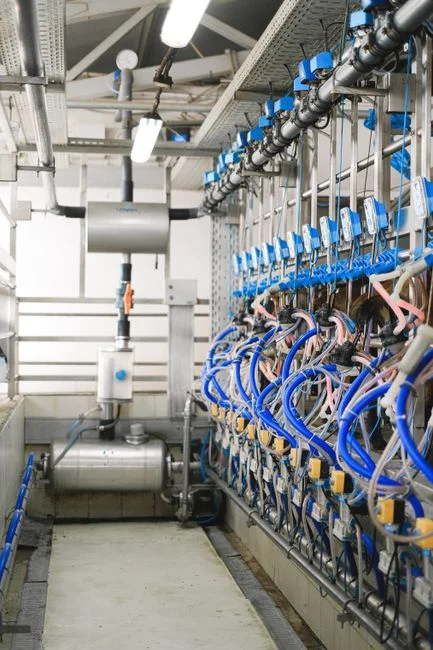
A defensible 2026 sequence for Stream 1 (UPW reject and reclaim) is: equalisation → multi-media filter for RO feed SDI control → hollow-fiber UF system for semiconductor reclaim pretreatment → industrial RO train for UPW make-up and reclaim → EDI polishing stack for 18.2 MΩ·cm UPW make-up. The UF step is explicitly justified by Saltworks' positioning that ultrafiltration "removes oils, grease, precipitated by-products, particulate, microbes, and suspended solids" from semiconductor wastewater; without it, RO membranes foul rapidly on a fab reject feed.
For Stream 2 (acid/alkali and heavy-metal rinses), the sequence is: flow and pH equalisation with PLC-controlled chemical dosing for pH adjustment and precipitation → chemical precipitation with lime or NaOH for heavy metals → lamella clarifier for heavy-metal precipitation settling or DAF for cooling-tower blowdown and pretreatment of fab wastewater for the metal-hydroxide sludge → ion exchange or RO for residual dissolved metals → AOP/Fenton only if COD from solvents and TMAH remains above the reuse or discharge target.
For Stream 3 (cooling-tower blowdown and greywater), the sequence is: side-stream softening → DAF or lamella clarification for suspended solids and any oil carryover → cartridge filtration → RO for TDS reduction → chemical or UV disinfection for any reuse loop feeding scrubbers, cooling make-up, or toilet flush.
Reclaimed water quality must be matched to the use case, not to a single specification. The TSMC benchmark shows that "reclaimed water" replaces fresh water in non-UPW duties (cooling, scrubbers, toilets) at 12% of total water in 2023, while UPW-grade reclaim requires the additional RO plus EDI train (Verdict, citing TSMC disclosure). A Baghdad engineer should therefore design two reuse qualities: one for non-UPW make-up (Stream 1 RO permeate plus Stream 3 RO permeate, blended) and one for UPW make-up (Stream 1 RO permeate polished through EDI).
Stream-to-equipment decision table for Baghdad 2026
The table below maps each stream to its primary contaminants, the headline unit operation, the polish step, and the realistic reuse destination. Final sizing in Baghdad still depends on locally confirmed inputs — feed TDS profile, ambient wet-bulb design temperature, electricity tariff structure, and applicable Iraqi effluent parameter limits — that the supplied research does not quantify.
| Stream | Primary contaminants | Headline unit operation | Polish step | Reuse destination |
|---|---|---|---|---|
| 1 — UPW reject / RO concentrate / EDI/IX waste | Low TDS, high volume, residual silica and boron | UF → two-pass RO | EDI polishing | UPW make-up (18.2 MΩ·cm) and non-UPW blended reuse |
| 2 — Wet-bench, CMP, rinse waters | Acid/alkali, fluoride, copper, TMAH, IPA, COD | pH adjust + lime/NaOH precipitation | Lamella or DAF → IX or RO → AOP if needed | Scrubber make-up, cooling-tower make-up, or safe discharge |
| 3 — Cooling-tower blowdown + greywater | Hardness, silica, biocides, suspended solids, trace oils | Side-stream softening + DAF | Cartridge filtration → RO → UV or chemical disinfection | Cooling-tower make-up, toilet flush, landscape |
Cutting fresh-water demand: the two levers that already work at fab scale
Process substitution acts as the first lever for reducing demand. Verdict reports that "companies can replace wet processes with dry processes, eliminating unnecessary water use by replacing it with gas," with gas-phase etching given as the working example. For a Baghdad site that has not yet broken ground, this is the cheapest megajoule of water saved: every wet bench that becomes a dry etch tool removes a Stream 2 source entirely, simplifies sludge handling, and shrinks the UPW make-up loop.
The second lever is an on-site reclaimed-water plant sized to a defensible target. TSMC "managed to replace 12% of its water resources with reclaimed water in 2023" and is building a dedicated reclaimed-water plant in Phoenix that broke ground in September 2025 and is scheduled to be operational in 2028, reducing that site's daily draw from "around 4.75 million gallons of water a day" to "around 1.2 million gallons daily" (Verdict, citing TSMC disclosure). That is a roughly 75% reduction in fresh draw at the Phoenix site.
For Baghdad, 12% reclaim is a defensible Year-1 target and the Phoenix 75% reduction is an upper-bound aspiration. The gap between them is the cost of a dedicated reclaim plant, the power to run two-pass RO and EDI continuously, and the contract structure with the landlord or off-taker for non-UPW reuse. None of those are quantified in the supplied research, and the engineer should not quote a Baghdad number as if it were one.
Phasing, sludge, and what to confirm locally before you buy
Phasing should be driven by compliance risk, not by capex optimisation. Stream 2 (heavy-metal and acid) pretreatment is the correct first phase in Baghdad, because a single failed discharge sample on copper, fluoride, or TMAH can stop a site. Phase 2 is a UF plus RO reclaim loop on Stream 1, sized to the realistic 12% reclaim benchmark rather than the aspirational Phoenix figure. Phase 3 closes Stream 3 with cooling-tower reclaim, which is the easiest chemistry but the largest volume.
Sludge handling is often under-scoped. Heavy-metal and TMAH-bearing sludges from Stream 2 must be dewatered through a filter press for dewatering of heavy-metal and TMAH sludges and sent to secured disposal, not co-mingled with sanitary grit. Sanitary or greywater sludge from Stream 3 can be routed through an MBR integrated wastewater treatment package, and any reuse loop carrying biological risk should pass through a UV sterilizer for water treatment as the final barrier.
Before any vendor quotation is treated as binding, the Baghdad engineer must collect data the supplied research does not contain: the influent TDS profile for each stream; the ambient wet-bulb design temperature at the site; the electricity tariff, outage profile, and any demand-charge structure; the specific Iraqi effluent parameter limits applicable to the receiving body (Tigris, Diyala, or municipal sewer); and the reclaimed-water end-use specification from the EPC or off-taker. For a comparable MBBR/UPW polish-loop reference, see the UPW polishing loop distribution technologies for 18.2 MΩ·cm guide and the 2026 engineering guide to reducing water consumption in manufacturing.
Frequently Asked Questions
What unit operations should a Baghdad fab specify for UPW reject and reclaim in 2026?
The defensible 2026 sequence for UPW reject and reclaim is equalisation, multi-media filtration, UF, two-pass RO, and EDI polishing, with reclaimed water blended for non-UPW reuse or polished to 18.2 MΩ·cm for UPW make-up. The UF step is required to protect RO membranes from oils, precipitated by-products, and suspended solids in semiconductor wastewater (Saltworks).
How should wet-bench and CMP rinse water be treated in Baghdad?
Wet-bench and CMP rinse water should be treated as a segregated stream: pH adjustment, lime or NaOH precipitation for heavy metals, lamella clarification or DAF for metal-hydroxide sludge, ion exchange or RO for residual dissolved metals, and AOP or Fenton only if COD from solvents and TMAH remains above target. This stream must never be co-mingled with UPW reject.