Why Slaughterhouse Wastewater Is a Special Case for Biological Treatment
Slaughterhouse wastewater is one of the strongest candidates for an MBR-based train because its organic load, FOG fraction, and pathogen content routinely push conventional activated sludge past its operating envelope. The MDPI Water 2021 review (citing the EU BAT Reference Document for Slaughterhouses and Animal By-products Industries) reports 1.5–18 m³ of wastewater per tonne of meat overall, with cattle and pigs at 1.6–9 m³/t, sheep at 5.5–8.3 m³/t, and poultry at 5–15 m³/t. The same review places meat processing at 24% of food-industry fresh-water demand, ahead of beverages (13%) and dairy (12%), which is why reuse is moving from a sustainability goal to a procurement requirement in 2026.
The composition is what makes the influent hostile to biology. SWW carries a high organic load, fats/oils/grease, proteins, suspended solids, and a meaningful pathogen load from faecal matter and carcasses (MDPI Water, 2021-11). FOG slugs are the main disruptor: they float, coat surfaces, and trigger biomass washout in a settling clarifier. The ScienceDirect 2025 pilot introduction is explicit that conventional activated sludge, while flexible, is the baseline being displaced because it cannot reliably hold back FOG and biomass under variable load. An MBR decouples solid-liquid separation from biology, which is precisely the property SWW needs.
Pretreatment Train: Screen, DAF, and Why the MBR Cannot Stand Alone
DAF before the membrane is non-negotiable for high-FOG SWW: a properly sized DAF unit is the standard MBR-protection step that removes the floatable FOG fraction which otherwise coats the membrane and drives fouling (MDPI Water, 2021-11). The 2021 Membranes poultry study quantified how much load the upstream train has to cut: its biological pretreatment stage removed 20–50% of TSS, 20–70% of COD, and 50–83% of FOG before the EGSB reactor even saw the stream (Membranes 11(5):345, 2021-05). At a plant level, an EU slaughterhouse typically runs a rotary mechanical bar screen followed by a DAF system for FOG and suspended solids removal, with screening alone common in Sweden (MDPI Water, 2021-11, citing the EU BAT Reference Document). The 2025 Spanish pig-slaughterhouse pilot installed a Decanter Unit plus an Air Flotation unit, then a Homogenization Tank, because raw SWW physicochemistry varied widely day-to-day; the equalization step smoothed that variability before the membrane tank (ScienceDirect, 2025).
| Stage | Unit operation | Primary target | Source |
|---|---|---|---|
| 1 | Mechanical bar screen | Solids, paunch material, hair | MDPI Water 2021-11; rotary bar screen |
| 2 | DAF | Floatable FOG, emulsified oils, fine TSS | MDPI Water 2021-11; DAF system |
| 3 | Equalization / homogenization | Load smoothing, pH/flow buffering | ScienceDirect 2025 pilot |
| 4 | MBR (submerged UF) | Dissolved organics, residual TSS, nitrification | Membranes 2021; ScienceDirect 2025 |
| 5 | RO (optional) | Process-water reuse polishing | MDPI Water 2021-11 |
Skip the DAF and the MBR carries the FOG load directly. That shortens membrane life, increases cleaning chemical consumption, and is the most common root cause of premature membrane fouling on SWW MBRs (MDPI Water, 2021-11). For a greenfield plant in 2026, the defensible pretreatment envelope is screen → DAF → equalization → MBR, with RO only if process-water reuse is in scope.
MBR Design Envelope for Slaughterhouse Wastewater
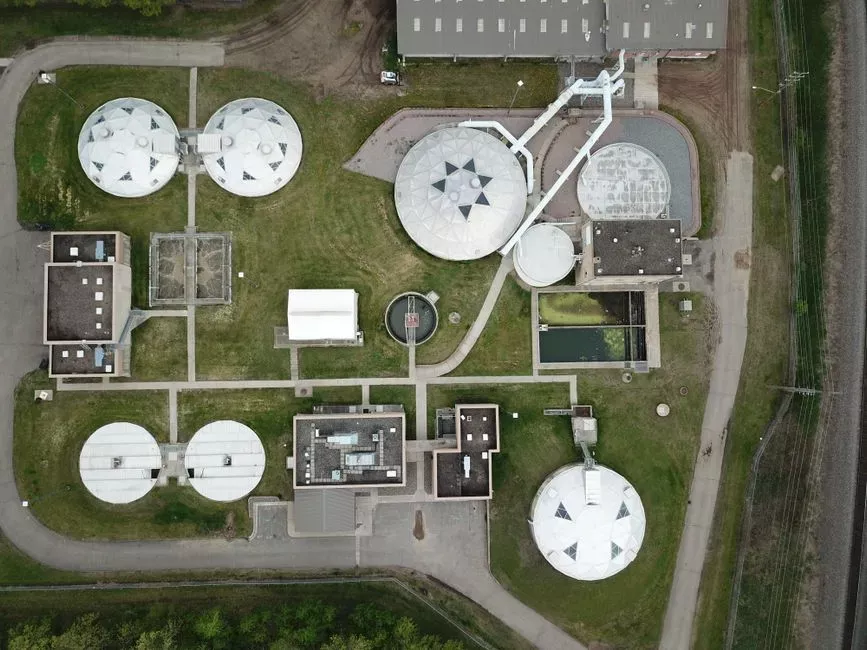
HRT of 2 days is the verified operating point for stable submerged MBR performance on pig SWW. The 2025 Spanish pilot at MAFRICA (Sant Joan de Vilatorrada, Catalonia, ~2,000 animals/day, over 600 d of operation across three periods) found that HRT of 2 d was the only condition fitting the parameters for process and cleaning water in a food facility under Spanish RD 1085/2024; below 1.5 d the MBR showed partial nitrification, nitrite accumulation, and a tenfold reduction in the abundance of key functional microorganisms (ScienceDirect, 2025). That single threshold is the most important design lever an engineer can pull in 2026.
The dominant membrane configuration for SWW is submerged ultrafiltration, with PVDF as the standard material because it tolerates FOG-laden influent and the chemical cleaning regimes that come with it. The 2025 pilot used a submerged UF membrane; the MDPI Water 2021 review lists submerged MBR as the standard configuration for SWW. Flat-sheet PVDF modules with integrated aeration boxes give continuous membrane scouring and a small footprint, which is why the dominant commercial offering for SWW is an integrated MBR membrane bioreactor system built around a PVDF flat-sheet MBR membrane module (HydropureWater DF series; consistent with the energy discussion in MDPI Water 2021).
Removal performance reference: the poultry pretreatment→EGSB→MBR train delivered >95% TSS, >95% COD, and 80% FOG at the MBR stage, with the combined train exceeding 97% TSS and COD and 97.5% FOG overall (Membranes 11(5):345, 2021-05). For MLSS and SRT, the supplied research did not publish a single SWW-specific MLSS target; what it confirms is that long SRT is needed to retain slow-growing nitrifiers at high FOG, and that submerged PVDF MBRs are designed for lower specific energy than external cross-flow systems. Request the supplier's design SRT, peak MLSS, and design flux for your specific influent during FAT — do not accept a generic municipal number.
| Parameter | Verified value or design lever | Source |
|---|---|---|
| HRT (MBR tank) | ≥ 2 d for stable permeate; <1.5 d triggers nitrite accumulation | ScienceDirect 2025 pilot |
| Membrane configuration | Submerged ultrafiltration, PVDF flat-sheet dominant | ScienceDirect 2025; MDPI Water 2021-11 |
| TSS removal (MBR stage) | >95% | Membranes 11(5):345, 2021-05 |
| COD removal (MBR stage) | >95% | Membranes 11(5):345, 2021-05 |
| FOG removal (combined train) | 97.5% | Membranes 11(5):345, 2021-05 |
| SRT | Long SRT to retain nitrifiers — request supplier value | ScienceDirect 2025 |
| MLSS | No SWW-specific target published — request supplier value | Not in research |
Reuse Targets: From Discharge to Process Water
Four reuse tiers emerge from the literature, and the train you build depends on which tier you are targeting. The MDPI Water 2021 review classifies SWW reuse as discharge, non-food-contact reuse (cleaning, boiler feed), process-water reuse, and agricultural irrigation. For process-water reuse inside an EU food facility, the regulation is the Drinking Water Directive 98/83/EC, with legal leeway if the operator demonstrates the alternative quality does not affect product wholesomeness (MDPI Water, 2021-11).
The 2025 Spanish pilot is the strongest current evidence that a single submerged MBR can meet non-food-contact reuse at an industrial slaughterhouse: at HRT = 2 d, the permeate met RD 1085/2024 criteria for process and cleaning water in a food facility (ScienceDirect, 2025). For higher-purity process-water reuse, the MDPI Water 2021 review identifies the DAF→MBR→RO train as the most-cited path, with RO polishing step for process-water reuse required to bring MBR permeate up to drinking-water-equivalent quality. For guidance on matching the MBR configuration to a high-load industrial water stream like SWW, the HydropureWater MBR configuration for high-load industrial water article provides a comparable decision structure.
Operating Risks: Membrane Fouling, FOG Slugs, and Nitrification Stability
Membrane fouling is the unresolved operational pain point on SWW MBRs. The 2025 pilot authors explicitly call out a knowledge gap on membrane fouling mechanisms, which depend on feed composition, biomass characteristics, module design, hydrodynamics, and operational setpoints, and note that this is why MBR operating strategies are hard to standardize (ScienceDirect, 2025). The single most common root cause of premature fouling in the field is under-sized or missing DAF, because residual FOG coats the membrane surface (MDPI Water, 2021-11). Nitrification stability is the second fragile point: at HRT < 1.5 d, the 2025 pilot recorded partial nitrification, nitrite accumulation, and a tenfold drop in functional microbial abundance, all of which have direct compliance implications for ammonia discharge limits (ScienceDirect, 2025).
Specify the following instrumentation at FAT so the operations team can see fouling and nitrification failures before they become off-spec discharges: online MLSS, transmembrane pressure (TMP) per membrane cassette, FOG in the DAF effluent, and ammonia plus nitrite in the MBR tank. No specific numeric setpoints were published in the supplied research; these values must be requested from the membrane supplier during FAT against the actual influent characterization.
2026 Cost Framework: What Drives the €/m³ Number
The supplied research does not publish a 2026 CAPEX or OPEX figure for an SWW MBR, so any single €/m³ number a vendor quotes should be treated as project-specific. Use the framework below to request comparable quotes rather than relying on one figure. Main CAPEX drivers are pretreatment (screen + DAF), the MBR tank and membrane cassettes, the blower and aeration system, RO polishing if reuse is targeted, and sludge handling — typically a sludge dewatering filter press for the FOG-rich waste activated sludge. Main OPEX drivers are aeration energy (typically dominant in submerged MBRs), membrane cleaning chemicals, membrane replacement interval, sludge hauling, and RO energy plus chemicals if RO is in the train.
The MDPI Water 2021 review calculated that biogas production from the organic fraction of SWW can theoretically cover the entire energy demand of wastewater treatment, which is a relevant OPEX offset for high-load plants considering an anaerobic front-end (MDPI Water, 2021-11). For a 2026 budget envelope, ask vendors for itemized quotes that separate pretreatment, MBR, RO, and sludge handling, then anchor the discussion with the current per-m³ benchmark in the 2026 MBR cost per m³ guide. For the DAF-vs-clarifier decision that drives a meaningful share of pretreatment CAPEX, the DAF vs clarifier selection for food and beverage plants piece is the matching reference.
| Cost line | Main driver | What to request in the quote |
|---|---|---|
| CAPEX — pretreatment | Screen + DAF sizing | Peak flow, FOG load basis, polymer dose |
| CAPEX — MBR | Tank volume, cassette count, blowers | HRT ≥ 2 d, design SRT, design flux |
| CAPEX — RO (optional) | Reuse target | Permeate quality vs 98/83/EC |
| CAPEX — sludge | Dewatering choice | Filter press sizing on dry solids |
| OPEX — energy | Aeration dominant | kWh/m³ at design load |
| OPEX — membranes | Cleaning regime, replacement interval | Clean-in-place frequency, membrane life |
| OPEX — offset | Biogas potential | Energy balance for anaerobic front-end |
Frequently Asked Questions
What is the minimum HRT an MBR needs to treat slaughterhouse wastewater reliably?
The 2025 Spanish pig-slaughterhouse pilot found HRT of 2 d was the only operating point that produced permeate suitable for non-food-contact reuse under RD 1085/2024, and that below 1.5 d the system showed partial nitrification, nitrite accumulation, and a tenfold drop in functional microbial abundance (ScienceDirect, 2025). For a 2026 design, specify HRT ≥ 2 d as the rated operating point.
Can a single MBR — without RO — produce process-water reuse quality?
For non-food-contact reuse (cleaning, boiler feed) at an industrial slaughterhouse, yes: the 2025 Spanish pilot reached RD 1085/2024 criteria at HRT = 2 d with a submerged UF MBR alone (ScienceDirect, 2025). For higher-purity process-water reuse, the MDPI Water 2021 review treats DAF→MBR→RO as the standard train, because MBR permeate alone does not meet Drinking Water Directive 98/83/EC limits without an RO polishing step.
What is the realistic 2026 CAPEX envelope per m³ for an SWW MBR?
The supplied research does not publish a 2026 €/m³ figure, so do not accept a single vendor number without itemization. Request separate quotes for pretreatment (screen + DAF), the MBR tank and membrane cassettes, blowers, optional RO, and sludge dewatering, then anchor the per-m³ benchmark with the HydropureWater 2026 MBR cost per m³ guide. Aeration energy is typically the dominant OPEX line in submerged MBRs, and biogas from the organic fraction can theoretically offset total energy demand (MDPI Water, 2021-11).
What should I check before selecting an MBR supplier for a slaughterhouse project?
Verify four things during FAT: (1) reference performance on FOG-laden influent, not just municipal data; (2) the membrane cleaning regime and expected replacement interval; (3) instrumentation for online MLSS, TMP per cassette, DAF-effluent FOG, and ammonia/nitrite in the MBR tank; and (4) the supplier's design SRT and peak MLSS for your specific influent — the supplied research did not publish a single SWW-specific MLSS target, so do not accept a generic number. The 2025 pilot also flagged membrane fouling as a standardization gap, so a supplier who can articulate their fouling-control strategy on FOG-rich SWW is materially lower risk (ScienceDirect, 2025).