
Why Soft Drink Wastewater Is a Special Case for MBR Design
Membrane bioreactor (MBR) design for soft drink industry wastewater (SDIW) must handle a CODt range of 2,242-11,717 mg/L, BOD of 400-1,150 mg/L, and pH swings of 6.1-11.8 driven by sugar syrup preparation, bottle-wash caustic and CIP chemicals. A multi-stage EGSB/MBR pilot achieved 95% CODt removal, with the MBR delivering 12-15 L/m²·h flux at 60-100 kPa TMP and permeate CODt below 253 mg/L - safe for sewer discharge but not potable reuse (Saiya et al., Chem. Eng. J. 2016, S3).
Three features separate SDIW from municipal or generic food-and-beverage influent. First, the BOD:COD ratio is bimodal: ~0.05:1 in bottle-wash equipment water, where residual caustic dominates, and ~0.6 in syrup preparation and CIP rinse streams, where dissolved sucrose, fructose and glucose dominate (S3). Second, sugar-driven soluble COD is the load: 62% of total organics are soluble sugars with a COD:TOC ratio of ~3.8, signalling that biological oxidation is the correct removal route, not physical separation (S3). Third, bottle-wash water constitutes ~50% of total plant flow, so any equalisation design that underestimates that single stream will pass caustic and sucrose spikes straight to the membranes (S3). Dissolved sucrose also raises mixed-liquor viscosity above the 8,000-12,000 mg/L MLSS baseline set out in the related MBR cost and sizing guide, which accelerates cake-layer formation and pulls sustainable flux toward the lower end of the design envelope.
Influent Characterisation: Building the Basis-of-Design Table
Before sketching a PFD, lock the influent numbers. SDIW is a blend of bottle-wash (~50% of flow), syrup preparation, conveyor lubricant rinse, floor and machinery wash, and CIP rinse. Bottle-wash averages CODt 4,540 mg/L, almost entirely soluble CODs (S3). The equalised combined stream ranges from 2,242-11,717 mg/L CODt with BOD 400-1,150 mg/L, and pH 6.1-11.8 depending on whether caustic bottle-wash or phosphoric-acid CIP dominates the day (S3). Soluble sugar mix - fructose, glucose, sucrose, lactose - contributes >60% of soluble organics with COD:TOC of ~3.8 (S3).
| Parameter | Bottle-wash | Equalised SDIW | Syrup / CIP stream |
|---|---|---|---|
| CODt (mg/L) | 4,540 (avg) | 2,242-11,717 (avg 5,638) | up to 145,000 (Guven, S3 ref 5) |
| BOD (mg/L) | 130-350 | 400-1,150 | up to 350 (sugar-rich) |
| BOD:COD | ~0.05:1 | 0.05:1 to 0.6 | ~0.5-0.6 |
| pH | 9-11 (caustic) | 6.1-11.8 | 3.4-6 (acid CIP) |
| TSS (mg/L) | 26-38,000 | 200-1,500 | low (soluble) |
| Total N (mg/L) | 20-1,180 | 40-120 | low |
| Total P (mg/L) | 130-250 | 10-30 | low |
Macro-nutrients in the equalised stream - NH4+, NO3-, PO4³- - sit below City of Cape Town industrial discharge by-laws but exceed SANS 241 drinking-water limits (S3). That single line determines whether RO polishing is required for the reuse case.
Pre-Treatment Train: Screening, Equalisation, pH and FOG
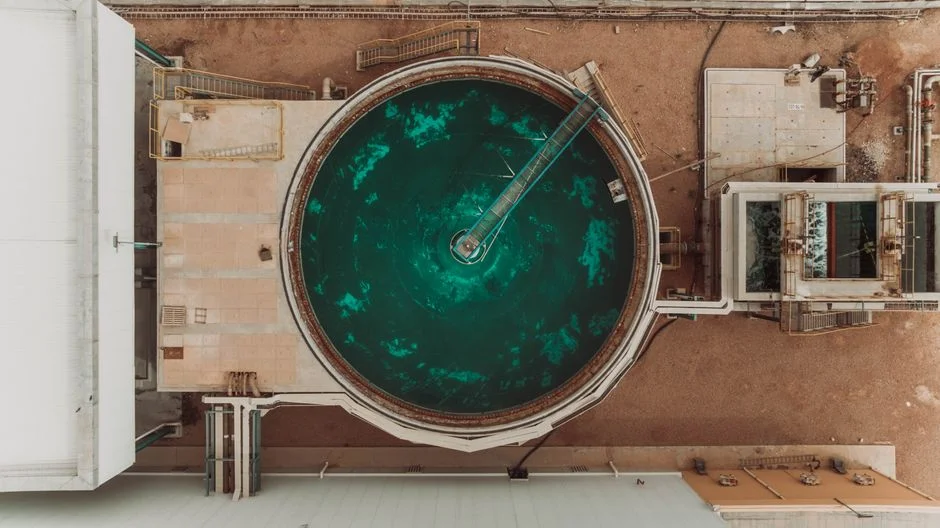
SDIW arrives at the biological stage with three membrane killers: sucrose spikes, lubricant oils and plastic fragments from the bottle-wash line, and CIP-driven pH excursions. The pre-treatment train is therefore not optional. A rotary bar screen with 1-3 mm aperture removes cap fragments, label pulp and broken glass before the stream hits the equalisation tank. The equalisation basin must buffer 8-24 h HRT to absorb syrup batch dumps and CIP surges; under-sizing it to 4 h or less is the most common root cause of BOD/COD swings that knock 30-50% off MBR flux within a single 24 h cycle (per S3 stream data).
pH correction to 6.5-8.5 using a CO2 stripper or a pH correction dosing skid is required upstream of the bioreactor - EGSB methanogens and MBR biomass both lose activity below pH 6 or above pH 9.5. A DAF unit or lamella clarifier then strips conveyor lubricant oils, colourants and the suspended fraction of TSS, protecting the UF membranes from irreversible oil fouling that no chemical clean will fully reverse.
MBR Design Parameters for SDIW
The parameter envelope below is drawn from the Saiya et al. SDIW pilot and cross-checked against municipal MBR sizing practice from the related MBR cost and sizing guide. Use it as the basis-of-design starting point for an integrated MBR system fitted with a DF series flat-sheet MBR module.
| Parameter | Design value (SDIW) | Source / note |
|---|---|---|
| MLSS (aerobic tank) | 8,000-12,000 mg/L | S3 + HydropureWater MBR guide |
| SRT | 20-40 d | S3; longer for sugar-rich feed |
| HRT anoxic zone | 0.4-1.0 h | S3 pilot, 0.41 h confirmed |
| HRT aerobic zone | 3-5 h | S3 pilot, 3.3-14 h range |
| DO setpoint | 2.0-3.7 mg/L | S3 |
| OLR aerobic | 2.3-3.1 kg COD/m³·d | S3; MBR alone to ~5,000-6,000 mg/L CODt |
| Membrane flux | 12-15 L/m²·h | S3; at TMP 60-100 kPa |
| Membrane air-scour rate | 0.3-0.6 m³ air/m² membrane·h | DF series rating |
| Membrane pore / material | 0.1 µm PVDF, submerged | DF series spec |
| Permeate CODt | <253 mg/L | S3 |
| Cycle (filtrate/relax) | 9 min on / 1 min relax | DF series standard CIP-resistant cycle |
Sustainable flux for SDIW sits at the low end of the flat-sheet rating window, so the design should add 20-25% membrane area as fouling margin when scaling the pilot data to a 100-2,000 m³/d commercial train. The relaxation/backwash cycle is what holds sucrose-driven cake formation in check between chemical cleans.
When to Add an EGSB Upstream: Hybrid EGSB/MBR Sizing
MBR alone is the right call when the equalised CODt averages below ~5,000-6,000 mg/L. Above that, a hybrid EGSB/MBR pays for itself. The pilot envelope is explicit: hybrid is justified when equalised CODt averages >6,000 mg/L or peak hourly load exceeds 10,000 mg/L (S3). At HRT 12 h, Vup 0.85 m/h and OLR 11 kg COD/m³·d the EGSB delivers up to 93% CODt removal while producing up to 17 L/d biogas at 70% CH4 - energy-positive at plants above ~500 m³/d (S3).
The EGSB operating window for full-scale design is HRT 12-60 h, Vup 0.59-1.1 m/h, temperature 35-37 °C and OLR up to 11 kg COD/m³·d (S3). Dropping the MBR's OLR from 2.3-3.1 kg COD/m³·d (MBR alone) to 1-2 kg COD/m³·d (post-EGSB) extends membrane life, stabilises flux and cuts aeration energy by roughly a third. For full sizing equations, follow the linked EGSB design parameter guide; for ROI and energy trade-offs, the anaerobic digester energy reduction strategies article gives the calculation framework.
Flat-Sheet vs Hollow-Fibre MBR for SDIW
Membrane geometry is a sugar-fouling decision, not a brand preference. The comparison below ties the Saiya pilot flux window to the DF series envelope and a generic 0.03 µm PVDF hollow-fibre UF train (for an UF system, see the related UF water treatment system).
| Criterion | Flat-sheet (DF series, 0.1 µm PVDF) | Hollow-fibre UF (0.03 µm PVDF) |
|---|---|---|
| Pack size / capacity | 80-225 m² per pack, 32-135 m³/d per pack | 2,000-40,000 L/h per train |
| Packing density | Lower, but individually replaceable elements | Higher, fibres in modules |
| Tolerance to high-viscosity MLSS and rags | High - rigid plate, integrated aeration box | Lower - fibres clog on rags and stringy biomass |
| Cleanability | Easy - lift out, hose, replace single plate | Harder - backwash only, chemistry-limited |
| Sustainable flux on SDIW | 12-15 L/m²·h (pilot-confirmed) | 10-13 L/m²·h, stricter pre-treatment needed |
| Air-scour energy vs cross-flow | 10-20× lower than external cross-flow | Similar; blower is 30-50% of MBR OpEx |
| Best fit for SDIW | Sugar-rich, high-MLSS, variable load | Tight effluent (reuse) where fouling can be tightly controlled |
For SDIW with sucrose-driven viscosity and the BOD/COD swings described above, flat-sheet wins on operability. The decision pivots on the 20-25% area margin: hollow-fibre makes sense only if the plant already has tight screening and DAF upstream and the reuse target demands the 0.03 µm pore.
Discharge vs Reuse: Where the MBR Stops

MBR permeate CODt consistently below 253 mg/L clears typical municipal sewer discharge limits (S3). NH4+, NO3- and PO4³- pass the City of Cape Town industrial discharge by-laws but exceed SANS 241 drinking-water thresholds, so reuse for potable applications is off the table without polishing (S3). For boiler feed, CIP rinse or any human-contact reuse, an RO polishing train at ~95% recovery is the standard add-on. Lower-grade reuse - cooling tower make-up, garden irrigation, toilet flush - needs only MBR plus a UV steriliser for pathogen control, which is typically what the plant manager is actually asking for when the word "reuse" comes up.
Frequently Asked Questions
What influent CODt range should I size an MBR for on a soft drink bottling plant?
Design the equalisation tank for a CODt range of 2,242-11,717 mg/L (average 5,638 mg/L) and pH 6.1-11.8, because the syrup, bottle-wash and CIP streams swing together across shifts (Saiya et al., Chem. Eng. J. 2016, S3). MBR alone is viable to ~5,000-6,000 mg/L CODt; above that, place an EGSB upstream.
What flux and TMP should I expect from a submerged MBR on SDIW?
The Saiya et al. pilot ran 12-15 L/m²·h at TMP 60-100 kPa on 0.1 µm PVDF submerged modules (S3). Add 20-25% membrane area as fouling margin when scaling to a commercial train, because SDIW flux sits at the lower end of the DF series rating window.
Is MBR permeate from SDIW suitable for direct reuse?
Not for potable reuse. MBR permeate CODt <253 mg/L meets sewer discharge limits, but NH4+, NO3- and PO4³- remain above SANS 241 drinking-water thresholds (S3). Add RO polishing for boiler feed or CIP rinse, or MBR + UV for cooling tower or irrigation reuse.
When is a hybrid EGSB/MBR worth the extra capex on SDIW?
When equalised CODt averages above ~6,000 mg/L or peak hourly load exceeds 10,000 mg/L, an upstream EGSB at HRT 12 h and OLR 11 kg COD/m³·d cuts CODt by up to 93% and produces up to 17 L/d biogas at 70% CH4, dropping MBR OLR to 1-2 kg COD/m³·d and extending membrane life (S3).