Why Rio de Janeiro in 2026 Is a Different Compliance Case from Inland Brazil
Brazil runs an 89% renewable grid, but the limiting utility in coastal Rio de Janeiro in 2026 is not electricity — it is water (Rest of World, 2025). A 40 MW campus drawing 200–800 m³/day of makeup sits at the intersection of two conflicting pressures: post-2024 drought stress on the Paraíba do Sul and Guandu basins that feed CEDAE, and tighter discharge scrutiny on Guanabara Bay, a Class 2 receiving water already operating at its pollution-assimilation ceiling. The 2024 Rio Grande do Sul floods, which displaced more than 600,000 residents and pushed Scala Data Centers' 4.75 GW Eldorado do Sul proposal into direct conflict with a recovering watershed, have set the national precedent: a hyperscale applicant now has to demonstrate it is not pulling water from a stressed system or discharging thermal or TDS load into one (Rest of World, 2025).
Three regulatory layers stack on top of the federal floor. CONAMA Resolution 430/2011 sets the national baseline for effluent quality. INEA's Guanabara Bay Class 2 expectations tighten chloride, TDS, and thermal limits by roughly an order of magnitude versus the COPAM/CERH-MG 01/2008 inland envelope, which caps TDS at ≤2,000 mg/L in drought-sensitive Minas Gerais sub-basins (HydropureWater, 2026). The third layer is REDATA — the Regime Especial de Tributação para Data Centers under Provisional Measure 1,318/2025 — which conditions tax breaks on a Water Usage Effectiveness benchmark measured in liters of water consumed per MWh of IT load (Aos Fatos, 2026; Mongabay, 2026-09). The combined equipment market for Brazilian data-center water and wastewater treatment is sized at $66.8M in 2026, projected to reach $119.2M by 2031 at 12.3% CAGR, with São Paulo and Rio de Janeiro as the primary capex drivers (MarketsandMarkets, 2026). A CONAMA-only specification is not enough for an INEA pre-meeting in 2026 — the engineer has to show the Guanabara Bay envelope and the REDATA WUE constraint on the same drawing.
Fab vs. Data Hall: Two Different Effluent Profiles in the Same Plant
A semiconductor fab and a hyperscale data hall cannot share a single equalization basin, and treating them as one campus is the most common FEED mistake in mixed Rio sites. Fab UPW (ultrapure water) blowdown and scrubber waste carry HF, NH₄F, IPA, TMAH, Cu, and other organics and metals that a data-hall blowdown never sees — a fab train therefore needs a fluoride-specific precipitation step plus organics destruction (Fenton oxidation or wet oxidation) upstream of biological polishing. Data-hall blowdown carries biocide residuals (phosphonates, isothiazolinones, free or combined chlorine) and silica scale fragments, with no fluoride or organic-solvent load. The chemistry difference drives the unit-operation sequence: fab streams route through CaCl₂ precipitation for fluoride (target <10 mg/L F⁻), Cu precipitation as hydroxide or sulfide (target <0.5 mg/L Cu), and TMAH/IPA destruction before any biological or membrane stage.
The data-hall train splits into two streams that must be physically segregated. Stream 1 is cooling-tower blowdown, the bleed cycle that holds cycles of concentration (COC) at 4–6 to prevent scale. Sized by Blowdown = Makeup / (COC − 1), blowdown for a 40 MW campus at PUE 1.4 runs 0.3–0.8% of makeup volume (HydropureWater, 2026). Stream 2 is domestic sanitary wastewater from staff, cafeteria, and restrooms, sized at 50–100 L/person/day for a hyperscale campus. The two streams cannot share a single equalization basin — biocide and phosphonate residuals in the blowdown would toxify the biological stage of any sanitary plant, and BOD swings in the sanitary stream would disrupt the chemistry-controlled softening and RO train. Globally, the typical data center uses 25–770 million L/yr, hyperscale facilities exceed 2 billion L/yr, and the semiconductor industry consumes roughly 210 trillion L/yr with about half in water-scarce basins (TNFD, 2026). Brazil still has no sector-specific data-center rule, so data halls fall under the general CONAMA framework with state overlays; a fab, by contrast, is far more likely to attract special-polluting-industry scrutiny even absent a DC rule (Rest of World, 2025).
| Parameter | Fab UPW Blowdown / Scrubber | Data-Hall Cooling-Tower Blowdown | Data-Hall Sanitary |
|---|---|---|---|
| Flow (% of makeup) | 40–70% (UPW reject) | 0.3–0.8% at 4–6 COC | 50–100 L/person/day |
| Key contaminants | HF, NH₄F, IPA, TMAH, Cu, organics | Ca/Mg hardness, silica, biocide, phosphonate | BOD, TSS, NH₃, fecal coliform |
| Critical unit op | F⁻ precipitation, Fenton / wet oxidation, Cu precipitation | DAF, softening, side-stream RO, ClO₂ | MBR or packaged STP |
| Toxic to biological stage? | Yes — must be segregated | Yes — biocide/phosphonate | No |
| Discharge target | CONAMA 430 + INEA Class 2 + fab permit | CONAMA 430 + INEA Class 2 + REDATA WUE | CONAMA 430 + INEA sanitary |
The Three-Layer Discharge Envelope a Rio Engineer Has to Hit
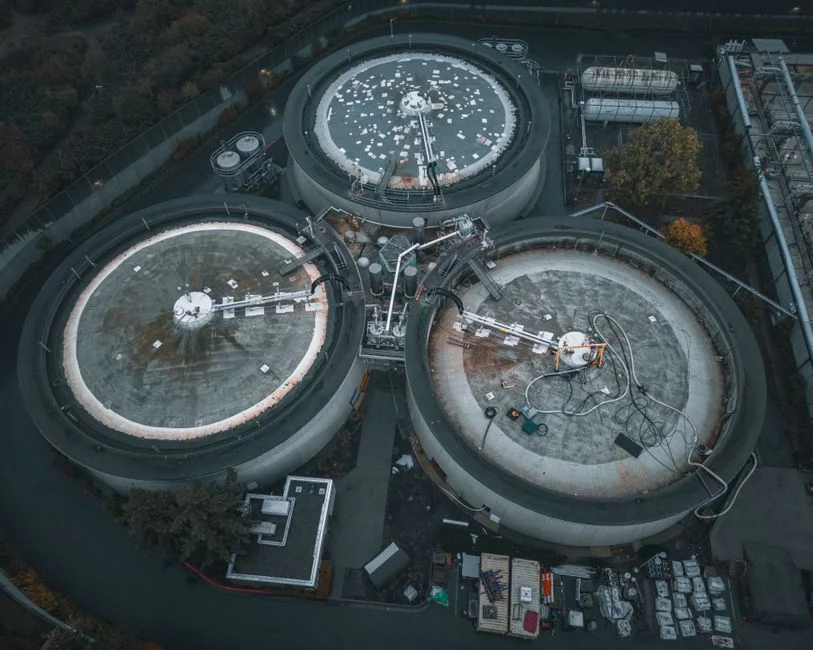
The numerical limits that drive every downstream unit operation sit on three legal layers, and a single wall-mounted table is the artifact that belongs in the INEA meeting room. The CONAMA 430/2011 national floor sets pH 5–9, BOD ≤120 mg/L for sewer discharge, oils & greases ≤50 mg/L, and TSS per receiving-water class (HydropureWater, 2026). INEA's Guanabara Bay Class 2 expectations tighten pH to 6.5–8.5, free chlorine residual to ≤0.1 mg/L at the point of discharge, oils & greases to ≤20 mg/L, and impose a thermal envelope (typically ΔT ≤3 °C at the mixing zone) and a TDS target of ≤1,500 mg/L (HydropureWater, 2026). The COPAM/CERH-MG 01/2008 inland comparison is more permissive: TDS ≤2,000 mg/L in drought-sensitive Minas Gerais sub-basins, no thermal envelope equivalent to Guanabara Bay. The REDATA WUE constraint overlays everything: liters of water consumed per MWh of IT load, with a 1 GW campus sized at 1.2M L/day = 438M L/yr at the benchmark (Mongabay, 2026-09).
| Parameter | CONAMA 430/2011 (national floor) | COPAM/CERH-MG 01/2008 (drought-sensitive MG) | INEA Guanabara Bay Class 2 (Rio) |
|---|---|---|---|
| pH | 5–9 | 6–9 | 6.5–8.5 |
| TDS (mg/L) | Per receiving water class | ≤2,000 (drought sub-basins) | ≤1,500 typical, thermal limit at receiver |
| BOD (mg/L) | ≤120 (sewer) | ≤60 (some classes) | Per receiving-water class, ≤40 for Class 2 streams |
| Oils & greases (mg/L) | ≤50 | ≤30 | ≤20 |
| Free Cl₂ residual (mg/L) | ≤0.5 | ≤0.1 | ≤0.1 at point of discharge |
| Thermal envelope | None specified | None specified | ΔT ≤3 °C at mixing zone |
Coastal Rio Lever: Seawater Free-Cooling and the Bromide Biocide Switch
Seawater-assisted free-cooling on the Barra and Recreio coast is the single largest freshwater-avoidance lever available to a coastal Rio campus, and it changes the biocide chemistry in a way the inland Minas Gerais spec does not. With seawater blended into the cooling loop, achievable COC rises to 5–7 versus 4–6 for freshwater makeup because the reduced freshwater fraction lowers calcium scale risk (HydropureWater, 2026). The trade-off is bromide: seawater cooling elevates bromide residual in the recirculating water to 5–50 mg/L, and free chlorine demand increases proportionally because chloride competes for oxidant demand. Free chlorine reacts with bromide to form brominated disinfection byproducts (bromoform, DBAA, DBAN) that the Guanabara Bay Class 2 receiving-water envelope cannot absorb in summer low-flow conditions. The design response is a biocide switch away from free chlorine to chlorine dioxide or bromine-based programs, and specifying a chlorine dioxide generator at 0.1–0.3 mg/L residual on the reuse line. The combined freshwater draw cut is 40–60% from seawater free-cooling plus another 20–30% from reclaimed CEDAE effluent, and the two levers are additive rather than competing (HydropureWater, 2026).
The 5-Step Treatment Train a Rio FEED Engineer Should Carry into INEA
The five-step train below is the spec a FEED engineer should carry into a Rio INEA pre-meeting, and each step has a defensible number behind it.
Step 1 — Equalization and neutralization. A 24–48 h equalization basin smooths TDS swings and absorbs slug discharges from cycle dumps; dose sulfuric acid or CO₂ to trim pH into the 7.0–8.0 window before the next unit operation (HydropureWater, 2026). For fab trains, a separate fluoride-equalization basin at pH 8–9 prevents HF volatilization.
Step 2 — DAF for oil, TSS, and partially-bound metal removal. A dissolved air flotation system in the 4–300 m³/h envelope goes upstream of softening and RO to keep oils, silica scale, and metal hydroxides off the membranes. Hydraulic residence time 20–30 min; air-to-solids ratio 0.005–0.015 typical.
Step 3 — Hardness reduction. Lime-soda softening or weak-acid cation exchange drops calcium and magnesium to <50 mg/L as CaCO₃. The resulting sludge dewatered on a plate-and-frame filter press to 25–35% dry solids for off-site haul. Multi-media filtration at 5 µm protects downstream RO from carryover.
Step 4 — Side-stream RO. An industrial RO polishing system treats a slipstream at 75–95% recovery, cutting net TDS bleed from the campus and returning permeate to the cooling loop; pretreatment is multi-media plus 5 µm cartridge. The fab train adds a second RO pass for UPW reclaim when feedwater fluoride has been polished below 10 mg/L.
Step 5 — Disinfection. A chlorine dioxide generator in the 50–20,000 g/h envelope holds 0.1–0.3 mg/L residual on the reuse line, preferred over free chlorine on coastal Rio sites because it does not react with the elevated bromide to form brominated DBPs (HydropureWater, 2026).
Hyperscale upgrade path: brine concentrator plus forced-circulation crystallizer for ZLD when basin TDS exceeds 1,500 mg/L or when a Minas Gerais–style drought allocation is imposed mid-life. High-recovery architectures push overall recovery past 95% and cut silica in the permeate to ~1 mg/L, a configuration that lets a Tier 3 campus commit to REDATA's WUE benchmark with margin to spare. Operators seeing recovery decline or scale on the second-pass should consult the industrial RO troubleshooting field guide before the membrane stack is damaged.
Sanitary Stream and the CEDAE Reclaimed-Effluent Makeup Option
The sanitary stream is sized separately and selected on flow, reuse intent, and the available CEDAE reclaimed-effluent concession. For a campus below ~80 m³/d of sanitary flow with no reuse intent, a WSZ underground packaged sewage treatment plant in the 1–80 m³/h envelope handles the load fully buried, with no on-site operator and a single annual sludge pump-out (HydropureWater, 2026). For a 40–80 MW hyperscale site that wants to reuse treated sewage for cooling-tower makeup, irrigation, or toilet flush, the spec is an MBR membrane bioreactor system with submerged PVDF at <1 µm pore size — roughly 60% smaller footprint than conventional activated sludge, with effluent BOD <5 mg/L and TSS <1 mg/L that meets reuse targets without tertiary polishing. The replaceable flat-sheet elements in the DF-series membrane module lineup cover 10–2,000 m³/day campus WWTPs and clean in place with standard CIP chemistry.
The CEDAE reclaimed-effluent route runs rotary bar screening through a GX series mechanical bar screen, a multi-media filter for turbidity and iron, the MBR for organics, an industrial RO pass for TDS cut, and a chemical dosing system feeding ClO₂ for residual control — and the whole train is gated by a CEDAE concession raised in the front-end engineering phase so the timeline matches the water-rights calendar. Cutting potable draw 60–80% is the resilience benefit, mirroring the COPASA concession model that Belo Horizonte operators use today (HydropureWater, 2026).
Three-Tier Decision Matrix: Colocation, Mid-Size, Hyperscale
Three tiers, each tied to cycles of concentration and reuse targets rather than a fixed process flow. Tier 1 (colocation, <5 MW): a WSZ packaged sanitary plant with blowdown discharged to sewer under INEA; no RO, no softening, DAF only if oils or TSS exceed 20 mg/L. Tier 2 (mid-size, 5–30 MW): WSZ or MBR sanitary plus DAF + softener + side-stream RO on blowdown, ClO₂ on the reuse loop — push COC to 6–8 to cut blowdown volume. Tier 3 (30+ MW hyperscale): full MBR sanitary, full pretreatment-RO train on blowdown, optional ZLD when TDS in the basin exceeds 1,500 mg/L, and reclaimed-CEDAE-effluent makeup enabled through a concession. The JY integrated water purification system and high-efficiency sedimentation tank fit Tier 2 and Tier 3 polishing loops, and the industrial water softener system supports both tiers (HydropureWater, 2026).
The CAPEX payback on RO water reuse falls below 3 years when municipal potable tariffs exceed roughly R$15/m³ — a threshold CEDAE has crossed in Rio's Zona Sul and Barra corridors (HydropureWater, 2026). The 40 MW breakpoint is the point at which side-stream RO stops being optional under Rio permit conditions; below 40 MW, an INEA reviewer will accept blowdown-to-sewer, above it the Guanabara Bay thermal envelope makes reuse the cheaper compliance path.
| Parameter | Tier 1 (<5 MW colocation) | Tier 2 (5–30 MW mid-size) | Tier 3 (30+ MW hyperscale) |
|---|---|---|---|
| Sanitary train | WSZ packaged STP, sewer discharge | WSZ or MBR | Full MBR + RO, reclaimed-CEDAE blend |
| Blowdown train | DAF only if TSS >20 mg/L | DAF + softener + side-stream RO + ClO₂ | DAF + softener + RO, optional ZLD crystallizer |
| Target COC | 4–5 | 6–8 | 6–8, plus 5–7 if seawater blend |
| Freshwater draw cut | 0–20% | 30–50% | 60–80% (with seawater + reclaimed CEDAE) |
| Permit trigger | INEA only | INEA + REDATA benchmark | INEA + REDATA benchmark + concession |
Pre-Submittal Checklist: Five Items That Separate a Defensible INEA Filing from an Information Request
- Raise the INEA effluent permit and the Guanabara Bay receiving-water class confirmation in the FEED phase, not during detailed design — by detailed design, the discharge envelope is locked and any tightening becomes a redesign (HydropureWater, 2026).
- Lock the CEDAE or third-party reclaimed-effluent concession before finalizing the MBR+RO train sizing, because the concession defines the design flow and reuse targets the train is built around.
- Design the equalization basin to absorb a future drought allocation cap or a CONAMA 430 revision — 24–48 h of blowdown storage is the cheapest insurance against a mid-life permit tightening.
- Instrument blowdown and makeup streams from day one; the 2021 Uptime Institute survey showed only 51% of data-center operators tracked their water use at all, and REDATA WUE reporting will reward the operators who do (HydropureWater, 2026).
- Treat the post-September 2026 REDATA WUE benchmark as a design constraint, not an afterthought — the difference between meeting the threshold and missing it is 15–25% of freshwater draw, which translates directly to a R$/m³ operating-cost swing the finance team will see.
Frequently Asked Questions
What regulatory limits apply to a 2026 Rio semiconductor or data-hall discharge?
A 2026 Rio facility discharges against three layers: CONAMA Resolution 430/2011 (national floor, pH 5–9, BOD ≤120 mg/L for sewer, O&G ≤50 mg/L), INEA's Guanabara Bay Class 2 expectations (pH 6.5–8.5, TDS ≤1,500 mg/L typical, free Cl₂ ≤0.1 mg/L at point of discharge, O&G ≤20 mg/L, ΔT ≤3 °C at mixing zone), and the REDATA WUE benchmark under Provisional Measure 1,318/2025. Brazil still has no sector-specific data-center rule, so data halls fall under the general CONAMA + state overlay; a fab is more likely to attract special-polluting-industry scrutiny (HydropureWater, 2026; Rest of World, 2025).
What is the REDATA Water Usage Effectiveness benchmark, and what does it mean for a 1 GW campus?
REDATA WUE is the liters of water consumed per MWh of IT load that a data center must hold below to retain PIS/Cofins and import-duty exemptions under Provisional Measure 1,318/2025. A 1 GW campus operating at the benchmark consumes roughly 1.2 million L/day (438 million L/year) — a volume large enough to fail any FEED package that has not addressed freshwater draw and reuse concurrently (Mongabay, 2026-09; Aos Fatos, 2026).
Can seawater free-cooling be used on a coastal Rio site, and what biocide change does it force?
Yes. Seawater-assisted free cooling on the Barra or Recreio coast reduces COC to 5–7 (versus 4–6 for freshwater makeup), cuts freshwater draw 40–60%, and the resulting blowdown is routed through the same DAF + softener + side-stream RO + ClO₂ train as freshwater-derived blowdown. The discharge must still meet CONAMA 430/2011 and INEA's tighter Guanabara Bay envelope, but the biocide selection must switch from free chlorine to chlorine dioxide or a bromine-based program to keep brominated DBPs in check (HydropureWater, 2026).
Can a fab and a data hall in the same Rio campus share a treatment train?
No. The two-stream rule is non-negotiable: a cooling-tower blowdown line sized by Blowdown = Makeup / (COC − 1), typically 0.3–0.8% of makeup for a 40 MW campus at PUE 1.4, plus a sanitary train sized at 50–100 L/person/day. A fab adds a third stream — UPW blowdown and scrubber waste carrying HF, NH₄F, IPA, TMAH, and Cu — that requires fluoride precipitation, Cu precipitation, and Fenton or wet oxidation upstream of any biological or membrane stage. The 40 MW breakpoint is the point at which side-stream RO stops being optional under Rio permit conditions (HydropureWater, 2026).
What bromide level triggers the biocide switch on a Rio coastal site?
Bromide residual rises to 5–50 mg/L when seawater is blended into the cooling loop, and free chlorine demand increases proportionally. The biocide must switch from free chlorine to chlorine dioxide or a bromine-based program to avoid brominated DBP formation; a ClO₂ generator at 0.1–0.3 mg/L residual on the reuse line is the standard Rio coastal design response (HydropureWater, 2026).