
Why Cullman Paper Mills Are Rethinking Their Primary Clarifier in 2026
Cullman County hosts a dense cluster of tissue, recycled containerboard, and specialty fiber mills whose NPDES-permitted discharges flow through ADEM-administered pretreatment programs — and 2026 has stacked three pressures on every plant manager's desk. Recovered fiber prices have climbed roughly 18% year-over-year (Pulp & Paper Week, 2026-01), pushing mill accountants to value what used to be flushed. ADEM's 2026 industrial pretreatment guidance reiterates that fiber-laden discharges must meet a 30-day average TSS limit tied to the EPA categorical rules under 40 CFR 430, with daily-max probes still active at most sites. Storm-season flow variability from Alabama's spring and fall cloudbursts routinely pushes primary clarifiers past their hydraulic limit, sending fiber surges to the headworks. The result is a 2026 buying decision in which the choice between a dissolved air flotation unit and a gravity or lamella clarifier turns on fiber economics, water-reuse intent, and local flow variability — not just first cost. This guide lays out a side-by-side framework tuned to those Cullman drivers.
How a DAF Clarifier Works in a Paper Mill
DAF clarifies paper-mill whitewater by attaching fine 20-40 micron micro-bubbles to low-density fiber and ash, lifting them to the surface in a fraction of the time gravity needs. The five-step flow documented for paper-mill DAFs is straightforward: (1) coagulant and flocculant dosing to neutralize surface charge and bridge fine fiber into a settleable/floatable floc; (2) a pressurized recycle stream (typically 20-40% of clarified flow at 5-7 bar) saturated with dissolved air; (3) micro-bubble contact through a release nozzle that nucleates the 20-40 micron bubble population; (4) float separation in a shallow "zero velocity" tank where bubble-floc aggregates rise in 3-5 minutes; and (5) clarified underflow drawn from below the floating mat, with thickened sludge scraped off the top at 2-4% consistency (DAF Corp product literature, 2025).
Why this beats gravity for fiber: cellulose and ash have specific gravities of roughly 0.7-1.0 — close to water — so Stokes-law settling velocities in a conventional clarifier are an order of magnitude slower than bubble-driven rise rates. DAF Corp's FC Maximizer circular tank exploits the "zero velocity" principle (uniform radial flow cancels bulk motion) and is rated for 92-98% TSS removal at 10-11,000 GPM with a 6-70 ft diameter envelope (DAF Corp, 2025). The Krofta Supracell, the historical benchmark, has 1,000+ global paper-mill installations and posts effluent TSS of 20-30 mg/L with the same 3-5 minute retention (LIWT-KEC, 2022). For a Cullman tissue mill chasing warm-whitewater reuse, that retention-time advantage is the whole story: less tank volume, less heat loss, less floor space.
How a Gravity or Lamella Clarifier Handles Pulp and Paper Wastewater
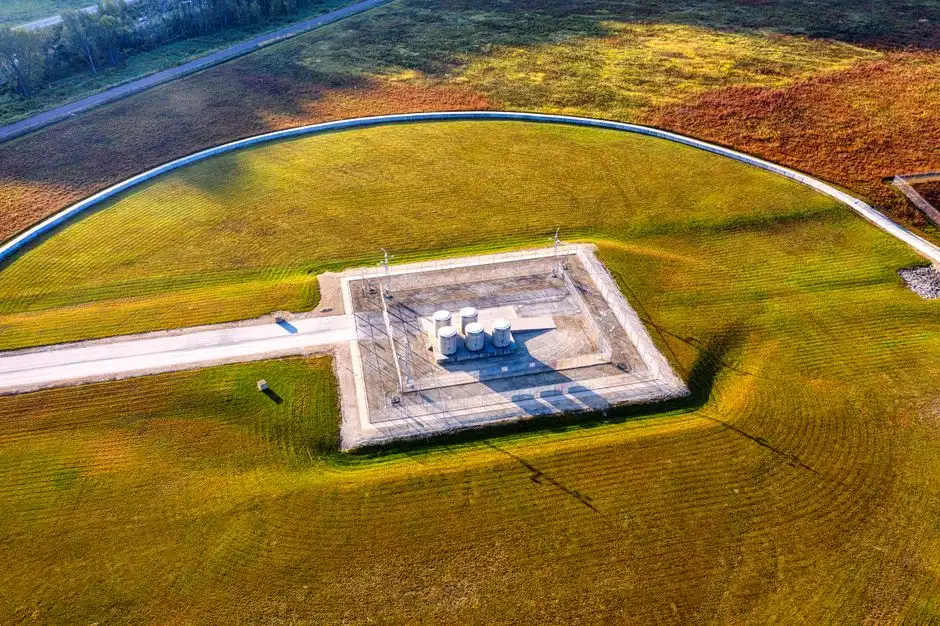
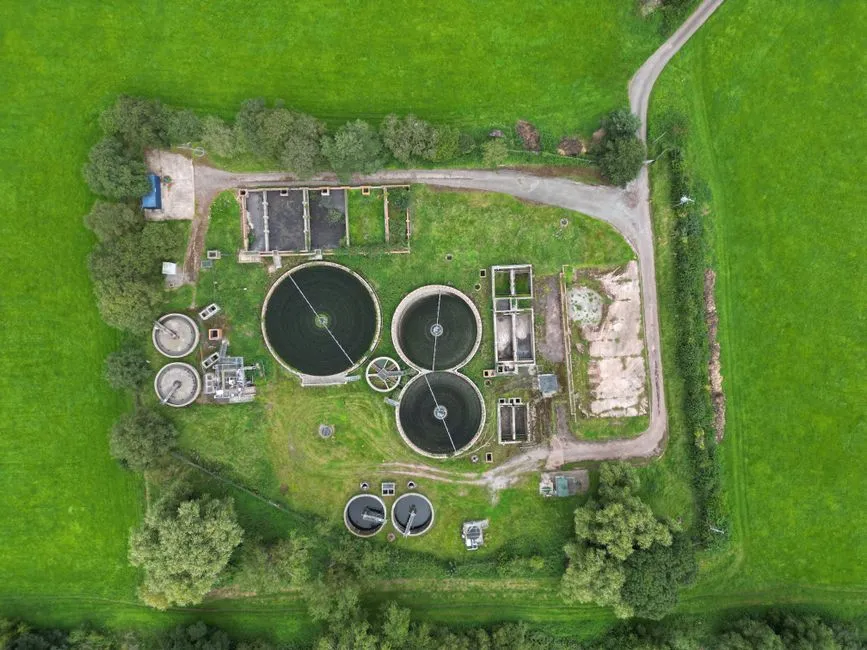
A conventional gravity clarifier relies on quiescent settling in a large basin with 2-4 hours of hydraulic retention, a slow-moving rake that conveys sludge to a central hopper, and a surface skimmer for scum. It is well-matched to settleable mineral solids above ~1.0 specific gravity — grit, primary sludge, and biological floc from a secondary clarifier — but it underperforms on the buoyant, sub-millimeter fiber that dominates a paper-mill whitewater stream. Effluent TSS from a gravity unit on paper-mill feed typically lands at 60-120 mg/L because fine fiber simply does not settle in the available time (industry range, 2025 field data).
A HydropureWater lamella clarifier compresses the same settling physics into a fraction of the footprint: inclined plates at 55-60° double the effective settling area within a small rectangular tank and push surface loading to 20-40 m³/m²·h — versus 1-2 m³/m²·h for a conventional basin. The trade-off is real but narrow. Lamella clarifiers struggle with sub-millimeter fiber fragments, ride out hydraulic surges poorly, and rarely polish a stream to the clarity required for warm-whitewater spray-nozzle reuse. Their best 2026 role in a paper mill is either as a cheap pre-clarifier for cooling-tower blowdown or as a polishing step downstream of a DAF, not as the primary fiber-removal unit on a kraft or recycled-fiber line.
DAF vs Clarifier: Side-by-Side Comparison for Paper Mill Duty
The table below consolidates the operating envelope a 2026 mill engineer should weigh before issuing an RFQ. Values reflect manufacturer ratings and 2025-2026 field performance on pulp-and-paper service; capex is an indicative order of magnitude, not a quotation.
| Parameter | DAF (FC Maximizer / Supracell class) | Gravity Clarifier | Lamella Clarifier |
|---|---|---|---|
| TSS removal | 85-97% (DAF Corp, 2025) | 50-75% | 60-85% |
| Effluent TSS | 20-30 mg/L (Supracell); <20 mg/L achievable | 60-120 mg/L | 40-80 mg/L |
| Hydraulic retention | 3-5 minutes (Krofta, 2026) | 2-4 hours | 15-30 minutes |
| Footprint at 500 GPM | ~12 ft × 12 ft (DAF Corp FC-150) | ~50 ft × 20 ft basin | ~30 ft × 20 ft (inclined-plate pack) |
| Polymer demand | 1-5 mg/L flocculant + coagulant | Higher per unit TSS removed | Higher per unit TSS removed |
| Sludge consistency | 2-4% thickened, dewatering-ready | 0.5-1.5%, needs thickener | 1-2% |
| Fiber recovery | Yes — float reused as furnish | No | Marginal |
| Flow sensitivity | Tolerates 1.5-2× surge for short periods | Poor — surges resuspend solids | Moderate |
| Indicative 2026 capex per GPM (installed) | $120-220/GPM | $40-80/GPM | $70-130/GPM |
| Scalability envelope | 48-11,000 GPM (DAF Corp); 18-1,320 GPM | Custom — large civil works | Typically capped ~200-500 GPM/unit |
When a Lamella or Gravity Clarifier Still Wins in 2026
DAF is not always the right answer. Three narrow envelopes in 2026 still favor gravity or lamella:
- Low-TSS, low-variability side streams. Influent below ~500 mg/L TSS and flow under 200 GPM — cooling-tower blowdown, clean condensate, or clarified filtrate — do not justify the chemical skid and air-saturation equipment of a DAF. A HydropureWater lamella clarifier at 20-40 m/h surface loading will hit 30% chemical reduction versus conventional coagulation and settle out the residual hardness and silica with no bubble infrastructure.
- Footprint-ample sites with cheap labor and no fiber value. A 2-4 hour gravity basin still costs less in capex per GPM (~$40-80/GPM installed) and can be the right call for an older mill with surplus land, no fiber-recovery economics, and TSS limits generous enough to accommodate 60-120 mg/L effluent.
- Polishing downstream of a DAF. Lamellas increasingly serve as a second-stage TSS polish before sand filtration or membrane reuse, especially when the DAF is being pushed near its TSS-removal ceiling on a 2,000+ mg/L feed stream.
Outside these cases — and outside the 200 GPM-per-unit cap that limits lamella scalability — DAF is the lower-risk 2026 default.
2026 Selection Framework for a Cullman Paper Mill
Use the three-question decision tree below to triage any new or retrofit clarification project this quarter.
- Is recovered fiber worth more than ~$80/ton at your site? If yes, DAF pays back on fiber alone. If no, proceed to question 2.
- Is feed TSS above 1,000 mg/L, or does flow vary by more than 2:1 between dry and storm conditions? If yes, DAF. If no, proceed to question 3.
- Do you intend to reuse warm whitewater for shower nozzles or repulp? If yes, DAF plus a Krofta Spray Filter polish. If no, a lamella clarifier is acceptable.
For a 500 GPM tissue or containerboard line running ~2,000 mg/L TSS, the working 2026 reference design is a DAF Corp FC-150 class unit (12 ft × 12 ft footprint) clarified to 50 mg/L or a dissolved air flotation system in the 4-300 m³/h (18-1,320 GPM) range, which covers the mid-size Cullman mill envelope. The same 500 GPM job on a lamella requires roughly 30 ft × 20 ft of inclined-plate pack and still leaves 40-80 mg/L in the overflow.
| 2026 Sizing Snapshot | DAF (FC-150 class) | Lamella Clarifier |
|---|---|---|
| Flow | 500 GPM | 500 GPM |
| Influent TSS | 2,000 mg/L | 2,000 mg/L |
| Effluent target | 50 mg/L | 50 mg/L (attainable with high polymer dose) |
| Footprint | ~12 × 12 ft | ~30 × 20 ft |
| Polymer consumption | 2-4 mg/L | 6-10 mg/L |
Integrating DAF With the Rest of the Mill's Treatment Train
Primary clarification does not stand alone. Three ancillaries should be in any 2026 Cullman DAF package:
- Upstream screening. A rotary mechanical bar screen in the 2-5 mm aperture range protects the DAF from plastic wrap, rags, and broke that routinely show up in tissue and containerboard whitewater. Without it, the float scoop and skim arm pay the price in unplanned shutdowns.
- Downstream dewatering. DAF sludge at 2-4% consistency is already at dewatering-ready levels. A plate-and-frame filter press brings it to 30-35% cake without a separate gravity thickener — a 2026 best practice for mills that previously sent 0.5-1.5% clarifier underflow to a thickener first. The same press handles gravity-clarifier sludge if the plant is retrofitted in place.
- Automatic chemical dosing. An automatic coagulant and flocculant dosing skid with flow-paced set points is now standard on paper-mill DAFs. It stabilizes performance across the 2:1 flow swings that Alabama storms deliver, and the 5-minute DAF retention gives the dose nearly real-time response — unlike a 2-4 hour gravity basin, where a feed change takes an entire shift to read out.
For broader context on integrating a DAF-thickened waste stream into a full dewatering train, the sludge dewatering guide for DAF-thickened waste covers polymer selection and cake-handling choices that translate directly from food to fiber duty. Cullman plants operating under an ADEM-issued NPDES permit should also confirm their 2026 pretreatment limits, BMP requirements, and any net-zero discharge language before locking the equipment spec.
Frequently Asked Questions
What influent TSS can a DAF handle versus a clarifier in a paper mill?
A DAF is routinely rated for influent TSS of 1,000-3,000 mg/L on paper-mill feed and can be pushed to 5,000+ mg/L with the right chemistry; gravity and lamella clarifiers are practical only up to ~1,000 mg/L, and their removal efficiency collapses above 500 mg/L on fiber streams (DAF Corp, 2025; HydropureWater field data, 2026).
How much does a 2026 DAF cost per GPM for a Cullman-sized paper mill?
Installed DAF pricing for a mid-size paper-mill unit in the 200-1,000 GPM class lands in the $120-220/GPM range in 2026, with the DAF line at the lower end of that envelope; a comparable lamella clarifier runs $70-130/GPM but typically requires more downstream polymer and a larger footprint (HydropureWater indicative pricing, 2026).
Can a lamella clarifier replace a DAF for whitewater reuse?
No. A lamella clarifier alone cannot polish to the sub-30 mg/L TSS range that protects modern shower nozzles from plugging, and it does not capture long fibers for reuse. The proven 2026 configuration is DAF for bulk TSS and fiber recovery, followed by a Krofta Spray Filter as the polishing step that protects the nozzles and supports warm-whitewater reuse (Krofta, 2026).
How often does a paper-mill DAF need sludge removal?
Continuous surface skimming keeps the float mat moving; the 2-3% thickened sludge consistency in the bottom cone is the operating signal that the air-to-solids ratio and polymer dose are correct. Most paper-mill DAFs discharge to a sludge holding tank or directly to a filter press on a 4-8 hour cycle, depending on feed TSS (LIWT-KEC, 2022).
What ADEM and EPA pretreatment parameters should a Cullman paper mill confirm before ordering either system?
Confirm the site's NPDES-permitted TSS, BOD, and pH limits under 40 CFR 430 subcategories, any net-zero or reuse provisions in the 2026 permit renewal, local limits for metals and color, and the local limits' enforcement of daily-maximum versus 30-day-average excursions. ADEM pretreatment coordinators will not accept a DAF or lamella spec that cannot demonstrate compliance during a storm-event peak flow event (ADEM pretreatment guidance, 2026).