The Three Rule Layers That Actually Control a Navasota Plant
Fabricated metals plants near Navasota, Texas meet sewer pretreatment limits by stacking 40 CFR Part 433 (Metal Finishing) PSES/PSNS categorical standards on top of 40 CFR 403.5 POTW local limits, then routing wastewater through flow equalization, oil removal, hexavalent chrome reduction at ORP 250–300 mV, cyanide oxidation, hydroxide precipitation at pH 8.5–9.5, and DAF clarification before pH trim. The controlling layer is whichever limit is strictest; TCEQ TPDES Industrial User permit conditions and the local Brazos-area POTW ordinance add Cu, Ni, Zn, Pb, and oil & grease caps on top of the federal table.
40 CFR Part 403 is the backbone. It defines three enforceable pretreatment instruments — general prohibitions, specific prohibitions, and categorical standards — and it authorizes the POTW to develop local limits under 40 CFR 403.5 that are always at least as stringent as the federal categorical table. All three are enforced simultaneously by EPA, TCEQ, and the control authority (the POTW), and the control authority applies the most stringent requirement where multiple provisions exist (per EPA, NPDES Pretreatment Standards and Requirements — Applicability).
40 CFR Part 433 covers the Metal Finishing point source category: forming, finishing, forging, foundry, metal spraying, and machining wash co-located with plating or anodizing lines. A stamping shop that ships only dry parts to a separate finisher is generally outside the category; a facility that runs its own zinc, nickel, or chromic acid tank is inside it. Part 433 splits limits into PSES (Pretreatment Standards for Existing Sources) and PSNS (Pretreatment Standards for New Sources), with PSNS tighter because they apply to sources constructed after the rule's promulgation date. In practice, most POTW pretreatment programs enforce PSNS-equivalent numbers on all industrial users, so even an existing Navasota plant should design to PSNS.
The Texas layer binds a Navasota plant through TCEQ's TPDES Industrial User permit conditions, issued under 30 TAC Chapter 305 (general permits) and 30 TAC Chapter 315 (pretreatment). On top of that, the Brazos-area POTW's local sewer ordinance, developed under 40 CFR 403.5, typically caps Cu, Ni, Zn, Pb, and oil & grease at values tighter than PSNS. An industrial user crosses into Significant Industrial User (SIU) status at 25,000 gpd of process wastewater, or when its process stream makes up 5% or more of the POTW's average dry-weather hydraulic or organic capacity, per 40 CFR 403.3(v). Once a Navasota plant is an SIU, baseline monitoring reports, 90-day compliance reports, and slug-control plans are all enforceable — so the design envelope must be built from the strictest of the four layers, not from the federal categorical table alone.
What Comes Out of a Fabricated Metals Floor Drain in Navasota
A mixed fabricated-metals floor drain in the Brazos County area carries four contaminant families: free and emulsified oils from stamping, machining, and drawing compounds; dissolved heavy metals (Zn, Ni, Cu, Cr, Pb, Cd) from plating rinsewater and acid pickling; hexavalent chromium from chromic acid anodizing, hard chrome, and conversion coating; and total suspended solids from grinding swarf, casting sand, and hydroxide floc carryover. Cyanide appears wherever alkaline cyanide plating (Zn, Cu, Cd, Ag) is still in use, and it must be destroyed upstream of metals precipitation or it will resolubilize the precipitates downstream.
| Parameter | Typical range at equalization inlet | Design driver |
|---|---|---|
| Oils (free + emulsified) | 50–500 mg/L | Spills from machine coolant dumps |
| Dissolved metals (sum of Cu/Ni/Zn/Pb/Cd) | 5–200 mg/L | Rinse dumps from plating line |
| Hexavalent chromium | 0–50+ mg/L (spike) | Hard chrome line rinse dump |
| Total suspended solids | 100–1,000 mg/L | Swarf, sand, hydroxide floc |
| pH | 2–12 across batch dumps | Acid pickling vs alkaline cleaning |
Source: HydropureWater field data, 2026. Ranges reflect composite samples collected at the headworks of mixed fabricated-metals pretreatment systems; site-specific numbers will vary with process mix and uptime.
The hard-chrome line is the parameter that destroys undersized equalization basins. A typical hard-chrome rinse dump spikes Cr(VI) above 50 mg/L and drops pH below 2 in a single slug. A 4-hour composite that misses the Friday afternoon dump will undersize the equalization basin by an order of magnitude and send that slug straight into the chrome-reduction reactor, where residence time runs out before the ORP probe sees it. The rule is to sample a full week of composite flow, including at least one deliberate capture of a rinse dump, before specifying equipment. The four contaminant families also do not all respond to the same chemistry — oils need physical separation or chemical break, hex chrome needs reduction, cyanide needs oxidation, and dissolved metals need pH-driven precipitation — so one reaction stage cannot handle all of them. That is why the standard train runs in series, not in parallel.
The Standard Pretreatment Train, Step by Step
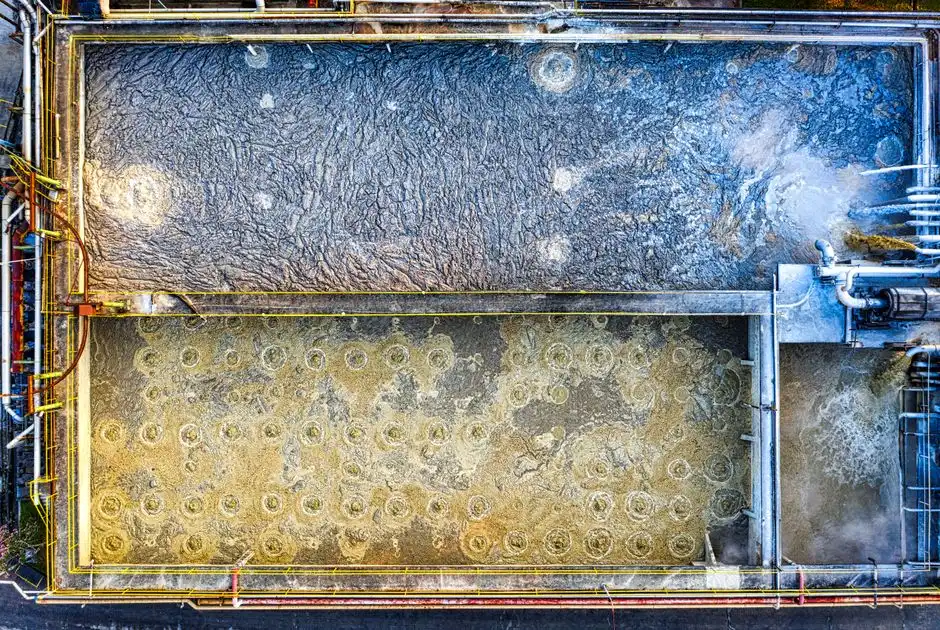
The treatment train below is the standard sequence a Navasota fabricated metals plant uses to hit PSNS-equivalent POTW limits. Each step has a defined purpose, a defined outlet spec, and a defined failure mode if it is skipped.
- Headworks screening. A rotary mechanical bar screen for headworks protection removes rags, wipes, and tramp metal before the equalization basin. Skipping it puts trash into the press cloth downstream and is the single most common cause of premature filter-press failure.
- Flow equalization. Target pH 6–9 smoothed and flow coefficient of variation below 0.5. This is the unit operation that makes the downstream chemistry work at all, because plating shops run batch dumps, not steady flow.
- Oil/water separation. An API interceptor or coalescing plate pack drops gross oils to roughly 50 mg/L before chemical treatment. Skipping it overloads the DAF float with free oil and starves the floc of air bubble attachment sites.
- Hexavalent chrome reduction. Sodium metabisulfite (or ferrous sulfate) at pH 2–3 with ORP controlled at 250–300 mV reduces Cr(VI) to Cr(III). Outlet spec: <0.1 mg/L Cr(VI). Skipping this step makes downstream Cr(OH)3 precipitation impossible because Cr(VI) hydroxide stays soluble across the entire pH 8.5–9.5 precipitation window.
- Cyanide oxidation. NaOCl at high pH (>10) destroys free and total cyanide to <0.1 mg/L. Skipping it resolubilizes the metal precipitates downstream and re-emits HCN at the DAF float.
- Hydroxide precipitation. NaOH raises pH to 8.5–9.5; Cr(OH)3 settles cleanly in this window, as do Cu, Ni, Zn, and Pb. Sulfide precipitation is the alternative for tighter heavy-metal caps. Dosing is governed by feedforward (flow-paced) and feedback (pH/ORP) control on a PLC-controlled automatic chemical dosing skid.
- DAF or lamella clarification. A DAF system for fabricated metals pretreatment is preferred when oils and floated floc dominate the stream; a high-efficiency sedimentation tank (lamella) is preferred when dense metal hydroxide dominates. DAF outlet spec is typically <10 mg/L TSS on a well-tuned system.
- pH trim and auto-divert. Final pH trim to 6–9. Alarm and shutdown interlocks on pH excursion, ORP out of range, and high TSS should automatically divert flow back to the equalization basin header, so a chemistry upset does not become a discharge violation.
Sizing the DAF Stage for a Navasota Plant
DAF sizing is governed by three knobs: hydraulic surface loading, air-to-solids ratio, and recycle rate. For a typical mixed fabricated-metals floor drain, the design point is air-to-solids around 0.02 with recycle at 20% of forward flow. Pushing A/S higher produces a drier float but costs blower power and can shatter fragile floc; pushing recycle rate higher improves TSS removal but dilutes the chemistry and inflates equalization demand.
| Knob | Operating range | Design point (mixed floor drain) | Effect of pushing higher |
|---|---|---|---|
| Hydraulic surface loading | 4–20 m/h | 10–15 m/h | Higher throughput, less contact time |
| Air-to-solids ratio (A/S) | 0.005–0.060 | 0.02 | Drier float, more blower power, risk of floc shatter |
| Recycle rate (% of forward flow) | 10–30% | 20% | Better TSS, dilutes chemistry, inflates equalization demand |
For oilier streams — compressor condensate or stamping coolant overflow — the right design point shifts toward higher A/S and higher recycle to keep TSS below 10 mg/L; the DAF sizing for compressor oily condensate piece covers that range. A rack-wash or plating-rinse stream sits closer to the A/S 0.02 design point above. The DAF vs clarifier decision for fabricated metals is summarized in the DAF vs clarifier selection for fabricated metals guide, which is the next read for any engineer weighing the two clarifier technologies head-to-head.
Sludge Handling and Haul-Off Economics
Floated metal-hydroxide sludge leaves the DAF system for fabricated metals pretreatment at 2–5% dry solids. That is the number that drives the haul-off economics. A plate and frame filter press for metal hydroxide sludge dewaterers to 25–35% dry solids; a belt press is cheaper and continuous but caps out around 22% on metal hydroxide. If the hauler bills by wet ton, plate and frame pays back through reduced tonnage despite higher capex — a 30% cake at 10 wet tons/day becomes roughly 2 wet tons/day, which compounds across a year of hauling. The upstream guardrail is the bar screen: a rotary mechanical bar screen ahead of the press is the single most common cause of premature press-cloth failure, and skipping it is the most expensive line-item omission in the dewatering train.
When a Polishing Step Is Worth the Money
Most Navasota plants hit sewer limits with the standard train and never need a polishing step. The three triggers that change the math are predictable: the POTW tightens local limits below PSNS, the plant wants to reuse rinsewater and needs RO-quality feed, or the EPA 2026 PFAS rulemaking scoped to chrome finishers drops a numerical limit. EPA's Metal Finishing Effluent Guidelines page lists the rulemaking as active for 2026, but no numerical PFAS limit has been published for chrome finishers yet. The right 2026 move is to design the train so a polish skid can be bolted on later, not to install it now and pay to operate it ahead of any actual limit.
For BOD/COD tightening or cooling-tower makeup reuse, a submerged PVDF MBR system for BOD/COD polishing delivers filtration below 1 μm and stable effluent. For sub-ppm TDS or specific metal caps like Ni <0.1 mg/L, RO is required, and a multi-media filter upstream must hold SDI15 below 3 or the RO membranes fail early. For the PFAS question specifically, anion exchange or GAC is the proven polish for the long-chain PFAS species tied to chrome plating. Closed-loop zero liquid discharge is rarely economic for a fabricated metals plant unless water scarcity or a specific reuse-economics case supports the capital. The same logic applies in other US pretreatment markets, including the Illinois and Kentucky settings covered in the Sycamore fabricated metals pretreatment guide and the Kimper mining and metals pretreatment guide.
Frequently Asked Questions
Does 40 CFR Part 433 apply to a stamping shop that ships only dry parts?
No. Part 433 covers forming, finishing, forging, foundry, metal spraying, and machining wash operations co-located with plating or anodizing lines. A stamping shop that ships only dry parts to a separate finisher is generally outside the category; a facility that runs its own zinc, nickel, or chromic acid tank is inside it.
How tight are Brazos-area POTW local limits versus PSNS?
Local limits developed under 40 CFR 403.5 are always at least as stringent as the federal categorical table and usually tighter. In practice they add caps for Cu, Ni, Zn, Pb, Ag, oil & grease, TSS, and pH on top of the Part 433 PSES/PSNS numbers. The design envelope should be built from the POTW table, not the federal table alone.
At what flow does a Navasota industrial user become a Significant Industrial User?
An IU becomes an SIU at 25,000 gpd of process wastewater (excluding sanitary, noncontact cooling, and boiler blowdown), or when the process stream makes up 5% or more of the POTW's average dry-weather hydraulic or organic capacity, per 40 CFR 403.3(v).
What ORP and pH are required for hexavalent chrome reduction?
Sodium metabisulfite (or ferrous sulfate) at pH 2–3 with ORP controlled at approximately 250–300 mV reduces Cr(VI) to Cr(III). The trivalent form then precipitates as Cr(OH)3 in the pH 8.5–9.5 precipitation stage.
Is a polishing step required today for PFAS at a Navasota chrome finisher?
No numerical PFAS limit has been published. EPA's 2026 rulemaking is scoped to chrome finishing facilities (per the EPA Metal Finishing Effluent Guidelines page), so the right move today is to design the pretreatment train so an anion-exchange or GAC polish skid can be bolted on later, rather than installing it now.