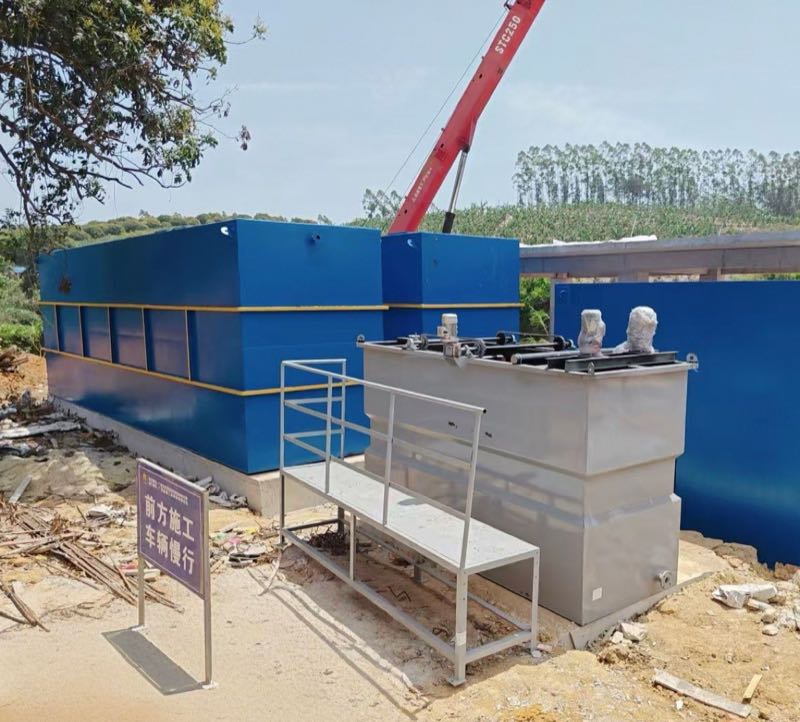
Why Accra hotels are switching to packaged MBR STPs
Hotel wastewater in Accra is a moving target: kitchen FOG spikes at breakfast and dinner, laundry greywater arrives in a 90-minute midday surge, guest bathrooms run at 60–80% occupancy on weekdays and near 100% on weekends, and pool backwash drops pH and adds free chlorine. A sequencing batch reactor (SBR) struggles with that variability because each cycle is fixed; a moving bed biofilm reactor (MBBR) absorbs shock but produces effluent that still needs polishing. A packaged MBR combines a fully mixed activated-sludge tank with submerged PVDF or hollow-fibre membranes, so the biomass buffers hydraulic and organic shocks while the membranes deliver a flat, low-TSS effluent (TSS <5 mg/L, COD <30 mg/L per HydropureWater field data, 2026) regardless of the upstream swings.
That quality is what unlocks reuse. An Accra hotel can send MBR permeate directly to toilet flushing, landscape irrigation and cooling-tower make-up — cutting municipal water purchases by 20–40% (HydropureWater field data, 2026) and turning the wastewater plant from a cost centre into a water-security asset. Footprint seals the case on tight Accra plots: a 200 m³/day MBR unit occupies roughly 40 m², about 60% less than a conventional activated-sludge plant of equal capacity (HydropureWater, 2026-02). A working reference is the Imemflo hollow-fibre MBR installed at a 200-bed, 5-star hotel at 250 m³/day, where the treated water has consistently met reuse standards since start-up (Imemflo, 2025). For developers working in Cantonments, Airport Residential or East Legon where land is priced per square metre, the HydropureWater integrated MBR system gives the right combination of packaged delivery, small footprint, and Class-A reuse output.
Step 1: Size the MBR for your hotel's daily flow
Defensible sizing starts with a per-capita water duty, not a rule-of-thumb. Use 200–250 L per guest per day as the design basis for full-service Accra hotels (lodging, F&B, laundry on-site), and add 50–80 L per F&B cover per day for kitchens, restaurants and bars. For a 150-room hotel running at 80% occupancy, the calculation is straightforward: 150 × 0.8 × 225 L = ~27 m³/day average. Apply a peak factor of 1.5–2.0× on instantaneous flow to size the equalization tank and to keep the membrane flux within the manufacturer's rated envelope. The result is a 30–50 m³/day packaged MBR with headroom for banquets and conference peaks.
For a 250-bed upscale property comparable to the Imemflo reference, size at 200–250 m³/day. Boutique properties under 50 rooms typically land in the 10–15 m³/day range and can use modular skid units. Before placing the PO, run a 7-day composite sampling campaign on the existing influent — or, for a new build, on an analogous property — and measure BOD₅, COD, TSS, FOG, NH₄-N and temperature at 2-hour intervals. Those numbers are what the vendor needs to confirm tank volumes, membrane area, and aeration duty; without them, every "standard" sizing is a guess. If a true below-grade, traffic-rated footprint is required for a basement plant room, the WSZ underground packaged STP is the equivalent skid packaged for burial.
Step 2: Confirm Ghana EPA effluent compliance
Ghana's EPA Liquid Waste Regulations (2019) define the discharge envelope for any hotel STP, and a Class A reuse claim is what separates a compliant plant from a marketable one. The table below shows the parameter set a vendor should commit to in writing for an Accra hotel project (ranges drawn from commonly published Ghana EPA Class A reuse guidance and cross-checked against HydropureWater field data, 2026):
| Parameter | Ghana EPA Class A reuse target | MBR typical performance |
|---|---|---|
| TSS | < 10 mg/L | < 5 mg/L |
| COD | < 50 mg/L | < 30 mg/L |
| BOD₅ | < 10 mg/L | < 5 mg/L |
| NH₄-N | ≤ 5 mg/L | ≤ 2 mg/L with nitrification |
| Total coliforms | ≤ 100 CFU/100 mL | Meets target with UV or chlorination polish |
| pH | 6.0–9.0 | 6.5–8.0 |
MBR comfortably meets every line in that table — HydropureWater field data (2026) shows 90–95% contaminant removal across TSS, COD and BOD₅ — while MBBR and SBR need tertiary polishing (sand filter + UV) to make the same reuse claim. Before commissioning, the hotel must also hold an EPA discharge/reuse permit; the workflow is a design submission, a permit-to-install, construction sign-off, and a permit-to-operate issued after a successful commissioning run. The compliance pattern is identical for industrial projects, and the Kumasi industrial wastewater guide walks through the same EPA submission sequence for reference.
Step 3: Match the technology to the site
For an Accra hotel targeting Class A reuse on a constrained plot, the technology choice is essentially a risk choice. MBR costs more per m³/day than MBBR or SBR but buys a smaller footprint, a better effluent, and no tertiary polishing — the trade is usually worth it. The head-to-head data, drawn from HydropureWater field data (2026) and Imemflo (2025), is below:
| Criterion | MBR | MBBR | SBR |
|---|---|---|---|
| Effluent TSS | < 5 mg/L | < 30 mg/L | < 20 mg/L |
| Effluent COD | < 30 mg/L | < 100 mg/L | < 80 mg/L |
| Footprint vs. conventional | ~60% smaller | Medium | Larger than MBR |
| CAPEX ($/m³/day, ex-civil) | $180–$300 | Lower than MBR | Lowest |
| Specific energy | ~1.0 kWh/m³ at $0.08/kWh | Lower than MBR | Lower than MBR |
| Membrane / carrier life | 5–7 years | Carrier low-wear | No membranes |
| Reuse readiness | High (direct reuse) | Low (needs tertiary) | Moderate (needs tertiary) |
| Operational complexity | Medium (membrane CIP) | Low | Medium (cycle tuning) |
The MBR column is dominated by the DF series flat-sheet MBR membrane module, which uses integrated aeration scouring and runs at 10–20× lower energy than external cross-flow designs (HydropureWater, 2026-02). MBBR wins on raw CAPEX but loses on reuse; SBR wins on simplicity but loses on footprint. For a 100–250 m³/day Accra hotel where the developer wants a single packaged skid, MBR is the lowest-risk default.
Step 4: Specify the pre-treatment train
Hotel wastewater is uniquely fouling: kitchen FOG, food solids, hair, and laundry lint will blind an MBR membrane in weeks if they reach the membrane tank. The pre-treatment train is therefore not optional — it is the membrane's first line of defence. Specify, in order: a rotary bar screen at 1–3 mm aperture for hair and lint, a grit chamber for sand and coffee grounds, a Dissolved Air Flotation (DAF) unit for FOG and emulsified oil, an equalization tank for flow and load buffering, and then the MBR.
Two refinements matter for hotels specifically. First, route kitchen flows through a dedicated grease trap before the DAF — this protects the DAF air-saturation system and cuts reagent consumption. Second, evaluate whether the laundry discharge should be split off into a small greywater treatment loop. Imemflo (2025) notes that many hoteliers install a separate greywater plant for laundry, which reduces the MBR's organic and lint load and can save 15–25% of the membrane area required. The matching pre-treatment packages are the HydropureWater DAF unit for FOG and the GX rotary mechanical bar screen for coarse screening.
Step 5: Engineer for Accra-specific operating conditions
Three Accra-specific risks drive the resilience spec. Grid instability is the first: specify the MBR with a PLC, remote telemetry, and a power panel pre-wired for UPS and generator backup. The MBR tank should hold enough mixed liquor to survive a 4–6 hour outage without biomass washout, and the equalization tank should be sized for at least 8 hours of average flow so the plant can ride through a power dip and restart on equalized influent rather than a slug. Ambient temperature is the second: PVDF flat-sheet and hollow-fibre membranes tolerate 30–40 °C operation well, and submerged designs with integrated aeration scouring consume 10–20× less energy than external cross-flow systems (HydropureWater, 2026-02). Keep diffusers submerged and shade the membrane tank where possible.
The third risk is operator skill. Many Accra hotel engineering teams are small and rotate. Build a remote-monitoring / SLA service contract into the procurement — the HydropureWater integrated MBR system ships with PLC telemetry, sodium-hypochlorite dosing for in-place membrane cleaning, and a CIP port. Budget for annual membrane replacement on a 5–7 year amortisation (HydropureWater field data, 2026); the equivalent of $0.01–$0.03 per litre of treated flow over membrane life, and the line item that most often breaks under-funded OPEX assumptions.
Step 6: Vendor evaluation checklist for Accra
Use this eight-point checklist before signing a purchase order. It mirrors what a consultant should put in a technical query to a shortlist of two or three vendors:
- Effluent guarantee in writing — TSS, COD, BOD₅, NH₄-N and coliforms at Ghana EPA Class A numbers, with liquidated damages for non-compliance.
- Membrane brand and replacement cost — PVDF preferred; ask for membrane cost per m², expected life (5–7 years per HydropureWater, 2026-02), and lead time for spares into Accra.
- PLC + remote monitoring — Modbus/TCP or 4G telemetry, with a documented alarm list and a local HMI.
- On-site commissioning in Ghana — confirm a regional commissioning engineer, not a fly-in fly-out supervisor.
- Operator training — minimum two days, with a written SOP in English.
- Spare-parts lead time — diffusers, pumps, blowers, dosing pumps: under 7 days to Accra.
- Reference hotel installations — comparable in size and climate. The Imemflo 250 m³/day, 5-star reference (Imemflo, 2025) is a useful benchmark; the DF series flat-sheet module is the product-level equivalent.
- CAPEX breakdown ex-civil works — skids, membranes, blowers, dosing, control panel, freight, installation, commissioning. Do not buy on $/m³/day alone; the 10-year cost is dominated by OPEX, membrane life and service.
The pattern is the same as for any industrial wastewater project, and the industrial wastewater equipment selection guide provides a longer framework. End the vendor interaction with a written request for a site-specific quote, not a generic price list.
Accra hotel MBR cost scenarios (2026)
The HydropureWater CAPEX band of $180–$300 per m³/day of capacity (HydropureWater, 2026-02) translates into the following three Accra hotel scenarios, ex-civil works:
| Scenario | Hotel size | Design flow | MBR CAPEX band | Annual energy OPEX* | Footprint |
|---|---|---|---|---|---|
| A — Boutique | 50 rooms, ~60% occupancy | ~12 m³/day | $2,200–$3,600 | ~$350/yr | ~10 m² |
| B — Mid-scale | 150 rooms, ~80% occupancy | ~40 m³/day | $7,200–$12,000 | ~$1,170/yr | ~20 m² |
| C — 5-star | 250 beds (Imemflo reference) | ~250 m³/day | $45,000–$75,000 | ~$7,300/yr | ~50 m² |
*Energy OPEX calculated at 1.0 kWh/m³ × Ghana tariff of $0.08/kWh × 365 days (HydropureWater field data, 2026).
Membrane replacement, amortised at 5–7 years (HydropureWater, 2026-02), is the second OPEX line and typically dwarfs energy. Reuse for toilet flushing, irrigation and cooling-tower make-up typically offsets 20–40% of municipal water spend, so the payback window on the MBR premium (vs. MBBR + tertiary) is often 2–4 years for an upscale Accra property. For a packaged skid that matches the scenarios above, the HydropureWater integrated MBR system ships in the relevant flow range.
Frequently Asked Questions
Does a packaged MBR meet Ghana EPA Class A reuse standards?
Yes. A correctly sized MBR with submerged membranes delivers TSS <5 mg/L and COD <30 mg/L (HydropureWater field data, 2026), comfortably inside the Ghana EPA Class A reuse envelope of TSS <10 mg/L and COD <50 mg/L (HydropureWater, 2026-02). The hotel must still hold an EPA permit-to-operate before commissioning.
How much does an MBR STP cost in Ghana?
Packaged MBR CAPEX in Ghana runs $180–$300 per m³/day of capacity, ex-civil works (HydropureWater, 2026-02). A 10 m³/day modular skid starts from roughly $20,000, and a 40 m³/day mid-scale hotel unit lands in the $7,200–$12,000 CAPEX range before freight and installation.
MBR vs MBBR — which is better for an Accra hotel?
MBR wins on effluent quality (TSS <5 mg/L vs. <30 mg/L) and footprint (~60% smaller than conventional), which makes it the right default for Class A reuse on a tight Accra plot. MBBR wins on raw CAPEX and simplicity but requires a tertiary polishing train (sand filter + UV) to make the same reuse claim (HydropureWater field data, 2026).
How much space does an MBR STP need?
An MBR needs roughly 60% less land than a conventional activated-sludge plant. A 200 m³/day MBR typically fits in about 40 m², and a 40 m³/day hotel unit in about 20 m² (HydropureWater, 2026-02).
What can MBR-treated hotel water be reused for?
MBR permeate is suitable for toilet flushing, landscape irrigation, and cooling-tower make-up, and the Imemflo 5-star reference has run on reuse since start-up (Imemflo, 2025). A UV or chlorination polish is normally added before reuse to hit the coliform target. For temperate-climate sizing benchmarks, our Frankfurt hotel MBR guide provides a useful counterpoint.