The 2026 Dublin DMR Problem: Why Clarifier-Only Lines Are Failing
On a Monday morning in 2026, a Dublin, Ohio stamping and machining shop opens its Discharge Monitoring Report and finds a FOG daily-max of 34 mg/L against a 26 mg/L ceiling — the third surcharge trigger in two quarters (per 40 CFR Part 437 daily-max). The shop's waste stream is a typical fabricated-metals mix: stamping lubricants, drawing compounds, water-soluble and straight cutting fluids, rust preventatives, quench oils, parts-washer rinses, and tramp oil from hydraulic sumps. The local receiving sewer runs to the City of Columbus POTW, which drains the Mud Run and Fancy Creek watershed and layers its own FOG and TSS surcharges on top of the federal Part 437 numbers. The clarifier installed in 2014 is doing what clarifiers do: free oil rises, settleable fines drop, and the supernatant overflows the weir. The problem is the 1–20 µm emulsified droplets stabilized by the surfactants in synthetic and semi-synthetic coolants — those slip right over the weir, past the gravity basin, and into the DMR. A legacy clarifier-only decision no longer holds in 2026, and the 50% of weekly shifts that include emulsified coolant are the ones driving the surcharge.
The Regulatory Stack: Part 437, Part 433, and the Dublin POTW
Dublin fabricated-metals plants sit on a three-layer regulatory ladder. Layer one is 40 CFR Part 437 (Metal Products), which sets the daily-maximum at 26 mg/L O&G and 60 mg/L TSS for streams without a plating rinse line. Layer two is 40 CFR Part 433 (Metal Finishing) PSES, which kicks in the moment a chrome, nickel, cadmium, or lead rinse line ties into the same floor drain — daily-maximum limits of 0.31 mg/L hexavalent chromium, 2.61 mg/L total chromium, 0.69 mg/L cadmium, 0.69 mg/L lead, and 3.98 mg/L nickel (per 40 CFR 433.13). Layer three is the City of Columbus pretreatment program, which applies FOG and TSS loadings-based surcharges on top of the federal ceiling. The 2026 trap most engineers miss is the cadmium asymmetry: PSES allows 0.69 mg/L daily-max while NSPS/PSNS tightens that to 0.11 mg/L — any new or substantially modified plating line in 2026 should size to the 0.11 mg/L number from day one, not retrofit in 24 months (per 40 CFR 433.15). The practical sizing rule: target 50% of the daily-max at the clarifier or DAF outlet so a single upset does not push the DMR over the line. Note that DAF removes the oils that interfere with downstream precipitation but does not precipitate dissolved metals itself — a separate precipitation step is required for Cr, Ni, Cd, and Pb.
How DAF Works vs How a Clarifier Works
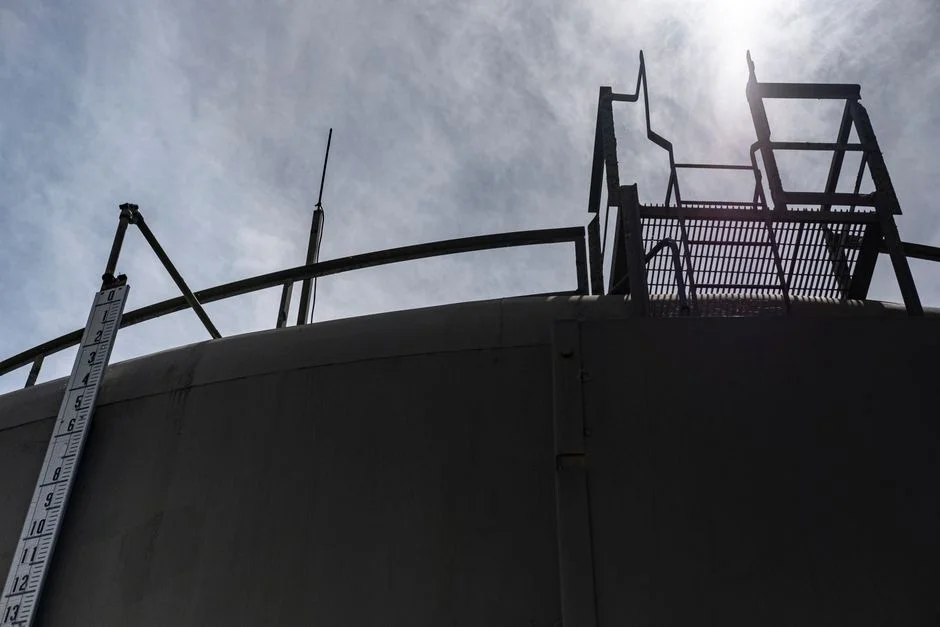
A dissolved air flotation unit saturates a pressurized side-stream recycle with air at 60–80 psig, then releases that stream through a needle-valve or micro-bubble generator into the flotation cell. The pressure drop flashes the dissolved air into a cloud of fine bubbles — 20–40 µm on the DAF Corp FC Maximizer, 30–50 µm on the SigmaDAF standard unit (sources: dafcorp.com, 2026; clearwaterind.com, 2026). Those bubbles attach to oil droplets and chemically conditioned floc and lift them in roughly 3 minutes of hydraulic retention. A paddle skimmer sweeps the float into a sludge hopper; DAF float exits at 2–4% solids, so no thickener is needed downstream (source: Wang & Wang, Lenox Institute, 2022). A gravity clarifier — circular, rectangular, or lamella-plate — relies on quiescent settling. Suspended solids heavier than water drop to the bottom; clarified supernatant overflows a peripheral weir. A lamella clarifier uses inclined plates at 55–60° to multiply effective settling area, achieving 20–40 m/h surface loading in a footprint one-quarter to one-fifth of an equivalent conventional basin (HydropureWater lamella product data, 2026). The cut-size limit is the deciding factor: DAF captures 1–50 µm via bubble attachment, while a clarifier only handles greater than 50–100 µm, so sub-50 µm emulsified oil passes straight through to the DMR. Clarifier underflow exits at 1–2% solids, which is why a thickener or filter press is almost always required downstream of a clarifier but rarely required downstream of a DAF.
DAF vs Clarifier: Side-by-Side Engineering Parameters
The table below consolidates the engineering parameters a Dublin procurement engineer will paste into a capex memo. Cost figures are illustrative 2026 USD bands for a 50–200 GPM mid-size job shop; exact pricing depends on chemistry integration, tank material, and site conditions.
| Parameter | DAF (FC Maximizer / SigmaDAF class) | Lamella / Gravity Clarifier |
|---|---|---|
| Removal efficiency (TSS) | 85–98% (FC Maximizer 92–98%) | 50–80% on metal-bearing wastewater; <50% on emulsified oil |
| Droplet cut-size | 1–50 µm via microbubble attachment | >50–100 µm only; sub-50 µm passes through |
| Surface loading | 20–40 m/h equivalent | 20–40 m/h lamella; 1/4 to 1/5 footprint of conventional basin |
| Solids output | 2–4% float, no thickener needed | 1–2% slurry, thickener typically required |
| HRT | ~3 minutes | 1–3 hours |
| CAPEX (50–200 GPM) | $120K–$280K + $15K–$40K chemistry | $40K–$180K lamella |
| OPEX (per 1,000 gal) | $0.30–$1.20 polymer/coagulant + $0.05–$0.15 power | $0.20–$0.80; sludge pumping and hauling dominates |
| Typical effluent | TSS 20–30 mg/L; O&G 15–30 mg/L — meets Part 437 | Marginal alone; usually needs polish step for FOG and metals |
| Ideal influent | Emulsified coolants, free oil, FOG, low-density fines, plating rinse interference | Settleable metal fines, grinding swarf, grit, sand |
Sources: DAF Corp product literature (2026); SigmaDAF USA via Clearwater Industries (2026); Wang & Wang, Lenox Institute, STEAM Vol. 4 No. 7C, July 2022; HydropureWater lamella product data (2026).
A 2026 Decision Tree for Dublin Fabricated Metals Plants
Pick DAF alone when free oil exceeds 50 mg/L, emulsified coolant exceeds 30 mg/L, or TSS exceeds 500 mg/L with significant FOG — covers most Dublin stamping, machining, parts-washer, and coolant-sump streams. A skid-mounted DAF in the 48–450 GPM range installs in days rather than the months a civil clarifier build requires (source: dafcorp.com, 2026). Pick a clarifier alone when the stream is dominated by settleable metal fines from grinding, lapping, or polishing, with FOG under 30 mg/L, and the site has the footprint for a 1–3 hour retention basin — lamella geometry makes this viable even on a constrained Dublin lot. Pick DAF followed by a lamella polisher when TSS exceeds 2,000 mg/L and FOG exceeds 200 mg/L — the DAF Corp FC-150 is documented at 500 GPM and 2,000 PPM loading clarified to 50 PPM in a single cell, which is the operating envelope where a polish step becomes optional rather than mandatory (source: dafcorp.com, 2026). Pick DAF as a retrofit on an existing clarifier when the legacy basin is breaching FOG or O&G limits; DAF Corp explicitly offers new and retro-fit installations, and the skid geometry drops into an existing hydraulic envelope (source: dafcorp.com, 2026). Under-scoped line item to budget: chemistry integration with an automatic polymer and coagulant dosing skid. For a discussion of related retrofit practice on petroleum streams, see the parallel DAF or clarifier for petroleum wastewater in Fort Wright guide. A HydropureWater DAF system paired with a HydropureWater high-efficiency sedimentation tank covers the DAF-primary and DAF-plus-polish branches out of the box.
Design Basis for a 150 GPM Dublin Job Shop
Design basis: 150 GPM forward flow, 500–2,000 mg/L TSS, 50–200 mg/L FOG, pH 6–9, intermittent metals from a small plating rinse line. Specify the DAF as a HydropureWater DAF system at ~34 m³/h, which sits in the mid-range of the 4–300 m³/h envelope across 13 standard models; 10–12 ft diameter skid; saturator at 75 psig; recycle ratio 25% of forward flow; micro-bubble generator compatible with FC Maximizer-class 20–40 µm bubble size. Specify the lamella polish as a HydropureWater high-efficiency sedimentation tank at 30 m/h surface loading, 55–60° plate angle, 50–80 mm plate spacing; footprint roughly 25% of an equivalent conventional basin. Specify the chemistry as an automatic polymer and coagulant dosing skid (5–15 mg/L polymer, 50–150 mg/L coagulant) with PLC trim on streaming current, integrated with the DAF controls. Specify the back end as a HydropureWater plate and frame filter press for combined DAF float and clarifier underflow, targeting 25–35% DS cake for direct hauling. For broader metals-side context, the 2026 guide to 40 CFR Part 437 and local POTW sewer-use limits for mining and metals walks through the regulatory mechanics; for back-end cake handling, the sludge dewatering and handling reference for the 2–4% DAF float and 1–2% clarifier underflow is a useful cross-check on press sizing.
CAPEX, OPEX, and a Dublin Payback Example
CAPEX bands in 2026 USD: skid-mounted DAF $120K–$280K turnkey for 50–200 GPM (add $15K–$40K for the chemistry package); lamella clarifier $40K–$180K for the same flow; full DAF + lamella + press train $250K–$800K. 304L stainless is standard; 316SS upgrade adds roughly 15–25% (HydropureWater field data, 2026). OPEX drivers split into chemistry, power, and hauling. The DAF premium is most often recovered in the hauling line: a 2–4% DAF cake versus 1–2% clarifier slurry typically cuts hauled volume by 30–50%, paying back the DAF premium in 12–24 months for any plant hauling more than 5 yd³/week.
| Cost line | Clarifier-only retrofit | DAF + lamella retrofit |
|---|---|---|
| Skid DAF (50–200 GPM) | — | $120K–$280K + $15K–$40K chemistry |
| Lamella clarifier | $40K–$180K | $40K–$180K |
| Filter press (1–500 m²) | $40K–$120K | $40K–$120K |
| Typical annual sludge hauling + FOG surcharges (200 GPM, 200 mg/L FOG) | $90K–$150K | $40K–$70K |
| Typical payback at 200 GPM, 200 mg/L FOG | 18–36 months via hauling savings | 12–24 months via hauling + surcharge avoidance |
Worked example: a 200 GPM Dublin stamping plant with 200 mg/L FOG influent spends roughly $90K–$150K per year on sludge hauling and FOG surcharges; a $180K DAF + lamella retrofit recovers that in 12–24 months under typical Central Ohio POTW tariff structures (HydropureWater field data, 2026). The HydropureWater plate and frame filter press closes the back end of the train at 25–35% DS cake, eliminating the water-haul surcharge on every load.
Frequently Asked Questions
Does my Dublin plant need to size to 0.11 mg/L cadmium or 0.69 mg/L?
0.11 mg/L if the plating line is new or substantially modified in 2026 (NSPS/PSNS, per 40 CFR 433.15); 0.69 mg/L if the line is an existing PSES source with no major modification (per 40 CFR 433.13). The 0.11 number is the more defensible long-term target.
Can I retrofit a DAF upstream of my existing clarifier without demolishing the basin?
Yes. DAF Corp explicitly offers new and retro-fit installations, and the Supracell/FC Maximizer skid geometry (48–450 GPM, 6–15 ft diameter) is designed to drop into an existing hydraulic envelope (source: dafcorp.com, 2026). Budget the chemistry integration separately.
Can a DAF alone meet 40 CFR Part 433 metals limits?
No. A DAF delivers 85–98% TSS removal and 15–30 mg/L effluent FOG — meeting Part 437 daily-max — but it does not precipitate dissolved hexavalent chromium, nickel, cadmium, or lead (per 40 CFR Part 437; 40 CFR Part 433.13). A separate precipitation/polish step is required after the DAF.