Why Plastics and Rubber Wastewater Is Hard to Clarify
Plastics compounding, rubber molding, and extrusion plants in Auburn discharge a contaminant mix that defeats conventional settling. Four families dominate the influent: polymer dust and pellets with specific gravity below 1.0 (LDPE, PP, EPS fines), latex and SBR residues from mold-release baths, emulsified release agents and plasticizer oils (silicone, mineral oil, phthalate-based), and dissolved organics from residual monomers and surfactants. The first two sit near the specific gravity of water; the third forms a stable emulsion with droplet sizes of 1-50 µm. Together they behave like a colloidal suspension that does not settle under gravity in any practical retention time, which is the technical reason dissolved air flotation is usually specified over a gravity clarifier for these streams.
Typical raw influent on these lines runs TSS 200-2,500 mg/L, FOG 50-1,500 mg/L, COD 500-5,000 mg/L, and pH 6-9 (industry-typical; jar testing is required for any specific plant because polymer additives shift the envelope by a factor of two or more). Most Auburn-area plants discharge either to the Auburn Water Works wastewater plant or to a Lee County POTW, where ADEM pretreatment limits trigger FOG and TSS surcharges above locally defined thresholds, and a daily-max violation on either parameter can halt a batch line. The wrong primary unit is not just a process mistake — it doubles OPEX through polymer overuse, downstream biological upsets, and filter-press throughput loss.
How a DAF Clarifier Works on Plastic and Rubber Streams
The DAF sequence is built around attaching micro-bubbles to contaminants that will not sink. Coagulant (typically a ferric or aluminum salt) is dosed first, then the flow enters a flocculation tube with 15-45 seconds of flash-mix residence time (per Clearwater Industries process documentation) where polymer is added. A recirculation pump takes 20-30% of clarified effluent, saturates it with air at 4-6 bar, and returns it to the flotation cell. When the pressure releases, 30-50 µm micro-bubbles form and attach to oil droplets and floc, lifting them to the surface as a float blanket. A skimmer pulls that blanket into a trough; clarified water exits below the blanket through a launder set above the floor.
For plastics and rubber, the bubble-to-droplet size match is what makes the technology work. Emulsified release-agent oils in the 1-50 µm range attach efficiently to 30-50 µm bubbles because the surface-area ratio favors collision, and a properly conditioned floc binds both fine polymer dust and oil into a single buoyant aggregate. A DAF clarifier is also built with a bottom sediment compartment, which matters when extrusion wash water carries heavier grit and pellet fragments that do sink — those are removed separately without re-entraining the float layer. Chemistry is polymer-specific: cationic polyacrylamide handles most SBR and release-agent streams, but highly anionic latex often requires an anionic or dual-polymer program to drop FOG below 25 mg/L (industry-typical starting point; jar test each line).
How a Gravity or Lamella Clarifier Performs on the Same Stream
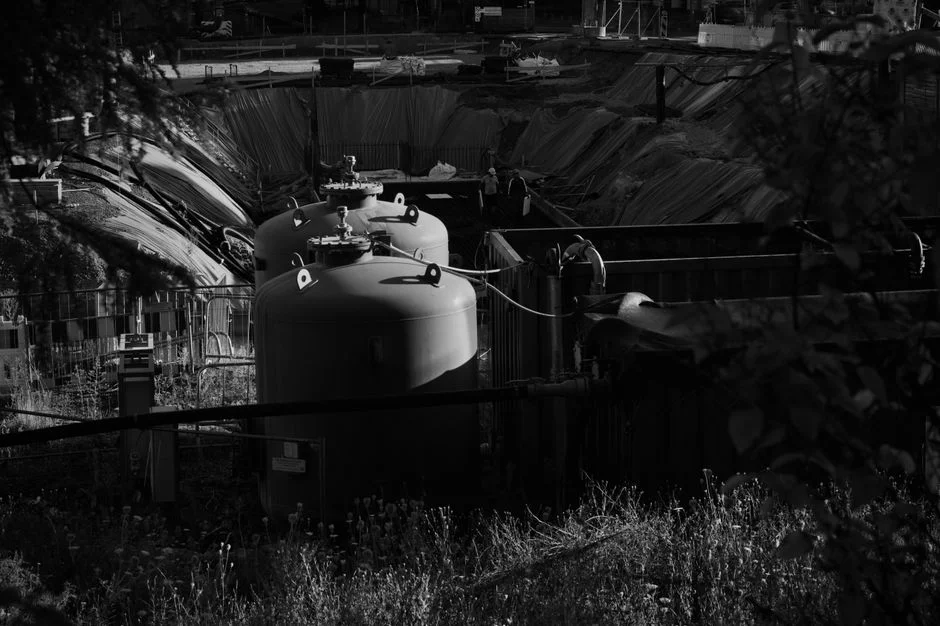
A conventional circular or rectangular gravity clarifier relies on density difference and long retention. Surface loading on a gravity unit is typically 1-3 m/h, which means a 50 m³/h stream needs 17-50 m² of footprint, and even then the unit depends on floc heavy enough to pull oil and polymer dust with it. On plastics and rubber streams, that rarely happens — emulsified oil and polymer fines with SG near 1.0 stay in suspension, and the only way to force them down is to over-dose coagulant, which traps oil inside the sludge and destroys any chance of recovering it as a skim product.
A lamella (inclined plate) clarifier compresses the same physics into a much smaller footprint. Per manufacturer data, lamella units run at surface loading 20-40 m/h with sludge recirculation, achieve up to 30% lower chemical demand than a conventional clarifier on suitable feed, and cut the footprint to roughly one-fifth. On a plastics stream the failure mode is the same as a conventional clarifier: the inclined plates shed anything with SG near water unless a heavy floc is engineered, and that floc embeds the oil. Typical lamella effluent on a plastics stream lands at TSS 60-150 mg/L and FOG 30-100 mg/L, which is often not low enough to meet an ADEM daily-max oil & grease limit of 100 mg/L on its own. For a stream headed to a biological or UF polish, a HydropureWater lamella clarifier can be the right primary if FOG is already controlled upstream; otherwise it is a polish step, not a primary.
DAF vs Clarifier: Direct Comparison for Plastics and Rubber
The trade-offs fit in one table. Surface loading, footprint, FOG removal, sludge dryness, and polymer dose all move together — there is no free lunch, but the ranking is consistent across the sector.
| Parameter | DAF | Lamella clarifier | Conventional gravity clarifier |
|---|---|---|---|
| Surface loading (m/h) | 5-25 | 20-40 | 1-3 |
| Footprint at 50 m³/h (m²) | 12-25 | 3-6 | 25-60 |
| FOG removal (%) | 80-95 | 40-70 | 30-60 |
| TSS removal (%) | 70-90 | 50-75 | 40-70 |
| Float/sludge dryness (% DS) | 3-8 | 2-4 | 1-3 |
| Polymer dose (mg/L) | 5-20 | 3-10 | 5-15 |
| Typical CAPEX 2026 (USD, 5-50 m³/h) | 35,000-180,000 | 25,000-120,000 | 40,000-200,000 (with civil) |
Two things stand out. First, DAF float at 3-8% DS dewateres on a plate-and-frame filter press at roughly half the OPEX of a 1-3% DS gravity underflow, which is a 30-50% downstream OPEX reduction (HydropureWater field data, 2026). Second, lamella wins on footprint and CAPEX but loses on FOG and float recovery — a real cost when oil is a sellable by-product or when downstream biology is oil-sensitive. CAPEX figures are planning estimates for 2026 and exclude building, instrumentation, and integration; treat them as order-of-magnitude.
Decision Framework: When to Pick DAF, Lamella, or Gravity in Auburn
Run this against your own influent numbers and discharge destination.
- Pick DAF if any of these are true: FOG above 50 mg/L, flow is variable because of batch washdowns or shift changes, the plant wants to recover and sell skim oil, or the downstream is a biological or UF polish that is oil-sensitive.
- Pick lamella if FOG is below 50 mg/L, flow is steady (less than ±20% diurnal swing), space is tight, and emulsification is already controlled upstream by good housekeeping on release-agent baths.
- Pick conventional gravity only on very high-flow, low-FOG cooling-tower blowdown or parts-wash streams where oil capture is not a goal and the receiving utility has generous TSS limits.
Now layer the Auburn compliance hooks. The receiving utility typically enforces oil & grease below 100 mg/L and TSS below 200 mg/L on a daily-max basis, with surcharges kicking in above those levels. If your plant runs near either threshold — and most rubber molding lines do — a DAF is the safer primary in 2026 because it leaves the most headroom on FOG. If you are already in a pretreatment program with a tightly written permit, an automatic polymer dosing skid tied to a streaming-current or jar-calibrated feed will keep the DAF inside band when the upstream polymer blend changes.
Sizing Example and 2026 OPEX for a 30 m³/h Rubber Molding Plant
Assume a rubber molding wash stream at 30 m³/h, 16 h/d, 5 d/wk, with influent TSS 1,200 mg/L, FOG 400 mg/L, COD 2,800 mg/L — a typical mid-range load for release-agent-rich molding.
| Parameter | DAF | Lamella |
|---|---|---|
| Hydraulic loading target | 12 m³/(m²·h) | 25 m³/(m²·h) |
| Required separation area | ~2.5 m² | ~1.2 m² projected plate area |
| Air-to-solids ratio (A/S) | 0.02-0.05 | n/a |
| Recycle rate | 20-30% | Sludge recirculation only |
| Expected FOG removal | 85-92% | ~55% |
| Float/sludge DS | ~5% | ~3% |
| Power draw (continuous) | 6-10 kW | 2-4 kW |
| Polymer consumption | 6-12 mg/L @ USD 4-7/kg | 4-8 mg/L @ USD 4-7/kg |
| OPEX 2026 (treated-m³ basis) | USD 0.18-0.32 | USD 0.10-0.20 |
The lamella is cheaper to run and smaller, but at 55% FOG removal the 400 mg/L feed drops to about 180 mg/L — still over a typical 100 mg/L daily-max. The DAF at 85-92% lands near 30-60 mg/L, leaving real compliance margin without a polish step. Float at ~5% DS feeds a plate and frame filter press at a cake of 25-35% DS, versus a lamella underflow at ~3% DS that dewateres to 20-28% and uses more polymer per dry ton. The 30-50% downstream dewatering OPEX gap is where the DAF pays for itself on this stream. All OPEX numbers are planning estimates for 2026; site power tariffs, polymer selection, and sludge disposal routing will shift them.
Frequently Asked Questions
Is DAF or a clarifier better for plastics and rubber wastewater in Auburn?
For most plastics and rubber plants in Auburn in 2026, a DAF clarifier is the better primary because polymer pellets, latex residues, and emulsified release-agent oils have specific gravity near water and resist gravity settling. A conventional or lamella clarifier only wins when FOG is below ~50 mg/L, flow is steady, and the receiving POTW has generous TDS and oil & grease limits.
Can a lamella clarifier replace DAF on a rubber molding line?
Yes if FOG is below 50 mg/L, flow is steady within ±20%, and the downstream is tolerant of 30-100 mg/L residual oil — for example, a holding tank ahead of a biological reactor with a long SRT. No if FOG is above 50 mg/L or the discharge permit enforces oil & grease below 100 mg/L on a daily-max basis; in that case a lamella alone will not meet the limit and DAF is the right primary.
What polymer dose does DAF need for latex wastewater?
Most latex streams run 5-20 mg/L of cationic polyacrylamide, but highly anionic latex typically needs an anionic or dual-polymer program to drop FOG below 25 mg/L. Jar-test each line — the dose can shift by a factor of three when the latex grade or surfactant package changes.
How often does a DAF need sludge removal on a plastics extrusion plant?
A DAF on a plastics extrusion line typically needs float removal every 4-8 hours of continuous operation. PLC-controlled skimmer speed set to float-blanket thickness (usually 50-150 mm) is the standard 2026 control scheme; running the skimmer on a fixed timer usually wastes polymer and under-skims during peak batch discharge.
Do I still need a DAF if I send waste to the city POTW in Auburn?
Yes if your FOG or TSS exceeds local limits or surcharge thresholds — most rubber molding lines do during at least part of a shift. If your monitoring shows FOG consistently below 50 mg/L and TSS below 200 mg/L with margin, a lamella or even a well-designed gravity clarifier may suffice, but verify with six to twelve months of daily-composite sampling before downgrading equipment.
Related Equipment
- DAF clarifier — specifications, capacity range, and technical data
- HydropureWater lamella clarifier — specifications, capacity range, and technical data