

How Birmingham Regulates Domestic Sewage in 2026
Domestic sewage discharge in Birmingham, Alabama, is governed by a three-layer regulatory stack: a city sewer-use ordinance, the local utility pretreatment program, and NPDES permit provisions applicable to the receiving municipal treatment works (per the Birmingham wastewater rules summary, 2025-11). The ordinance defines prohibited discharges and grants the enforcing authority power to set numeric limits tied to individual permits or local rules; the pretreatment program outlines sampling, monitoring, reporting, and recordkeeping obligations for industrial or non-domestic sources; the NPDES framework governs the municipal plant that ultimately receives the flow. For a residential, hotel, school, or small commercial site, all three layers apply, but day-to-day interaction occurs with the Birmingham Water & Sewer / Engineering Department through the city's sewer and engineering pages on bhamgov.org.
Purely domestic sources are handled under the sewer-use ordinance and a connection permit, while industrial or non-domestic sources typically require an industrial wastewater or pretreatment permit with numeric pollutant limits, sampling cadence, and periodic compliance reports (per the Birmingham wastewater rules summary, 2025-11). The city's enforcement toolkit includes administrative fines, cease-discharge orders, repair and upgrade directives, civil actions, and referral for criminal prosecution. Because the cited Birmingham pages do not publish a specific fine schedule, escalation numbers must be confirmed directly with the enforcing office. Permit names, forms, and fees are controlled by the sewer authority; therefore, the official application must be retrieved from the utility website or customer portal rather than the ordinance text.
What Counts as 'Domestic' Sewage at a Birmingham Site
Domestic sewage in Birmingham consists of wastewater from sanitary fixtures—toilets, showers, kitchen sinks, and laundry—originating in residences, hotels, schools, hospital non-clinical areas, and offices. This wastewater contains human waste and household cleaning products, characterized by biodegradable organics, suspended solids, ammonia, and pathogens. Any process wastewater, high-volume commercial laundry, food-service grease-laden flow, hospital clinical waste, or trade effluent is classified as industrial or non-domestic and is subject to the pretreatment permit route (per the Birmingham wastewater rules summary, 2025-11).
Understanding this distinction is critical because misclassifying a stream as domestic when the utility views it as non-domestic is a recurring trigger for cease-discharge orders and upgrade directives in Birmingham. Engineers should evaluate the flow source, pollutant type, and load to determine classification. A 300-unit apartment block producing mostly BOD, TSS, and ammonia is domestic; however, the same block with a central commercial laundry discharging surfactant-heavy liquor, or a hotel with a high-FOG kitchen, is not. Since the cited Birmingham page does not publish numeric domestic-specific mg/L thresholds, confirm classification with the utility before finalizing the design basis.
2026 Process Options for Domestic Sewage Treatment in Birmingham
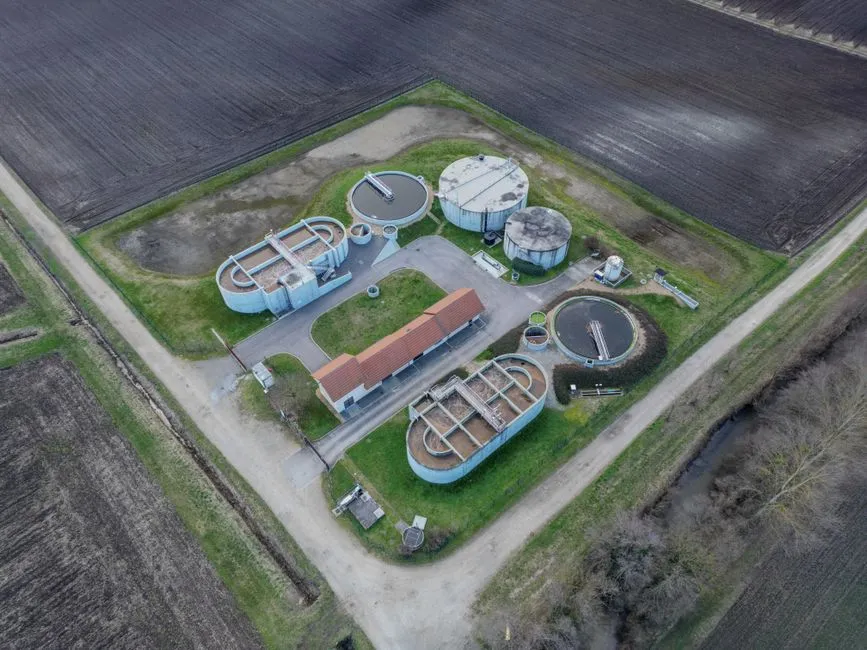
Five primary routes exist for domestic sewage treatment in Birmingham: a buried A/O package plant, an MBR, a DAF front-end on a downstream biological step, a decentralized constructed wetland or vermifiltration system, and conventional activated sludge for larger municipal-scale sites. These options are evaluated in the table below based on flow envelope, BOD/COD/TSS removal, footprint, operator requirements, reuse potential, and Birmingham applicability, using the WSZ catalog (HydropureWater verified product data, 2026) and technical literature.
| Process option | Flow envelope | BOD / COD / TSS band | Footprint | Operator | Reuse fit | Birmingham applicability |
|---|---|---|---|---|---|---|
| Buried A/O package plant (WSZ) | 1–80 m³/h | Secondary-treatment quality; BOD/TSS suitable for sewer discharge | Buried; near-zero surface footprint | None (fully automated) | Limited — secondary effluent, not reuse-grade | Default for small residential, hotel, school, small commercial |
| MBR membrane bioreactor (integrated MBR) | 10–2,000 m³/day | Near-reuse quality via <1 μm submerged PVDF membrane | ~60% smaller than CAS of equal capacity | Automated + routine membrane maintenance | High — landscape, toilet flush, cooling makeup | Tight-footprint or reuse-targeted sites |
| DAF pretreatment (HydropureWater) + downstream biological | 4–300 m³/h (DAF) | Removes FOG, oil & grease, colloids upstream of biology | Skid-mounted, added headworks footprint | Standard operator for sludge handling | Inherited from downstream step | Food-service, commercial-kitchen, FOG-heavy sites |
| Constructed wetland / vermifiltration | Site-specific; small decentralised flows | Qualitatively described as efficient with low energy (S4) | Land-intensive | Low expertise required (S4) | Possible for restricted irrigation | Limited — land availability, climate, and permitting constrain use |
| Conventional activated sludge (CAS) | Municipal scale, > ~2,000 m³/day | Secondary-treatment quality | Large aeration basins + clarifiers | Trained plant staff | Limited unless polished | Utility-scale, not typical for a single Birmingham facility |
The buried A/O package plant is the standard for the 1–80 m³/h Birmingham segment because it integrates anoxic and aerobic biological contact oxidation, sedimentation, and disinfection into a single automated unit suitable for installation beneath parking or landscaped areas. The MBR is the preferred choice for sites with tight footprints or reuse requirements. DAF units serve as polishing or protective steps when FOG or food-service loadings threaten the biological stage. While decentralized wetland and vermifiltration routes are technically viable, their use in Birmingham is constrained by land availability and specific climate conditions; treat these as qualitative options rather than standard drop-in solutions.
A/O Package Plant vs MBR: Engineering Parameters Side by Side
For a Birmingham facility in the 200–500 m³/day range, the decision typically lies between an A/O package plant and an MBR. The following table compares these systems using the WSZ catalog and the MBR DF-series module specifications (HydropureWater verified product data, 2026).
| Parameter | A/O package plant (WSZ) | MBR (integrated) |
|---|---|---|
| Flow range | 1–80 m³/h | 10–2,000 m³/day |
| Core process | Anoxic + aerobic biological contact oxidation + sedimentation + disinfection in one buried unit | Activated sludge + submerged PVDF membrane module (DF-series flat sheet) |
| Filtration cut-off | None — sedimentation only, secondary effluent | <1 μm (submerged PVDF) |
| Effluent quality | Secondary-treatment quality suitable for sewer discharge | Near-reuse quality (suitable for toilet flush, landscape, cooling makeup with disinfection) |
| Footprint | Buried; near-zero surface footprint, landscaping above | ~60% smaller than a conventional activated-sludge plant of equal capacity |
| Operation | Fully automated, no operator required | Automated; routine membrane maintenance and aeration box cleaning |
| Energy profile | Lower — small blower duty for aeration | Higher than CAS due to membrane aeration, partially offset by smaller bioreactor volume |
| Sludge handling | Waste activated sludge to downstream dewatering | Waste activated sludge to downstream dewatering |
Engineers should normalize units between m³/h and m³/day, noting that 80 m³/h is approximately 1,920 m³/day, meaning the WSZ and MBR flow envelopes overlap significantly. The primary decision factor is reuse: if the site requires near-reuse-quality effluent for toilet flushing or irrigation, the MBR's submerged PVDF membrane is essential; if the goal is sewer discharge at secondary quality with a minimal footprint, the buried A/O package plant offers superior simplicity and lower OPEX.
Sizing a Domestic Sewage System for a Birmingham Facility
System sizing follows a four-step process: determining design flow from occupancy and fixture units, applying a peak factor for diurnal variation, matching the result to the appropriate WSZ or MBR flow envelope, and adding a DAF front-end if FOG or food-service loadings are high. For a 200-bed hotel, design flow typically ranges from 200–400 m³/day, placing the selection within the WSZ 5–20 m³/h band or the lower end of the integrated MBR range. Final equipment selection depends on the specific duty point, but designers must confirm downstream sewer capacity with the Birmingham Water & Sewer / Engineering Department before placing orders (per the Birmingham wastewater rules summary, 2025-11).
Headworks protection is essential for system longevity. A GX-series rotary mechanical bar screen provides standard fine-screening for downstream pumps and biological processes. Disinfection downstream of an A/O or MBR system can be achieved via a pipeline UV sterilizer for chemical-free pathogen control, or a chlorine dioxide generator for higher-log kill on hospital effluent. Waste activated sludge produced by these processes is typically dewatered using a plate and frame filter press prior to disposal.
Birmingham Permit, Connection, and Compliance Path
Step 1 — Pre-design. Confirm zoning, the available sewer connection point, and downstream capacity with the Birmingham Water & Sewer / Engineering Department to ensure the receiving sewer can accommodate the design flow at peak diurnal rates.
Step 2 — Classification. Consult with the utility to determine if the wastewater stream is classified as domestic or non-domestic. Non-domestic streams typically require an industrial wastewater or pretreatment permit, which mandates specific pollutant limits, sampling, and reporting (per the Birmingham wastewater rules summary, 2025-11).
Step 3 — Design. Submit engineering documentation to the Engineering Department. Buried package plants, such as the WSZ A/O system, are often preferred during Birmingham plan review due to their small surface footprint and fully automated operation, which simplify long-term compliance.
Step 4 — Commissioning. Establish sampling, monitoring, and recordkeeping obligations with the utility before startup, as the utility may require its own sampling program or periodic compliance reports regardless of the source classification (per the Birmingham wastewater rules summary, 2025-11).
Step 5 — Operation. Maintain accurate sampling records and log sludge handling. Be aware that any future capacity expansion that increases flow may trigger a reclassification to non-domestic. For guidance on specifying packaged MBR systems for hotels, the packaged MBR STP sizing guide for hotels provides relevant selection logic, while the wastewater treatment station planning guide outlines broader considerations for new facilities.
Frequently Asked Questions
Who regulates domestic sewage discharge in Birmingham, Alabama?
Domestic discharge is regulated through the city's sewer-use ordinance, the local utility pretreatment program, and applicable NPDES permit provisions; the Birmingham Water & Sewer / Engineering Department acts as the primary contact for connection review, capacity confirmation, and pretreatment coordination (per the Birmingham wastewater rules summary, 2025-11).
Does a small hotel or residential block need an industrial wastewater permit in Birmingham?
Generally, no, provided the stream is limited to sanitary fixtures, kitchens, and laundry within domestic-strength ranges. Process wastewater, high-volume commercial laundry, food-service grease, or clinical waste typically require an industrial wastewater or pretreatment permit with numeric pollutant limits, sampling cadence, and reporting (per the Birmingham wastewater rules summary, 2025-11).
How do I size a package plant for a Birmingham domestic site?
Convert occupancy and fixture-unit counts into a design flow in m³/day, apply a peak factor for diurnal variation, match the duty point to the WSZ m³/h or integrated MBR m³/day envelope, and confirm downstream sewer capacity with Birmingham Water & Sewer before ordering equipment (HydropureWater verified product data, 2