UK Regulatory Framework for Rural Sewage Treatment in 2026
The General Binding Rules (GBR), introduced 1 January 2020 under the Environmental Permitting (England and Wales) Regulations 2016, remain the primary control mechanism for rural sewage treatment in the UK in 2026. Under GBR, a single domestic discharge of up to 5 m³/day to ground or 2 m³/day to surface water requires no permit fee, but the installed system must meet British Standard performance criteria (typically BS EN 12566-3 for packaged plants) and the discharge must not enter protected surface waters or Source Protection Zone 1 (SPZ1) inner groundwater abstractions (per Environment Agency, 2020 GBR guidance, in force 2026).
Above 2,000 L/day (2 m³/day) the site crosses into Environment Agency Section 34 Small Discharge permit territory in England, with equivalent regulators being Natural Resources Wales (NRW), the Scottish Environment Protection Agency (SEPA), and the Northern Ireland Environment Agency (NIEA). A Section 34 permit typically imposes a flow limit matched to design, effluent quality limits (commonly BOD <25 mg/L, ammoniacal nitrogen <10 mg/L, suspended solids <35 mg/L), quarterly or six-monthly self-monitoring, and a defined discharge point approved by the regulator (per Environment Agency standard permit conditions, 2025). Permit application fees are charged in addition to plant CAPEX; the writer should source the current 2026 fee band from the Environment Agency charging scheme before quoting.
Two further 2020 regulatory shifts still shape decisions in 2026. New septic tank discharges to surface water were banned in England and Wales from 1 January 2020, and the Cesspools (Scotland) and equivalent Northern Ireland provisions limit cesspool use to short-term storage with a registered collection contract. Together these rules mean a 2026 rural site with poor soil percolation, a small watercourse nearby, or a population producing more than 2 m³/day will, in almost every case, need a packaged biological treatment plant rather than a septic tank and soakaway.
How to Size a Rural Sewage Plant: UK Loading Assumptions
The standard UK domestic flow allowance is 150 L per person per day, with a per-capita organic load of 60 g BOD/person/day and an ammoniacal nitrogen load of 13 g NH4-N/person/day. These figures originate in BS 6297 for septic tank sizing and are the same baseline used to verify BS EN 12566-3 packaged plant performance (per Environment Agency standard domestic assumptions, 2024). Multiplying the design population by 150 L gives the average daily flow; multiplying by the per-capita loads gives the BOD and NH4-N design loads a supplier must size the aeration tank and sludge age against.
For a 10-person rural dwelling: 10 × 150 L = 1,500 L/day average flow, with 600 g BOD/day and 130 g NH4-N/day. For a 30-person farm workers' hostel: 30 × 150 L = 4,500 L/day, with 1,800 g BOD/day and 390 g NH4-N/day. Both sit at or below the 5 m³/day GBR ceiling, but the 30-person site exceeds the 2,000 L/day Section 34 trigger and triggers an environmental permit application. Where a small system (<5 m³/day) has no flow equalisation, apply a peaking factor of 1.3–1.5× to the average flow to keep morning and evening surges within the plant's hydraulic capacity.
Always round the design flow up to the next standard packaged plant size. A calculated 1.5 m³/day should be specified as a 2 m³/day unit, giving the operator 25% hydraulic reserve for visitors, future occupancy creep, and the morning peak. This is the difference between a plant that works for fifteen years and one that bypasses solids in its third winter.
| Parameter | Unit | Value (per EA / BS 6297) |
|---|---|---|
| Domestic flow per person | L/person/day | 150 |
| BOD load per person | g/person/day | 60 |
| NH4-N load per person | g/person/day | 13 |
| Hydraulic peaking factor (small systems) | — | 1.3–1.5 |
| 10-person dwelling average flow | m³/day | 1.5 |
| 30-person hostel average flow | m³/day | 4.5 |
| 2,000 L/day Section 34 trigger | m³/day | 2.0 |
Process Options for Off-Mains Sites: Septic, A/O, MBR, Reed Bed
Four process types dominate the UK off-mains market. A septic tank is primary-only settlement with no biological stage: cheapest to install, but typically discharges 200–300 mg/L BOD, which is only acceptable under GBR where the soakaway performs the secondary treatment in well-draining subsoil. An aerobic biological (A/O) package plant adds submerged aeration and settlement in a single buried unit, producing 20–30 mg/L BOD effluent suitable for standard surface water or ground discharge consents; the buried A/O package sewage treatment plant in the WSZ series covers 1–80 m³/h with no operator attendance.
A membrane bioreactor (MBR) couples activated sludge with sub-micron PVDF membrane filtration, typically delivering <10 mg/L BOD and <1 NTU turbidity — close to reuse quality and well below any normal UK discharge consent. The trade-off is footprint: MBR achieves the same effluent in roughly 60% of the A/O volume but carries membrane replacement every 7–10 years. An MBR membrane bioreactor system rated 10–2,000 m³/day suits a 50–200 PE rural site, an equestrian venue, or a small-hotel cluster where the receiving watercourse is sensitive.
A constructed wetland or reed bed is the low-energy option, tolerant of intermittent loading, but demands 5–10 m² of land per person equivalent and only delivers modest BOD removal on its own. In the UK it is usually specified as a tertiary polishing stage after an A/O or septic upstream, or as a standalone system on farms with ample land and good soil percolation.
| Criterion | Septic tank | A/O package (WSZ) | MBR | Reed bed |
|---|---|---|---|---|
| Typical effluent BOD | 200–300 mg/L | 20–30 mg/L | <10 mg/L | 20–40 mg/L |
| Footprint (relative) | Small | Medium | ~60% of A/O | Very large (5–10 m²/PE) |
| CAPEX band (5–20 m³/day) | Lowest | Low–medium | Medium–high | Low (if land available) |
| Operating cost driver | Desludging | Aeration power + desludging | Membrane replacement + power | Minimal power |
| Desludging interval | 12 months | 6–12 months | 12–24 months | 5–10 years |
Site Constraints That Drive Equipment Choice in the UK
Soil percolation governs whether a septic tank and soakaway is even viable. The British Standard percolation test (BS 6297:2007 +A1:2012, still referenced in 2026) measures the time for water to drop in a test hole and translates to a design loading rate in litres/m²/day for the sub-surface drainage field. A percolation result slower than about 100 s/mm typically rules out a standard soakaway and pushes the design toward a packaged A/O or MBR plant with a separate discharge route.
Groundwater protection overrides percolation. Source Protection Zone 1 (SPZ1) around a licensed abstraction borehole, and any Environment Agency defined groundwater source protection area, generally excludes new septic tank discharges under GBR and often excludes packaged plant discharges without enhanced treatment. For a farm or rural hotel within an SPZ1, an MBR with UV disinfection is the pragmatic choice. For a similar site well outside any SPZ, a buried A/O package is usually sufficient and far cheaper to install.
Winter temperature matters. Buried package plants in southern England sit around 8–12 °C through the winter, dropping to roughly 5 °C in a hard frost; in northern Scotland the figure can fall to 3–5 °C. Nitrification rate halves for every 6–8 °C drop below 15 °C, so an A/O plant sized only for summer ammonia load will fail its NH4-N consent in February. Always check the supplier's stated minimum operating temperature, and oversize the aeration tank by one standard model if the site sits above 200 m elevation or north of Yorkshire. Buried installation also resolves most UK planning visibility concerns because the lid sits below the landscaping line.
Cost Bands and Operating Costs in 2026 (GBP)
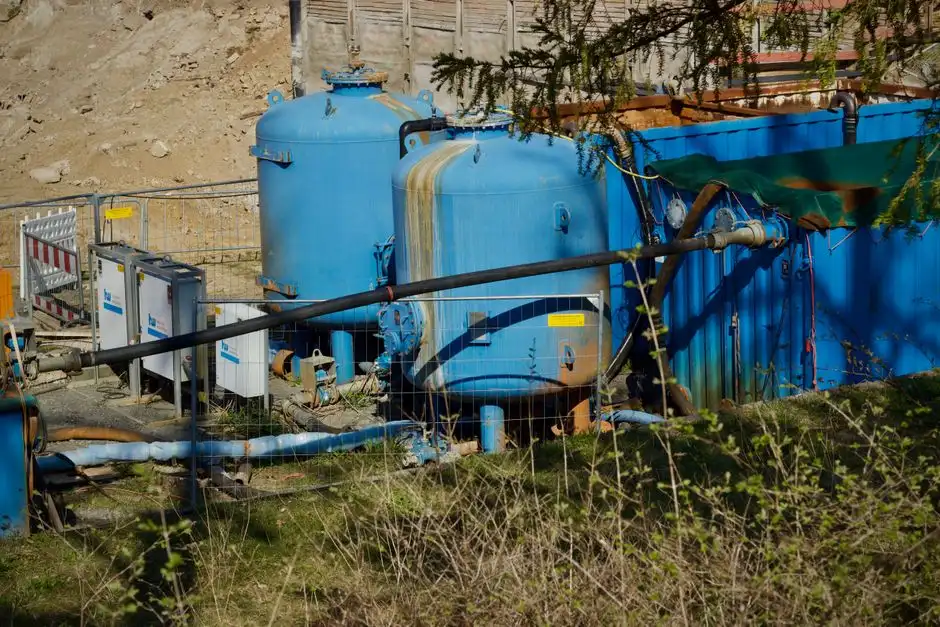
Capital cost for a 5–20 m³/day buried A/O package plant in the UK in 2026 — installed, percolation tested, commissioned, and connected to a discharge point — typically falls in the range of £18,000–£45,000 depending on ground conditions, depth of invert, electrical run length, and discharge route (writer to source current published figures from at least two UK suppliers before publication). An equivalent MBR system at the same flow band sits roughly 40–70% higher in CAPEX, driven by the membrane cassette, larger blower, and more complex control panel.
Operating cost follows a different shape. A domestic A/O unit running a 0.75–1.5 kW blower consumes around 4–6 kWh/day, or roughly £350–£550/year at 2026 UK unit rates, plus annual desludging at £150–£300 per visit on a 6–12 month interval. MBR power draw is similar, but the dominant OPEX line is membrane replacement: a cassette change at 7–10 years typically costs 15–25% of the original plant CAPEX. Reed beds are the cheapest to run but require land the developer may not have.
The Section 34 permit application fee is charged separately. The Environment Agency's standard permit subsistence charge for a small discharge sits in the low hundreds of pounds per year (writer to confirm against the 2026 charging scheme). Budget for the application fee plus first-year subsistence in addition to plant CAPEX; readers often miss this line and overrun their contingency.
| Cost line | A/O package (5–20 m³/day) | MBR (5–20 m³/day) | Reed bed (standalone) |
|---|---|---|---|
| CAPEX band (2026, installed) | £18k–£45k | ~40–70% above A/O | Lower if land available |
| Annual power | £350–£550 | £400–£650 | Negligible |
| Desludging | £150–£300 every 6–12 months | Less frequent | Every 5–10 years |
| Major replacement | Blower at 5–8 years | Membranes at 7–10 years | Media at 15–20 years |
| Section 34 permit fee | EA subsistence, low £100s/year | EA subsistence, low £100s/year | EA subsistence, low £100s/year |
Specifying a Package Plant: Practical Checklist
Confirm BS EN 12566-3 certification and CE marking on the plant data plate. BS EN 12566-3 is the harmonised European standard for packaged wastewater treatment plants up to 50 PE and is the minimum the Environment Agency will accept for a GBR or Section 34 discharge. A supplier who cannot produce a current test report should be struck off the list.
Specify inlet screening when the line carries coarse solids. A small farm or rural hotel kitchen can push rags, vegetable matter, and bone fragments into the biological stage, where they foul diffusers and clog membranes. A rotary mechanical bar screen upstream of the biological stage removes these at 1–6 mm spacing and protects the plant.
Add a disinfection stage if the discharge is near a sensitive receptor — a designated bathing water, a trout stream, or an SPZ1. A UV steriliser for the final effluent at flows up to 20,000 g/h is the lowest-maintenance option; chlorine dioxide generation is a parallel route where residual disinfection is required in a long pipe run. Specify a PLC with GSM telemetry so the operator can see blower fault, high level, and power loss alerts on a phone rather than driving 40 miles to an unmanned site.
Write the expected effluent quality into the purchase specification: BOD <25 mg/L, NH4-N <10 mg/L, SS <35 mg/L (per Environment Agency standard permit conditions, 2025). Holding the supplier to these numbers in writing makes any consent failure a warranty issue rather than a dispute.
For a fuller treatment-train walkthrough on a similar rural scale, see the effluent treatment plant engineering buyer's guide and the MBR vs conventional activated sludge comparison. A broader process overview is in the domestic sewage treatment process guide.
Frequently Asked Questions
Do I need a permit for a sewage treatment plant under 2,000 L/day in England?
No, provided the discharge complies with the General Binding Rules 2020: it must be domestic, under 5 m³/day to ground or 2 m³/day to surface water, and outside SPZ1, and the plant must meet BS EN 12566-3. Above 2,000 L/day you need a Section 34 Small Discharge environmental permit from the Environment Agency (per GBR 2020, in force 2026).
What size package plant do I need for a 10-person rural dwelling?
Apply the UK domestic assumption of 150 L per person per day, which gives 1,500 L/day for 10 people. Add a 1.3–1.5× peaking factor and round up to the next standard model, typically a 2 m³/day buried A/O or MBR unit (per BS 6297 / BS EN 12566-3 sizing baseline).
What effluent quality should a packaged sewage plant achieve in the UK?
Under a Section 34 permit, expect limits of BOD <25 mg/L, NH4-N <10 mg/L, and SS <35 mg/L. A correctly specified buried A/O plant typically meets these, while an MBR delivers well below 10 mg/L BOD (per Environment Agency standard permit conditions, 2025).
How often does a domestic A/O package plant need desludging?
For a typical UK rural dwelling on a 150 L/person/day load, desludging every 6–12 months is the standard operating interval. Heavier loads, an under-sized plant, or excessive fat ingress shorten the interval; MBRs extend it to 12–24 months because of higher MLSS and lower sludge yield.