Victoria's 2026 Regulatory Framework for Domestic Sewage
Domestic sewage treatment in Victoria in 2026 is regulated by the Environment Protection Act 2017, Part 5.7 of the Environment Protection Regulations 2021, and the State Environment Protection Policy (Waters of Victoria). Any system — sewer connection, decentralised package plant, or onsite system — must satisfy the general environmental duty. Properties under 4,000 m² in low-density residential zones are required to connect to sewer; unsewered high-risk townships identified by council (e.g. Yarra Ranges, Mornington Peninsula) are progressively serviced through water-authority sewer backlog or community sewerage programs.
The 2017 Act replaced the 1970 Act and shifted the centre of gravity from prescriptive licensing to a duty-based regime. Section 25 of the EP Act 2017 imposes a general environmental duty: a person engaging in an activity must "eliminate or reduce risks of harm to human health or the environment, so far as reasonably practicable" (EPA Victoria, S2). For a packaged-plant designer, that duty is operationalised through Part 5.7 of the EP Regulations 2021, which sets the obligations of owners and occupiers of land with an onsite wastewater management system Victoria, and through the SEPP (Waters of Victoria), which sets receiving-water objectives that flow back into plant design. The Planning and Environment Act 1987 layers in the 4,000 m² low-density planning threshold that triggers mandatory sewer connection (VAGO 2018, S5).
EPA Victoria administers permissions for activities with significant impact; water corporations (Yarra Valley Water, South East Water, Melbourne Water) run the Community Sewerage Program and sewer backlog programs; local councils hold delegated powers under the EP Act 2017 to regulate onsite systems, including for sub-threshold lots that cannot connect (EPA Victoria, S2; VAGO 2018, S5). The waste-management hierarchy — avoid, reuse/recycle, treat for reuse, dispose — pushes Victorian designers toward irrigation reuse wherever a discharge pathway allows it, particularly in unsewered communities where fit-for-purpose alternative services are evaluated against equivalent environmental and public health outcomes to sewer (VAGO 2018, S5).
What Counts as 'Domestic Sewage' and Where the Risks Sit
VAGO defines domestic wastewater as the combined flow from bathrooms, kitchens, laundries and toilets, and groups the risk of poorly managed systems into three categories: public health (pathogen contamination of drinking and recreational waters), environmental (surface and groundwater harm to aquatic fauna and indigenous vegetation), and amenity (odour, pooling, property-value impact) (VAGO 2018, S5). That three-bucket framework is the lens EPA Victoria and the water corporations apply when assessing any Edmonton domestic sewage treatment guide-style risk register against Victorian conditions.
The highest-risk cohort in 2018 — and the focus of the VAGO audit — was legacy systems: pre-1996 installations without a permit, with a permit but no maintenance conditions, or approved to discharge treated or untreated wastewater offsite (VAGO 2018, S5). MPSC (Mornington Peninsula Shire Council) and YRC (Yarra Ranges Council) were the audit's two case-study councils, and the resulting recommendations explicitly called for water authorities and councils to address systems approved before 1988 that allowed offsite discharge and the ongoing use of outdated permits (S5). For a 2026 engineer, that legacy backlog is the upstream pressure behind every new Calgary domestic sewage engineering guide-style specification: a new package plant may be specified today, but the permit assessment will weigh the performance of the system it is replacing.
When scoping a project, treat those three risk categories as the data points you must defend in front of council and the water authority. A system that meets the SEPP receiving-water targets for BOD, TSS and ammonia still has to address the amenity and public-health vectors at the discharge point, which is where disinfection, screening, and sludge handling earn their line items.
The Process Train: Preliminary, Biological, Disinfection, Sludge
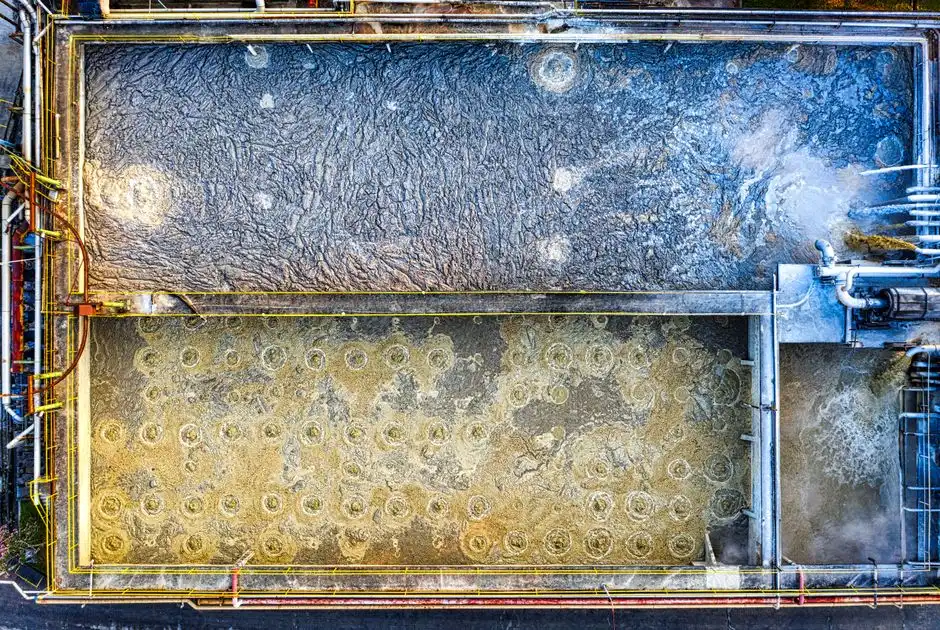
Any Victorian-compliant domestic sewage plant is built from four functional stages. Specifying stages, not brands, is what keeps a design defensible under the general environmental duty.
Preliminary. A GX rotary mechanical bar screen removes rags, plastics and fibrous debris ahead of pumps and biological reactors, protecting downstream membranes and reducing ragging in aeration tanks — a routine failure mode in packaged plants that receive laundry and kitchen discharge from 50–500 dwellings.
Biological. The bulk of BOD, COD and ammonia reduction happens here. A typical buried A/O package, such as the WSZ series, combines anoxic and aerobic contact oxidation with sedimentation and disinfection in a single buried unit operating at 1–80 m³/h with full automation and no dedicated operator (HydropureWater WSZ product brief, S6). The alternative is a submerged MBR with PVDF membranes at sub-1 μm pore size, which delivers near-reuse-quality effluent at roughly 60% smaller footprint than conventional activated sludge, but at higher energy draw and a membrane-replacement line item the design must carry (HydropureWater MBR product brief).
Disinfection. An on-site chlorine dioxide generator provides pathogen kill with documented compliance against EPA, EU Drinking Water Directive 98/83/EC, and WHO guidelines, but effectiveness against chlorine-resistant organisms such as Cryptosporidium and Giardia is limited; for irrigation-reuse end uses, ozone or UV is often the safer specification (HydropureWater ClO₂ generator product brief). Where membrane filtration precedes disinfection, the pathogen load on the disinfection stage is already low, which is the case for MBR plants but not for A/O packages without tertiary filtration.
Sludge. A plate-and-frame sludge filter press or screw press dewatersthe wasted biological solids to a transportable cake, cutting haulage cost. Sludge handling is one of the most under-costed items in Victorian decentralised projects because ongoing maintenance and desludging are rarely priced into the 20-year whole-of-life.
Effluent Quality Targets by Discharge Pathway
Effluent targets in Victoria are set by the discharge pathway the permit authorises, not by the technology chosen. The same A/O package can meet very different numbers depending on whether it discharges to sewer, surface water or irrigation reuse.
| Discharge pathway | Regulator / instrument | Indicative BOD (mg/L) | Indicative TSS (mg/L) | Indicative NH₃-N (mg/L) | Indicative E. coli (cfu/100 mL) | Additional parameters |
|---|---|---|---|---|---|---|
| To sewer (trade waste) | Water corporation consent (YVW / SEW / MW) | ≤ 200 (typical consent) | ≤ 200 | Site-specific | Not routinely set | pH 6–10, oil/grease, metals per consent |
| To surface water (SEPP WoV) | EPA Victoria, SEPP (Waters of Victoria) | < 20 | < 30 | < 5 | < 100 (recreational waters) | DO, nutrients, toxicants per receiving-water segment |
| Irrigation reuse (Class A) | EPA Victoria recycled-water guidance | < 10 | < 10 | < 2 | < 1 | Turbidity < 2 NTU, Cl₂ residual |
| Irrigation reuse (Class B) | EPA Victoria recycled-water guidance | < 20 | < 30 | < 5 | < 100 | Buffer distances, restricted-access irrigation |
Discharge to sewer carries a water-corporation trade-waste consent rather than an SEPP receiving-water target; limits are typically 200 mg/L BOD and 200 mg/L TSS, with the receiving treatment plant providing the environmental buffer (VAGO 2018, S5). For surface water under the SEPP, design targets of BOD <20 mg/L, TSS <30 mg/L, NH₃-N <5 mg/L and E. coli <100 cfu/100 mL align with VAGO's discussion of receiving-water risk and recreational protection (S5). Class A and Class B recycled-water end uses add turbidity, pathogen and nutrient targets per EPA Victoria's recycled-water guidance, and reflect the waste-management hierarchy preference for reuse over disposal (S2).
Packaged Plant Technologies Compared for Victoria
For most Victorian 50–500-dwelling schemes, the shortlist is a buried A/O package, an MBR, or a sequencing batch reactor (SBR). Each fits a different flow range, footprint envelope, and discharge target.
| Technology | Flow range | Process core | Typical effluent BOD / TSS / NH₃-N (mg/L) | Footprint signal | Automation | Best-fit Victorian use case |
|---|---|---|---|---|---|---|
| Buried A/O package (WSZ series) | 1–80 m³/h | Anoxic + aerobic contact oxidation, sedimentation, disinfection in one buried unit | ≤ 20 / ≤ 20 / ≤ 10 (with disinfection) | Smallest envelope; buried below landscaping or trailer-mounted | Fully automated, no dedicated operator | Default lowest-CAPEX option for community sewerage programs and 50–500 dwelling schemes (S6) |
| Submerged MBR | 10–2,000 m³/day | Activated sludge + submerged PVDF membranes at <1 μm | ≤ 5 / ≤ 1 / ≤ 1 | ~60% smaller than CAS; higher energy draw | PLC with periodic membrane clean-in-place | Constrained sites, irrigation-reuse end use, Class A targets |
| SBR | 10–5,000+ m³/day | Batch fill–react–settle–decant in a single tank | ≤ 20 / ≤ 20 / ≤ 5 (with disinfection) | Larger tankage than continuous-flow A/O | Higher control-logic demand | Variable loads typical of unsewered townships where influent is unsteady |
| Vermifiltration (passive) | Single-lot scale | Earthworm + filter media on septic-tank effluent | Documented removal of BOD and TSS, pathogen reduction | Larger land area per m³/day | Minimal, periodic media maintenance | Single rural or remote properties, no scheme scale (S3) |
The A/O package, in the form of a WSZ buried A/O package plant, is the default lowest-CAPEX option: 1–80 m³/h flow, fully automated, no operator, installable below grade with landscaping above or on a trailer for mobile deployment (HydropureWater WSZ product brief, S6). MBR is the reuse-quality option, with submerged PVDF membranes at <1 μm and a footprint roughly 60% smaller than conventional activated sludge, but with a higher energy and membrane-replacement cost (HydropureWater MBR product brief). SBR is a strong fit for variable loads typical of unsewered townships, but the larger tankage and more complex control logic push CAPEX and operator input above the A/O package. Vermifiltration is documented in the academic literature as efficient, low-expertise, decentralised treatment of septic-tank effluent — relevant for very small or remote Victorian properties but not for scheme-scale flows (S3). For most 50–500-dwelling Victorian schemes, the engineering decision is between buried A/O (lower CAPEX, lower operator skill) and MBR (higher CAPEX, reuse-quality effluent, smaller footprint).
Selection Framework: Which Plant Fits Which Victorian Project
Apply this sequence in a scoping meeting. It maps the project type to the technology, the discharge pathway, and the permit evidence you will need to lodge.
- Lot under 4,000 m² in a low-density zone. Connect to sewer; a packaged plant is the wrong solution here (VAGO 2018, S5).
- 50–500 dwellings, sub-threshold lots in a Community Sewerage Program, or a new unsewered township. Default to a buried A/O package plant such as the WSZ buried A/O package plant as the lowest-CAPEX option (S6).
- Same scale, but with irrigation-reuse end use or constrained land. Specify an MBR with replaceable DF-series MBR flat-sheet modules and pair it with an on-site chlorine dioxide generator or UV polishing to meet Class A recycled-water targets.
- Single rural property, very small flow, no operator. Consider vermifiltration or other passive systems (S3); confirm with council permit, a Land Capability Assessment, and a maintenance plan.
- Any packaged plant in Victoria. Must be supported by a current Part 5.7 permit, an LCA, a maintenance schedule, and an automatic chemical dosing system where disinfection chemistry is part of the design — all of which together evidence satisfaction of the general environmental duty (EPA Victoria, S2; VAGO 2018, S5).
For projects producing biosolids, retain a plate-and-frame sludge filter press or screw press on the desludging line, and price the haulage and disposal route into the 20-year whole-of-life before the technology is locked in.
Frequently Asked Questions
What permits does a Victorian domestic sewage treatment plant need in 2026?
A packaged plant or onsite system in Victoria needs a permit under Part 5.7 of the Environment Protection Regulations 2021, a Land Capability Assessment, and a maintenance schedule, all of which together evidence compliance with the general environmental duty in section 25 of the Environment Protection Act 2017. Where the plant discharges to sewer, a water-corporation trade-waste consent (YVW, SEW or Melbourne Water) is also required.
When is sewer connection mandatory in Victoria?
Properties under 4,000 m² in a low-density residential zone are required to connect to sewer, because sub-threshold lots are presumed unable to safely treat and contain wastewater onsite (VAGO 2018, S5). Sub-threshold lots that cannot connect are serviced through water-authority sewer backlog or Community Sewerage Programs after council identifies the township as high risk.
How are legacy domestic sewage systems being replaced in Victoria?
Pre-1996 legacy systems — those without a permit, with a permit lacking maintenance conditions, or approved to discharge treated or untreated wastewater offsite — are the highest-risk cohort flagged by VAGO and the focus of ongoing replacement through water-authority sewer backlog programs and Community Sewerage Programs, with MPSC and Yarra Ranges Council as the audit's two case studies (VAGO 2018, S5).
What effluent quality applies for surface-water discharge in Victoria?
For surface-water discharge under the SEPP (Waters of Victoria), design to indicative targets of BOD <20 mg/L, TSS <30 mg/L, NH₃-N <5 mg/L, and E. coli <100 cfu/100 mL for recreational-protection waters, with additional parameters set by the receiving-water segment (VAGO 2018, S5; EPA Victoria, S2).
How does an MBR differ from a buried A/O package plant in Victorian use?
A buried A/O package such as the WSZ series treats 1–80 m³/h, is fully automated with no operator, and typically achieves BOD ≤20 mg/L, TSS ≤20 mg/L and NH₃-N ≤10 mg/L with disinfection. An MBR uses submerged PVDF membranes at <1 μm, delivers near-reuse-quality effluent (BOD ≤5 mg/L, TSS ≤1 mg/L) at roughly 60% smaller footprint, but draws more energy and requires periodic membrane replacement (HydropureWater product briefs; HydropureWater MBR troubleshooting field guide).
Related equipment and engineering reading
- Underground Package Sewage Treatment Plant (WSZ Series)
- Domestic Sewage Treatment in San Diego: 2026 Engineering Guide
- Domestic Sewage Treatment in Binh Duong: 2026 Engineering Guide
- Anaerobic Digester for Domestic Sewage: 2026 Engineering Guide
- Belt Filter Press for Domestic Sewage Wastewater: 2026 Engineering Guide