

What a Belt Filter Press Does in a Domestic Sewage Plant
A belt filter press is a continuous mechanical dewatering unit that conditions sludge with polymer, drains free water on a moving porous belt, then squeezes the cake through wedge and S-path rollers before doctor-blade discharge. For domestic sewage plants, it is typically used to dewater thickened waste activated sludge (WAS) or a primary-plus-WAS blend to a target cake dryness of roughly 18–25% DS (percent dry solids), depending on sludge age and polymer dose. The BFP sits inside the solids train, not the liquid train — it never sees raw influent and it does not treat wastewater directly.
The BFP always sits downstream of thickening. A typical sequence in a 2026 municipal flowsheet is: screening → grit removal → primary clarification (or MBR skip) → biological treatment (activated sludge or membrane bioreactor) → sludge thickening (DAF or gravity belt thickener, typically 3–5% DS) → belt filter press → cake handling, transport, or further drying. The volume reduction is significant: a thickened sludge at 2–4% DS that exits the press at 22% DS is roughly 5–8× smaller in volume, which cuts haulage tonnage, landfill levies, and storage footprint. For plants that use a HydropureWater MBR membrane bioreactor as the biological step, the WAS produced is consistently low in filamentous bulking and behaves predictably on a BFP — a useful property for stable cake dryness.
How a Belt Filter Press Works: From Head Box to Cake Discharge
Water removal in a BFP is staged across six mechanical steps, and the machine's performance is the sum of how well each stage is set.
- Polymer conditioning. Cationic polyacrylamide (CPAM) is dosed inline at the suction of the feed pump or in a static/dynamic mixer, typically 3–10 g/kg DS for domestic WAS (per S3 conditioning-quality point and S4 CPAM research). This is the variable most often wrong in poorly operating units.
- Head box distribution. Conditioned sludge enters a head box that spreads the flow evenly across the full belt width so the entire filtering area is used (per S5).
- Gravity drainage zone. Free water drops through the moving porous belt before any mechanical pressure is applied. This zone typically removes 30–50% of the total water (per S3, S5).
- Wedge / pressure zone. Sludge enters between upper and lower belts that converge, applying gradually increasing pressure as the cake forms a "sandwich" (per S5).
- S-path compression rollers. Belts wrap a series of rollers in an S configuration, where surface pressure from belt tension squeezes more water out (per S5).
- Doctor-blade cake discharge. Dry cake is scraped off by doctor blades and falls onto a conveyor; filtrate is collected separately in a tray and piped back to the head of the plant (per S3, S5).
The parts a specifier will hear from vendors are: the filter belt itself (woven polyester, 80–200 mesh depending on sludge type), the pneumatic or hydraulic belt tracking and tensioning system, the belt wash shower (nozzles fed at 3–5 bar), and the doctor blade (typically polyurethane, replaceable). A misalignment of 5–10 mm at the roller is enough to start edge wear that shortens belt life from a typical 2,000–4,000 operating hours to under 1,000.
Belt Filter Press Design Parameters for Domestic Sewage
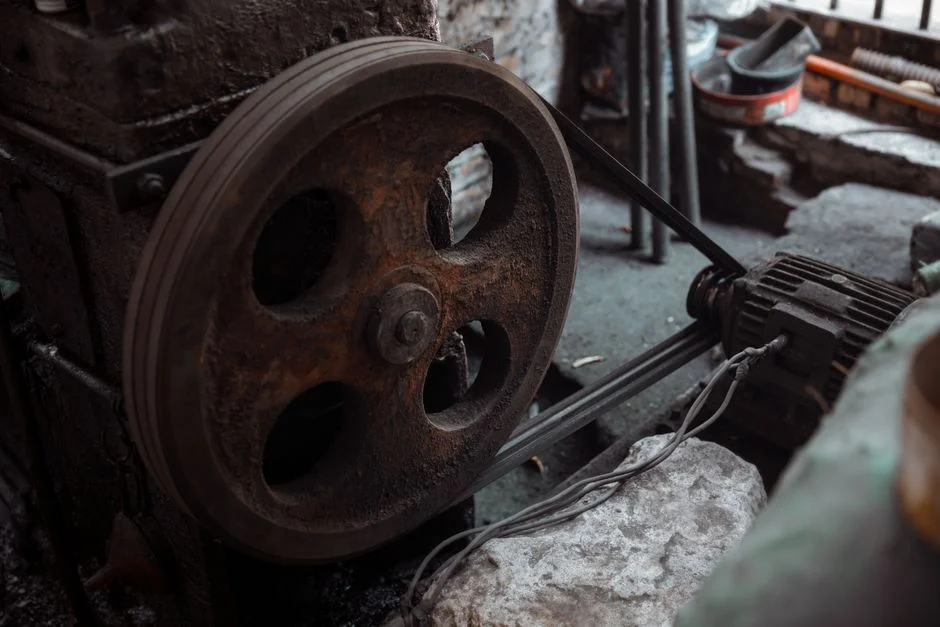
First-pass sizing for a 2026 municipal or package-plant BFP uses the parameter table below. Numbers are drawn from the staged-mechanism sources, full-scale plant data, and standard municipal dewatering practice; treat them as a defensible starting point that you refine against vendor curves and jar tests on your specific sludge.
| Parameter | Design range / value for domestic sewage |
|---|---|
| Feed solids to BFP | 2–4% DS thickened; below 1.5% DS the press runs wet, above 5% DS the belt blinds prematurely (per S3 feed-consistency point) |
| Hydraulic loading | 5–15 m³/h per m belt width; lower end for WAS-only, higher end for primary-plus-WAS blend with good conditioning |
| Belt width selection | 1.0 m up to ~1,000 m³/day; 1.5–2.0 m for 1,000–5,000 m³/day; 2.0–2.5 m for 5,000–20,000 m³/day |
| Belt speed | 1–6 m/min, with 2–4 m/min typical; slower speed increases cake dryness at the cost of throughput |
| Polymer type | High-molecular-weight cationic polyacrylamide (CPAM), charge density 20–60%, MW 6–12 MDa (per S4) |
| Polymer dose | 3–10 g/kg DS for domestic WAS, often 2–6 g/kg DS for well-aged digested sludge |
| Cake dryness — raw WAS | 18–22% DS |
| Cake dryness — thickened + aerobic digestion | 22–25% DS |
| Cake dryness — anaerobic digested primary + WAS | 25–28% DS |
| Solids capture | 92–97% design target on well-conditioned domestic sewage |
| Filtrate quality | 0.2–1.0% DS; route back to headworks or biological stage |
| Power draw | 1.5–4 kW per m belt width |
| Belt wash water | 1–3 m³/h per m belt width at 3–5 bar |
| Operating hours | 8–16 h/day typical for small plants; size for peak-day flow, not average |
Two design rules worth keeping in mind: (1) the BFP is a downstream of thickening, so the thickener sets the design feed solids — if your DAF or gravity belt thickener is undersized, the BFP cannot fix that, and (2) peak-day, not average-day, governs belt width because municipal plants rarely run on a flat profile.
Polymer Conditioning: The Variable That Decides BFP Performance
Polymer selection and dose — not the press hardware — are usually why a BFP underperforms specification (per S3). Cationic polyacrylamide is the default for domestic sewage because biological floc is negatively charged; CPAM neutralizes surface charge and bridges fine particles into larger agglomerates that release water easily (per S4 CPAM literature).
The standard lab method is jar testing: dose the candidate polymer across 2–15 g/kg DS, measure capillary suction time (CST) and supernatant turbidity, and pick the dose that gives the lowest CST at acceptable cost. On the plant, the cleanest field check is filtrate clarity — clear filtrate with a visible "eye" of free water on the belt is well-conditioned; cloudy filtrate and a soupy belt are under-conditioned.
For 2026 small-plant retrofits, emulsion or inverse-emulsion polymers dominate over dry-polymer systems because activation is faster and make-down equipment is simpler. Dry-polymer systems still win on logistics for remote sites where liquid polymer is hard to deliver. Either way, a consistent make-down is essential, and a HydropureWater automatic chemical dosing system delivers the maturation time, dilution ratio, and dose stability the press needs to run on spec.
Over-dosing is a common and expensive mistake: excess polymer re-stabilizes the sludge, raises filtrate solids, and increases operating cost without improving cake dryness. A worked 2026 cost example: at 6 g/kg DS dosing on a 2% DS WAS feed treating 50 m³/day, polymer consumption is about 6 kg/day, giving a polymer cost on the order of USD 0.6–1.2 per m³ of feed at typical polyacrylamide prices. Treat this as an order-of-magnitude figure, not a vendor quote — your actual price depends on local market, ionic grade, and emulsion vs dry.
Belt Filter Press vs Centrifuge vs Plate-and-Frame Filter Press
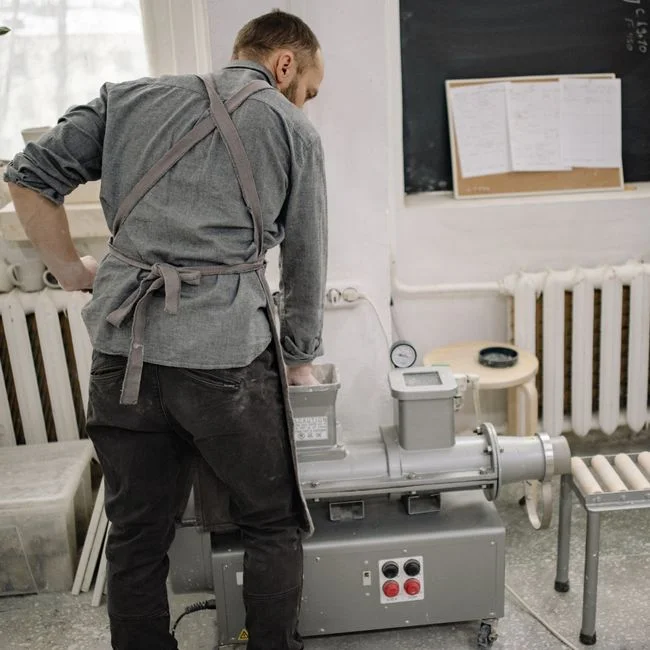
The three dominant mechanical dewatering technologies for domestic sewage solve the same problem from different angles. The matrix below is built for 2026 design-stage comparison, not for marketing.
| Criterion | Belt filter press (BFP) | Decanter centrifuge | Plate-and-frame filter press |
|---|---|---|---|
| Capex band (relative) | Lowest (×1 baseline) | Moderate (×1.5–2.5) | Highest (×3–6) |
| Energy use | 1.5–4 kW per m belt width | 15–30 kW per unit (main + back-drive) | 5–15 kW per unit (hydraulic pump intermittent) |
| Cake dryness range | 18–25% DS typical, up to 28% on digested blends | 22–28% DS | 30–40% DS |
| Solids capture | 92–97% | 90–95% | >98% |
| Operation mode | Continuous | Continuous | Batch (cycle 1–4 h) |
| Operator skill | Moderate; mainly polymer tuning | Higher; sensitive to feed and grit | Lower per cycle; high labor for cloth and cake release |
| Footprint | Long, low | Compact, vertical | Large frame; needs cake drop zone |
| Odor and aerosol | Open; needs enclosure or ventilation in 2026 | Enclosed; best for odor-sensitive sites | Open during plate shift; intermittent odor pulses |
| Sensitivity to grit/sand | Moderate | High — combined sewer flows cause wear | Low |
| Maintenance | Belt replacement, bearings, wash nozzles | Bowl/scroll wear, vibration monitoring | Cloth replacement, seal and plate cleaning |
| Suitable plant size | Small to mid, < ~20,000 m³/day | Mid to large, > ~5,000 m³/day | Any size where cake dryness is non-negotiable |
| 2026 typical use case | Municipal WWTPs and package plants with continuous sludge output | Plants with odor constraints, industrial blends, or high cake dryness needs | Landfill-ban sites, brick/cement kilns, or sites selling cake as a product |
Decision rule of thumb for 2026: pick a BFP for small-to-mid domestic sewage plants under ~20,000 m³/day where continuous operation, low capex, and low energy matter; pick a centrifuge where odor control and slightly higher dryness drive the spec; pick a plate-and-frame filter press where the cake is a saleable product, haulage cost per tonne is high, or landfill rules require >30% DS. Whichever machine you pick, dewatering alone rarely closes the disposal problem (per S3) — the BFP's working range of 18–25% DS is sufficient for many 2026 landfill rules but still leaves composting or drying on the table where rules tighten further.
Where a BFP Fits in a 2026 Domestic Sewage Flowsheet
The full 2026 sludge line for a small-to-mid municipal or community WWTP runs: screening → grit removal → primary clarification (or MBR skip) → biological treatment (activated sludge or MBR) → sludge thickening → belt filter press → cake handling and disposal. Filtrate from the BFP and wash water from the belt shower both return to headworks; they are not lost from the hydraulic balance.
The thickening step is what makes a BFP economical. A HydropureWater dissolved air flotation system typically produces 3–5% DS thickened sludge, which is the right feed window for a BFP without blinding. For sites that keep primary clarification in the train, a HydropureWater high-efficiency sedimentation tank handles primary settling, and the primary sludge blends with WAS in a holding tank before the BFP — this blend dewater better than WAS alone because the primary solids form a coarser, more permeable cake matrix.
For very small residential, hotel, or hospital sites — typically below ~50 m³/day of sludge production — a HydropureWater WSZ package sewage treatment plant produces sludge that is hauled liquid or thickened, and a BFP only makes economic sense above that threshold. For 2026 disposal rules, cake above ~22% DS meets most landfill acceptance criteria without further drying; below that, composting, lime stabilization, or mechanical/thermal drying enters the picture.
Operating and Maintenance Essentials for Long-Term BFP Performance
Most BFP reliability problems are not technology failures — they are operating and feed-management issues (per S3). The day-to-day items that decide uptime:
- Belt tracking and tension: check at every shift. Misalignment causes edge wear and tear; most premature belt replacement comes from poor tracking, not from wear through the belt body.
- Belt wash water: keep shower nozzles clear, maintain 3–5 bar pressure, and confirm 1–3 m³/h per m belt width. Blinded belts are the single biggest cause of falling cake dryness on a BFP that has not changed mechanically.
- Polymer dose logging: trend grams of polymer per kg dry solids against cake moisture weekly. Drift almost always means a feed-sludge change (more WAS, different SRT, new grit load) rather than a press fault.
- Roller bearings and doctor blades: inspect monthly. A worn doctor blade lets cake carry-over back onto the belt and re-wets the next drainage zone.
- Filtrate quality: a sudden rise in filtrate solids usually means polymer under-dose or feed solids too high — not a press fault. Address upstream before touching the press.
- Safety: BFPs are open, noisy, and aerosol-generating. In 2026, simple enclosure with odor extraction and a local wash-down station is becoming standard at municipal sites and is required in some jurisdictions for indoor installations.
The related engineering context — how dewatering integrates with the wider 2026 treatment train — is covered in the broader 2026 organic wastewater treatment guide, and a region-specific example for the U.S. Southeast is in the 2026 municipal sewage treatment plants in Georgia guide. For sites that plan to reuse the dewatered cake or the treated effluent, the 2026 wastewater reuse for irrigation article walks through the relevant reuse standards.
Frequently Asked Questions
What cake dryness can a belt filter press reach for domestic sewage sludge?
For domestic sewage, a BFP typically reaches 18–22% DS on raw WAS, 22–25% DS on a thickened and aerobically digested blend, and 25–28% DS on an anaerobically digested primary-plus-WAS blend. Final dryness depends on polymer dose, belt speed, and upstream sludge age.
Is a belt filter press continuous?
Yes. A BFP is a continuous mechanical dewatering unit, which is the main reason it is preferred for municipal plants with steady sludge output and limited operator hours, compared with batch equipment such as a plate-and-frame press.
How much polymer does a BFP use for sewage sludge?
For domestic WAS, 3–10 g/kg DS of cationic polyacrylamide is a typical 2026 operating range. Well-aged digested sludge often doses lower, at 2–6 g/kg DS. Above the optimum, extra polymer re-stabilizes the sludge and raises filtrate solids without improving cake dryness.
Belt filter press vs centrifuge for a small municipal WWTP — which is better?
For plants below ~20,000 m³/day, a BFP usually wins on capex and energy (1.5–4 kW/m vs 15–30 kW per centrifuge). A centrifuge wins where odor containment matters, where the site is enclosed, or where cake dryness closer to 28% DS is required. Capex and footprint usually decide it for small plants.
Can a belt filter press handle septic-tank or package-plant sludge?
Only after separate thickening. Raw septic or package-plant sludge is typically below 1.5% DS, which is too thin for direct BFP feed and runs wet. A DAF or gravity belt thickener upstream is the standard way to bring that sludge into the BFP's 2–4% DS feed window.
Does a BFP produce a landfill-ready cake?
In many 2026 jurisdictions, yes, if the cake is above ~22% DS, which is achievable on a BFP for most digested blends. Where local rules require higher dryness, or where haulage cost dominates, a BFP is the first step and composting, lime stabilization, or mechanical/thermal drying is the second.