Why Tannery Sludge Demands Its Own Treatment Train
Tannery wastewater sludge cannot be handled with generic industrial-sludge guidance because three contaminant classes — chromium, sulfide, and high-strength organics — co-exist in a single waste stream. Raw tannery influent typically carries 2,000–4,000 mg/L COD, 500–2,000 mg/L BOD, 1,000–3,000 mg/L total suspended solids, 50–500 mg/L sulfide, and a pH swing between 8 and 12 depending on the beamhouse process in operation (Environ Sci Pollut Res Int, 2026-06). A coagulation-flocculation step alone at 5 g/L FeCl₃ and pH 7 has been shown to remove 73% of COD while stripping color and turbidity completely (Environ Sci Pollut Res Int, 2026-06, PMID 42399543) — but the contaminants it does not remove end up concentrated in the sludge.
Three sludge streams emerge, each requiring a distinct handling logic:
- Chromium-bearing primary sludge from chrome tanning baths, typically 4–8% total solids (TS) and rich in Cr(III) hydroxides.
- Sulfide-rich liming/hair-burn sludge from unhairing, with high pH and FeS formation potential.
- Biological waste-activated sludge at 0.8–1.5% TS, high in volatile solids (VS) and protein fraction.
The hazard most engineers miss is pyrophoric self-heating: dried tannery sludge can spontaneously oxidize iron sulfides to iron oxides and sulfates, releasing heat that has been documented to ignite stored cake (Journal of Hazardous Materials, 2015, S2 title). Storage silos, drying beds, and cake conveyors therefore require temperature monitoring and — for any cake held above 40–50% DS — inerting or rapid removal. Mixing tannery sludge with municipal biosolids is also restricted in most jurisdictions because Cr(VI) leaching under landfill or land-application conditions breaches hazardous-waste thresholds, and recovery or stabilization is preferred over dilution.
Sludge Characterization: The Numbers That Drive Equipment Selection
Equipment vendors will ask for total solids, specific resistance to filtration (SRF), volatile-to-ash ratio, and metal partitioning before they quote a press or a centrifuge. For a typical leather-processing facility, the following benchmarks apply — these should always be confirmed with site-specific jar tests and pilot work:
| Parameter | Primary clarifier | DAF float | Waste-activated sludge | Combined / blended |
|---|---|---|---|---|
| Total solids (TS, %) | 4–8 | 3–6 | 0.8–1.5 | 2–5 after thickening |
| Volatile solids (% of TS) | 55–65 | 65–75 | 70–80 | 55–70 |
| SRF (×10¹³ m/kg) | 2–5 | 1–3 | 5–15 | 1–5 (with polymer) |
| Chrome, Cr total (mg/kg DS) | 5,000–25,000 | <500 | 200–1,000 | 2,000–15,000 |
| Sulfide, S²⁻ (mg/kg DS) | 2,000–8,000 | <200 | <100 | 1,000–5,000 |
| Methane yield potential (m³ CH₄/kg VS) | — | — | 0.20–0.35 | 0.20–0.35 (bio fraction) |
SRF in the 1–5×10¹³ m/kg band is high by municipal standards and is driven by fine collagen fibers, chrome-tanned particulates, and emulsified fat. Without polymer conditioning at 2–8 kg active polymer per ton DS, no mechanical dewatering device will reach the 22–28% DS band that makes downstream handling economical. Heavy-metal partitioning is the second decision input: RSC Adv (2026-08) PMFC work achieved near-complete Cr, Co, Cd, Cu, Mn, and Fe removal from the liquid phase — but those metals concentrate in the sludge, and the cake itself still requires stabilization or recovery before disposal. Volatile solids at 55–70% are high enough to justify anaerobic digestion of the biological fraction, with a methane yield potential of 0.20–0.35 m³ CH₄ per kg VS added under mesophilic (35–37 °C) conditions.
Process Flow: From Equalization to Dewatered Cake

A defensible 2026 train for tannery sludge runs through five unit operations, each tied to a specific contaminant class. Skipping any step degrades cake quality, dewatering performance, or compliance posture.
- Equalization and chrome recovery. Sulfide stripping (air or N₂ at pH < 6.5) precedes chrome precipitation with MgO or NaOH to pH 8.0–8.5; recovered Cr(OH)₃ can be calcined to Cr₂O₃ and reused in tanning baths, displacing 10–30% of fresh chrome input at large operations. Automatic chemical dosing for chrome precipitation and polymer conditioning keeps reagent stoichiometry within ±5% of target.
- Primary clarification or DAF. A DAF unit for tannery primary sludge and FOG is preferred over gravity clarification because floatable hair, emulsified fat, and unhairing residues skim cleanly at 3–6% TS, reducing downstream digester loading.
- Biological treatment. A ScienceDirect (2023) review of membrane bioreactors for tannery wastewater found MBBR configurations most effective for COD and salinity reduction, with submerged MBR modules as the polishing step where space is constrained. See the industrial MBR selection guide for sizing logic, and the MBR vs conventional activated sludge comparison for when to skip membranes.
- Sludge thickening. A lamella clarifier or high-efficiency sedimentation tank lifts waste-activated sludge from 0.8–1.5% to 3–5% TS; sludge recirculation designs cut coagulant demand by up to 30% by re-using fines as a floc nucleus.
- Conditioning and dewatering. Cationic polyacrylamide at 2–8 kg/t DS, followed by a plate-and-frame filter press for tannery sludge dewatering, delivers 22–28% DS cake with >95% volume reduction versus the raw sludge. Cake handling then routes to chrome stabilization (lime/FeSO₄) before lined-landfill disposal or to a chrome-recovery circuit.
Comparing Dewatering Technologies for Tannery Sludge
Procurement and process engineers should weigh cake solids, energy intensity, polymer demand, and footprint against the pyrophoric-iron-sulfide risk before specifying a device. The table below is built for side-by-side evaluation at the RFQ stage.
| Technology | Cake DS (%) | Polymer (kg/t DS) | Energy (kWh/t DS) | Duty | Cr fouling risk | CapEx band (2026) |
|---|---|---|---|---|---|---|
| Plate-and-frame filter press | 22–28 | 2–8 | 2–5 | Batch, 1–500 m² | Low–moderate | USD 80k–150k (30 m²) |
| Belt filter press | 18–22 | 4–10 | 3–6 | Continuous | High (belt blinding) | USD 50k–120k |
| Decanter centrifuge | 20–24 | 3–7 | 15–30 | Continuous, enclosed | Moderate | USD 120k–300k |
| Drying beds (covered/inerted) | 25–35 | 0–2 | <1 | Batch, 5–14 day cycle | Low (if monitored) | USD 20k–80k |
| Thermal hydrolysis + AD + press | 28–35 | 4–10 | 40–80 (THP) | Continuous, packaged | Low | USD 1.0M–3.0M |
For most 50–500 m³/day plants, the plate-and-frame filter press hits the best balance: lowest polymer and energy per ton DS, batch duty that tolerates feed swings, and cake dry enough to landfill without odor or leachate penalties. Belt presses win on continuous throughput and lower CapEx but suffer chrome blinding on the belt and rarely exceed 22% DS. Drying beds remain attractive at very small flows — but the pyrophoric risk noted in the Journal of Hazardous Materials (2015, S2) demands covered or inerted designs and continuous temperature monitoring, with cake removed before bed temperatures exceed 60 °C. Decanter centrifuges are the right call for enclosed, odor-sensitive sites; their 15–30 kWh/t DS energy load is the trade-off. Thermal hydrolysis followed by anaerobic digestion and pressing is the 2026 direction-of-travel at larger sites, lifting VS destruction above 50% and cutting sludge mass 30–40% before the press.
2026 Compliance Map for Tannery Sludge Disposal and Reuse
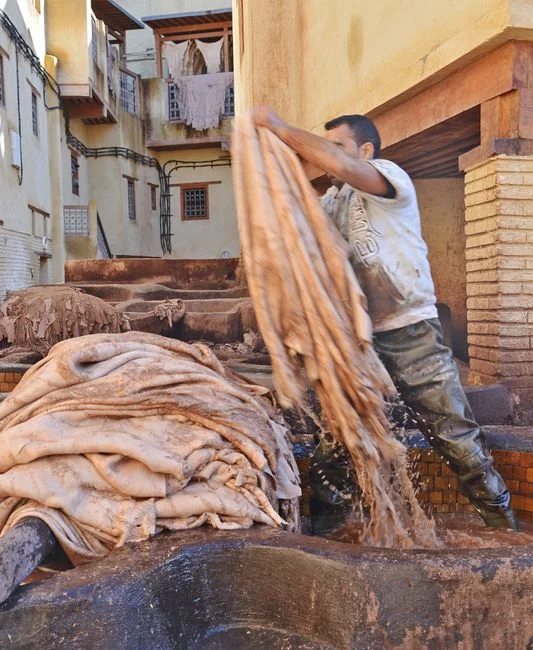
Three regulatory frames dominate tannery sludge compliance in 2026, and the EHS manager must satisfy all that apply to a given site.
- EU IED BAT conclusions for tanning (2024/2026 update) require BAT-associated chrome recovery or controlled disposal, with discharge ceilings on Cr, sulfide, BOD, and TSS; failing to recover Cr(III) from primary sludge triggers a permit review.
- US EPA categorical standards (40 CFR Part 425) for leather tanning establish pretreatment limits for total chromium (≈ 0.86 mg/L daily max in many subcategories), sulfide, BOD, and TSS that flow back into sludge handling rules.
- India CPCB tannery-cluster CETPs at Kanpur, Ranipet, and Pallavaram enforce shared chrome-management protocols, with member tanneries required to segregate chrome-bearing streams and report monthly Cr mass balances.
Reuse pathways shape the compliance story: chrome recovery (precipitation, calcination, reuse in tanning baths) is the most economically attractive; biogas from anaerobic digestion of the biological sludge fraction offsets digester OPEX and counts toward corporate Scope 1 reductions; cake disposal in lined hazardous landfills is the regulated default where Cr exceeds 2,500 mg/kg DS or the TCLP leach test fails local thresholds. Co-digestion with municipal biosolids is generally not permitted because Cr(VI) re-oxidation under aerobic land-application conditions breaches most leachate limits.
Capex and Opex: A 500 m³/day Tannery Plant Worked Example
For a representative 500 m³/day tannery sludge train in 2026, indicative equipment CapEx and OPEX bands are shown below. These are order-of-magnitude envelopes for an early-stage CAPEX review, not vendor quotes.
| Item | CapEx band (USD) | OPEX driver | Annual OPEX share |
|---|---|---|---|
| DAF (15–25 m³/h) | 60,000–120,000 | Air compressor, polyaluminium chloride | 10–15% |
| Gravity/lamella thickener | 25,000–50,000 | Polymer, sludge pump energy | 10–15% |
| 30 m² plate-and-frame filter press | 80,000–150,000 | Cationic polyacrylamide, wash water | 20–35% |
| Polymer dosing skid | 15,000–30,000 | Polymer consumption | 20–35% |
| Chrome precipitation + recovery | 40,000–90,000 | MgO/NaOH, filtration | 5–10% |
| Cake handling + transport | 30,000–60,000 | Diesel, landfill gate fees | 10–20% |
An integrated treatment cost of 4.8 USD per m³ of treated tannery wastewater has been demonstrated at small-to-mid scale using coagulation-flocculation followed by an ultrasound-assisted photo-Fenton process (Environ Sci Pollut Res Int, 2026-06, PMID 42399543); a sludge-handling-only allocation typically lands in the 0.6–1.2 USD per m³ of treated flow band. The three largest OPEX levers are polymer (often 20–35% of sludge OPEX), energy for presses and any centrifuges, and cake transport plus landfill tipping fees. Payback is materially improved by chrome-recovery revenue (offsetting 5–15% of fresh-chrome purchases at large sites), biogas utilization from anaerobic digestion of the biological fraction, and avoided hazardous-landfill gate fees where stabilization lets the cake go to a non-hazardous facility. See the chemical precipitation for heavy-metal removal reference for the reagent-cost math behind the chrome-recovery line item.
Frequently Asked Questions
What dry solids (DS%) should a plate-and-frame filter press achieve on tannery sludge?
22–28% DS is the realistic operating band for properly conditioned tannery sludge on a plate-and-frame press, versus 18–22% on a belt press and 20–24% on a decanter centrifuge. Below 20% DS, cake transport and landfill costs dominate the OPEX ledger.
Is tannery sludge mixed with municipal biosolids permitted?
Generally no. Co-disposal or co-digestion with municipal biosolids is restricted in most jurisdictions because Cr(VI) can re-oxidize under aerobic land-application conditions and breach TCLP leachate thresholds, and the pyrophoric iron-sulfide risk noted in the Journal of Hazardous Materials (2015, S2) also persists in blended cake.
What is the indicative total treatment cost for a small-to-mid tannery plant in 2026?
4.8 USD per m³ of treated tannery wastewater has been demonstrated for an integrated coagulation-flocculation plus sono-photo-Fenton train (Environ Sci Pollut Res Int, 2026-06, PMID 42399543), with a sludge-handling-only allocation typically in the 0.6–1.2 USD per m³ band for a 500 m³/day plant.
Which biological reactor performs best for tannery effluent upstream of sludge handling?
Moving bed biofilm bioreactor (MBBR) configurations were identified as most effective for COD and salinity reduction in a critical review of MBR technologies for tannery wastewater (ScienceDirect, 2023), with submerged MBR modules as the polishing step where discharge-quality reuse is required.
Related Equipment
- submerged MBR for tannery effluent — specifications, capacity range, and technical data