
What wastewater does a typical Addis Ababa factory actually generate?
The tannery, textile, and food sectors dominate Addis Ababa's industrial discharge profile, and each one dictates a fundamentally different treatment train. Selecting equipment before characterising the influent is the single most common reason packaged plants fail to meet Ethiopia's Federal Environment Authority effluent limits.
Per the 23-page Addis Ababa Tannery (AAT) case study, the tannery stream carries high total dissolved solids (TDS), high suspended solids, and the characteristic contaminants of beamhouse and tanning operations: chromium from chrome tanning, sulfide from unhairing/liming, and high organic load from soaking and finishing. The AAT currently relies on chemical coagulation, which removes TSS and some metals but does not address dissolved BOD/COD, ammonia, or residual chromium to reuse standards (Addis Ababa Tannery Wastewater Treatment, scribd.com, 2024).
Textile mills in the Bole Lemi and Dire Dawa industrial parks generate high-temperature dye-house effluent with pH swinging from 4 to 12 across batch runs, intense color, and residual salts from reactive dyeing. A DAF unit alone will clarify the suspended dye but leaves the dissolved color, salts, and refractory COD untouched — a biological and often tertiary oxidation stage is mandatory.
Food, beverage, and FMCG plants produce the most predictable profile: BOD 500–8,000 mg/L, FOG from cooking or dairy, pH swings from clean-in-place (CIP) chemicals, and moderate TSS (per S2 research, 2025-08). For these flows, a DAF + MBBR combination is the default answer, with an equalisation tank ahead of the DAF to dampen pH and load spikes.
Addis Ababa sits at approximately 2,355 m elevation with an ambient range of roughly 10–24°C year-round. Cooler temperatures suppress biological reaction rates — nitrification rates drop roughly 50% at 15°C compared to 25°C — so aeration tanks and MBBR carrier volumes must be sized 30–50% larger than equivalent Middle East designs (per standard activated-sludge kinetics, Metcalf & Eddy). A factory owner comparing quotes from Dubai or Riyadh suppliers should insist on cold-climate kinetic factors rather than accepting a Gulf-region design as-is.
The decision rule is straightforward: the technology follows the water, not the other way around. Match the unit operations to the influent characterisation, then size each stage to the peak daily flow plus a 20% margin.
For factories starting with primary clarification and FOG removal, the DAF system covers 4–300 m³/h and is the standard first stage across all four sectors discussed above.
Which ETP technology matches which Addis Ababa factory?
Once the influent profile is known, the process train selects itself. The table below maps the dominant Addis Ababa industrial sectors to the recommended treatment chain, with the typical flow band and the technology fit for each. All combinations start with screening and equalisation; the differences lie in what comes after the DAF.
| Sector | Typical flow (m³/day) | Process train | Why this train |
|---|---|---|---|
| Tannery | 50–500 | DAF + chemical precipitation (Cr, sulfide) + MBBR | Removes floatables and precipitates chromium and sulfide before aerobic polishing; MBBR handles the high residual BOD |
| Textile | 100–500 | Equalisation + DAF + MBBR (optional Fenton/ozone) | DAF clears suspended dye and fibre; MBBR reduces COD; AOPs needed for color discharge to surface water |
| Food / beverage / dairy | 10–200 | Equalisation + DAF + MBBR | DAF strips FOG; MBBR handles variable BOD 500–8,000 mg/L; simplest and most cost-effective train |
| Brewery | 50–300 | UASB + MBBR + DAF (polish) | High-strength carbohydrate wastewater is ideal for anaerobic UASB; MBBR polishes residual BOD |
| FMCG / personal care | 10–100 | Packaged MBBR or MBR | Smaller packaged units suit mixed wastewater with surfactant and CIP loads; MBR if reuse is targeted |
| Small commercial / mixed-use | 1–80 m³/h | WSZ underground package plant | Not for heavy industrial; suits small offices, hotels, and staff-camp sewage |
A DAF unit — almost always the DAF system with 95%+ TSS and FOG removal at 4–300 m³/h — is the near-universal first stage because Addis Ababa industrial influent streams carry settleable and floatable loads that biological treatment alone cannot handle. Skipping the DAF is the most frequent cause of downstream MBBR clogging and MBR membrane fouling.
MBBR is sufficient when the goal is standard BOD/COD reduction to sewer-discharge limits and the site has no water-reuse requirement. MBR is required when the factory wants reuse for cooling, boiler makeup, or gardening, or when the effluent must hit TSS < 10 mg/L consistently. The HydropureWater MBR system covers 10–2,000 m³/day and produces permeate with TSS typically < 1 mg/L, with roughly 60% smaller footprint than an equivalent clarifier-based train — but it carries a 40–60% CAPEX premium over MBBR and demands membrane cleaning every 6–12 months. For small commercial or staff-camp flows, the WSZ underground package plant is a fit-for-purpose option at 1–80 m³/h, but it is not engineered for tannery or textile heavy metals.
For a deeper comparison of DAF-only versus DAF + MBBR versus DAF + MBR across flow ranges, the 2026 DAF unit decision framework breaks down removal efficiencies and cost trade-offs in detail.
How does the DAF unit actually work inside the ETP train?
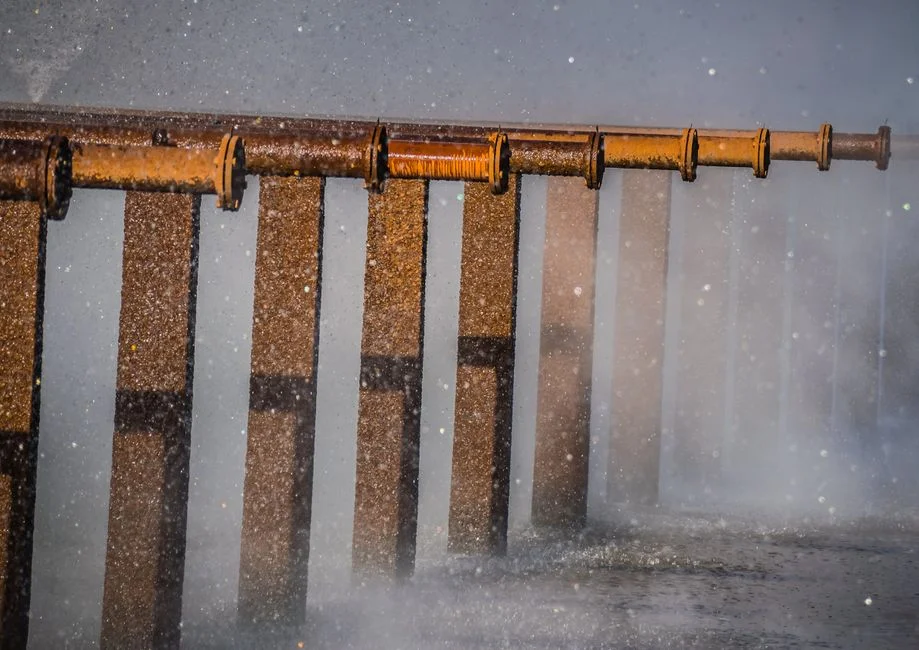
A DAF does one job exceptionally well: it separates suspended solids, oils, and greases from water using micro-bubbles. Understanding what it does — and what it does not — is the difference between a passing and failing ETP.
The physics is straightforward. Recycle water (typically 20–30% of the forward flow) is saturated with air at 40–70 psi in a pressure vessel, then released through needle valves or specialised nozzles into the flotation tank. The sudden pressure drop generates 20–50 µm micro-bubbles that attach to flocculated TSS, oil droplets, and FOG, lifting them to the surface where a rotating skimmer removes the float layer. The clarified underflow exits the bottom of the tank. The DAF line covers 13 standard models from 4 m³/h (DAF-1) to 300 m³/h (DAF-13), with stainless-steel wetted parts suitable for food-grade effluent, a micro-bubble generator, and an automatic skimmer as standard.
For a fuller description of the microbubble physics and nozzle hydraulics, the DAF microbubble physics guide is a useful technical reference.
What a DAF does not do is equally important. It does not reduce dissolved BOD or COD, it does not remove dissolved chromium or sulfide, it does not strip ammonia, and it does not kill bacteria. Any vendor proposal that offers a DAF as a standalone "treatment plant" for tannery, textile, or food effluent should be rejected. A downstream biological stage (MBBR or MBR) and, for surface-water discharge, a disinfection stage (chlorination or UV) are non-negotiable.
In most Addis Ababa applications, a coagulant (typically PAC or ferric chloride) and a flocculant (anionic polyacrylamide) are dosed into the stream immediately upstream of the DAF to agglomerate colloids into particles large enough for the bubbles to capture. The automatic chemical dosing skid handles this with flow-paced dosing and avoids the overdose/underdose cycling that plagues manual systems.
What does a packaged ETP cost for an Addis Ababa factory in 2026?
Budget figures below are equipment-only, CIF Djibouti, for a containerised or skid-mounted packaged ETP including screening, equalisation, DAF, biological stage, and tertiary filtration. Civil works, installation labour, commissioning, and the first three months of consumables are excluded and should be budgeted separately as a 25–40% uplift on the equipment cost.
| Flow range (m³/day) | Typical Addis Ababa factory profile | Equipment cost band (USD, CIF Djibouti) | Logistics uplift Djibouti → Addis Ababa |
|---|---|---|---|
| 10–50 | Small dairy, FMCG, abattoir | $35,000 – $90,000 | +15–20% |
| 50–200 | Mid-size tannery, textile, food plant | $90,000 – $320,000 | +18–22% |
| 200–500 | Industrial-scale brewery, tannery cluster, large textile mill | $320,000 – $750,000 | +20–25% |
These figures are anchored to the 5–200 m³/day containerised ETP range cited in the S2 supplier research and extrapolated to the 200–500 m³/day band using typical per-m³ cost slopes (per S2 research, 2025-08, scaled for Ethiopian flow demand). The 15–25% logistics uplift covers inland trucking from Djibouti port (~900 km via Dire Dawa corridor), customs clearance, and on-site lifting. Inland transport costs have remained elevated through 2026 due to FX-driven fuel pricing; confirm at quote date.
An MBR-based train carries a 40–60% CAPEX premium over the equivalent MBBR train at the same flow. For a 100 m³/day system, that is roughly $150,000–$220,000 (MBBR) versus $240,000–$340,000 (MBR) equipment-only. The premium is justified only when the factory has a confirmed reuse target (cooling tower, boiler, gardening) or a regulatory driver forcing TSS < 10 mg/L. The HydropureWater MBR system datasheet should be requested with the MBBR quote for an apples-to-apples comparison.
What is not in the equipment cost: civil foundations and bunding (10–15% of equipment), electrical and control cabling (5–8%), installation labour, commissioning engineer travel, and the first three months of polyelectrolyte, defoamer, and membrane-cleaning chemicals. A factory owner who budgets equipment cost alone will run out of money at the commissioning stage. Plan for the total installed cost to be roughly 1.4–1.6× the equipment cost for a turnkey handover. For regional context, the DAF system engineering guide for East Africa provides comparable cost bands and logistics uplands for neighbouring markets.
How does an Ethiopian factory actually procure a DAF or ETP?
Containerised CIF shipment via Djibouti followed by overland truck to Addis Ababa is the only practical procurement route for most Ethiopian factories. Local civil build of a comparable 200 m³/day ETP takes 6–9 months; a containerised packaged unit ships in 8–12 weeks from order to commissioned operation (per S2 research on packaged delivery timelines, 2025-08).
The realistic supplier shortlist is Chinese and Indian OEMs with African project experience. Quotes typically arrive EXW China, FOB China, or CIF Djibouti. Confirm the Incoterm before comparing — CIF Djibouti is the safest for an Addis Ababa buyer because the seller bears port-of-origin costs and ocean freight, while the buyer handles Djibouti customs, inland trucking, and installation. Order 8–10 weeks before the desired commissioning date to absorb shipping delays at Djibouti, which is common.
Four contract clauses are non-negotiable:
- Performance guarantee on the treated water: specify BOD, COD, TSS, FOG, pH, and (for tannery) total chromium and sulfide as numeric values, not "compliant with regulations".
- Spare parts package — 12 months of critical spares including DAF nozzles, pumps, and one set of MBR membranes (if applicable) — sourced through the spare parts and consumables channel.
- On-site commissioning by the OEM engineer, with a signed commissioning report and operator training.
- 12-month warranty covering manufacturing defects, with response time stated in days, not "best effort".
Finally, align the ETP sizing with the Ethiopian Federal Environment Authority EIA submission. The EIA must declare peak daily flow and pollutant load; the ETP must demonstrably meet those values plus the federal effluent limits for BOD, COD, TSS, and pH. A factory that installs an undersized unit to save CAPEX will face compliance notices within the first year of operation. The ETP datasheet and the EIA effluent section should reference the same flow and load numbers.
Frequently Asked Questions
What size DAF does a 50 m³/day tannery in Addis Ababa need?
Select a DAF-5 or DAF-7 (15–25 m³/h) to handle peak flow with a 20% margin, paired with chemical precipitation for chromium and sulfide and an MBBR for the residual BOD.
Can a DAF alone meet Ethiopia's Federal Environment Authority effluent limits?
No. A DAF removes 95%+ TSS and FOG but does not reduce dissolved BOD/COD, ammonia, chromium, or sulfide. A biological stage (MBBR or MBR) and, for surface-water discharge, disinfection are mandatory downstream of the DAF.
How long does it take to commission a containerised 100 m³/day ETP in Addis Ababa?
From purchase order, allow 10–14 weeks: 4–6 weeks factory assembly and FAT, 4–6 weeks ocean transit to Djibouti, and 2–3 weeks for customs clearance, inland trucking, and on-site commissioning.
Is MBR worth the 40–60% CAPEX premium over MBBR for an Ethiopian factory?
Only if there is a confirmed water-reuse target (cooling tower, boiler, irrigation) or a regulatory driver requiring TSS < 10 mg/L. Without reuse, the MBR premium rarely pays back.