Why Monosodium Glutamate Wastewater Is a Special UF Application
Monosodium glutamate fermentation wastewater (MSGW) arrives at the treatment works with one of the most punishing envelopes in industrial effluent: COD 10,000–30,000 mg/L, NH4+–N 15,000–25,000 mg/L, SO42− 15,000–30,000 mg/L, and pH 1.5–2.5 (per S3, Resources, Conservation and Recycling, 2004; UASB data in S5 confirms the COD and pH ranges in 2010 bench trials). A generic UF datasheet designed for municipal tertiary polishing will foul inside hours on this liquor. Biology must go first: the successive yeast + activated sludge (AS) train documented in S3 removed roughly 95% of influent COD and raised pH from 2.5 to 5.0–6.0 at a 40 h HRT, and UASB pilots in S5 delivered 57.0–79.6% COD removal on influents of 11,878–16,922 mg/L. Even so, the combined effluent still exits biology at 360–1,300 mg/L COD with 70 mg/L suspended solids — most of it residual yeast and soluble protein. That residual is exactly the fraction a 0.01–0.1 µm PVDF ultrafiltration stage is built to capture. The economic framing is unforgiving: USP-grade MSG must assay at 99.0–100.5% (S4, U.S. Pharmacopeia), and the S3 yeast stage concentrates suspended solids containing 55.8% crude protein and 18 amino acids — a sellable single-cell protein (SCP) stream. Every kilogram of that biomass, or every kilogram of residual glutamate, that escapes to drain is recoverable margin lost to a downstream RO or a discharge pipe.
Where the UF Stage Sits in a 2026 MSGW Treatment Train
UF earns its place in one of two positions on a modern MSGW train, and the choice changes both the mass balance and the revenue case. The dominant 2026 configuration is post-biology UF: the activated sludge or UASB effluent is pH-adjusted to 6–7, passed through a strainer and a DAF pre-treatment ahead of UF for bulk TSS stripping, then through a hollow-fiber PVDF UF that captures the residual yeast biomass and the soluble protein fraction. UF permeate (typically COD < 500 mg/L, turbidity < 1 NTU) feeds a brackish-water RO for reuse or direct cooling-tower make-up. Retentate — the protein concentrate — is the new product line. The second configuration is pre-biology UF, used when the goal is fermenter product recovery rather than wastewater polishing: fermenter broth is sent directly through UF, the retentate is returned to the crystallizer for residual glutamate capture, and the permeate feeds the yeast contact oxidation stage. This configuration converts the 55.8% protein biomass of S3 from a wasted sludge into a recovered SCP concentrate. When upstream COD into the UF exceeds ~5,000 mg/L — common in pre-biology duty — a coagulation stage ahead of UF is mandatory. S3's bench data shows FeCl3 at 1,400 mg Fe/L drops post-biology COD from 1,300 to 360 mg/L, and the same iron dose protects UF membrane pore geometry from organic overload. A PLC-controlled CIP and coagulant dosing skid sized to that FeCl3 range is a standard 2026 scope item.
UF Membrane Specification for MSG Wastewater
The membrane spec below is the realistic 2026 window for MSGW duty, not a generic municipal UF datasheet. Pore size 0.03–0.1 µm combined with MWCO 100–150 kDa is the right size envelope: large enough to pass monovalent ions (Na+, Cl−, NH4+) into permeate, tight enough to retain yeast cells (3–6 µm), the bulk of soluble protein, and extracellular polysaccharide (EPS) fragments. Hollow-fiber PVDF is the 2026 default chemistry because of its 1–11 pH tolerance — needed for acidic MSGW influent and alkaline CIP — 300 ppm feed turbidity tolerance, and dry-storage capability that lets modules ship and sit idle without biocide fills. Design flux on MSGW runs 50–100 LMH at TMP 0.1–0.3 MPa, with 90–95% recovery and a backwash every 20–30 minutes using permeate. CIP is on a 7–14 day cycle, dominated by NaOH wash (pH 11–12, 50–60 °C) for organic and protein removal and citric acid (1–2%, pH 2–3) for iron-scale control — the iron scale being a direct consequence of the FeCl3 dose in the upstream coagulation step. The feed pH window of 2–10 on PVDF maps cleanly to MSGW: raw broth enters near pH 2.0, the yeast stage raises it to 5.0–6.0 (S3), and CIP excursions reach pH 12 without chemistry damage.
| Parameter | 2026 Design Value for MSGW UF | Engineering Rationale |
|---|---|---|
| Membrane chemistry | PVDF hollow-fiber | pH 1–11 tolerance, dry storage, >300 ppm turbidity feed |
| Pore size | 0.03–0.1 µm | Retains yeast (3–6 µm) and soluble protein |
| MWCO | 100–150 kDa | Passes monovalent salts, retains protein/EPS |
| Design flux | 50–100 LMH | Sustainable on protein-bearing feed at 0.1–0.3 MPa TMP |
| TMP | 0.1–0.3 MPa | Operating envelope, not clean-water value |
| Recovery | 90–95% | Limits backwash volume to 5–10% of permeate |
| Backwash interval | 20–30 min | Permeate backwash with air scour |
| CIP frequency | 7–14 days | Driven by TMP creep from protein and EPS fouling |
| Feed pH window | 2–10 (operating), 1–12 (CIP) | Covers raw MSGW pH 2.0 and alkaline CIP |
| Expected permeate COD | < 500 mg/L (post-bio), < 100 mg/L (post-coag+UF) | Protects downstream RO from organic overload |
Procurement typically specifies modules rated to the values above; the hollow-fiber PVDF ultrafiltration system datasheet is the right template, and UF membrane replacement elements should be stocked on a 3–5 year rotation based on the OPEX analysis below. Engineers cross-checking against food-industry UF duty will recognize the parameter envelope from UF on food-processing wastewater with high organic load and UF on vegetable processing wastewater — the same PVDF chemistry and flux range apply because the fouling mechanism (protein + EPS) is the same.
UF vs MBR vs DAF for the Same MSGW Duty
When only one budget line is available, the procurement choice is typically between DAF, MBR, and post-biology UF. The table below scores each on the axes that matter for an MSG plant in 2026: COD removal ceiling, suspended solids removal, biomass recovery, footprint, OPEX complexity, and concentrate value. DAF is the cheapest and fastest to install but only addresses gross FOG and TSS; it leaves the bulk of soluble COD and produces no recoverable product. MBR integrates biology and membrane in one tank, but the mixed-liquor biology consumes the SCP as substrate for endogenous respiration — there is no protein concentrate to sell. UF after biology is the only configuration that delivers a sellable protein concentrate (the S3 55.8% protein stream concentrated further by membrane) and an RO-quality permeate. The cost is a separate membrane building and a more sophisticated CIP loop.
| Criterion | DAF | MBR | Post-biology UF (this design) |
|---|---|---|---|
| COD removal ceiling | 30–50% (gross TSS only) | 95–98% (integrated biology) | 40–60% on UF stage alone; combined with biology > 99% |
| Suspended solids in effluent | 30–80 mg/L | < 5 mg/L | < 1 mg/L (turbidity < 1 NTU) |
| Biomass recovery | Float as waste sludge | Wasted as excess MLSS | Retentate contains 55.8% protein SCP per S3 — sellable |
| Footprint (relative) | Small | Medium | Medium (membrane skid + CIP) |
| OPEX complexity | Low (polymer dose only) | Medium (membrane scour + AS control) | Medium-high (CIP chemicals, membrane replacement) |
| Concentrate / by-product value | None — float to disposal | None — wasted sludge | Protein concentrate + RO-quality permeate for reuse |
| RO protection | Poor (high COD + TSS) | Good (low TSS, moderate COD) | Excellent (low COD, low SDI) |
An MBR reference design can substitute for the UF stage when the plant has no intent to recover SCP, but in 2026 economics the protein-stream recovery case justifies UF on a new MSGW scope.
2026 OPEX and Lifecycle Considerations for MSGW UF
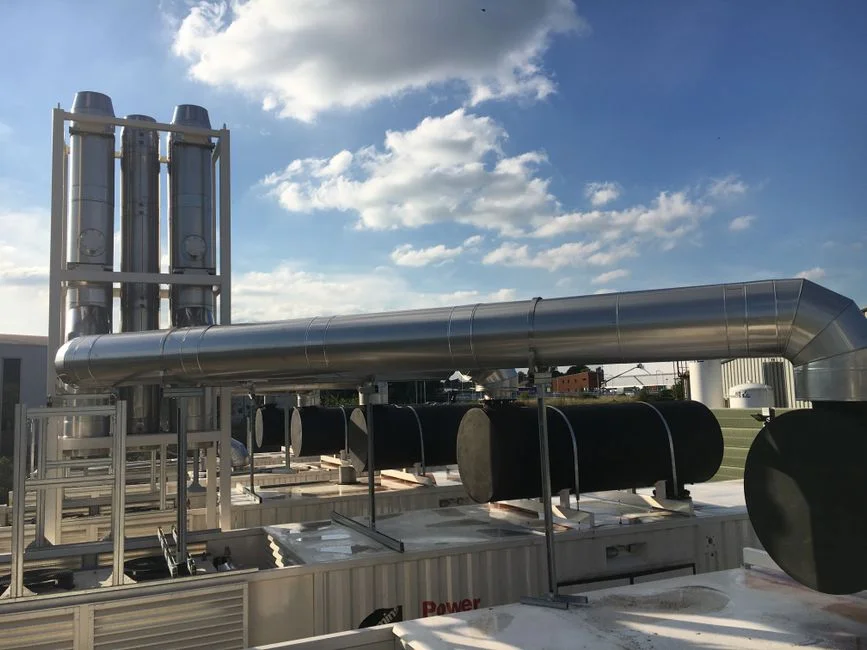
Membrane replacement on MSGW duty runs 3–5 years with disciplined CIP — the limiting failure mode is irreversible organic fouling from residual protein and EPS rather than mechanical failure, so the cycle is chemistry-driven. CIP chemical OPEX is dominated by NaOH (organic wash) and citric acid (iron-scale wash, mandatory because of the upstream FeCl3 dose of 1,400 mg Fe/L documented in S3). Backwash water is 5–10% of permeate volume — small enough to recycle upstream of the activated sludge basin without upsetting hydraulic residence time. A realistic 2026 OPEX framing for sizing the consumables budget is laid out in UF spare parts and consumables OPEX for 2026, and the dosing skid delivering CIP and coagulant should be specified as a single PLC-controlled CIP and coagulant dosing skid to keep interlocks and titration logic in one place.
Frequently Asked Questions
What pore size and MWCO should I specify for UF on MSG wastewater?
Specify 0.03–0.1 µm pore size with 100–150 kDa MWCO on a PVDF hollow-fiber module. This window retains yeast cells (3–6 µm) and soluble protein while passing monovalent salts, and matches the operating envelope proven on similar protein-bearing food wastewaters.
Where does UF sit in an MSGW treatment train — before or after biology?
Post-biology UF is the default 2026 layout: biology (yeast + AS at ~95% COD removal, or UASB at 57–80%) does the bulk carbon reduction, then UF captures the residual yeast biomass and soluble protein before RO. Pre-biology UF is used only when fermenter product recovery is the priority.
Can the yeast-stage biomass really be sold as single-cell protein?
Yes — the S3 bench data characterizes the suspended solids from the yeast contact oxidation stage as 55.8% crude protein with 18 amino acids, which is a standard